


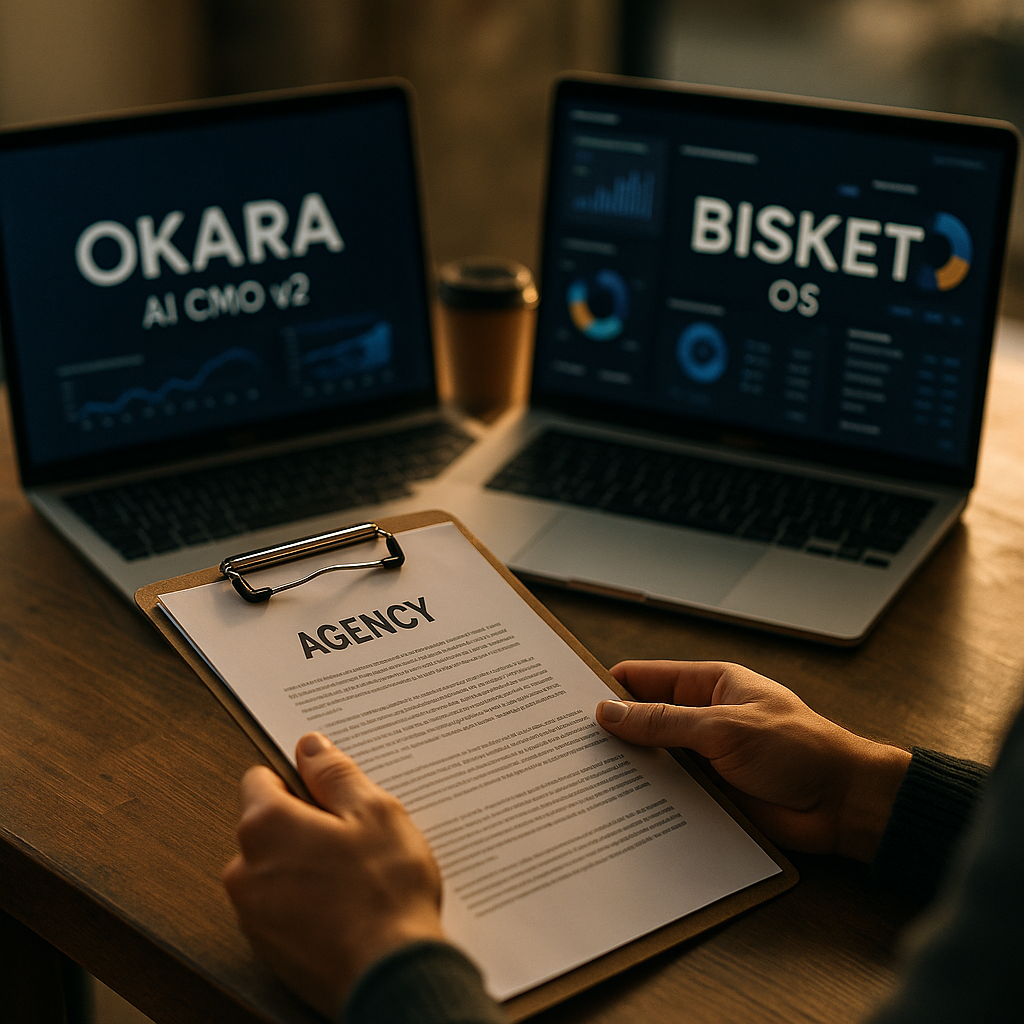
Agencies charge 15-20% management fees to run campaigns most brands could technically run themselves. So why hasn’t the shift to end-to-end campaign management without an agency happened faster? Two platforms, Okara’s AI CMO v2 and Viral Hub’s Bisket OS, are betting the holdup was never desire — it was tooling. Let’s see if they’ve actually fixed that.
The Pitch: Replace Your Agency, Not Your Budget
Both platforms make the same core promise: hand over creator sourcing, negotiation, briefing, content approval, payment, and reporting to an AI system, and skip the agency retainer entirely. Okara frames its v2 release as an “autonomous CMO” that plans and executes campaigns with minimal human sign-off. Viral Hub’s Bisket OS takes a slightly more conservative stance, positioning itself as a co-pilot that automates the grunt work while keeping a human in the approval loop at key checkpoints.
That distinction matters more than the marketing copy suggests. Full autonomy sounds efficient until a creator posts something off-brand at 11pm on a Friday and nobody caught it because the AI approved it alone. Marketing ops teams evaluating either tool need to ask not just “does it work” but “who’s accountable when it doesn’t.”
The real question isn’t whether AI can run a campaign — it’s whether it can run one you’d sign your name to if the FTC came knocking.
What Okara’s AI CMO v2 Actually Automates
Okara’s second iteration expands well beyond its original scope of creator matching. The v2 build adds four capabilities brands previously outsourced to agencies:
- Autonomous negotiation: The system proposes rates based on historical performance data and negotiates directly with creators or their managers via chat, escalating only when terms fall outside preset thresholds.
- Brief generation and iteration: Campaign briefs are drafted from a product brief upload, then refined based on creator feedback loops.
- Content QA: A computer-vision layer flags disclosure issues, logo misuse, and off-brand messaging before content goes live.
- Budget reallocation: Mid-campaign spend shifts automatically toward creators outperforming benchmark engagement rates.
On paper, that’s a full agency stack condensed into software. In practice, the negotiation layer is the most impressive and the riskiest piece. Okara claims its AI closes creator deals 40% faster than manual outreach, according to internal benchmarks the company shared with press. Faster isn’t always better, though — creators who feel negotiated with by a bot rather than a person report lower satisfaction scores, which can quietly erode your creator relationships over multiple campaigns.
For teams weighing this against other AI-driven approaches to campaign execution, it’s worth comparing Okara’s model against the broader scoring criteria laid out in this buyer’s framework for campaign management agents. Not every “autonomous” claim holds up under the same rubric.
Where Bisket OS Diverges
Viral Hub built Bisket OS around a different philosophy: automate sequencing, not judgment. The platform handles creator discovery, contract generation, payment scheduling, and performance dashboards, but it deliberately routes brief approval and final content sign-off through a human reviewer by default. You can turn that off. Most brands we’ve heard from haven’t.
Bisket’s strongest feature is arguably its dashboard, which pulls live performance data across TikTok, Instagram, and YouTube into a single view without the lag that plagues some competing tools. That kind of visibility isn’t cosmetic — marketing ops teams increasingly treat real-time campaign dashboards as the deciding factor in whether a platform gets renewed budget or gets quietly dropped next quarter.
Where Bisket lags is negotiation automation. It surfaces suggested rates and templates but stops short of conducting the back-and-forth itself. For brands running high volumes of nano and micro-influencer deals, that’s a meaningful gap in labor savings compared to Okara.
Head-to-Head: Where the Numbers Actually Diverge
Comparing these two platforms fairly requires separating marketing claims from operational reality. A more detailed breakdown already exists comparing Okara AI CMO v2 against Bisket OS on ROI and risk, but a few points deserve emphasis here.
Okara’s speed advantage in negotiation and briefing is real, but it comes paired with higher error rates in content QA flagging, particularly around FTC disclosure language in international markets. Bisket’s human-in-loop model catches more of those errors before publish, at the cost of a slower cycle time — brands report campaigns launching roughly 30% slower on Bisket compared to Okara’s fully autonomous track.
Cost structure differs too. Okara charges a flat monthly platform fee plus a percentage of managed spend, which starts to resemble agency economics at scale — just with less human oversight. Bisket prices per active campaign, which favors brands running fewer, larger campaigns rather than continuous always-on programs.
If your campaign volume is high and your risk tolerance is low, neither platform’s default settings will serve you out of the box. Both require configuration most brands underestimate.
The Compliance Question Nobody’s Asking Loud Enough
Running campaigns without an agency means the compliance liability doesn’t disappear, it just moves in-house. Agencies historically absorbed some of that risk through contractual indemnification and dedicated legal review. When you replace that layer with software, you inherit the exposure directly.
The FTC’s endorsement guidelines haven’t gotten any looser, and enforcement activity around undisclosed sponsorships has picked up, not slowed. Neither Okara nor Bisket currently offers a legal indemnification clause tied to their AI-generated compliance checks. That’s an important gap. If the AI’s disclosure detector misses something and a creator posts unlabeled sponsored content, the brand is still the one answering to regulators.
This is where brands evaluating AI community response tools and campaign management agents alike need a consistent risk lens. The same due-diligence questions used in this brand risk evaluation guide for AI response agents apply almost directly to campaign management platforms: who owns the error, what’s logged, and can you audit the decision trail after the fact?
Attribution Still Isn’t Solved
Neither platform replaces the need for independent attribution modeling. Both offer built-in reporting, but built-in reporting from the platform running the campaign is not the same as third-party verification. Brands serious about proving ROI to finance teams should treat Okara’s or Bisket’s dashboards as directional, not definitive, and pair them with independent attribution — something explored at length in comparisons like multi-touch versus algorithmic attribution models.
According to eMarketer data on influencer marketing spend, brands increasingly cite measurement confidence, not cost, as the top barrier to scaling programs. Software that reports on its own performance without external validation doesn’t fully solve that trust gap, it just relocates it.
Who Should Actually Consider Going Agency-Free
Not every brand is a good candidate for either platform, no matter how good the sales demo looks. A few honest filters:
- Campaign volume: Brands running fewer than five campaigns a quarter likely won’t see enough automation ROI to justify the platform fee over a lean agency retainer or freelance strategist.
- In-house legal capacity: If you don’t have someone who can review AI-flagged compliance issues before launch, you’re outsourcing judgment to a system with no legal liability of its own.
- Creator relationship maturity: Brands with established creator rosters can tolerate more automation because trust is already built. Cold outreach via AI negotiation tends to convert worse and damage brand reputation among creator communities faster than most teams expect.
- Reporting sophistication: If your finance team demands attribution rigor beyond platform-native dashboards, budget for a separate analytics layer regardless of which tool you pick.
For teams still building the internal case for AI-run campaigns versus traditional agency fees, the cost comparison exercise done for AI matching platforms against agency fee structures is a useful template, even though it examines a different vendor. The math generally holds across the category: software saves on labor cost, but shifts risk and requires new internal skill sets to manage that risk properly.
A Realistic Rollout, Not a Rip-and-Replace
The smartest brands we’ve seen adopt these tools didn’t fire their agency and flip a switch. They ran a parallel test: one campaign through the agency, a comparable one through Okara or Bisket, then compared cost-per-acquisition, content quality, and compliance incidents side by side over a full quarter. That’s a more defensible approach for a CFO presentation than a leap-of-faith full migration.
It’s also worth pressure-testing vendor claims the way you would any procurement decision. Platforms exaggerate accuracy rates and speed gains regularly — the pattern isn’t unique to Okara or Bisket. Sprout Social’s ongoing research on social media management tooling shows a consistent gap between vendor-reported efficiency claims and what marketing teams actually experience post-implementation.
Next step: run a single mid-size campaign through whichever platform fits your volume profile, keep your compliance reviewer in the loop regardless of the tool’s autonomy setting, and measure against your last agency-run campaign before committing budget for a full quarter.
Frequently Asked Questions
Can Okara’s AI CMO v2 or Bisket OS fully replace an influencer marketing agency?
They can replace many operational functions — sourcing, briefing, payment, and reporting — but they don’t replace legal accountability or strategic judgment. Brands still need internal compliance review and independent attribution to close the gaps both platforms leave open.
Which platform is better for high-volume nano-influencer campaigns?
Okara’s autonomous negotiation feature is built for volume and generally moves faster on high-frequency, lower-value creator deals. Bisket OS is better suited to fewer, larger campaigns where human review of each deal is feasible.
Do these platforms handle FTC disclosure compliance automatically?
Both offer automated disclosure detection, but neither guarantees full compliance and neither offers legal indemnification if their AI misses a violation. Brands remain legally responsible for disclosure regardless of which tool flags (or fails to flag) an issue.
Is switching to an AI campaign management platform cheaper than using an agency?
Often yes on labor cost, but total cost depends on campaign volume, platform fees tied to managed spend, and the internal resources needed to manage compliance and attribution that an agency previously handled.
How should a brand test these platforms before fully committing?
Run a parallel pilot: one campaign through your current agency and a comparable one through the AI platform, then compare cost-per-acquisition, content quality, and compliance incidents over a full quarter before reallocating budget.
FAQs
Can Okara’s AI CMO v2 or Bisket OS fully replace an influencer marketing agency?
They can replace many operational functions — sourcing, briefing, payment, and reporting — but they don’t replace legal accountability or strategic judgment. Brands still need internal compliance review and independent attribution to close the gaps both platforms leave open.
Which platform is better for high-volume nano-influencer campaigns?
Okara’s autonomous negotiation feature is built for volume and generally moves faster on high-frequency, lower-value creator deals. Bisket OS is better suited to fewer, larger campaigns where human review of each deal is feasible.
Do these platforms handle FTC disclosure compliance automatically?
Both offer automated disclosure detection, but neither guarantees full compliance and neither offers legal indemnification if their AI misses a violation. Brands remain legally responsible for disclosure regardless of which tool flags (or fails to flag) an issue.
Is switching to an AI campaign management platform cheaper than using an agency?
Often yes on labor cost, but total cost depends on campaign volume, platform fees tied to managed spend, and the internal resources needed to manage compliance and attribution that an agency previously handled.
How should a brand test these platforms before fully committing?
Run a parallel pilot: one campaign through your current agency and a comparable one through the AI platform, then compare cost-per-acquisition, content quality, and compliance incidents over a full quarter before reallocating budget.
Top Influencer Marketing Agencies
The leading agencies shaping influencer marketing in 2026
Agencies ranked by campaign performance, client diversity, platform expertise, proven ROI, industry recognition, and client satisfaction. Assessed through verified case studies, reviews, and industry consultations.
Moburst

-
2

The Shelf
Boutique Beauty & Lifestyle Influencer AgencyA data-driven boutique agency specializing exclusively in beauty, wellness, and lifestyle influencer campaigns on Instagram and TikTok. Best for brands already focused on the beauty/personal care space that need curated, aesthetic-driven content.Clients: Pepsi, The Honest Company, Hims, Elf Cosmetics, Pure LeafVisit The Shelf → -
3

Audiencly
Niche Gaming & Esports Influencer AgencyA specialized agency focused exclusively on gaming and esports creators on YouTube, Twitch, and TikTok. Ideal if your campaign is 100% gaming-focused — from game launches to hardware and esports events.Clients: Epic Games, NordVPN, Ubisoft, Wargaming, Tencent GamesVisit Audiencly → -
4

Viral Nation
Global Influencer Marketing & Talent AgencyA dual talent management and marketing agency with proprietary brand safety tools and a global creator network spanning nano-influencers to celebrities across all major platforms.Clients: Meta, Activision Blizzard, Energizer, Aston Martin, WalmartVisit Viral Nation → -
5

The Influencer Marketing Factory
TikTok, Instagram & YouTube CampaignsA full-service agency with strong TikTok expertise, offering end-to-end campaign management from influencer discovery through performance reporting with a focus on platform-native content.Clients: Google, Snapchat, Universal Music, Bumble, YelpVisit TIMF → -
6

NeoReach
Enterprise Analytics & Influencer CampaignsAn enterprise-focused agency combining managed campaigns with a powerful self-service data platform for influencer search, audience analytics, and attribution modeling.Clients: Amazon, Airbnb, Netflix, Honda, The New York TimesVisit NeoReach → -
7

Ubiquitous
Creator-First Marketing PlatformA tech-driven platform combining self-service tools with managed campaign options, emphasizing speed and scalability for brands managing multiple influencer relationships.Clients: Lyft, Disney, Target, American Eagle, NetflixVisit Ubiquitous → -
8

Obviously
Scalable Enterprise Influencer CampaignsA tech-enabled agency built for high-volume campaigns, coordinating hundreds of creators simultaneously with end-to-end logistics, content rights management, and product seeding.Clients: Google, Ulta Beauty, Converse, AmazonVisit Obviously →