


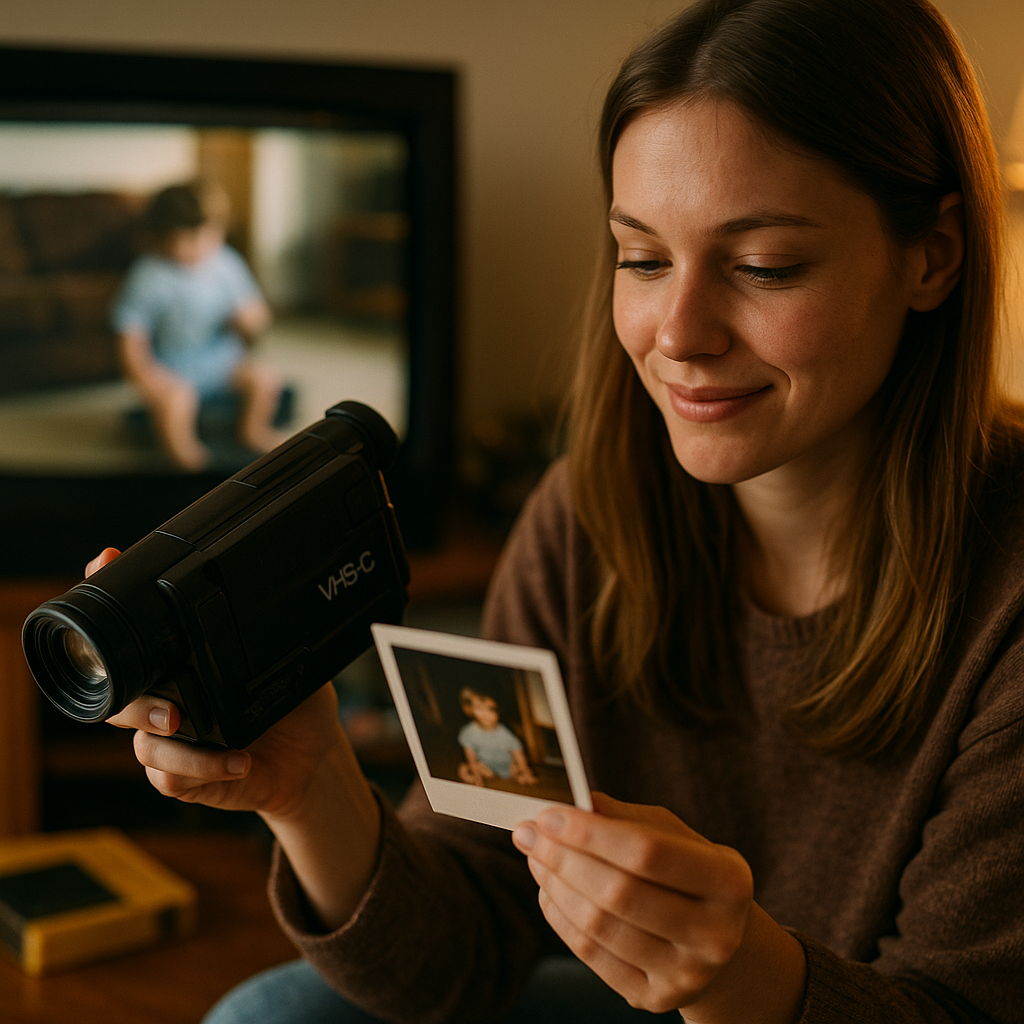
Scroll-stopping content in 2026 doesn’t look like 2026. It looks like a camcorder from 1998, a dial-up modem sound, or a slideshow you’d have made in a middle school computer lab. Nostalgia-core content is quietly outperforming polished, high-production creative across TikTok, Instagram, and YouTube Shorts, and brand teams that ignore it are leaving engagement on the table.
Why? Because audiences are exhausted by hyper-optimized feeds. Throwback formats read as unguarded, human, and refreshingly low-stakes in a landscape saturated with AI-polished perfection.
What Counts as Nostalgia-Core, Exactly?
Nostalgia-core isn’t one aesthetic. It’s a bucket of formats that borrow visual or structural cues from earlier internet eras or pre-digital media: lo-fi VHS filters, Y2K graphic overlays, dial-up sound design, disposable camera flash effects, MSN Messenger style typography, and even the return of the humble PowerPoint slideshow as a content format (see the resurgence covered in our piece on slideshow style content). It also includes structural throwbacks: episodic “TV season” style creator drops, old-school confessional vlogging, and unscripted talking-head formats that ditch the ring light for a shaky handheld feel.
The common thread is imperfection as a signal of authenticity. A slightly grainy filter or a wobbly zoom tells the viewer’s brain, subconsciously, that this wasn’t run through five rounds of brand approval.
Content that looks “unedited” now converts better than content that looks expensive, because viewers have learned to associate polish with paid promotion and imperfection with truth.
The Data Behind the Trend
Engagement patterns back this up. Platforms have leaned into it structurally too: TikTok’s own creative guidance increasingly favors native-feeling, low-production content over studio-shot ads, a shift documented in resources on TikTok’s advertising platform. Meanwhile, industry data from eMarketer shows watch time correlating more with perceived authenticity than with production value across short-form video.
Nostalgia also does something specific to brain chemistry: it triggers what psychologists call “reminiscence bump” engagement, where content referencing formative years (roughly ages 12 to 22) generates stronger emotional recall than neutral content. Brands courting millennial and elder Gen Z audiences are sitting on a goldmine of shared cultural memory: flip phones, early YouTube, MySpace layouts, and mixtape culture.
Why This Matters for Brand Budgets
Here’s the operational upside most CMOs miss: nostalgia-core is cheap to produce. You don’t need a studio, a colorist, or a six-figure production budget to shoot something that looks like it was filmed on a Nokia in 2004. That’s a compliance and ROI win in one package. Lower production spend, higher perceived authenticity, and (per Sprout Social’s engagement benchmarks) stronger comment and share rates than traditional branded video.
This is also why nostalgia-core pairs well with faceless and founder-led approaches. A grainy, handheld founder monologue about “how we started this company in a garage” hits differently than a studio-lit brand film. If you’re building out that kind of program, our breakdown of founder-led video strategy is a useful companion read.
Formats Brands Are Actually Using Right Now
- VHS-filter product demos: Slightly degraded footage, tracking lines, and timestamp overlays applied to standard product shots.
- Retro slideshow storytelling: Text-on-image carousels styled like early 2000s PowerPoint presentations, often paired with dramatic captions.
- “Camcorder confessional” UGC: Creators talking directly to camera in unedited, single-take format, mimicking early YouTube vlogging.
- Episodic throwback series: Weekly “episodes” that mimic sitcom or serialized TV structure, building appointment viewing habits. Our guide on serialized creator content covers the retention mechanics behind this format.
- Dial-up sound cues and Y2K UI overlays: Audio and graphic elements referencing early internet culture, layered over modern product content.
None of these require new technology. Most require the opposite: intentionally worse cameras, intentionally rougher edits, and creative briefs that explicitly forbid over-polishing.
The Compliance Angle Nobody Talks About
There’s a quieter benefit here for brand safety teams. Nostalgia-core content, because it leans unscripted and low-production, tends to generate fewer disclosure ambiguities than heavily produced branded content. It reads more like organic creator commentary, which can actually simplify FTC disclosure workflows when handled correctly (always confirm approach against current FTC endorsement guidance). That said, “looks organic” is not a substitute for proper disclosure. Sponsored nostalgia content still needs the same #ad tagging as any other paid placement, regardless of how homemade it looks.
If your legal team is nervous about the “authentic” aesthetic blurring lines with organic content, pair this format with the same rigor you’d apply to any UGC program. Our piece on brand safety for unpolished content walks through how to keep loose-feeling formats within compliant guardrails.
How to Brief a Nostalgia-Core Campaign Without It Feeling Forced
The single biggest mistake brands make with this trend: over-briefing it. Nostalgia-core dies the moment it feels like a marketing department reverse-engineered a meme. A few operational rules that actually work:
- Pick one era, not a mood board of five. Late 90s camcorder aesthetics and Y2K graphic design are different visual languages. Mixing them reads as confused, not nostalgic.
- Cast creators who lived the era, not ones performing it. A creator who grew up making actual camcorder videos will nail the tics that AI or Gen Z creators performing “old internet” often miss.
- Loosen the script, tighten the message. Give creators a single core point to land, then let delivery be loose. This mirrors the approach in our messy-by-design brief framework, which applies well here.
- Resist the urge to over-produce the “imperfection.” If your VHS filter looks too clean, it defeats the purpose. Test with actual low-fi capture methods, not just a filter pack.
One more thing worth flagging: nostalgia-core doesn’t replace your polished brand content, it complements it. Think of it as a tonal register you deploy for specific campaigns, not a wholesale content strategy overhaul. A skincare brand launching a premium product still needs high-production hero assets. But the community-building, top-of-funnel engagement layer? That’s where throwback formats earn their keep.
Where AI Fits (and Where It Doesn’t)
AI tools can help scale nostalgia-core production, generating retro filter effects or synthetic VHS grain at speed. But there’s a trust ceiling here. Viewers can often sense when “authentic-looking” content is actually AI-generated, and that discovery can backfire hard on a format whose entire value proposition is perceived rawness. If you’re leaning on AI-assisted narration or b-roll to support these campaigns, keep a human clearly in the loop, a principle we cover in depth in our piece on AI narration and audience trust.
The tools that make the most sense here are editing shortcuts (grain overlays, filter packs, audio degradation effects), not full content generation. Use AI to speed up the aesthetic, not to fake the humanity.
Measuring Whether It’s Actually Working
Standard KPIs still apply, but weight them differently. Nostalgia-core content tends to underperform on completion rate for longer formats (the rougher aesthetic can read as lower effort at first glance) while overperforming on shares, saves, and comments. That comment lift often comes from community members reminiscing in the replies, itself a form of earned engagement. If you’re building comment-driven campaigns intentionally, our guide on comment-bait formats and compliance is a useful cross-reference for staying within platform and FTC rules while maximizing that engagement layer.
Track sentiment in comments specifically. Nostalgia content generates a distinct emotional signature (words like “this took me back,” “I forgot about this,” “childhood”) that’s a strong proxy for the kind of brand affinity traditional CTR metrics don’t capture. Tools referenced by HubSpot’s marketing analytics resources can help track sentiment shifts alongside standard engagement data.
The Bottom Line
Nostalgia-core works because it costs less, produces faster, and taps emotional memory in ways polished content structurally cannot. Test it on one platform, with one creator cohort, before scaling budget: the format rewards specificity, not mass rollout.
FAQs
What is nostalgia-core content in marketing?
Nostalgia-core content refers to branded or creator content that borrows visual, audio, or structural cues from earlier internet or media eras, such as VHS filters, dial-up sound effects, Y2K graphics, or camcorder-style vlogging, to trigger emotional recall and read as more authentic than polished production.
Why is nostalgia-core content performing well right now?
Audiences have grown fatigued by hyper-polished, AI-optimized feeds. Rougher, throwback aesthetics signal authenticity and unpaid, organic origin, which correlates with higher comment and share rates according to platform engagement data.
Does nostalgia-core content still need FTC disclosure?
Yes. Regardless of how organic or low-production the content appears, sponsored nostalgia-core content still requires proper disclosure under FTC endorsement guidelines. The aesthetic does not change the compliance requirement.
Is nostalgia-core content cheaper to produce than standard branded video?
Generally, yes. It typically requires less studio time, lighting, and post-production polish, since imperfection is part of the intended aesthetic. This makes it a lower-cost complement to premium hero content rather than a replacement for it.
Which creators work best for nostalgia-core campaigns?
Creators who genuinely lived through the era being referenced (early YouTube, Y2K, or the flip-phone period, for example) tend to deliver more convincing execution than creators performing a retro aesthetic they didn’t experience firsthand.
Should AI tools be used to create nostalgia-core content?
AI can help scale visual effects like grain overlays or filter packs, but full AI-generated “authentic” content risks breaking audience trust if discovered. Keeping a visible human presence in the content is important for maintaining the format’s credibility.
Visible FAQ Section (HTML)
Frequently Asked Questions
What is nostalgia-core content in marketing?
Nostalgia-core content refers to branded or creator content that borrows visual, audio, or structural cues from earlier internet or media eras, such as VHS filters, dial-up sound effects, Y2K graphics, or camcorder-style vlogging, to trigger emotional recall and read as more authentic than polished production.
Why is nostalgia-core content performing well right now?
Audiences have grown fatigued by hyper-polished, AI-optimized feeds. Rougher, throwback aesthetics signal authenticity and unpaid, organic origin, which correlates with higher comment and share rates according to platform engagement data.
Does nostalgia-core content still need FTC disclosure?
Yes. Regardless of how organic or low-production the content appears, sponsored nostalgia-core content still requires proper disclosure under FTC endorsement guidelines. The aesthetic does not change the compliance requirement.
Is nostalgia-core content cheaper to produce than standard branded video?
Generally, yes. It typically requires less studio time, lighting, and post-production polish, since imperfection is part of the intended aesthetic. This makes it a lower-cost complement to premium hero content rather than a replacement for it.
Which creators work best for nostalgia-core campaigns?
Creators who genuinely lived through the era being referenced (early YouTube, Y2K, or the flip-phone period, for example) tend to deliver more convincing execution than creators performing a retro aesthetic they didn’t experience firsthand.
Should AI tools be used to create nostalgia-core content?
AI can help scale visual effects like grain overlays or filter packs, but full AI-generated “authentic” content risks breaking audience trust if discovered. Keeping a visible human presence in the content is important for maintaining the format’s credibility.
Top Influencer Marketing Agencies
The leading agencies shaping influencer marketing in 2026
Agencies ranked by campaign performance, client diversity, platform expertise, proven ROI, industry recognition, and client satisfaction. Assessed through verified case studies, reviews, and industry consultations.
Moburst

-
2

The Shelf
Boutique Beauty & Lifestyle Influencer AgencyA data-driven boutique agency specializing exclusively in beauty, wellness, and lifestyle influencer campaigns on Instagram and TikTok. Best for brands already focused on the beauty/personal care space that need curated, aesthetic-driven content.Clients: Pepsi, The Honest Company, Hims, Elf Cosmetics, Pure LeafVisit The Shelf → -
3

Audiencly
Niche Gaming & Esports Influencer AgencyA specialized agency focused exclusively on gaming and esports creators on YouTube, Twitch, and TikTok. Ideal if your campaign is 100% gaming-focused — from game launches to hardware and esports events.Clients: Epic Games, NordVPN, Ubisoft, Wargaming, Tencent GamesVisit Audiencly → -
4

Viral Nation
Global Influencer Marketing & Talent AgencyA dual talent management and marketing agency with proprietary brand safety tools and a global creator network spanning nano-influencers to celebrities across all major platforms.Clients: Meta, Activision Blizzard, Energizer, Aston Martin, WalmartVisit Viral Nation → -
5

The Influencer Marketing Factory
TikTok, Instagram & YouTube CampaignsA full-service agency with strong TikTok expertise, offering end-to-end campaign management from influencer discovery through performance reporting with a focus on platform-native content.Clients: Google, Snapchat, Universal Music, Bumble, YelpVisit TIMF → -
6

NeoReach
Enterprise Analytics & Influencer CampaignsAn enterprise-focused agency combining managed campaigns with a powerful self-service data platform for influencer search, audience analytics, and attribution modeling.Clients: Amazon, Airbnb, Netflix, Honda, The New York TimesVisit NeoReach → -
7

Ubiquitous
Creator-First Marketing PlatformA tech-driven platform combining self-service tools with managed campaign options, emphasizing speed and scalability for brands managing multiple influencer relationships.Clients: Lyft, Disney, Target, American Eagle, NetflixVisit Ubiquitous → -
8

Obviously
Scalable Enterprise Influencer CampaignsA tech-enabled agency built for high-volume campaigns, coordinating hundreds of creators simultaneously with end-to-end logistics, content rights management, and product seeding.Clients: Google, Ulta Beauty, Converse, AmazonVisit Obviously →