


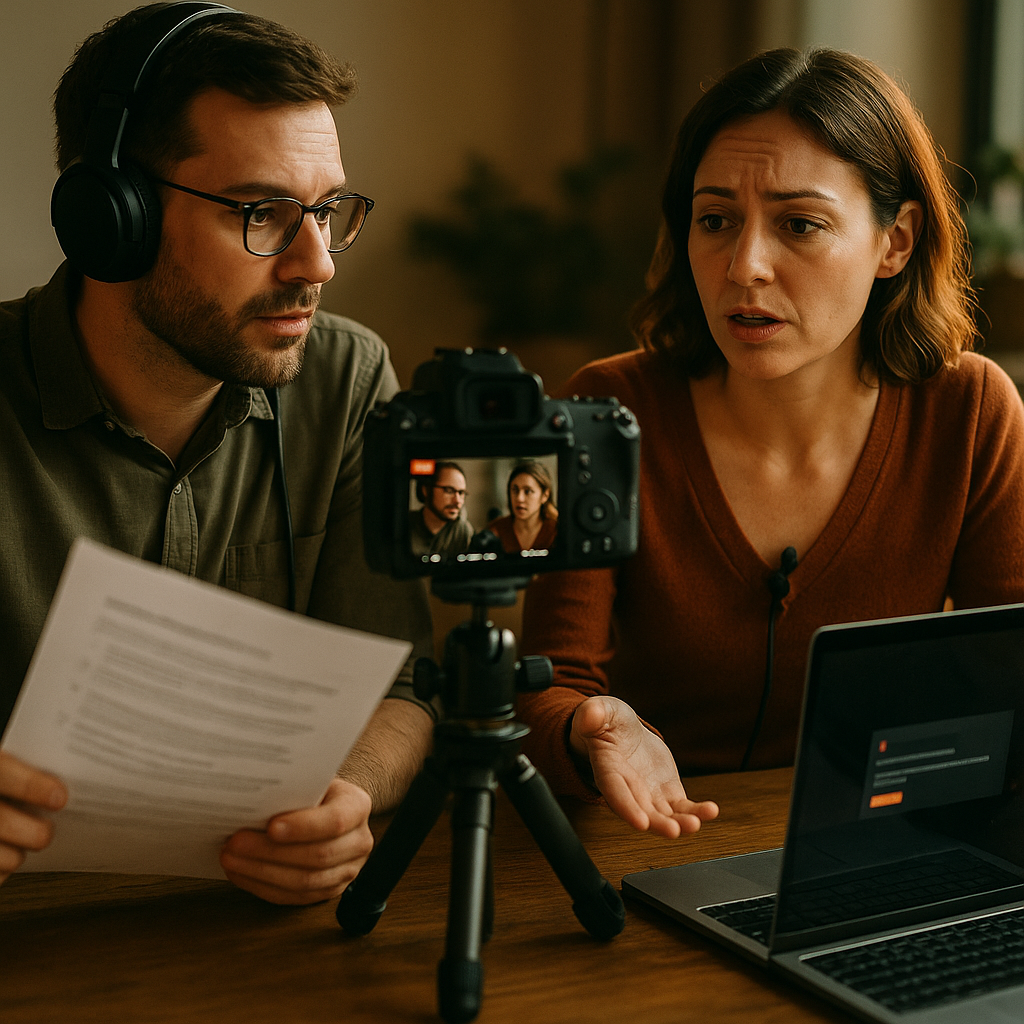
A single dead-air moment on a live shopping stream can cost a brand hundreds of viewers in seconds. Pair an untrained brand rep with a seasoned creator and you get exactly that: awkward silences, talked-over CTAs, and a comment section nobody answers. Livestream cohost scripts exist to fix that mismatch, giving brand reps and creator talent a shared playbook so the stream feels natural instead of like two people who met five minutes before hitting “go live.”
Why Cohosted Streams Outperform Solo Creator Feeds
Solo creator streams are great for personality. They’re not always great for product accuracy, inventory updates, or answering the technical question that actually closes a sale. That’s where the brand rep comes in: someone who knows SKU details, return policy, and promo codes cold. The creator brings audience trust and pacing. Neither role replaces the other, but without a script, the two voices compete instead of complement.
Brands running consistent cohosted formats report longer average watch time and higher add-to-cart rates than single-host streams, according to platform data cited by eMarketer. That’s not surprising. Two people with defined lanes create rhythm. One person winging it for sixty minutes usually doesn’t.
A scripted handoff isn’t a scripted stream. It’s a shared map so two people with different jobs don’t accidentally do each other’s job badly.
The Role Split That Actually Works
Most failed cohost pairings fail for one reason: nobody defined who owns what before the camera turned on. Here’s the split that tends to work across live shopping and demo formats:
- Brand rep owns: product specs, pricing, promo codes, shipping and return policy, and any regulatory disclosures tied to the offer.
- Creator owns: energy, storytelling, audience Q&A tone, and translating spec sheets into “why should I care” language.
- Shared ownership: comment engagement, urgency cues (stock counters, time-limited discounts), and the close.
Write this split into the script itself, not just a verbal briefing beforehand. Reps forget under live pressure. A printed or on-screen cue sheet that says “REP: confirm size chart” next to “CREATOR: hype the drop” removes guesswork in the moment.
Building the Script: Structure Without Sounding Scripted
The goal isn’t a word-for-word teleprompter feed. Nobody trusts a livestream that sounds read. The goal is a beat sheet: a sequence of moments both people know are coming, with rough talking points and clear ownership, leaving room for improvisation inside each beat.
A workable structure for a 30 to 45 minute cohosted session looks like this:
- Cold open (0 to 2 minutes): Creator greets, hypes what’s coming. Rep introduces themselves briefly, establishes credibility (“I run product at [Brand]”).
- Product walkthrough (2 to 15 minutes): Rep leads specs, creator interjects with use-case commentary and questions a viewer would actually ask.
- Live Q&A block (15 to 30 minutes): Shared, but rep fields anything policy or spec related, creator fields anything personality or lifestyle related.
- Urgency and close (30 to 40 minutes): Creator drives emotional urgency, rep confirms logistics (stock, code expiration, checkout link).
- Sign-off (final minutes): Both recap, both thank viewers, rep restates the offer one last time for anyone joining late.
Notice the rep speaks more in the middle, the creator carries the open and close. That’s deliberate. Viewers arrive for the creator’s energy and stay for proof the product actually works.
Who Talks When? Handling Handoffs and Dead Air
Dead air is the single biggest tell of an unscripted cohost pairing. It happens when both people wait for the other to jump in, or worse, both talk over each other answering the same comment. Solve this with explicit handoff language built into the script itself: phrases like “I’ll let [Rep name] break down the sizing” or “back to you on the discount code.” These aren’t scripted lines read verbatim, they’re trained reflexes both parties rehearse before going live.
Run at least one full rehearsal per new pairing, even fifteen minutes helps. Treat it the way founder style talking head coaching treats delivery: the words matter less than the pacing and confidence behind them. If your brand rep freezes on camera, that’s a coaching problem to solve in rehearsal, not live in front of 3,000 viewers.
Comment moderation is another handoff point people forget to script. Decide in advance who reads comments aloud and who responds. Leaving this ambiguous is how you end up with a comment sitting unanswered for four minutes while both hosts assume the other saw it.
Compliance Isn’t Optional: Disclosure Scripting for Two Voices
When a brand rep and a paid creator share a stream, disclosure gets murkier, not simpler. Viewers need to understand which voice represents the company and which is a paid endorser, and both need to make material connection disclosures clear under FTC guidelines. Script this explicitly rather than hoping someone mentions it organically.
A workable line, spoken by the creator near the top of the stream: “Quick disclosure, I’m partnered with [Brand] for this event, and [Rep name] here works on their product team.” That covers both relationships in one breath, sets expectations, and takes fifteen seconds. Build it into the cold open beat every single time, no exceptions, no “we’ll say it if it comes up naturally.” It won’t come up naturally. It needs a slot.
Disclosure language that isn’t scripted is disclosure language that gets forgotten under live pressure, and that’s a regulatory risk, not just a courtesy.
Casting the Right Rep for the Pairing
Not every brand employee should be on camera. The best cohost reps share three traits: they know the product without reading from notes, they can take a joke without getting defensive, and they don’t panic when a comment gets hostile. If your product or comms team doesn’t have someone who fits, don’t force it. A nervous rep reading specs flatly undercuts the creator’s energy and drags conversion down, not up.
Some brands solve this by rotating a small bench of two or three trained reps rather than relying on one person, similar to how certified live shopping talent programs formalize training for creators. Applying that same rigor to internal reps, not just external talent, closes the skill gap that scripts alone can’t fix.
Rehearsal Formats That Don’t Waste Everyone’s Time
Full run-throughs are expensive when you’re paying creator rates by the hour. A tighter alternative: a 20 minute “beat walk” where both hosts talk through each section of the script out loud without full production, just confirming who says what and where the handoffs land. Save the full dress rehearsal for high-stakes launches, like a new SKU drop or a first-time creator pairing.
Some teams borrow techniques from reaction content briefing to prep hosts for unpredictable audience input, since live comments function a lot like an unscripted duet partner. If your brand rep has never handled a hostile comment on camera, that’s worth simulating before the real stream, not during it.
Measuring What Matters
Watch time and peak concurrent viewers are vanity if conversion doesn’t follow. Track handoff-adjacent metrics too: comment response time, drop-off rate during the product walkthrough segment, and whether urgency cues (delivered jointly) correlate with checkout spikes. Tools like Sprout Social and native platform analytics on TikTok Shop can segment engagement by stream timestamp, letting you map dips directly back to specific script beats. If drop-off spikes right after the Q&A block, that’s your script, not your platform, telling you something.
Cross-reference against comment engagement scripting tactics used in short-form content. The principles transfer: specific prompts get specific replies, vague prompts get silence.
FAQs
What is a livestream cohost script?
It’s a beat sheet that outlines the sequence of a live shopping or demo stream, assigning ownership of talking points, handoffs, and disclosures between a brand representative and creator talent, without dictating exact wording.
How long should a cohost script rehearsal take?
A short “beat walk” of 15 to 20 minutes covers most pairings. Reserve a full rehearsal for high-stakes launches or first-time pairings between a new brand rep and creator.
Who should handle FTC disclosure on a cohosted stream?
The creator typically states the disclosure near the opening of the stream, covering both the paid partnership and the brand rep’s employment relationship in one statement, scripted into the cold open rather than left to chance.
What’s the biggest mistake brands make pairing reps with creators?
Skipping the role split. Without clear ownership of specs versus storytelling, both hosts either talk over each other or leave gaps neither fills, which shows up as dead air and stalled comment engagement.
How do you pick a brand rep for a livestream?
Choose someone who knows the product without notes, handles criticism calmly, and can adapt tone on the fly. Consider training a small rotating bench of reps rather than relying on a single person for every stream.
FAQs
What is a livestream cohost script?
It’s a beat sheet that outlines the sequence of a live shopping or demo stream, assigning ownership of talking points, handoffs, and disclosures between a brand representative and creator talent, without dictating exact wording.
How long should a cohost script rehearsal take?
A short “beat walk” of 15 to 20 minutes covers most pairings. Reserve a full rehearsal for high-stakes launches or first-time pairings between a new brand rep and creator.
Who should handle FTC disclosure on a cohosted stream?
The creator typically states the disclosure near the opening of the stream, covering both the paid partnership and the brand rep’s employment relationship in one statement, scripted into the cold open rather than left to chance.
What’s the biggest mistake brands make pairing reps with creators?
Skipping the role split. Without clear ownership of specs versus storytelling, both hosts either talk over each other or leave gaps neither fills, which shows up as dead air and stalled comment engagement.
How do you pick a brand rep for a livestream?
Choose someone who knows the product without notes, handles criticism calmly, and can adapt tone on the fly. Consider training a small rotating bench of reps rather than relying on a single person for every stream.
Start with one scripted beat sheet, one rehearsal, and one disclosure line locked into the cold open before your next cohosted stream goes live. Everything else gets easier once those three things are fixed.
Top Influencer Marketing Agencies
The leading agencies shaping influencer marketing in 2026
Agencies ranked by campaign performance, client diversity, platform expertise, proven ROI, industry recognition, and client satisfaction. Assessed through verified case studies, reviews, and industry consultations.
Moburst

-
2

The Shelf
Boutique Beauty & Lifestyle Influencer AgencyA data-driven boutique agency specializing exclusively in beauty, wellness, and lifestyle influencer campaigns on Instagram and TikTok. Best for brands already focused on the beauty/personal care space that need curated, aesthetic-driven content.Clients: Pepsi, The Honest Company, Hims, Elf Cosmetics, Pure LeafVisit The Shelf → -
3

Audiencly
Niche Gaming & Esports Influencer AgencyA specialized agency focused exclusively on gaming and esports creators on YouTube, Twitch, and TikTok. Ideal if your campaign is 100% gaming-focused — from game launches to hardware and esports events.Clients: Epic Games, NordVPN, Ubisoft, Wargaming, Tencent GamesVisit Audiencly → -
4

Viral Nation
Global Influencer Marketing & Talent AgencyA dual talent management and marketing agency with proprietary brand safety tools and a global creator network spanning nano-influencers to celebrities across all major platforms.Clients: Meta, Activision Blizzard, Energizer, Aston Martin, WalmartVisit Viral Nation → -
5

The Influencer Marketing Factory
TikTok, Instagram & YouTube CampaignsA full-service agency with strong TikTok expertise, offering end-to-end campaign management from influencer discovery through performance reporting with a focus on platform-native content.Clients: Google, Snapchat, Universal Music, Bumble, YelpVisit TIMF → -
6

NeoReach
Enterprise Analytics & Influencer CampaignsAn enterprise-focused agency combining managed campaigns with a powerful self-service data platform for influencer search, audience analytics, and attribution modeling.Clients: Amazon, Airbnb, Netflix, Honda, The New York TimesVisit NeoReach → -
7

Ubiquitous
Creator-First Marketing PlatformA tech-driven platform combining self-service tools with managed campaign options, emphasizing speed and scalability for brands managing multiple influencer relationships.Clients: Lyft, Disney, Target, American Eagle, NetflixVisit Ubiquitous → -
8

Obviously
Scalable Enterprise Influencer CampaignsA tech-enabled agency built for high-volume campaigns, coordinating hundreds of creators simultaneously with end-to-end logistics, content rights management, and product seeding.Clients: Google, Ulta Beauty, Converse, AmazonVisit Obviously →