


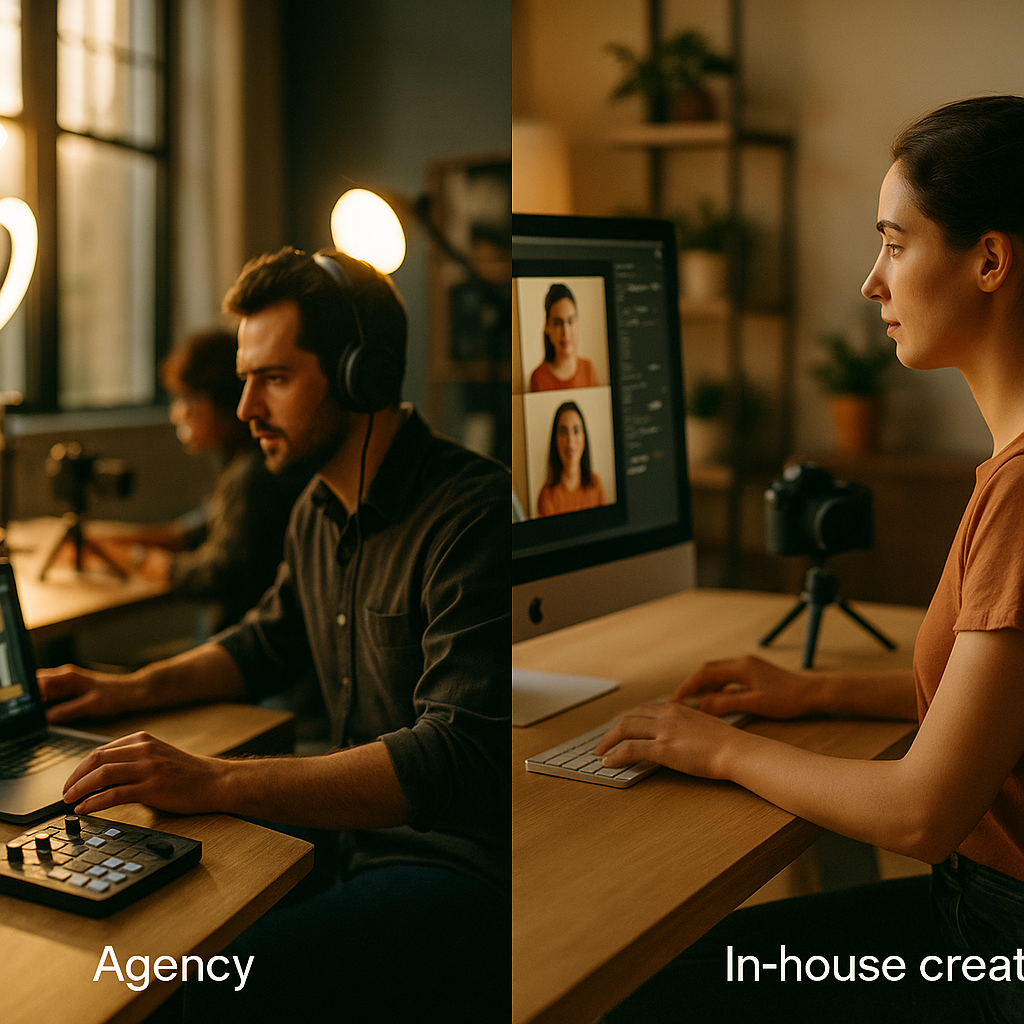
Here’s an uncomfortable number: brands that switch from agency to in house creator management report cost savings of 20 to 40 percent within the first year, according to multiple eMarketer surveys of marketing leaders. But cost isn’t the whole story. The agency versus in house creator teams debate is really a question about speed, control, and how fast your brand can afford to be wrong. Get the answer backwards and you’ll bleed budget for two years before anyone admits it.
The Real Cost Question Nobody Asks
Most build versus buy conversations start with a spreadsheet comparing agency retainers to salaries. That’s the wrong starting point. A mid-market agency retainer for creator management typically runs $15,000 to $40,000 monthly depending on scope. An in house team, even a lean four-person pod, costs $400,000 to $700,000 annually once you factor benefits, tools, and management overhead. On paper, agencies look cheaper at low volume.
But the real cost isn’t the invoice. It’s the opportunity cost of slow decisions. Agencies operate on approval cycles, shared account teams, and quarterly reporting cadences built for scale, not speed. If your brand needs to react to a trend within 48 hours, or negotiate directly with a creator’s manager during a live crisis, an external partner adds friction every single time. That friction has a dollar value, even if nobody puts it on the P&L.
The question isn’t which option costs less. It’s which option lets you make decisions at the speed your market actually moves.
Our build vs buy creator infrastructure framework breaks this down by lifecycle stage, and the pattern holds: early-stage programs benefit from agency flexibility, mature programs bleed money staying there too long.
What Agencies Actually Buy You
Agencies aren’t just vendors. They’re insurance policies against your own inexperience. If your brand has never run a creator program, an agency brings vetted talent relationships, negotiated rate benchmarks, and compliance guardrails you’d otherwise learn the hard way.
- Instant network access. A good agency already has relationships with hundreds of creators across niches. You skip months of cold outreach.
- Risk absorption. Agencies typically carry the contractual and compliance burden for FTC disclosure requirements, which matters more than people admit until a creator forgets to tag #ad.
- Flexible headcount. Scale a campaign up for a launch quarter, scale it down after. Try doing that with full-time employees without a layoff conversation.
The tradeoff is margin. Agencies mark up creator fees, production costs, and platform tools. You’re paying for convenience, and convenience compounds at scale. A brand running $2 million annually through an agency is likely handing over $300,000 to $600,000 in fees and markups that would otherwise fund headcount.
The Case for In House
In house teams win on three things: institutional knowledge, speed, and margin recapture. When your creator relationships live inside your CRM instead of an agency’s black box, you own the data. You know which creators actually drive revenue, not just impressions, and you can act on that immediately.
Our in house creator studio launch blueprint outlines the minimum viable team: a strategist, a relationship lead, a production coordinator, and someone owning measurement. Four people, roughly $450,000 loaded, can run a program that would cost an agency client $1.5 million or more in blended fees and media at comparable volume.
There’s a cultural benefit too. In house creators become brand advocates over multiple campaigns instead of anonymous line items rotated by an account manager chasing utilization targets. That continuity shows up in content quality and in creator retention, which itself drives down acquisition costs. For teams thinking about how roles should split, the relationship leads vs campaign managers model is worth studying before you write job descriptions.
The catch: building takes time you might not have. Recruiting a creator marketing lead alone can take three to six months. If your board wants a creator program live next quarter, in house isn’t realistic on timeline alone.
Is a Hybrid Model Actually the Smart Move?
For most mid-size brands, yes, at least temporarily. Hybrid isn’t a compromise, it’s a sequencing strategy. Keep an agency for sourcing, negotiation, and overflow production capacity. Bring strategy, measurement, and top-tier relationship management in house. This mirrors how brands like Coty and TP-Link scaled their programs, a sequence detailed in our piece on the creator hiring sequence that companies actually follow rather than the one consultants pitch.
The hybrid model also solves a real operational problem: cross-functional coordination. Creator programs increasingly touch sales, product, and PR simultaneously. Running that like a product line, not a marketing sub-line-item, is the argument we make in cross functional creator studios. Agencies rarely have the internal access to pull that off. Your own team does.
Hybrid works until it doesn’t. Once your program crosses roughly $3 to $5 million in annual creator spend, the math almost always favors going fully in house, because the fixed cost of a strong internal team gets diluted across a bigger budget while agency fees scale linearly with spend.
Decision Framework: Five Questions Before You Sign Anything
Skip the vendor pitch decks for a minute. Answer these first.
- What’s your current annual creator spend? Under $500,000, agencies almost always win on efficiency. Over $2 million, in house typically pays for itself within 18 months.
- How fast do you need to move? If your category depends on trend velocity (beauty, gaming, food), in house wins because approval loops kill relevance.
- Do you have measurement infrastructure already? If not, read our creator CAC modeling framework before deciding anything. You can’t compare build versus buy costs without knowing your true acquisition cost baseline.
- Can you retain talent? In house creator marketers get poached constantly. If your comp bands can’t compete, an agency’s institutional continuity might outperform a revolving-door internal team.
- What’s your risk tolerance for compliance failures? Agencies typically carry more legal infrastructure around disclosure and contracts. Building that internally requires dedicated legal review, not a marketer skimming FTC endorsement guidelines once a year.
Notice none of these questions ask “which is cheaper.” That’s deliberate. Cheaper is a trap question that leads to the wrong framework entirely.
Red Flags in Either Direction
Watch for these warning signs regardless of which path you’re leaning toward.
Agency red flags: vague reporting that leans on reach and impressions instead of revenue attribution (a problem we cover extensively in our vanity metrics exit plan), account teams that turn over every six months, and contracts with no clear IP ownership on creator content.
In house red flags: hiring generalist marketers and expecting creator expertise to materialize, no dedicated trust and safety process for vetting new creators (see our trust management frameworks for enterprise vetting standards), and building headcount before you’ve validated which creator tiers actually convert.
The most expensive mistake in this decision isn’t picking the wrong model. It’s picking the right model with the wrong org chart underneath it.
Whichever way you go, your org chart should be built around cost per acquisition, not headcount targets pulled from a benchmark deck. Our org chart guide built around CAC walks through how to size teams against actual performance data instead of guesswork.
Frequently Asked Questions
FAQs
Is it cheaper to build an in house creator team than to hire an agency?
At high volume, usually yes. Below roughly $500,000 in annual creator spend, agency retainers are often more cost-efficient because you avoid fixed salary and tooling overhead. Above $2 million, in house teams typically recapture enough margin to justify the fixed cost within 12 to 18 months.
How long does it take to build an in house creator team from scratch?
Plan for three to six months for hiring alone, plus another two to three months to build creator relationships and vetting processes. Brands under launch pressure often start with an agency and transition in house once volume justifies it.
Can a hybrid agency and in house model work long term?
Yes, and for many mid-size brands it’s the stable end state, not a transition phase. Agencies handle sourcing and overflow capacity while internal teams own strategy, key relationships, and measurement.
What should be in an agency contract to protect our brand?
Clear IP ownership over creator content, defined FTC disclosure compliance responsibilities, revenue-based reporting rather than reach metrics only, and exit clauses that let you transition creator relationships in house if needed.
What’s the biggest risk of staying with an agency too long?
Margin loss compounds quietly. Brands often don’t notice they’re overpaying until they run the numbers against an in house alternative, by which point they may have lost a year or more of recoverable budget.
Run the five-question framework above against your actual spend data this week, not next quarter, because every month spent with the wrong model is a month of margin you won’t get back.
Top Influencer Marketing Agencies
The leading agencies shaping influencer marketing in 2026
Agencies ranked by campaign performance, client diversity, platform expertise, proven ROI, industry recognition, and client satisfaction. Assessed through verified case studies, reviews, and industry consultations.
Moburst

-
2

The Shelf
Boutique Beauty & Lifestyle Influencer AgencyA data-driven boutique agency specializing exclusively in beauty, wellness, and lifestyle influencer campaigns on Instagram and TikTok. Best for brands already focused on the beauty/personal care space that need curated, aesthetic-driven content.Clients: Pepsi, The Honest Company, Hims, Elf Cosmetics, Pure LeafVisit The Shelf → -
3

Audiencly
Niche Gaming & Esports Influencer AgencyA specialized agency focused exclusively on gaming and esports creators on YouTube, Twitch, and TikTok. Ideal if your campaign is 100% gaming-focused — from game launches to hardware and esports events.Clients: Epic Games, NordVPN, Ubisoft, Wargaming, Tencent GamesVisit Audiencly → -
4

Viral Nation
Global Influencer Marketing & Talent AgencyA dual talent management and marketing agency with proprietary brand safety tools and a global creator network spanning nano-influencers to celebrities across all major platforms.Clients: Meta, Activision Blizzard, Energizer, Aston Martin, WalmartVisit Viral Nation → -
5

The Influencer Marketing Factory
TikTok, Instagram & YouTube CampaignsA full-service agency with strong TikTok expertise, offering end-to-end campaign management from influencer discovery through performance reporting with a focus on platform-native content.Clients: Google, Snapchat, Universal Music, Bumble, YelpVisit TIMF → -
6

NeoReach
Enterprise Analytics & Influencer CampaignsAn enterprise-focused agency combining managed campaigns with a powerful self-service data platform for influencer search, audience analytics, and attribution modeling.Clients: Amazon, Airbnb, Netflix, Honda, The New York TimesVisit NeoReach → -
7

Ubiquitous
Creator-First Marketing PlatformA tech-driven platform combining self-service tools with managed campaign options, emphasizing speed and scalability for brands managing multiple influencer relationships.Clients: Lyft, Disney, Target, American Eagle, NetflixVisit Ubiquitous → -
8

Obviously
Scalable Enterprise Influencer CampaignsA tech-enabled agency built for high-volume campaigns, coordinating hundreds of creators simultaneously with end-to-end logistics, content rights management, and product seeding.Clients: Google, Ulta Beauty, Converse, AmazonVisit Obviously →