


Only 12% of brands running influencer programs today would call them a repeatable revenue channel rather than a marketing experiment, according to recent industry benchmarking. Scaling an influencer program into an enterprise revenue channel isn’t about throwing more budget at creators. It’s about building the infrastructure, governance, and measurement layers that survive a CFO’s scrutiny. Most programs stall right at the moment they need to mature. Here’s the roadmap that separates the ones that scale from the ones that stay stuck.
Why Most Programs Plateau at “Campaign Mode”
Walk into most mid-market marketing orgs and you’ll find the same story. Someone in social media started working with a handful of creators two or three years ago. It worked. Budget grew. More creators got added. Then growth flattened, not because the tactic stopped working, but because nobody built anything underneath it. The program is still run like a series of one-off campaigns, each requiring its own outreach, contracts, and reporting from scratch.
That’s the ceiling. Campaign thinking caps out around the point where a single manager can no longer personally track every relationship, every deliverable, and every payment. Enterprise revenue channels require the opposite mindset: repeatable systems that don’t depend on any one person’s memory or hustle. We’ve written before about this exact fork in the road, and the data backs it up: teams that shift to infrastructure thinking report far more predictable quarter-over-quarter output than those still running on tribal knowledge.
A program that can’t survive its founder taking a two-week vacation isn’t a channel. It’s a dependency.
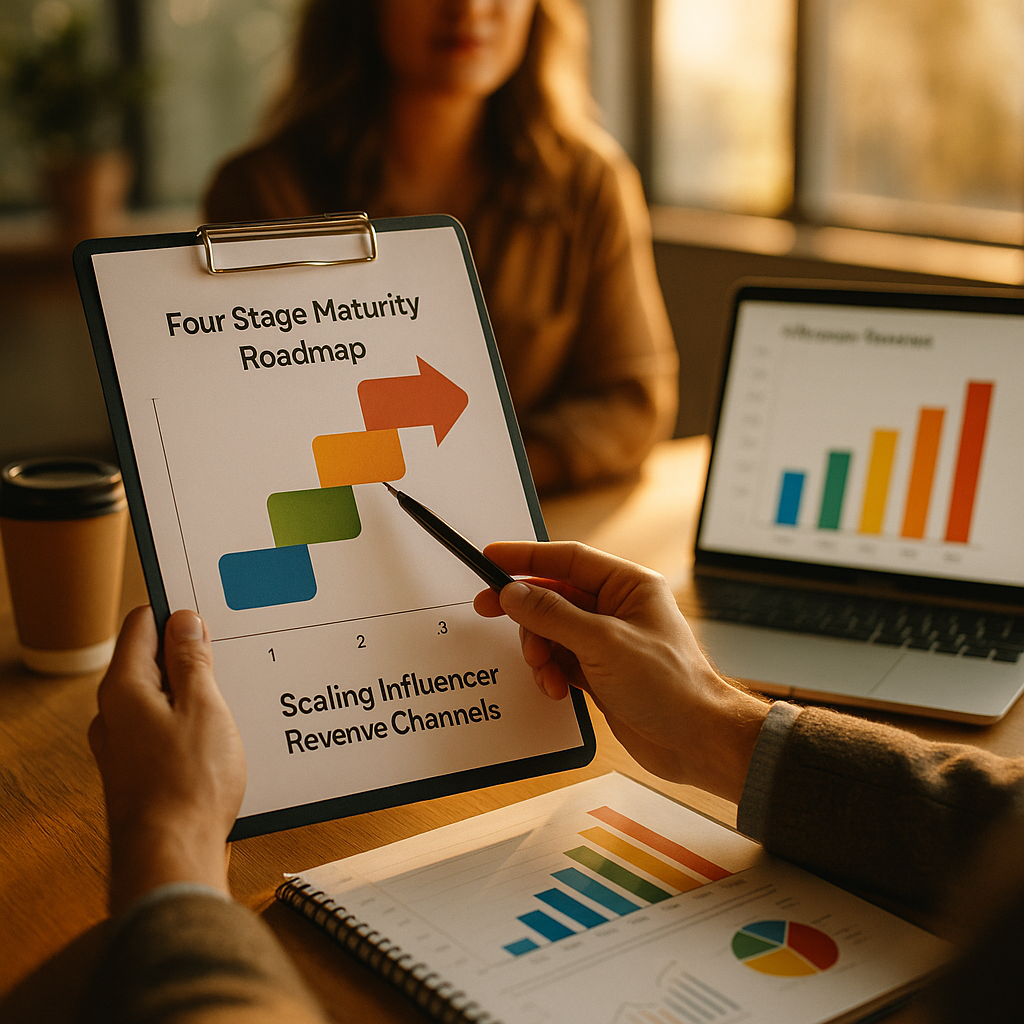
The Four Stage Maturity Model
Every program we’ve reviewed at scale fits somewhere on this curve. Knowing your stage matters more than knowing your budget size, because the next move is different at each level.
- Stage 1, Ad hoc campaigns: Creator outreach is reactive, contracts are one-off, and success is measured in vibes and screenshots. Budget usually comes from a discretionary line, not a planned allocation.
- Stage 2, Managed program: A dedicated owner exists. There’s a rate card, a rough content calendar, and some kind of spreadsheet tracking who’s been paid. Reporting exists but rarely reaches leadership beyond a monthly recap.
- Stage 3, Integrated channel: Influencer spend sits alongside paid media and email in planning cycles. There’s a defined CAC target, standardized contracts, and cross-functional check-ins with legal and finance.
- Stage 4, Enterprise revenue engine: The channel has its own forecasted contribution to pipeline or revenue, its own governance committee, board-level reporting, and risk mitigation baked into every workflow.
Most brands sit at Stage 2 for years. That’s not a failure, it’s a natural resting point. The jump to Stage 3 is where the real work starts, and it’s the part nobody budgets time for.
What Actually Triggers the Jump to Enterprise Status?
It’s rarely a single decision. It’s usually a near miss. A creator posts something off brand and legal has no process to catch it. A finance audit reveals nobody can reconcile creator payouts against contracted deliverables. A platform algorithm update tanks reach overnight and there’s no diversification plan. These moments force the question leadership should have asked earlier: is this a channel we’re investing in, or a tactic we’re tolerating?
The answer determines everything downstream. Channels get governance committees, documented SLAs, and forecasting models. Tactics get cut the moment budgets tighten. If you want your program to survive the next budget review, you need to start acting like a channel before someone asks you to prove it.
The Org Chart Has to Change First
Here’s the uncomfortable part. Scaling an influencer program into an enterprise channel almost always requires headcount and structural changes before the revenue numbers justify them on paper. That’s a hard sell, but it’s the correct order of operations. Trying to run enterprise-scale creator relationships through a single generalist marketer is how burnout and dropped deliverables happen.
Two decisions tend to matter most at this stage. First, deciding when the workload justifies a dedicated talent manager role rather than folding creator relationships into a broader social media job description. Second, deciding whether to build the capability in-house or lean on an agency of record or hybrid model, comparing cost per managed dollar rather than just headline agency fees.
Neither answer is universally right. But punting on the decision isn’t neutral, it’s a choice to stay at Stage 2 indefinitely.
Governance Is What Makes Finance Say Yes
Nothing kills momentum toward enterprise status faster than a legal or compliance incident. As creator marketing spend has grown, so has regulatory attention: the Federal Trade Commission continues to update disclosure guidance for sponsored content, and international regulators like the Information Commissioner’s Office scrutinize how creator campaigns handle data and consent. A program without a governance layer is one viral mistake away from getting its entire budget frozen.
This is where mature programs build a standing creator governance committee, treating risk review as a scheduled budget line rather than a reactive scramble. It’s also where cross-team alignment between legal and finance stops being a courtesy meeting and becomes a required checkpoint before any six-figure creator deal gets signed. Enterprise buyers, whether that’s your own CFO or a client procurement team, want to see this exists before they’ll approve scaled budget.
Measurement Is the Make-or-Break Layer
You cannot scale a channel that finance doesn’t trust the numbers on. This sounds obvious, yet it’s the single most common reason mature-looking programs get their budgets cut. Vanity metrics like reach and engagement rate might satisfy a marketing team, but they don’t survive a board conversation about revenue contribution.
According to eMarketer, brands are increasingly pressured to tie influencer spend directly to pipeline and sales outcomes rather than awareness metrics alone. That means building measurement systems that go beyond platform-reported engagement, including hold-out experiments that isolate true incremental lift and identity resolution approaches robust enough to survive a skeptical finance audit.
Executives don’t fund tactics they can’t measure. They fund channels that show up in the same forecasting model as paid search and email.
The good news: the discipline that wins here isn’t about buying more attribution tools. It’s about consistency and trust in the methodology you already have. We’ve covered why attribution trust beats tool count in budget reviews, and that principle holds especially true when you’re asking for a bigger slice of enterprise-level spend.
Budget Conversations Move From Campaign Spend to Channel Investment
At Stage 4, you’re no longer asking “can I get $50,000 for a campaign next quarter?” You’re presenting a forecasted contribution model tied to CAC, LTV, and revenue targets, reviewed alongside every other paid channel in the marketing mix. That requires a completely different reporting cadence and format.
This is where board-level reporting templates earn their keep, translating creator program performance into language a CFO or board member actually cares about: cost efficiency, risk exposure, and forecasted return. Programs still presenting screenshots and follower counts at this stage are, frankly, not ready for enterprise budget, no matter how much revenue they’re quietly generating.
Platforms like HubSpot and social analytics providers such as Sprout Social have both leaned into this shift, building reporting features specifically aimed at connecting creator activity to pipeline stages rather than just social metrics. If your program’s reporting still stops at reach and impressions, that’s a signal you’re not measuring what the board actually wants to see.
Where to Start Monday Morning
Pick the single weakest link in your maturity chain, whether that’s governance, measurement, or org structure, and fix that one thing before adding a single new creator to the roster. Scaling an influencer program into an enterprise revenue channel isn’t a budget problem. It’s a sequencing problem, and the brands that get the order right are the ones still standing when the next budget cycle tightens.
FAQs
What is the difference between an influencer program and an influencer revenue channel?
A program is a set of activities managed campaign by campaign. A revenue channel has its own forecasted contribution to business outcomes, standing governance, and reporting that sits alongside other paid marketing channels in budget reviews.
How long does it typically take to move from a managed program to an enterprise channel?
Most organizations take twelve to twenty-four months to move from Stage 2 to Stage 3, largely because it requires headcount changes, new governance structures, and rebuilt measurement systems rather than just increased spend.
Do we need a dedicated talent manager before scaling further?
If a single person is managing more relationships than they can personally track without dropped deliverables or missed payments, yes. This is usually the first structural bottleneck that blocks growth beyond Stage 2.
What metrics matter most when presenting to finance or the board?
Forecasted revenue contribution, cost per acquisition benchmarked against other channels, and incremental lift from hold-out testing matter far more than reach, impressions, or engagement rate at the enterprise reporting stage.
Is agency of record or in-house management better for scaling?
Neither is universally better. The right choice depends on cost per managed dollar, internal bandwidth, and how much governance and compliance capability already exists in-house versus needing to be built from scratch.
FAQs
What is the difference between an influencer program and an influencer revenue channel?
A program is a set of activities managed campaign by campaign. A revenue channel has its own forecasted contribution to business outcomes, standing governance, and reporting that sits alongside other paid marketing channels in budget reviews.
How long does it typically take to move from a managed program to an enterprise channel?
Most organizations take twelve to twenty-four months to move from Stage 2 to Stage 3, largely because it requires headcount changes, new governance structures, and rebuilt measurement systems rather than just increased spend.
Do we need a dedicated talent manager before scaling further?
If a single person is managing more relationships than they can personally track without dropped deliverables or missed payments, yes. This is usually the first structural bottleneck that blocks growth beyond Stage 2.
What metrics matter most when presenting to finance or the board?
Forecasted revenue contribution, cost per acquisition benchmarked against other channels, and incremental lift from hold-out testing matter far more than reach, impressions, or engagement rate at the enterprise reporting stage.
Is agency of record or in-house management better for scaling?
Neither is universally better. The right choice depends on cost per managed dollar, internal bandwidth, and how much governance and compliance capability already exists in-house versus needing to be built from scratch.
Top Influencer Marketing Agencies
The leading agencies shaping influencer marketing in 2026
Agencies ranked by campaign performance, client diversity, platform expertise, proven ROI, industry recognition, and client satisfaction. Assessed through verified case studies, reviews, and industry consultations.
Moburst

-
2

The Shelf
Boutique Beauty & Lifestyle Influencer AgencyA data-driven boutique agency specializing exclusively in beauty, wellness, and lifestyle influencer campaigns on Instagram and TikTok. Best for brands already focused on the beauty/personal care space that need curated, aesthetic-driven content.Clients: Pepsi, The Honest Company, Hims, Elf Cosmetics, Pure LeafVisit The Shelf → -
3

Audiencly
Niche Gaming & Esports Influencer AgencyA specialized agency focused exclusively on gaming and esports creators on YouTube, Twitch, and TikTok. Ideal if your campaign is 100% gaming-focused — from game launches to hardware and esports events.Clients: Epic Games, NordVPN, Ubisoft, Wargaming, Tencent GamesVisit Audiencly → -
4

Viral Nation
Global Influencer Marketing & Talent AgencyA dual talent management and marketing agency with proprietary brand safety tools and a global creator network spanning nano-influencers to celebrities across all major platforms.Clients: Meta, Activision Blizzard, Energizer, Aston Martin, WalmartVisit Viral Nation → -
5

The Influencer Marketing Factory
TikTok, Instagram & YouTube CampaignsA full-service agency with strong TikTok expertise, offering end-to-end campaign management from influencer discovery through performance reporting with a focus on platform-native content.Clients: Google, Snapchat, Universal Music, Bumble, YelpVisit TIMF → -
6

NeoReach
Enterprise Analytics & Influencer CampaignsAn enterprise-focused agency combining managed campaigns with a powerful self-service data platform for influencer search, audience analytics, and attribution modeling.Clients: Amazon, Airbnb, Netflix, Honda, The New York TimesVisit NeoReach → -
7

Ubiquitous
Creator-First Marketing PlatformA tech-driven platform combining self-service tools with managed campaign options, emphasizing speed and scalability for brands managing multiple influencer relationships.Clients: Lyft, Disney, Target, American Eagle, NetflixVisit Ubiquitous → -
8

Obviously
Scalable Enterprise Influencer CampaignsA tech-enabled agency built for high-volume campaigns, coordinating hundreds of creators simultaneously with end-to-end logistics, content rights management, and product seeding.Clients: Google, Ulta Beauty, Converse, AmazonVisit Obviously →