


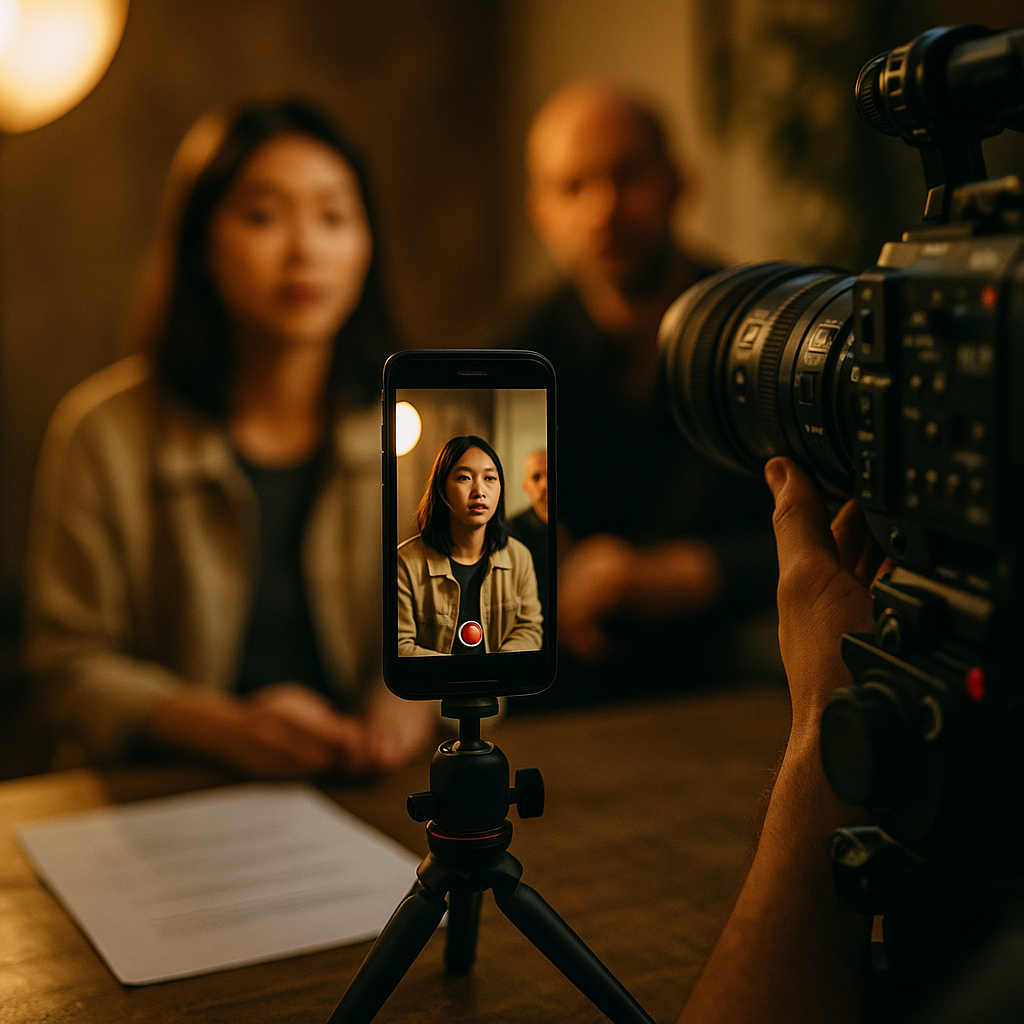
Vertical micro-drama apps now pull in more daily watch time per user than most streaming platforms, and brands are finally catching up. ReelShort and DramaBox have proven that audiences will binge sixty-second episodes shot for a phone screen. The question for brand marketers isn’t whether vertical micro-drama works. It’s whether your production process can keep up with a format that demands a new episode every two or three days without burning your budget or your creator relationships.
This guide breaks down how to actually produce a branded vertical micro-drama series, from greenlighting the concept through measuring whether episode six is still converting.
What Counts as a Vertical Micro-Drama, Exactly?
Vertical micro-drama is a serialized video format shot in 9:16, built around tight episodes (usually 60 to 180 seconds), released on a drip schedule, and structured around a cliffhanger that forces the next tap. It’s not a brand film chopped into pieces. It’s closer to a soap opera written for TikTok Shop and Reels.
The format borrows heavily from apps like ReelShort and DramaBox, which have shown that viewers will pay for episode unlocks the same way they’d binge a Netflix series, just compressed into phone-sized bites. Brands aren’t trying to replicate the paywall model. They’re borrowing the narrative mechanics: fast hooks, recurring characters, unresolved tension, and a release cadence that trains audiences to come back.
A branded micro-drama series only works if episode one earns the right to a season, not because the brand paid for a season upfront.
If you’ve dabbled in episodic creator series before, vertical micro-drama is the more compressed, more plot-driven cousin. Less lifestyle vlog, more “will they get caught” tension around a product reveal.
Why Brands Are Greenlighting These Series Now
Three forces are converging. First, attention spans on short-form platforms keep shrinking, but completion rates on well-structured serialized content are holding steady or climbing, according to data from eMarketer. Second, TikTok Shop and Instagram’s shoppable video tools have made it trivial to tag products inside a dramatic scene without breaking the fourth wall. Third, performance marketing teams are tired of one-off UGC spots that spike for a week and die.
A micro-drama series solves the fatigue problem. Each episode is new creative, but it’s built on the same cast, same world, and same production template. That means your creative testing budget stretches further because you’re not reinventing the concept every sprint, you’re just writing the next beat.
It also plays well with risk-averse legal and compliance teams, oddly enough. Because the format is clearly fictionalized and serialized, disclosure expectations are more straightforward than with ambiguous “is this sponsored” content. The FTC’s guidance on endorsements still applies in full, but a clearly branded drama series with consistent disclosure in episode one carries less ambiguity than a single influencer post that blurs the line between opinion and ad. Review the FTC’s endorsement guidelines before you lock your disclosure strategy, every episode needs it, not just the first.
Casting: Your Creators Are Actors Now
This is where most brands trip. You can’t cast a vertical micro-drama the way you cast a standard influencer campaign. You need people who can hit a mark, deliver a line with timing, and stay in character across a dozen shoot days, not just look good holding your product.
Pull from three pools: actual trained actors with social followings (growing fast as talent agencies lean into the format), established creators who already do skits or character work, and a smaller tier of micro-influencers cast in recurring supporting roles to widen distribution. The lead role carries the narrative. Supporting roles carry the seeding, each supporting creator posts their own episode cut to their own audience, multiplying reach without multiplying production cost.
Budget for a chemistry read before you commit to a season. A single awkward pairing between your two leads will tank completion rates faster than a weak script will. If you’re building toward a season arc, lock your cast contracts for the full run upfront. Recasting mid-season is a visible, audience-breaking disaster.
Scripting the Hook Loop
Every episode needs its own complete hook-to-cliffhanger arc, even while it serves the larger season plot. Think of each episode as a mini contract with the viewer: you promise a resolution, you deliver three-quarters of it, and you withhold the final beat for episode two.
- Cold open in the first two seconds. No brand logo, no “hey guys.” Drop straight into conflict or tension.
- Plant the product organically by episode two or three. Forcing it into episode one reads as an ad, not a story.
- End on an unresolved decision, not a resolved one. A character about to say something, a reveal half-shown, a door about to open.
- Caption the cliffhanger question directly. “Wait, did she know the whole time?” works harder than a vague teaser.
Teams that have already tested cliffhanger hook scripting for single-video formats will recognize the mechanics. Micro-drama just stretches that tension across an entire season instead of resolving it in one sixty-second clip. If you want viewers to come back twelve times instead of once, the withholding has to feel earned, not cheap.
Avoid the trap of over-plotting before you’ve shot anything. Write episode one, two, and three in full, then outline the rest of the season in beats only. Audience response to the first three episodes should inform casting for recurring characters, pacing, and even whether a subplot gets cut. Treat your season bible as a living document, not a locked script.
Production Logistics That Actually Scale
Here’s the uncomfortable truth: most brands underestimate how much a serialized format costs in pre-production, not shoot days. A single 90 second episode might take fifteen minutes to film once you’re set up, but the script, blocking, continuity notes, and wardrobe tracking across a ten-episode season require a genuinely different operational muscle than a one-off UGC brief.
Build a continuity bible before day one. Track what every character wears, what prop is where, and what’s been revealed to the audience versus what’s still secret. Nothing breaks audience trust faster than a prop that changes color between episodes, or a character knowing something they haven’t learned yet. This sounds like film school nitpicking until you’re three episodes into a season and your comments section is pointing out every inconsistency.
Shoot in blocks. Film three to four episodes in a single multi-day shoot rather than shooting one episode per week. This protects your schedule against creator availability, reduces per-episode cost, and gives your editing team a buffer to release on schedule even if reshoots are needed. A two-day drought between scheduled episodes is enough to tank your series completion rate, audiences on this format expect reliability almost like a TV broadcast slot.
If your series includes any interactive elements, viewers choosing which path a character takes, which subplot gets more screen time, map it out using the same logic as branching video formats. It adds production complexity, but it also gives you first-party data on which plotlines your audience actually prefers, which is gold for season two planning.
Where to Actually Place the Brand
The single biggest mistake brands make with vertical micro-drama is treating the product like the main character. It isn’t. The relationship, the secret, the rivalry, whatever drives the plot, that’s the main character. The product is a supporting prop that solves a problem inside the story.
If you can delete your product from the scene and the plot still makes sense, your integration is too shallow to drive sales. If deleting it breaks the plot, you’ve nailed the balance.
Good integration patterns: the product resolves a plot-relevant problem (a skincare reveal before a big date, a gadget that catches someone in a lie), a character has a visible, repeated relationship with the brand across episodes (not a one-time mention), and the product shows up in b-roll even in episodes where it’s not plot-central, reinforcing presence without forcing another sales pitch.
This is similar in spirit to the pivot structure covered in demo to drama hybrid scripting, except in a full season format you get to spread that pivot across multiple episodes instead of cramming it into one clip. Use that runway. A slower reveal across episode three and four builds more trust than a hard pitch in episode one.
Measuring What Actually Matters
Standard short-form metrics don’t tell the whole story for a serialized format. Watch time per episode matters, but so does episode-over-episode retention, meaning what percentage of episode one’s viewers actually show up for episode two. A series with strong single-episode views but a steep retention drop-off is a story problem, not a distribution problem.
Track these specifically:
- Episode-to-episode retention rate, your clearest signal of whether the plot is working.
- Comment sentiment on cliffhangers, are viewers theorizing about what happens next, or confused and disengaged?
- Conversion lag, since purchases often happen two or three episodes after the product is introduced, not immediately.
- Cross-platform hook performance, since the same episode may need different opening seconds for TikTok versus Reels audiences.
Run your opening hooks through the same rigor as cross-channel hook testing before committing a full episode cut across every platform. A hook that works on TikTok’s faster scroll culture might underperform on Instagram, where viewers are more patient with a slower build. According to HubSpot’s marketing benchmarks, video content with serialized structure consistently outperforms one-off posts on repeat engagement, which is exactly the asset class brands are underusing.
Don’t ignore platform-specific tools either. Meta’s ad platform and TikTok’s creative center both offer retention curve data at the video level, use it to compare your episodes against platform benchmarks, not just against each other. Check Meta Business and TikTok Ads Manager for native analytics before building a custom dashboard from scratch.
The Next Step
Don’t greenlight a ten-episode season on a hunch. Shoot and release a three-episode pilot arc, measure episode-to-episode retention honestly, and only commission the rest of the season once you’ve confirmed viewers are coming back for the story, not just the first hook.
FAQs
How long should a branded vertical micro-drama episode be?
Most successful episodes run between 60 and 180 seconds. Shorter episodes work better early in a season when you’re still building audience investment, while slightly longer episodes can work once viewers are hooked on the characters.
How many episodes should a first season include?
Start with a three-episode pilot arc to test retention before committing further. If retention and sentiment hold up, expand to a six to ten episode season, which is the typical range for brand-sponsored series right now.
Do micro-drama episodes need a different disclosure approach than standard influencer posts?
No, FTC endorsement guidance still applies to every episode, not just the first. Because the series is clearly scripted and serialized, consistent disclosure from episode one tends to reduce audience confusion compared to single ambiguous posts.
What’s the biggest production mistake brands make with this format?
Treating the product as the main character instead of a supporting element inside the plot. Integrations that could be deleted without breaking the story usually read as ads and hurt completion rates.
How is success measured differently for serialized video versus single posts?
Episode-to-episode retention and conversion lag matter more than single-video view counts. A series can have strong episode one views but fail if retention drops sharply by episode three, signaling a story problem rather than a reach problem.
FAQPage Schema
Top Influencer Marketing Agencies
The leading agencies shaping influencer marketing in 2026
Agencies ranked by campaign performance, client diversity, platform expertise, proven ROI, industry recognition, and client satisfaction. Assessed through verified case studies, reviews, and industry consultations.
Moburst

-
2

The Shelf
Boutique Beauty & Lifestyle Influencer AgencyA data-driven boutique agency specializing exclusively in beauty, wellness, and lifestyle influencer campaigns on Instagram and TikTok. Best for brands already focused on the beauty/personal care space that need curated, aesthetic-driven content.Clients: Pepsi, The Honest Company, Hims, Elf Cosmetics, Pure LeafVisit The Shelf → -
3

Audiencly
Niche Gaming & Esports Influencer AgencyA specialized agency focused exclusively on gaming and esports creators on YouTube, Twitch, and TikTok. Ideal if your campaign is 100% gaming-focused — from game launches to hardware and esports events.Clients: Epic Games, NordVPN, Ubisoft, Wargaming, Tencent GamesVisit Audiencly → -
4

Viral Nation
Global Influencer Marketing & Talent AgencyA dual talent management and marketing agency with proprietary brand safety tools and a global creator network spanning nano-influencers to celebrities across all major platforms.Clients: Meta, Activision Blizzard, Energizer, Aston Martin, WalmartVisit Viral Nation → -
5

The Influencer Marketing Factory
TikTok, Instagram & YouTube CampaignsA full-service agency with strong TikTok expertise, offering end-to-end campaign management from influencer discovery through performance reporting with a focus on platform-native content.Clients: Google, Snapchat, Universal Music, Bumble, YelpVisit TIMF → -
6

NeoReach
Enterprise Analytics & Influencer CampaignsAn enterprise-focused agency combining managed campaigns with a powerful self-service data platform for influencer search, audience analytics, and attribution modeling.Clients: Amazon, Airbnb, Netflix, Honda, The New York TimesVisit NeoReach → -
7

Ubiquitous
Creator-First Marketing PlatformA tech-driven platform combining self-service tools with managed campaign options, emphasizing speed and scalability for brands managing multiple influencer relationships.Clients: Lyft, Disney, Target, American Eagle, NetflixVisit Ubiquitous → -
8

Obviously
Scalable Enterprise Influencer CampaignsA tech-enabled agency built for high-volume campaigns, coordinating hundreds of creators simultaneously with end-to-end logistics, content rights management, and product seeding.Clients: Google, Ulta Beauty, Converse, AmazonVisit Obviously →