


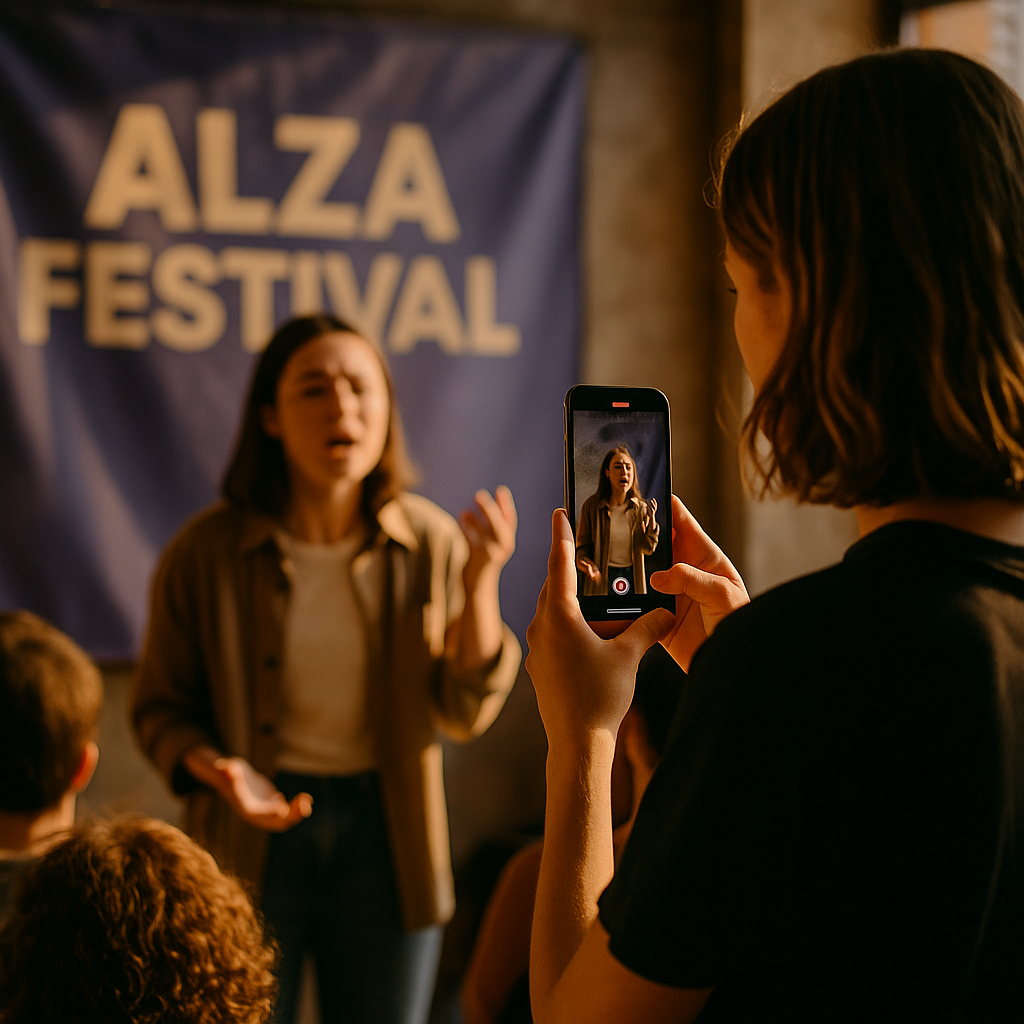
A sixty to ninety second vertical video that ends on a cliffhanger, loops you into episode two, and asks for a micro payment before episode three. That’s the microdrama formula, and it’s already pulling in billions of dollars in app revenue globally. So when ALZA, a vertical fiction studio, made its first appearance at a dedicated microdrama festival this year, the move read less like a publicity stunt and more like a signal flare for brand marketers watching the creator economy’s next format war.
The Festival Moment That Caught Marketers Off Guard
Festivals exist to legitimize formats. Cannes did it for short film. SXSW did it for interactive media. Now a wave of dedicated microdrama and vertical fiction festivals are doing the same for the serialized, phone-first drama that’s been quietly eating attention spans in apps like ReelShort, DramaBox, and ShortMax. ALZA’s debut at one of these events wasn’t just a studio showcase. It was a statement that vertical fiction has moved past its scrappy, China-export origins and into something resembling an established content category, complete with industry panels, distribution deals, and yes, brand sponsorship conversations happening in the hallways.
That matters for anyone running a media budget. Formats that graduate to “festival status” tend to attract ad infrastructure fast. Think about how branded content panels at Cannes Lions preceded a surge in influencer-studio production deals. The same pattern is forming around microdrama, and brands that wait for the format to fully mature will pay a premium to catch up.
What Exactly Is a Microdrama, and Why Should Brands Care?
Microdramas, sometimes called vertical fiction or short dramas, are serialized scripted content built for mobile viewing. Episodes run sixty to a few hundred seconds. Plots lean melodramatic on purpose: secret heirs, revenge arcs, forbidden romance. The entire genre is engineered for binge behavior inside a vertical feed, which is precisely why it’s drawing comparisons to early-era TikTok and the first wave of branded Reels content.
The appeal to marketers isn’t the melodrama itself. It’s the completion rates. Unlike fifteen-second ad creative that users skip within the first three seconds, microdrama episodes routinely hold attention for their full runtime because the narrative hook does the retention work. That’s a fundamentally different engagement mechanic than the interruption-based advertising brands have relied on for two decades.
The Numbers Behind the Format’s Rise
Industry estimates from research firms tracking app monetization put global microdrama app revenue in the billions annually, with some platforms reporting user spend rivaling mid-tier mobile games. eMarketer and Statista have both flagged short-form serialized video as one of the fastest-growing mobile content categories, driven largely by in-app micro transactions rather than ad impressions. That revenue model detail is important. It means the audience is already primed to pay for content they’re emotionally invested in, which is a very different psychology than the ad-avoidant scroll behavior brands usually contend with.
A format that trains users to pay for narrative payoff is a format where branded storytelling has a structural advantage over interruptive advertising.
This lines up with a trend Influencers Time has tracked across the broader creator economy: audiences increasingly reward emotional investment over polish. Our coverage on how emotional ROI is reshaping budget allocation found that marketers are shifting spend toward formats that build attachment rather than just impressions. Microdrama fits that thesis almost perfectly.
Branded Vertical Fiction: Early Experiments and What They Reveal
A handful of brands have already tested product placement and sponsored episodes inside microdrama apps, mostly in beauty, finance, and mobile gaming verticals where the audience demographics overlap heavily with the platforms’ user base (skewing female, 25 to 45, high mobile engagement). Early results, shared informally at industry events like ALZA’s festival panel, suggest completion-rate-driven ad recall outperforms standard pre-roll by a meaningful margin. Nobody has published a rigorous third-party study yet, which should make any marketer cautious about treating anecdotal panel data as proven ROI.
Still, the production model itself is worth studying. Microdrama studios shoot fast, cheap, and iteratively, testing hooks the way performance marketers test ad creative. That approach mirrors what Influencers Time has documented in episodic creator series outperforming one-off posts on retention metrics. Vertical fiction is essentially that same episodic logic, industrialized and scaled with professional writers rooms instead of solo creators.
It also echoes the structural shift covered in our piece on series partnerships turning creators into owned media channels. Brands that lock in recurring narrative real estate, whether through a creator’s series or a microdrama studio’s episode slate, are buying something closer to a media channel than a single campaign.
Where the Risk Hides
None of this is risk-free, and B2B marketers should treat microdrama with the same scrutiny applied to any emerging channel. A few concerns worth flagging before you brief a studio:
- Disclosure ambiguity. Sponsored episodes blur the line between entertainment and advertising in ways the FTC has already scrutinized in influencer content. Clear sponsorship labeling inside a narrative format is harder to execute cleanly than a simple #ad tag.
- Measurement immaturity. Most microdrama platforms don’t yet offer the attribution depth marketers expect from established channels. That’s a familiar problem. Our analysis of the creator ROI paradox found that plenty of brands report perceived gains they can’t actually prove, and new formats without mature reporting infrastructure make that problem worse, not better.
- Production and rights complexity. Licensing a brand integration inside a serialized narrative involves different contract terms than a single sponsored post. Marketers used to standard influencer agreements should expect more complicated rights negotiations, closer to the territory covered in our piece on contract disputes breaking down pay terms.
- Platform concentration risk. A handful of apps control most microdrama distribution right now. Betting budget on a channel with few platform options carries the same concentration risk flagged in our coverage of marketplace expansion and compliance exposure.
Should Your Brand Test Vertical Fiction Now?
Here’s the honest answer: it depends on your audience and your appetite for experimentation. If your target demo already overindexes on microdrama app usage (and the data suggests younger millennial and Gen Z women do), a small test budget makes sense. Treat it the way you’d treat any emerging channel pilot: capped spend, clear KPIs, and a willingness to walk away if the measurement story doesn’t hold up after one or two cycles.
What you shouldn’t do is wait for a fully mature measurement stack before testing at all. The brands that got outsized value from TikTok, from live shopping, and from short-form creator series were the ones testing early while the CPMs were cheap and the competition was thin. That pattern has repeated across nearly every format shift Influencers Time has covered, including the budget reallocation documented in display budgets shrinking as CFOs reroute dollars to creators. Vertical fiction looks like it’s entering that same early window right now.
Start small. Pick one studio partner, negotiate a single-series integration, and set measurement expectations before production begins, not after. Tools like HubSpot or Sprout Social can help bridge the attribution gap until native platform reporting catches up.
Frequently Asked Questions
What is vertical fiction in marketing terms?
Vertical fiction, also called microdrama, refers to serialized scripted video content shot for mobile vertical viewing, typically delivered in sixty to ninety second episodes through dedicated apps. Marketers are exploring it as a sponsored content and product placement channel because of its unusually high episode completion rates.
Why does ALZA’s festival debut matter for brands?
A dedicated microdrama platform appearing at a content festival signals the format is moving from niche app behavior to an industry category with formal distribution, production, and sponsorship infrastructure, the same maturity path other formats followed before attracting serious ad spend.
Is microdrama advertising measurable yet?
Not fully. Most platforms lack the attribution depth marketers get from established social channels, so brands testing this space should rely on controlled pilots with clear baseline KPIs rather than platform-reported engagement alone.
What industries are best suited to test vertical fiction sponsorships?
Beauty, finance, and mobile gaming brands have run the earliest tests, largely because their target demographics overlap with current microdrama app audiences, who skew toward women aged 25 to 45 with high mobile engagement.
What compliance risks come with sponsored microdrama content?
The main risk is disclosure clarity. Embedding a brand integration inside a narrative episode makes sponsorship labeling harder to execute than a standard social post, which raises the same transparency concerns regulators have already applied to influencer marketing.
FAQ Schema
If vertical fiction is on your radar, don’t wait for case studies to pile up. Negotiate one pilot series with capped spend, lock disclosure language into the contract upfront, and measure it against the same rigor you’d apply to any paid channel, not the looser standards early creator deals often got away with.
Top Influencer Marketing Agencies
The leading agencies shaping influencer marketing in 2026
Agencies ranked by campaign performance, client diversity, platform expertise, proven ROI, industry recognition, and client satisfaction. Assessed through verified case studies, reviews, and industry consultations.
Moburst

-
2

The Shelf
Boutique Beauty & Lifestyle Influencer AgencyA data-driven boutique agency specializing exclusively in beauty, wellness, and lifestyle influencer campaigns on Instagram and TikTok. Best for brands already focused on the beauty/personal care space that need curated, aesthetic-driven content.Clients: Pepsi, The Honest Company, Hims, Elf Cosmetics, Pure LeafVisit The Shelf → -
3

Audiencly
Niche Gaming & Esports Influencer AgencyA specialized agency focused exclusively on gaming and esports creators on YouTube, Twitch, and TikTok. Ideal if your campaign is 100% gaming-focused — from game launches to hardware and esports events.Clients: Epic Games, NordVPN, Ubisoft, Wargaming, Tencent GamesVisit Audiencly → -
4

Viral Nation
Global Influencer Marketing & Talent AgencyA dual talent management and marketing agency with proprietary brand safety tools and a global creator network spanning nano-influencers to celebrities across all major platforms.Clients: Meta, Activision Blizzard, Energizer, Aston Martin, WalmartVisit Viral Nation → -
5

The Influencer Marketing Factory
TikTok, Instagram & YouTube CampaignsA full-service agency with strong TikTok expertise, offering end-to-end campaign management from influencer discovery through performance reporting with a focus on platform-native content.Clients: Google, Snapchat, Universal Music, Bumble, YelpVisit TIMF → -
6

NeoReach
Enterprise Analytics & Influencer CampaignsAn enterprise-focused agency combining managed campaigns with a powerful self-service data platform for influencer search, audience analytics, and attribution modeling.Clients: Amazon, Airbnb, Netflix, Honda, The New York TimesVisit NeoReach → -
7

Ubiquitous
Creator-First Marketing PlatformA tech-driven platform combining self-service tools with managed campaign options, emphasizing speed and scalability for brands managing multiple influencer relationships.Clients: Lyft, Disney, Target, American Eagle, NetflixVisit Ubiquitous → -
8

Obviously
Scalable Enterprise Influencer CampaignsA tech-enabled agency built for high-volume campaigns, coordinating hundreds of creators simultaneously with end-to-end logistics, content rights management, and product seeding.Clients: Google, Ulta Beauty, Converse, AmazonVisit Obviously →