


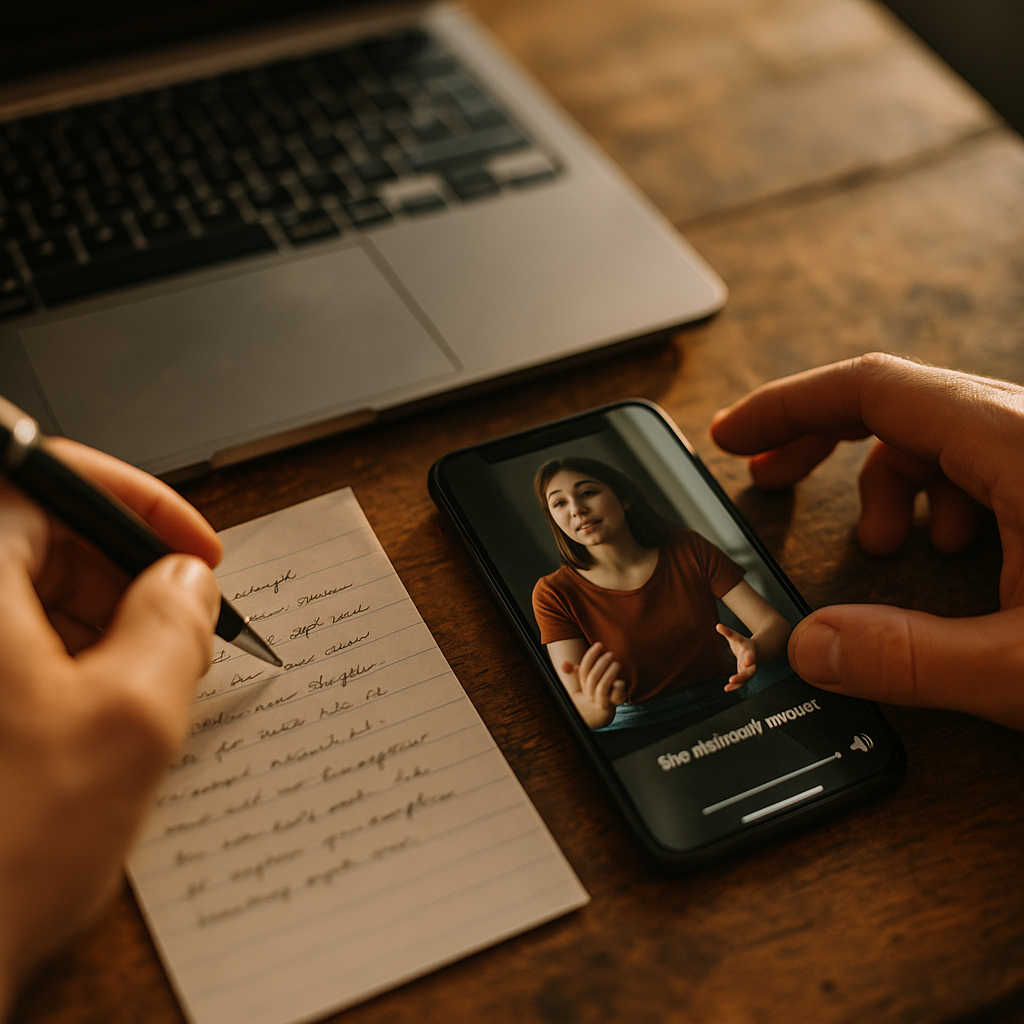
85% of video views on Facebook happen with the sound off, and TikTok’s own creator guidance pushes captions as a default, not an accessibility afterthought. If your scripts still treat captions as something an editor bolts on in post, you’re losing the first three seconds of every single view. Caption led creator videos aren’t a nice-to-have anymore. They’re the primary storytelling layer for silent autoplay feeds, and the brands still writing audio-first scripts are quietly bleeding watch time.
Why Silent Autoplay Changed the Scripting Job
Autoplay feeds default to muted. That’s not a platform quirk, it’s a design decision Meta, TikTok, and YouTube Shorts all made because muted autoplay feels less intrusive while scrolling on a train or in a meeting. The consequence for creator content is blunt: your hook, your product reveal, and your call to action all have to land visually before anyone chooses to tap the speaker icon.
This is a different writing discipline than scripting for a voiceover or a talking-head testimonial. You’re not writing dialogue that happens to get captioned. You’re writing a caption track that happens to have audio underneath it. Flip that mental model and the whole brief changes, from shot list to on-screen text timing to how you structure the offer.
Treat the caption as the script and the voiceover as the soundtrack. If the video still makes sense with the audio stripped out entirely, it’s built for the feed it’s actually living in.
The Anatomy of a Caption Led Script
A traditional creator brief gives talent a hook line, three key talking points, and a CTA, assuming someone is listening. A caption led brief needs an extra layer: a beat sheet that maps exactly what text appears on screen, when, and for how long. Think of it less like a script and more like a silent film intertitle sequence, built for 2026 attention spans.
- Hook caption (0 to 1.5 seconds): A short, punchy statement or question, large font, high contrast, no more than six to eight words. This has to work standalone, before any voiceover kicks in.
- Proof or tension caption (1.5 to 4 seconds): Builds the problem or stakes. This is where a lot of scripts fail because writers default to a full sentence when a fragment hits harder.
- Demonstration captions (4 to 15 seconds): Short labels tied to visual beats, not full transcription. “Still greasy after 2 washes” over a before shot does more work than a paragraph of narration text.
- CTA caption (final 2 to 3 seconds): Reinforced by an on-screen graphic or sticker, not just text, since viewers skim rather than read at this point.
Notice what’s missing: a full word-for-word transcript. Auto-generated captions that just subtitle everything a creator says tend to clutter the frame and move too fast to actually help comprehension. Scripted captions are edited for the eye, not transcribed for the ear.
Writing Rhythm for Text, Not Speech
Spoken scripts rely on pacing, tone, and pauses to build rhythm. Caption scripts rely on word count, font changes, and timing cuts. A good rule from editors working with creators at scale: cap on-screen caption cards at five to seven words, and change the card every 1.5 to 2.5 seconds. Go longer and viewers either skip past before finishing the read or they bounce entirely.
This is also why caption led scripts often read choppier on paper than they look on screen. “No more frizz. No more heat damage. Just this.” reads fragmented in a Google Doc. On a silent autoplay reel, each fragment lands as its own beat, timed to a visual cut. Writing for the page and writing for the feed are not the same skill, and briefs need to say so explicitly to avoid confused creator pushback.
Does Sound Still Matter?
Yes, just not as the primary channel. Roughly 15% to 20% of viewers do watch with sound on, especially once they’re engaged past the first few seconds, and sound dramatically affects completion rate for viewers who’ve already opted in. The smart approach layers audio as a bonus experience rather than the main one. Music beats, a well placed “pop” sound effect on product reveal, or a single spoken punchline near the end reward sound-on viewers without being required for comprehension.
This dual-layer approach also happens to be the same logic behind ASMR product sound briefs, where sound is a differentiator for a specific audience segment rather than a load-bearing element of the story. Build your core narrative so it survives without audio, then layer sound as enhancement, not dependency.
Common Mistakes That Tank Silent Performance
Most brands don’t fail at caption led storytelling because they ignore captions entirely. They fail because they treat captions as an afterthought bolted onto an audio-first script during editing. Here’s where it typically breaks down.
- Auto-caption dumping. Running a creator’s raw voiceover through an auto-caption tool and calling it done. Auto-captions transcribe speech patterns, filler words and all. Scripted captions edit for clarity and punch.
- Burying the offer past the fold. If the price, discount, or core claim only gets spoken aloud at second 20, sound-off viewers never see it. Every key claim needs a caption counterpart, timed early.
- Font and contrast failures. White text on a light background, tiny font sizes, captions placed where platform UI elements (like TikTok’s comment icon stack) cover them. This is a production detail, but it kills comprehension just as fast as a bad script.
- Treating captions as compliance text. Disclosure language like #ad should be visible, not just spoken. The FTC’s endorsement guidance applies to what’s displayed on screen, and relying on a mumbled verbal disclosure is a real risk, not a technicality.
If your compliance disclosure only exists in the audio track, you don’t have a disclosure. You have a liability waiting for a muted autoplay view to expose it.
Building the Brief: What to Hand Creators
Creators aren’t mind readers, and most have been trained by platform algorithms to prioritize watch time over readability. Your brief needs to be explicit about caption-first construction without turning into a word-for-word script that kills authenticity. A workable structure:
- Caption beat sheet, not dialogue. List the five to seven caption cards you need to see, in order, with rough timing. Let the creator write their own spoken words around that skeleton.
- Visual pairing notes. Each caption should correspond to a specific visual beat (product close-up, before/after cut, reaction shot). This mirrors the approach used in before and after documentation series, where the visual proof does the heavy lifting and text reinforces it.
- Font and placement specs. Give a reference video or template showing where captions should sit so they don’t clash with platform UI.
- Mandatory on-screen elements. Price, offer code, disclosure tag, brand handle: anything legally or commercially essential needs to be specified as “must appear in text,” not “must be said.”
This structure plays especially well with CapCut template seeding strategies, since a locked caption timing template can be reused across dozens of creators while still letting each one bring their own voice and footage.
Testing Captions Like You Test Hooks
Brands that already run cross-channel hook testing programs should extend the same discipline to caption variants. Swap the opening caption card across three versions of the same creator cut: a question, a bold claim, a number-led stat. Run them as paid variants and watch completion rate, not just click-through, since completion is the metric most sensitive to whether your silent-first storytelling actually works.
Platforms like TikTok Ads Manager and Meta Ads Manager both report sound-on versus sound-off view breakdowns at the ad level, which gives you a direct read on whether your caption-first approach is pulling its weight compared to legacy audio-first cuts.
Where This Fits Against Other Silent-First Formats
Caption led storytelling isn’t a standalone tactic, it’s part of a broader shift toward content built for distracted, sound-off scrolling. It overlaps heavily with the thinking behind silent demo scripting, where product demonstrations are sequenced to be understood purely through visual action. Captions and silent demos solve the same problem from two angles: one through text, one through staged visuals. The strongest briefs combine both, using captions to carry narrative and claims while visual sequencing carries proof.
It also pairs well with split screen comparison formats, where captions label each side of the frame instead of relying on a voiceover to explain which product is which. Research from Sprout Social on short-form video consumption consistently shows that clarity in the first two seconds, delivered visually, correlates with higher completion across every major platform.
Measuring What Actually Moved
Don’t just track views. Track the gap between sound-on and sound-off completion rates before and after you switch to caption led scripting. If that gap narrows, your captions are doing their job as a standalone narrative device. Watch three metrics specifically: three-second hold rate, completion rate on muted impressions, and CTA click-through on sound-off segments if your platform allows that split. A HubSpot or internal attribution dashboard that can segment by sound state gives you the clearest read on whether the rewrite is paying off financially, not just anecdotally.
If you’re also running emotionally driven creative, apply the same caption discipline there. The feeling-first brief approach still needs its emotional beats carried in text for silent viewers, otherwise the entire emotional arc disappears the moment someone scrolls with sound off.
FAQs
Frequently Asked Questions
What is caption led storytelling in creator video?
It’s a scripting approach where on-screen text carries the core narrative, hook, proof, and call to action, so the video works fully with sound off. Audio becomes a secondary enhancement rather than the primary delivery method.
Why does silent autoplay matter for influencer marketing briefs?
Most feed platforms default to muted playback, and a large share of users never turn sound on. If your brief assumes viewers are listening, the key message often never reaches the audience that matters most for impressions and reach.
How is this different from just using auto-generated captions?
Auto-generated captions transcribe speech verbatim, including filler words and run-on sentences. Scripted captions are edited for pacing, word count, and visual timing, built to be read quickly rather than to match spoken audio exactly.
Do compliance disclosures need to appear in captions?
Yes. Regulatory guidance from the FTC applies to what’s visible on screen, so a spoken-only disclosure in a muted autoplay context does not meet the bar for clear and conspicuous disclosure.
How many words should appear per caption card?
Most high-performing creator videos cap caption cards at five to seven words, changing roughly every 1.5 to 2.5 seconds to match natural reading speed during a scroll.
Should brands still write a voiceover script at all?
Yes, but as a secondary layer. Write the caption beat sheet first, then build spoken dialogue around it so the video rewards sound-on viewers without depending on audio for comprehension.
Next step: Pull your last three creator briefs and check whether the CTA, price, and disclosure exist as on-screen text, not just spoken lines. If they don’t, you’ve found the fastest fix available for your next batch of silent autoplay views.
Top Influencer Marketing Agencies
The leading agencies shaping influencer marketing in 2026
Agencies ranked by campaign performance, client diversity, platform expertise, proven ROI, industry recognition, and client satisfaction. Assessed through verified case studies, reviews, and industry consultations.
Moburst

-
2

The Shelf
Boutique Beauty & Lifestyle Influencer AgencyA data-driven boutique agency specializing exclusively in beauty, wellness, and lifestyle influencer campaigns on Instagram and TikTok. Best for brands already focused on the beauty/personal care space that need curated, aesthetic-driven content.Clients: Pepsi, The Honest Company, Hims, Elf Cosmetics, Pure LeafVisit The Shelf → -
3

Audiencly
Niche Gaming & Esports Influencer AgencyA specialized agency focused exclusively on gaming and esports creators on YouTube, Twitch, and TikTok. Ideal if your campaign is 100% gaming-focused — from game launches to hardware and esports events.Clients: Epic Games, NordVPN, Ubisoft, Wargaming, Tencent GamesVisit Audiencly → -
4

Viral Nation
Global Influencer Marketing & Talent AgencyA dual talent management and marketing agency with proprietary brand safety tools and a global creator network spanning nano-influencers to celebrities across all major platforms.Clients: Meta, Activision Blizzard, Energizer, Aston Martin, WalmartVisit Viral Nation → -
5

The Influencer Marketing Factory
TikTok, Instagram & YouTube CampaignsA full-service agency with strong TikTok expertise, offering end-to-end campaign management from influencer discovery through performance reporting with a focus on platform-native content.Clients: Google, Snapchat, Universal Music, Bumble, YelpVisit TIMF → -
6

NeoReach
Enterprise Analytics & Influencer CampaignsAn enterprise-focused agency combining managed campaigns with a powerful self-service data platform for influencer search, audience analytics, and attribution modeling.Clients: Amazon, Airbnb, Netflix, Honda, The New York TimesVisit NeoReach → -
7

Ubiquitous
Creator-First Marketing PlatformA tech-driven platform combining self-service tools with managed campaign options, emphasizing speed and scalability for brands managing multiple influencer relationships.Clients: Lyft, Disney, Target, American Eagle, NetflixVisit Ubiquitous → -
8

Obviously
Scalable Enterprise Influencer CampaignsA tech-enabled agency built for high-volume campaigns, coordinating hundreds of creators simultaneously with end-to-end logistics, content rights management, and product seeding.Clients: Google, Ulta Beauty, Converse, AmazonVisit Obviously →