


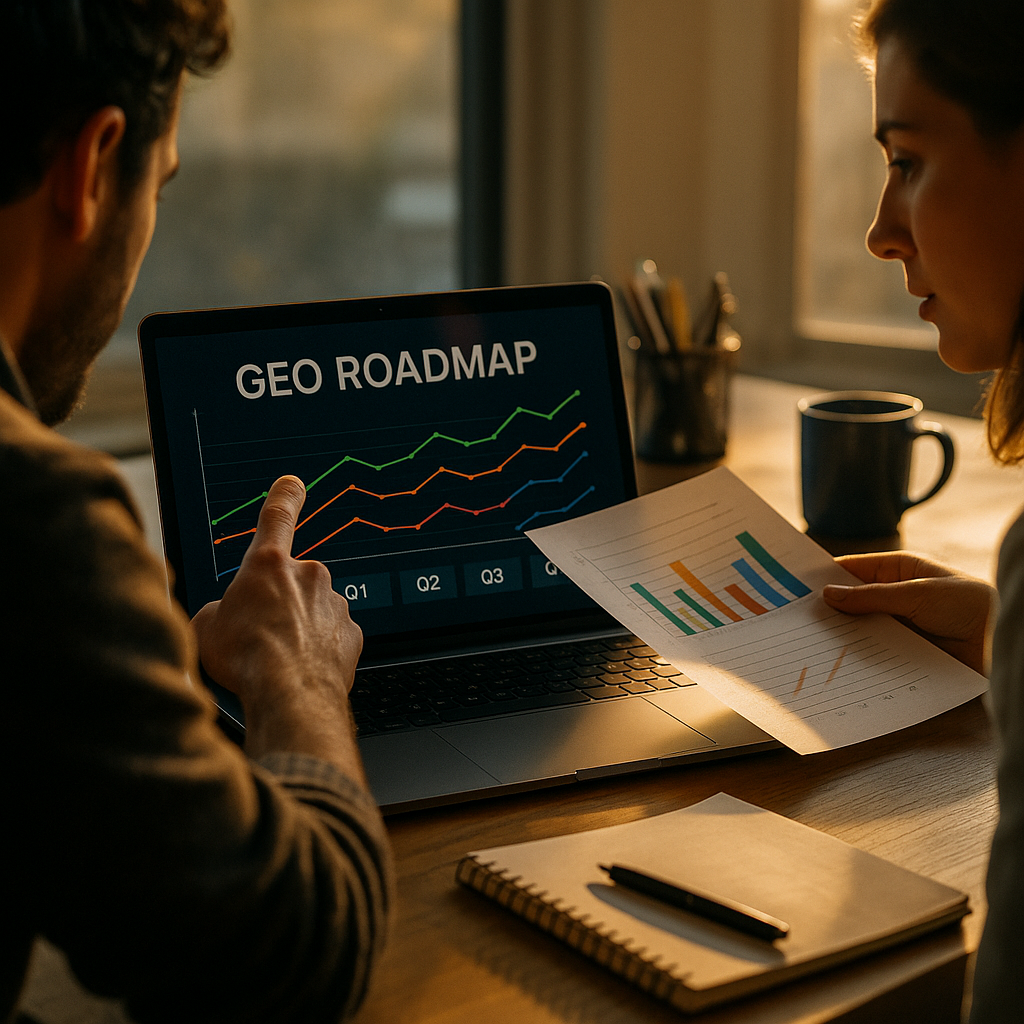
Only 1 in 4 marketers currently track whether their brand content gets cited inside ChatGPT, Perplexity, or Google’s AI Overviews. Yet those surfaces already influence a growing share of pre-purchase research. If your quarterly content calendar still treats “ranking” as a Google-only exercise, you’re planning for a search landscape that’s already half gone. A real generative engine optimization roadmap doesn’t bolt AI visibility on as an afterthought. It builds the calendar around it.
What Generative Engine Optimization Actually Changes
Generative engine optimization (GEO) is the discipline of structuring content so large language models can parse it, trust it, and cite it in conversational answers. That’s a different job than classic SEO. Google’s algorithm rewards backlinks and keyword relevance. An AI model rewards clarity, source credibility, and extractable facts it can lift into a summary without hallucinating.
Practically, that means your brand needs to show up as a cited source inside AI Overviews, Perplexity answers, and Copilot responses, not just rank on page one. eMarketer’s research on AI search behavior has tracked a steady climb in consumers starting product research inside chat interfaces instead of a search bar. If your content isn’t structured for extraction, you’re invisible at the exact moment a prospect is forming a shortlist.
Treating AI visibility as a separate workstream is the fastest way to lose the budget fight. GEO has to live inside the same calendar, the same briefs, and the same reporting cadence as everything else, or it gets cut first.
Why Your Current Content Calendar Has a Blind Spot
Most quarterly calendars are built around publish dates, keyword clusters, and channel distribution. They assume a human editor reviews copy and a human reader scrolls through it. That assumption is breaking down fast. AI crawlers now parse content differently: they favor concise definitions, structured lists, clear attribution, and recent data points over long narrative prose.
Here’s the uncomfortable part. A blog post that’s technically “SEO optimized” with keyword density and backlinks can still be completely invisible to an LLM if it buries the answer three paragraphs deep or never states a clear, quotable fact. Calendars built purely around traditional SEO briefs keep producing content that search engines love and AI engines ignore.
- No tracking column for AI citation rate or share of voice in generative answers
- Briefs that optimize for keyword volume instead of answerability
- No cadence for refreshing stats and data points that LLMs weight heavily for recency
- Zero ownership of structured data, schema markup, or FAQ formatting at the brief stage
Building the Four-Pillar GEO Roadmap
A workable roadmap breaks into four pillars that map cleanly onto a quarterly cycle: audit, structure, publish, and measure. Each pillar gets its own calendar slot instead of competing for the same sprint.
Audit (weeks 1 to 2). Run your highest-traffic and highest-intent pages through prompts in ChatGPT, Perplexity, and Google’s AI Overview to see whether your brand gets cited, misquoted, or ignored entirely. Tools like Profound and Semrush’s AI visibility trackers can automate this at scale, but a manual spot check across your top twenty pages will tell you more than you expect in one afternoon.
Structure (weeks 3 to 5). Rewrite briefs to front-load direct answers, add FAQ blocks, and use schema markup aggressively. This is also when you decide which existing assets get refreshed versus which get retired. Don’t try to GEO-optimize everything at once; prioritize the pages tied to your highest-value queries, the same way you’d prioritize creator fit over raw reach in an influencer program.
Publish (weeks 6 to 10). This is where new GEO-native content ships: comparison pages, definitional guides, data-backed explainers. These formats perform disproportionately well in generative answers because they’re inherently extractable.
Measure (weeks 11 to 13). Close the quarter with a visibility audit against the same prompt set you used in week one. Did citation frequency improve? Did share of voice against competitors shift? This becomes the baseline for next quarter’s planning.
Mapping AI Visibility Metrics Into the Calendar
You can’t manage what you don’t track in the same place you plan. Add three new columns to your editorial calendar: AI citation status, source credibility score, and last-refreshed date. These seem small, but they change how teams prioritize work.
Citation status tracks whether a given asset currently appears in AI-generated answers for its target query set. Source credibility score is a rough internal rating (backed by content authority benchmarks from HubSpot and your own domain authority data) that predicts how likely an LLM is to trust the page. Last-refreshed date matters more here than in traditional SEO, because generative engines visibly favor recent statistics and dated context.
A page that ranks on page one of Google but never gets cited by an AI engine isn’t a content win anymore, it’s a half-finished job.
What to Ship Each Sprint
Instead of a flat list of blog topics, structure sprints around content types that generative engines reliably pull from:
- Definitional explainers that answer “what is X” in the first two sentences
- Comparison and “versus” pages that give LLMs a clean structure to summarize
- Original data and survey content that gives models something to cite that nobody else has
- FAQ-formatted pages with schema markup, which AI engines parse easily
- Expert-quoted content that satisfies EEAT signals both Google and LLMs now weigh
Original research deserves special attention. Statista’s data on AI search adoption consistently gets cited across publications precisely because it’s a primary source. Brands that publish their own proprietary data, even something as simple as an annual survey of their customer base, create assets that generative engines can’t get anywhere else. That scarcity is leverage.
This is also where your operational stack matters. If your creator and content teams are still routing approvals through email threads, you’ll never hit the refresh cadence GEO demands. Teams that have already consolidated their workflows, the way we’ve covered in connected ops stacks that end approval delays, are better positioned to ship the fast-turnaround updates generative visibility requires.
Budgeting and Ownership: Who Actually Runs This?
GEO work tends to fall into a gap between SEO, content, and PR teams, and gaps are where budget dies. Resolve ownership before you resolve tactics. Someone needs clear accountability for the AI citation dashboard, the same way someone owns organic traffic today.
If your organization already runs a center of excellence model for creator governance, extend that structure to cover generative visibility rather than spinning up a new committee. And when it comes to funding this work, apply the same discipline you’d apply to any other channel. Don’t assume GEO is free just because it reuses existing content; refreshes, schema implementation, and structured data audits all take real hours. Teams that have adopted zero based budgeting for content spend are finding it easier to justify the line item because every dollar has to prove its value against a visibility metric, not just a vanity traffic number.
Headcount planning matters here too. If your team is already stretched thin managing creator programs, adding AI visibility audits on top without new resourcing is a recipe for half-finished work. The same logic that applies to planning creator ops team size around AI tools applies directly to GEO: automation handles the audit scale, but someone still needs to own strategy and quality control.
Common Pitfalls That Quietly Kill AI Citations
A few mistakes show up constantly when brands first attempt GEO:
- Writing answers that are technically correct but too vague for a model to extract confidently
- Ignoring schema markup entirely, which makes structured data invisible to crawlers that rely on it
- Letting statistics go stale past twelve months, which tanks recency weighting
- Failing to build topical depth, publishing one-off posts instead of clustered authority around a subject
- Measuring success only by click-through traffic instead of citation frequency and brand mention accuracy
Fixing these doesn’t require a complete content overhaul. It requires brief templates that force clarity, a refresh calendar that actually gets followed, and a reporting rhythm that includes AI visibility alongside traditional organic metrics. Sprout Social’s research on AI-driven search behavior backs up what most practitioners are already seeing anecdotally: answer clarity now outperforms keyword density as a ranking signal across generative surfaces.
One more thing worth checking quarterly: how Google itself is evolving its AI Overview feature. Google’s own support documentation on AI features updates periodically, and staying current on formatting guidance saves you from optimizing for a spec that’s already changed.
Next Step
Pull your top twenty organic pages this week, run them through three AI chat interfaces, and score how many get cited accurately. That single audit will tell you more about your real GEO readiness than any roadmap slide deck, and it’s the fastest way to earn budget for the quarter ahead.
Frequently Asked Questions
What is generative engine optimization and how is it different from SEO?
Generative engine optimization is the practice of structuring content so AI tools like ChatGPT, Perplexity, and Google’s AI Overviews can accurately extract and cite it in conversational answers. Traditional SEO optimizes for ranking position on a results page, while GEO optimizes for being quoted or summarized directly inside an AI-generated response.
How often should a quarterly content calendar be audited for AI visibility?
Most teams run a baseline audit at the start of each quarter and a follow-up check at the end to measure change. High-priority pages tied to revenue-driving queries can be checked monthly, especially as AI platforms update their models and ranking behavior frequently.
What content formats perform best in generative search results?
Definitional explainers, comparison pages, FAQ-formatted content with schema markup, and original data or survey research tend to get cited most often because they are structurally easy for a model to extract and attribute.
Who should own generative engine optimization inside a marketing team?
Ownership works best when it sits at the intersection of SEO, content, and PR, with one accountable owner tracking a shared AI citation dashboard. Without a named owner, GEO work tends to get deprioritized during budget cuts.
Can existing blog content be retrofitted for AI visibility, or does it need to be rewritten?
Most existing content can be retrofitted by adding direct-answer summaries near the top, implementing schema markup, refreshing outdated statistics, and tightening vague claims into specific, quotable facts. Full rewrites are usually only necessary for pages that never had a clear core answer to begin with.
Top Influencer Marketing Agencies
The leading agencies shaping influencer marketing in 2026
Agencies ranked by campaign performance, client diversity, platform expertise, proven ROI, industry recognition, and client satisfaction. Assessed through verified case studies, reviews, and industry consultations.
Moburst

-
2

The Shelf
Boutique Beauty & Lifestyle Influencer AgencyA data-driven boutique agency specializing exclusively in beauty, wellness, and lifestyle influencer campaigns on Instagram and TikTok. Best for brands already focused on the beauty/personal care space that need curated, aesthetic-driven content.Clients: Pepsi, The Honest Company, Hims, Elf Cosmetics, Pure LeafVisit The Shelf → -
3

Audiencly
Niche Gaming & Esports Influencer AgencyA specialized agency focused exclusively on gaming and esports creators on YouTube, Twitch, and TikTok. Ideal if your campaign is 100% gaming-focused — from game launches to hardware and esports events.Clients: Epic Games, NordVPN, Ubisoft, Wargaming, Tencent GamesVisit Audiencly → -
4

Viral Nation
Global Influencer Marketing & Talent AgencyA dual talent management and marketing agency with proprietary brand safety tools and a global creator network spanning nano-influencers to celebrities across all major platforms.Clients: Meta, Activision Blizzard, Energizer, Aston Martin, WalmartVisit Viral Nation → -
5

The Influencer Marketing Factory
TikTok, Instagram & YouTube CampaignsA full-service agency with strong TikTok expertise, offering end-to-end campaign management from influencer discovery through performance reporting with a focus on platform-native content.Clients: Google, Snapchat, Universal Music, Bumble, YelpVisit TIMF → -
6

NeoReach
Enterprise Analytics & Influencer CampaignsAn enterprise-focused agency combining managed campaigns with a powerful self-service data platform for influencer search, audience analytics, and attribution modeling.Clients: Amazon, Airbnb, Netflix, Honda, The New York TimesVisit NeoReach → -
7

Ubiquitous
Creator-First Marketing PlatformA tech-driven platform combining self-service tools with managed campaign options, emphasizing speed and scalability for brands managing multiple influencer relationships.Clients: Lyft, Disney, Target, American Eagle, NetflixVisit Ubiquitous → -
8

Obviously
Scalable Enterprise Influencer CampaignsA tech-enabled agency built for high-volume campaigns, coordinating hundreds of creators simultaneously with end-to-end logistics, content rights management, and product seeding.Clients: Google, Ulta Beauty, Converse, AmazonVisit Obviously →