


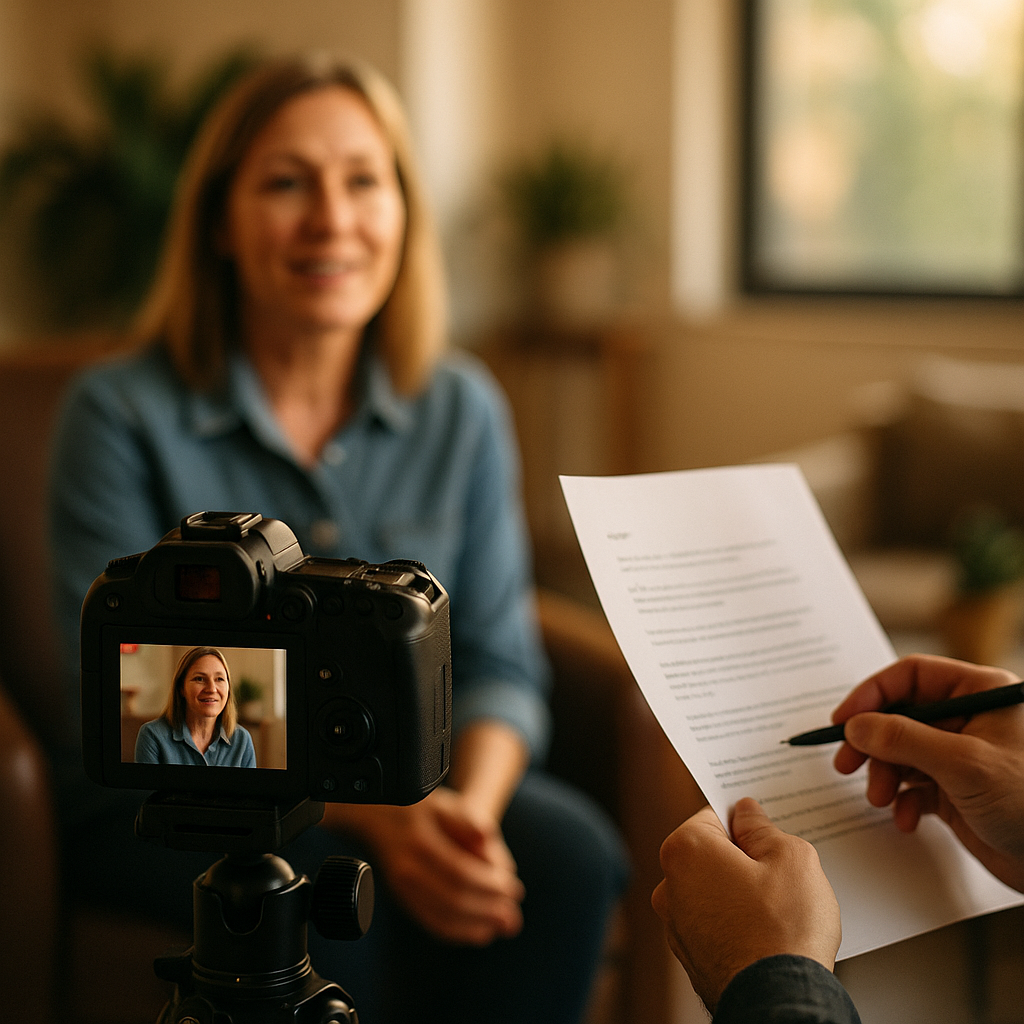
One good clipped testimonial reel can outperform a six-figure brand campaign on trust alone. A 2026 Sprout Social benchmark found that consumers rank peer and customer testimonials above influencer posts and brand ads when deciding whether to buy. Yet most brands still sit on hours of raw customer interview footage, using maybe ninety seconds of it. The gap between “we have the proof” and “we have a reel that converts” is a scripting problem, not a filming problem.
Why Raw Footage Isn’t a Strategy
Marketing teams love booking the customer interview. It feels like due diligence: get the client on camera, ask some open questions, capture the magic. Then the footage sits in a shared drive for three months because nobody built a plan to extract anything usable from it.
The problem isn’t the interview. It’s the absence of a script for the edit. A forty-minute conversation contains maybe four minutes of genuinely quotable, on-brand, legally clean proof points. Finding them without a framework means an editor scrubbing timestamps for a full day, guessing at what matters.
Treat the long-form interview as raw material for a dozen assets, not a single highlight reel. The scripting work happens after the camera stops rolling, in how you structure the clip extraction.
Build the Proof Point Map Before You Film
The highest-leverage move happens before the interview even starts: building a proof point map. This is a short document, not a full interview script, that lists the specific claims your sales team needs validated. Think “reduced onboarding time by 40%,” “replaced three vendors,” or “paid for itself in the first quarter.”
Hand this map to whoever is conducting the interview. Their job isn’t to read scripted questions verbatim. It’s to steer the conversation toward moments where the customer says something close to those proof points in their own words. This is the same scaffolding logic used in founder UGC scaffolds: structure without scripting the actual words.
- List the three to five claims that matter most to your sales funnel
- Translate each claim into an open-ended question, never a yes/no prompt
- Prep a follow-up probe for each (“Can you put a number on that?”)
- Flag any claim that needs substantiation documentation for legal
Skip this step and you’ll get a lovely, warm interview full of vague sentiment: “it’s been great working with them.” Nice, but useless for a testimonial reel built to move a prospect through a buying decision.
The Interview Structure That Produces Clippable Gold
Structure the conversation in three acts, even though the customer never sees a script. Act one: the problem state, get them describing the pain in specific, sensory detail. Act two: the pivot, what changed when they adopted your product. Act three: the proof, hard numbers and comparisons.
Each act should run long enough that the subject forgets they’re being recorded and starts talking naturally. That’s when the best soundbites happen, somewhere around minute twelve, not minute two. Anyone who’s run a confessional booth testimonial shoot knows the first five minutes are almost always throwaway warmup.
Scripting the Clip, Not the Customer
Here’s where most teams get it backwards. You don’t script what the customer says. You script how the edit is assembled from what they actually said. That’s a different discipline entirely, closer to documentary editing than ad copywriting.
A clip script for a testimonial reel typically includes: the selected timestamp range, the on-screen text overlay reinforcing the claim, a cutaway point (b-roll or data graphic) to break up a long talking head, and a note on where this clip lives in the funnel (top of funnel social cut, mid funnel landing page embed, bottom of funnel sales deck asset).
This matters because the same forty-second quote can serve three different purposes depending on the wrapper around it. A line about cost savings becomes a paid social hook with a bold text overlay. The same line, dropped into a sales enablement deck with a slower pace and a company logo lower third, becomes a closing argument.
One interview, scripted correctly for extraction, should yield at least six to eight distinct clips across funnel stages. If you’re only getting one reel per interview, you’re leaving most of the value on the cutting room floor.
Disclosure and Compliance Still Apply
Testimonial content sits inside FTC guidance just like influencer posts do. If the customer received any compensation, a discount, free product, or an agency fee for their time, that needs disclosure under the FTC’s endorsement guidelines. Marketing teams often assume testimonials are exempt because the subject is a “real customer” rather than a paid influencer. That assumption has gotten brands into trouble.
Document consent and compensation terms before the shoot, not after. Keep a release form that covers usage rights across the specific channels you intend to cut clips for: paid social, website, sales decks, trade show loops. A release that only covers “website use” doesn’t cover a TikTok ad spend behind the same footage. This is the same substantiation discipline covered in myth busting script guidance, where every claim needs a paper trail ready for legal review.
Check the FTC’s endorsement guidance directly if your legal team hasn’t reviewed it recently; the agency updated enforcement priorities around fake and incentivized reviews, and testimonial reels can get swept into that scrutiny if compensation isn’t disclosed clearly.
Editing Patterns That Hold Attention
A testimonial clip lives or dies in the first three seconds. Open on the proof point, not the preamble. “We cut support tickets by sixty percent” as the opening line beats “So, um, let me tell you about our experience” every time.
A few patterns that consistently outperform in paid and organic testing:
- Number-first opens: lead with the hard metric, let context follow
- Jump cuts over long holds: trim pauses and filler words aggressively, but never alter the meaning of what was said
- Text overlay reinforcement: repeat the key phrase on screen as the customer says it, for sound-off viewing
- Short is the default: fifteen to thirty seconds for social, saving the two-minute cut for landing pages where intent is already higher
This overlaps heavily with the retention mechanics covered in storytime text overlay work, though testimonial reels have one advantage over influencer storytime content: the credibility is already built in. You’re not earning trust through narrative tension, you’re transferring trust from a real customer to a prospective one.
Where to Deploy the Finished Clips
Don’t let the finished reel die in a single Instagram post. A well-scripted extraction plan maps each clip to a destination before editing even starts.
- Paid social hooks for cold audiences (the number-first open works best here)
- Landing page embeds near the pricing or demo CTA
- Sales deck inserts for specific objections (“too expensive,” “too complex to implement”)
- Email nurture sequences for stalled deals
- Trade show loop reels, which benefit from the same travel-friendly editing logic used in live event clip production
Mapping destinations first changes how you cut. A sales deck clip can run longer and slower, because the viewer is already a warm lead sitting across from a rep. A cold paid social clip has maybe two seconds of patience before the scroll happens.
Measuring Whether the Reel Actually Works
Vanity metrics lie. View count on a testimonial clip tells you almost nothing about pipeline impact. Track instead: click-through from the clip to a demo page, time-on-page lift when the clip is embedded versus when it isn’t, and sales team feedback on whether prospects mention the testimonial unprompted during calls.
HubSpot’s research on content marketing benchmarks consistently shows customer proof content converting at higher rates than product-led content further down the funnel, which lines up with what most B2B marketing teams see anecdotally: the testimonial clip doesn’t win attention, it wins the final hesitation before a signature.
Run A/B tests on the same interview source. Cut two versions of the same quote, one opening on the number, one opening on the emotional context. Platforms like TikTok Ads Manager and Meta’s ad tools make this cheap to test at small spend before committing budget to a winner. The data usually settles the “number-first versus story-first” debate within a few days of testing.
What to Do With the Interview Footage You Already Have
Most marketing teams don’t need another round of customer interviews. They need to go back into the footage they already captured over the past year and apply this extraction discipline retroactively. Pull the proof point map together first, then scrub existing interviews against it. You’ll likely find three or four unused clips sitting in old footage that outperform anything currently running.
Frequently Asked Questions
How long should a source interview be to get enough clippable material?
Plan for thirty to forty-five minutes. Shorter interviews rarely give the subject enough time to relax into specific, quotable detail, and the best soundbites tend to surface after the first ten minutes of warmup.
Do customer testimonials need FTC disclosure like influencer content?
Yes, if there’s any compensation, discount, or incentive involved. Document consent and compensation terms before filming and confirm your release form covers every channel you plan to use the clips on.
How many clips should one long-form interview produce?
Aim for six to eight distinct clips mapped to different funnel stages: social hooks, landing page embeds, sales deck inserts, and email nurture assets. A single highlight reel from a forty-minute interview is a sign the extraction process was too narrow.
Should the interview questions be scripted word for word?
No. Script the proof points you need validated, then build open-ended questions around them. A rigid script produces stiff, unusable answers; a proof point map produces natural language that still hits the claims your sales team needs.
What’s the biggest mistake brands make with testimonial footage?
Treating the interview as the deliverable instead of raw material. The real work, and the real ROI, comes from scripting the edit afterward: selecting timestamps, mapping clips to funnel stages, and reinforcing claims with on-screen text.
Next step: Pull your three most recent customer interviews, build a proof point map against them, and re-cut for at least six funnel-specific clips before you schedule another shoot.
Top Influencer Marketing Agencies
The leading agencies shaping influencer marketing in 2026
Agencies ranked by campaign performance, client diversity, platform expertise, proven ROI, industry recognition, and client satisfaction. Assessed through verified case studies, reviews, and industry consultations.
Moburst

-
2

The Shelf
Boutique Beauty & Lifestyle Influencer AgencyA data-driven boutique agency specializing exclusively in beauty, wellness, and lifestyle influencer campaigns on Instagram and TikTok. Best for brands already focused on the beauty/personal care space that need curated, aesthetic-driven content.Clients: Pepsi, The Honest Company, Hims, Elf Cosmetics, Pure LeafVisit The Shelf → -
3

Audiencly
Niche Gaming & Esports Influencer AgencyA specialized agency focused exclusively on gaming and esports creators on YouTube, Twitch, and TikTok. Ideal if your campaign is 100% gaming-focused — from game launches to hardware and esports events.Clients: Epic Games, NordVPN, Ubisoft, Wargaming, Tencent GamesVisit Audiencly → -
4

Viral Nation
Global Influencer Marketing & Talent AgencyA dual talent management and marketing agency with proprietary brand safety tools and a global creator network spanning nano-influencers to celebrities across all major platforms.Clients: Meta, Activision Blizzard, Energizer, Aston Martin, WalmartVisit Viral Nation → -
5

The Influencer Marketing Factory
TikTok, Instagram & YouTube CampaignsA full-service agency with strong TikTok expertise, offering end-to-end campaign management from influencer discovery through performance reporting with a focus on platform-native content.Clients: Google, Snapchat, Universal Music, Bumble, YelpVisit TIMF → -
6

NeoReach
Enterprise Analytics & Influencer CampaignsAn enterprise-focused agency combining managed campaigns with a powerful self-service data platform for influencer search, audience analytics, and attribution modeling.Clients: Amazon, Airbnb, Netflix, Honda, The New York TimesVisit NeoReach → -
7

Ubiquitous
Creator-First Marketing PlatformA tech-driven platform combining self-service tools with managed campaign options, emphasizing speed and scalability for brands managing multiple influencer relationships.Clients: Lyft, Disney, Target, American Eagle, NetflixVisit Ubiquitous → -
8

Obviously
Scalable Enterprise Influencer CampaignsA tech-enabled agency built for high-volume campaigns, coordinating hundreds of creators simultaneously with end-to-end logistics, content rights management, and product seeding.Clients: Google, Ulta Beauty, Converse, AmazonVisit Obviously →