


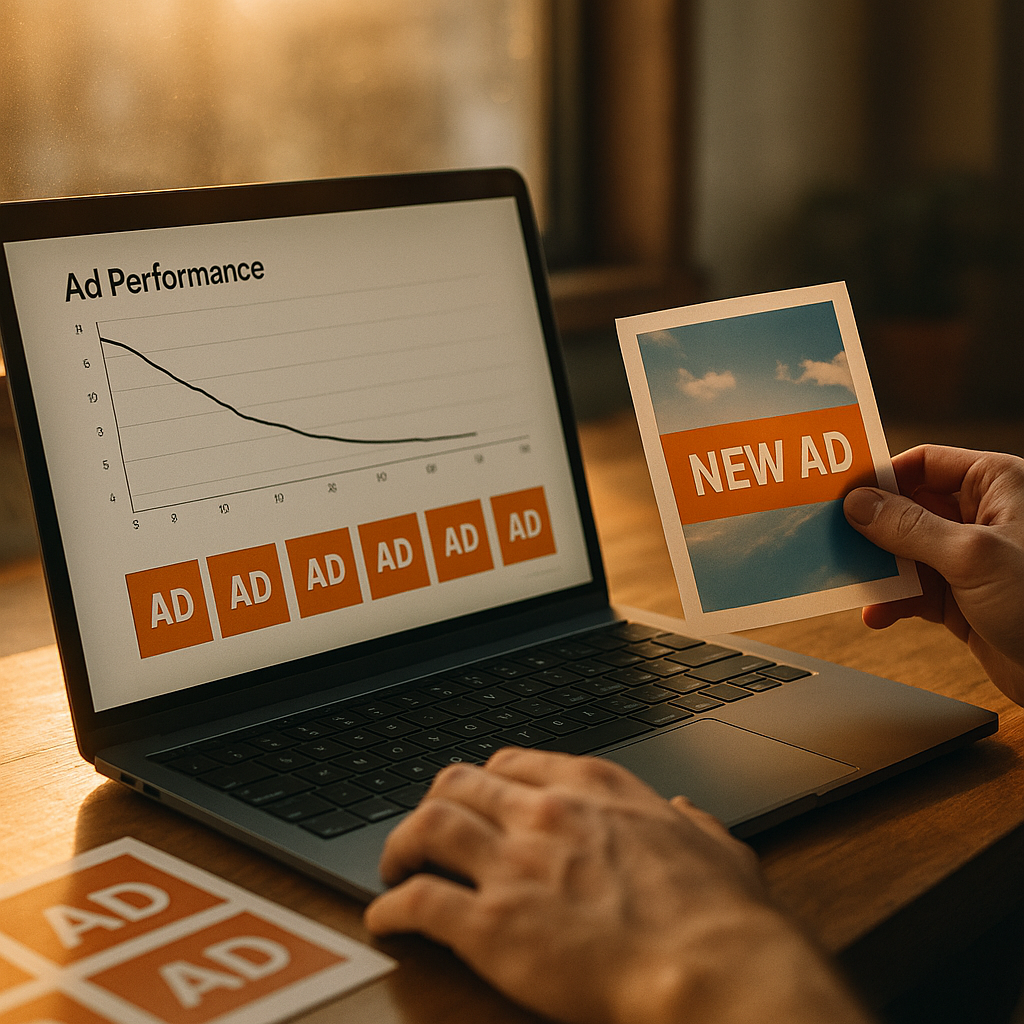
Thirty-six days. That’s roughly how long the average creator ad holds its performance before CPMs climb and CTR slides into the floor, according to patterns media buyers have tracked across Meta and TikTok campaigns for years. If your creative pipeline can’t outpace that decay curve, you’re not running a creator ad replacement cadence, you’re running on fumes.
Most brands discover wear-out the hard way: a winning ad suddenly tanks, nobody knows why, and the scramble to find a replacement eats two weeks of budget at degraded efficiency. There’s a better way to think about this, and it starts with treating creative supply like inventory, not inspiration.
Why 36 Days Is the Number That Matters
Ad fatigue isn’t mysterious. It’s math. Once a meaningful chunk of your target audience has seen a creative three to five times, response rates start dropping, and frequency caps in platforms like Meta and TikTok push you toward broader, colder audiences to keep delivery flowing. That shift alone drags down relevance scores and inflates CPMs.
The 36-day figure comes from aggregated wear-out data across mid-to-large spend accounts, where daily budgets of a few thousand dollars or more burn through unique reach fast enough that even a strong ad hits saturation within five to six weeks. Smaller accounts stretch longer. Larger ones compress shorter. But 36 days is a workable planning benchmark, and it’s the number that should anchor your production calendar.
If your creative team needs more than 36 days to produce a replacement, you are structurally guaranteed to run fatigued ads at some point every single cycle.
That’s the uncomfortable part. Most in-house teams and even agencies aren’t built for that velocity. They’re built for campaign launches, not continuous supply.
The Forty-Ad Cadence, Explained
Here’s the logic: if an ad’s useful life is roughly 36 days, and you want zero gaps in fresh creative across a quarter, you need enough ad variants in the pipeline to rotate every five weeks without repeating a tired asset. Run the math across multiple audience segments, platforms, and funnel stages, and you land close to forty net-new or meaningfully refreshed ads per month for a mid-sized always-on program.
Forty isn’t arbitrary. It accounts for:
- Multiple hook variations testing against the same core offer (typically 8 to 12 per concept)
- Platform-specific cuts for Meta, TikTok, and YouTube Shorts, since a vertical hook that works on TikTok often underperforms as-is on Meta
- Funnel-stage splits, cold prospecting creative versus retargeting creative that assumes prior awareness
- A buffer for underperformers that get killed in the first 48 hours and need immediate backfill
Teams that have already operationalized this volume have written about the staffing and workflow implications in detail. If you’re scoping what it actually takes to hit forty ad variants a month, this breakdown of creator ops team structure is worth studying before you build your own org chart.
Mapping the Pipeline, Not Just the Calendar
A content calendar tells you what’s publishing. A pipeline tells you what’s being sourced, vetted, shot, edited, and queued behind it. The forty-ad cadence only works if you’re managing both simultaneously.
Think of it in three lanes running in parallel:
- Active rotation. The ads currently live and spending, typically 15 to 25 at any given time depending on budget and segmentation.
- Staged replacements. Fully edited, approved, and ready to launch the moment an active ad’s CPA crosses your kill threshold.
- Raw pipeline. Creator-shot footage, briefs sent, and contracts in progress, feeding the staged lane two to three weeks out.
The failure mode almost every brand hits is treating this as one lane. They brief creators when an ad starts dying, which means a two-week production lag happens at the exact moment they need speed. Decouple sourcing from reaction, and the wear-out curve stops being an emergency.
Programs that formalize this split tend to lean on scorecards and defined triggers rather than gut calls. A refresh cadence built around clear fatigue triggers removes the guesswork about when exactly to pull an ad and push the next one live.
What Does a Realistic Creator Pipeline Budget Look Like?
Forty ad variants a month sounds expensive until you break down what’s actually driving cost. Most of that volume comes from editing variations and hook swaps on a smaller pool of raw creator shoots, not forty separate creator contracts.
A workable structure for a mid-market brand spending $150,000 to $400,000 monthly on paid social might look like:
- 8 to 12 creators shooting raw footage monthly, mixing nano, micro, and a handful of mid-tier names for variety
- 3 to 5 edited variants pulled from each creator’s raw footage (different hooks, captions, pacing)
- A dedicated editor or small editing pod turning raw clips into platform-native cuts within 48 to 72 hours
This is where tiered creator sourcing earns its keep. Nano and micro creators are cheaper and faster to turn around, which makes them ideal for volume hooks, while mid-tier and bigger names anchor the flagship concepts that get the heaviest paid push. If you haven’t formalized your tiers yet, a quarterly portfolio rebalancing model gives you a framework for deciding how much budget flows to each tier based on what’s actually converting.
Don’t skip the vetting step just because you need volume. Rushed creator selection to hit a production quota is exactly how brand safety issues sneak in. A scorecard-based vetting process built before contracts go out keeps speed from compromising fit.
Setting the Kill Threshold Before You Need It
Here’s a question that trips up a lot of teams: at what point, exactly, does an ad count as “worn out”? Waiting for gut feel means you react too late, after CPA has already climbed and budget has already leaked.
Set numeric thresholds in advance. A common approach:
- CTR drops more than 25% below the ad’s first-week average over a rolling 3-day window
- Frequency exceeds 3.5 within a single audience segment
- CPA climbs above a defined ceiling (often 15 to 20% over target) for two consecutive days
Any one of these triggers should automatically queue the next staged replacement, not kick off a scramble to find one. This is the entire point of separating the pipeline lanes described above.
Treat wear-out thresholds as a trading rule, not a discussion. The moment you start debating whether an ad is “really” fatigued, you’ve already lost three or four days of efficient spend.
Governance matters here too. Someone needs explicit authority to pull a worn ad and push a replacement without waiting on a committee. Governance structures built for always-on creator spend typically assign this decision to a single media buyer or pod lead, with weekly reporting upward rather than real-time approval chains.
Where Most Teams Get the Math Wrong
The most common mistake isn’t underestimating cost. It’s underestimating lead time. Teams plan creator shoots on a monthly cycle, then wonder why they’re always one week behind the wear-out curve.
The fix is ugly but effective: build your sourcing calendar on a rolling three-week lead, not a monthly one. Brief creators for the ads you’ll need in three weeks, today. That means your current month’s production is really serving next month’s rotation.
Second mistake: treating every ad as equally disposable. Not all forty variants need equal investment. A small number of “hero” concepts (typically four to six per month) deserve full creative development, multiple creator options, and A/B testing before launch. The rest can be lower-cost derivative cuts, caption swaps, and hook variations off existing footage. Trying to produce forty fully original concepts a month is how budgets blow up without a performance gain to show for it.
Third, and this one’s subtle: teams often forget to budget for the editing layer, not just the creator fees. If you’re paying creators well but starving the edit pipeline, raw footage sits unused while your active rotation runs dry. Weekly UGC pipeline staffing models are a useful reference for sizing the editing and QA layer relative to raw content volume.
External benchmarks back up the urgency here. Industry trend reports from eMarketer have repeatedly flagged creative fatigue as a top driver of rising CPMs on social platforms, and Meta’s own Meta for Business guidance explicitly recommends creative refresh cycles as a lever against frequency-driven decay. TikTok’s advertiser resources echo the same point through its TikTok Ads platform, which surfaces frequency and fatigue signals directly in campaign reporting.
Tying the Cadence to ROI, Not Just Volume
Forty ads a month means nothing if you can’t tell which ones are earning their keep. The cadence is a production target, not a success metric. Pair it with a tiered scoring system that ranks creative by CPA, ROAS, and hold rate, so your editing team knows which concepts to iterate on and which to retire for good.
This is also where finance conversations get easier. A documented cadence, with clear kill triggers and tiered spend, gives finance a predictable monthly number instead of a reactive one. ROI scorecards built for finance sign-off turn “we need more creative budget” into a defensible, data-backed ask.
For deeper context on how creative fatigue interacts with overall program budgeting, HubSpot’s marketing resource hub and Sprout Social’s social media benchmark research both offer useful cross-industry comparisons for what “normal” wear-out and refresh rates look like outside your own account data.
The Next Step
Audit your last 60 days of ad performance, flag every ad that ran past 36 days without a creative refresh, and calculate the CPA drag it cost you. That number is your business case for building the pipeline now, before next quarter’s budget cycle locks you into the same reactive scramble.
Frequently Asked Questions
What exactly causes the 36-day wear-out pattern?
It’s primarily frequency saturation. Once a large share of your target audience has seen the same creative three to five times, engagement drops and platforms respond by widening delivery to colder audiences, which raises CPMs and lowers relevance scores. The 36-day window reflects how fast most mid-to-large budgets burn through unique reach in a given audience segment.
Do smaller budgets need to worry about the forty-ad cadence?
Smaller accounts hit wear-out slower because they reach fewer unique users per day, so the cadence can scale down proportionally. A brand spending $20,000 a month might only need 10 to 15 fresh variants, not forty, but the underlying principle of staged replacements ahead of fatigue still applies.
How many creators do I actually need to hit forty ad variants a month?
Most programs don’t need forty separate creators. A pool of 8 to 12 creators shooting raw footage, combined with 3 to 5 edited variations per shoot, typically covers the volume. The editing and hook-testing layer does more of the lifting than raw creator headcount.
What’s the fastest way to know an ad is worn out before CPA spikes?
Watch CTR decay and frequency together rather than waiting for CPA to move, since CPA is usually a lagging indicator. A CTR drop of 25% or more from the first week’s average, combined with frequency climbing past 3.5 in a segment, is a reliable early signal.
Should every ad replacement be a brand-new creative concept?
No. Reserve full new concepts for a small number of hero ideas each month, then generate the bulk of your rotation through hook swaps, caption changes, and re-edits of existing raw footage. This keeps production costs sane while still hitting the volume needed to beat wear-out.
FAQ Schema (JSON-LD)
Top Influencer Marketing Agencies
The leading agencies shaping influencer marketing in 2026
Agencies ranked by campaign performance, client diversity, platform expertise, proven ROI, industry recognition, and client satisfaction. Assessed through verified case studies, reviews, and industry consultations.
Moburst

-
2

The Shelf
Boutique Beauty & Lifestyle Influencer AgencyA data-driven boutique agency specializing exclusively in beauty, wellness, and lifestyle influencer campaigns on Instagram and TikTok. Best for brands already focused on the beauty/personal care space that need curated, aesthetic-driven content.Clients: Pepsi, The Honest Company, Hims, Elf Cosmetics, Pure LeafVisit The Shelf → -
3

Audiencly
Niche Gaming & Esports Influencer AgencyA specialized agency focused exclusively on gaming and esports creators on YouTube, Twitch, and TikTok. Ideal if your campaign is 100% gaming-focused — from game launches to hardware and esports events.Clients: Epic Games, NordVPN, Ubisoft, Wargaming, Tencent GamesVisit Audiencly → -
4

Viral Nation
Global Influencer Marketing & Talent AgencyA dual talent management and marketing agency with proprietary brand safety tools and a global creator network spanning nano-influencers to celebrities across all major platforms.Clients: Meta, Activision Blizzard, Energizer, Aston Martin, WalmartVisit Viral Nation → -
5

The Influencer Marketing Factory
TikTok, Instagram & YouTube CampaignsA full-service agency with strong TikTok expertise, offering end-to-end campaign management from influencer discovery through performance reporting with a focus on platform-native content.Clients: Google, Snapchat, Universal Music, Bumble, YelpVisit TIMF → -
6

NeoReach
Enterprise Analytics & Influencer CampaignsAn enterprise-focused agency combining managed campaigns with a powerful self-service data platform for influencer search, audience analytics, and attribution modeling.Clients: Amazon, Airbnb, Netflix, Honda, The New York TimesVisit NeoReach → -
7

Ubiquitous
Creator-First Marketing PlatformA tech-driven platform combining self-service tools with managed campaign options, emphasizing speed and scalability for brands managing multiple influencer relationships.Clients: Lyft, Disney, Target, American Eagle, NetflixVisit Ubiquitous → -
8

Obviously
Scalable Enterprise Influencer CampaignsA tech-enabled agency built for high-volume campaigns, coordinating hundreds of creators simultaneously with end-to-end logistics, content rights management, and product seeding.Clients: Google, Ulta Beauty, Converse, AmazonVisit Obviously →