


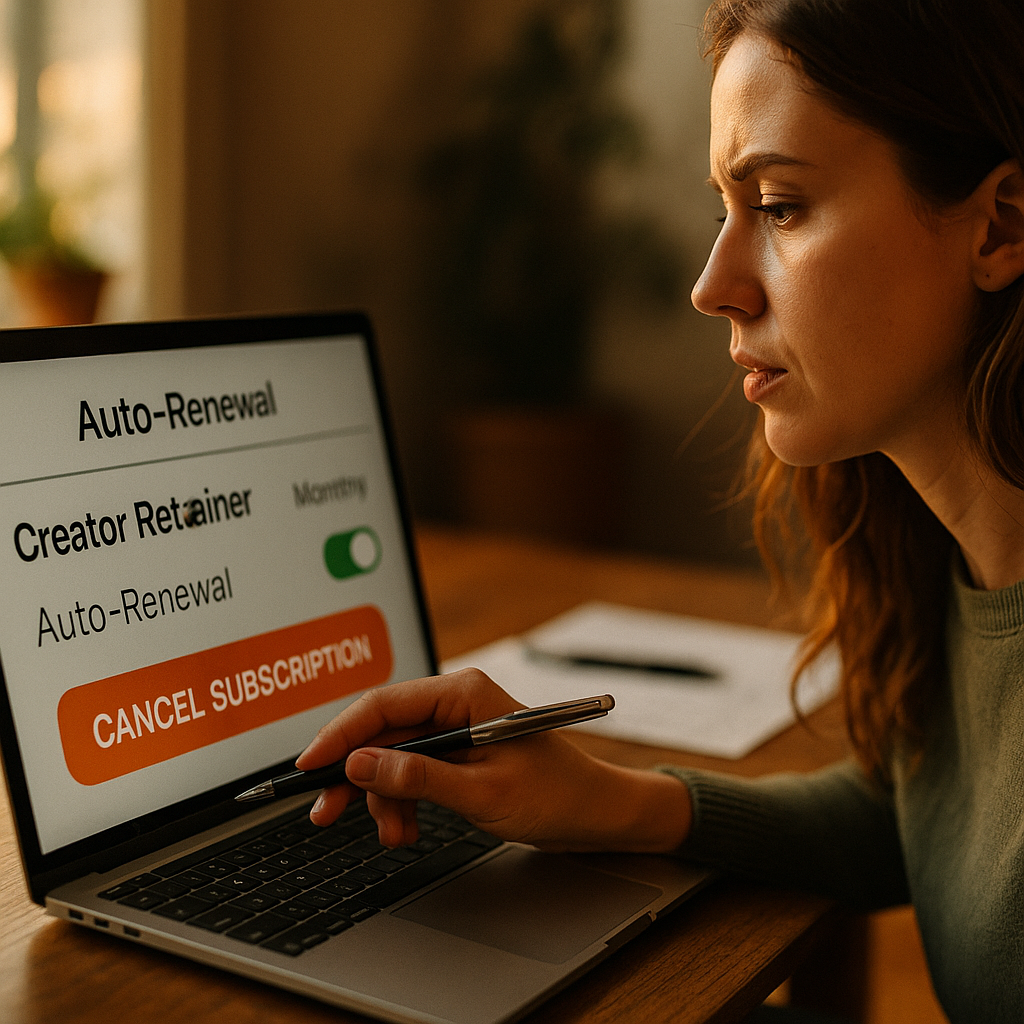
Forty-six states now regulate automatic renewal clauses in some form. Most marketing teams assume those laws apply to gym memberships and streaming subscriptions, not the $8,000-a-month retainer they just signed with a creator roster. That assumption is wrong often enough to matter. An auto-renewal clause buried in a creator retainer contract can trigger state consumer protection statutes, and when it does, the brand usually loses the right to enforce the renewal at all.
The B2B Exemption Myth
Legal teams love to tell marketing that consumer protection auto-renewal laws don’t touch B2B agreements. Technically, many statutes do carve out business-to-business contracts. But here’s the catch: most creator retainers aren’t signed with a corporation. They’re signed with an individual, a sole proprietor, or a single-member LLC that courts and regulators sometimes treat as a consumer for contract purposes, especially when the creator lacks bargaining power or legal counsel.
California’s Automatic Renewal Law (ARL), amended again in recent years, is the aggressive one. It requires clear and conspicuous disclosure of renewal terms, affirmative consent separate from the rest of the contract, and an easy cancellation mechanism, and it doesn’t cleanly exempt every contract just because the other party operates under a business name. New York, Illinois, Vermont, and a growing list of states have followed with their own versions, some explicitly extending coverage to contracts with individuals regardless of how they file taxes.
If your creator retainer auto-renews and the creator is a sole proprietor or single-member LLC, you may be inside the scope of a consumer protection statute whether your legal team planned for it or not.
This isn’t theoretical. Attorneys general in several states have opened inquiries into auto-renewal practices across industries in the past two years, and class action firms have started mining service contracts for exactly this fact pattern: individual signer, recurring fee, renewal clause, thin disclosure.
Which States Actually Reach Creator Contracts?
There’s no uniform national standard, which is part of the problem. A clause that’s fine in Texas might be unenforceable in California. A few patterns worth tracking:
- California: Requires pre-renewal notice for term increases, clear cancellation instructions, and consent that isn’t buried in a signature block. Courts have been willing to apply ARL protections broadly.
- New York: General Business Law Section 527 covers automatic renewal and continuous service arrangements, with notice requirements tied to contract length.
- Illinois: Amended its Automatic Contract Renewal Act to require written notice before renewal for contracts with individuals, not just traditional consumers.
- Vermont and Oregon: Both have broadened definitions of “consumer” in ways that pull independent contractors closer into scope when the contract resembles a recurring service subscription.
Notice the common thread: these states aren’t asking whether your contract says “B2B” at the top. They’re asking whether the person signing looks and acts like a consumer in practice, regardless of the LLC paperwork sitting behind the signature.
Where Retainer Contracts Actually Fail
Most of the retainer templates circulating among agencies and in-house teams were built by lifting language from influencer ambassador deals, then tweaking the deliverables section. Nobody revisits the renewal clause until something goes sideways. The failure points repeat across almost every contract audit we’ve seen referenced in industry legal commentary:
- No advance notice window. Many states require notice 15 to 60 days before a renewal locks in, especially for contracts running a year or longer. A clause that renews “automatically unless terminated” with no lead time fails on its face in states like California.
- Consent buried in boilerplate. If the auto-renewal term sits inside paragraph 14 of a 20-page agreement with no bolding, no separate initial line, no distinct acknowledgment, it likely doesn’t meet “clear and conspicuous” standards.
- No easy exit path. A clause requiring certified mail, 90-day notice, and a cancellation fee stacked together starts to look like exactly the kind of consumer trap these laws were written to stop.
- Silent on price changes. Several statutes require separate notice if the renewal term includes a rate increase. Brands that quietly bump retainer fees at renewal without flagging it are creating a second violation on top of the first.
None of this is exotic. It’s the same discipline required for ambassador contract auto-renewal terms, just applied to the retainer side of the relationship instead of the brand deal side.
Why This Matters More as Retainers Get Longer
The creator economy has shifted hard toward retained relationships over one-off campaigns. According to eMarketer, brands are increasingly favoring always-on creator partnerships over single-post deals, partly because repeat exposure drives better performance than one-off placements. Sprout Social’s research on creator partnerships echoes the same trend: longer engagements, recurring content cadences, retainer-based compensation.
Longer retainers mean more renewal cycles, which means more chances for a defective clause to get tested. A single bad renewal clause sitting dormant in a six-month deal is low risk. The same clause sitting inside a three-year master services agreement that auto-renews annually is a compounding liability every single cycle.
A defective auto-renewal clause doesn’t just fail once. It fails every renewal cycle it’s attached to, which turns a one-time drafting error into a recurring exposure.
There’s also a classification wrinkle worth flagging here. The same ambiguity that makes some creators look like “consumers” under renewal statutes overlaps with the broader worker classification debate covered in nano creator classification risk. If a creator is functionally treated like an employee or a protected individual party in one legal context, regulators and plaintiffs’ attorneys tend to pull that same framing into adjacent disputes, including contract enforcement.
What a Defensible Clause Actually Looks Like
Fixing this doesn’t require scrapping retainer structures. It requires rewriting one section with the same rigor legal teams already apply to morality and IP clauses. A defensible auto-renewal provision generally includes:
- A specific, bolded renewal notice period (30 to 60 days is a safe default across most state regimes)
- Separate affirmative acknowledgment of the renewal term, not just a signature on the full document
- A cancellation method that’s as easy as the sign-up process, ideally email-based rather than certified mail
- Explicit disclosure of any rate change tied to the renewal term
- A reminder notice sent to the creator before the renewal window closes, documented for your own file
That last point matters more than brands expect. Several state laws don’t just require the clause to exist, they require proof you sent the reminder. Set a calendar trigger in your contract management system, not a sticky note on someone’s desk. The FTC’s negative option rule enforcement actions over the past few years show regulators care about the paper trail as much as the clause language itself.
It’s also worth building this review into the same workflow you use for UGC audit rights clauses and other recurring contract terms. Auto-renewal shouldn’t be a one-time legal sign-off. It should be a standing item in your annual contract audit, right alongside payment terms and IP scope.
Operational Fixes That Don’t Require a Rewrite of Every Contract
Not every brand has the bandwidth to re-paper its entire creator roster overnight. A few lower-lift moves close most of the exposure:
- Audit by renewal date, not by creator tier. Pull every active retainer sorted by next renewal trigger. Fix the clauses hitting renewal in the next 90 days first.
- Standardize the notice language once, apply everywhere. Legal drafts one compliant renewal paragraph, ops swaps it into every active and new template.
- Centralize reminder tracking. Whatever contract management tool you use (HubSpot and similar CRM platforms can handle this with basic automation), set reminders 45 days out from every renewal date.
- Flag single-member LLC and sole proprietor creators for extra scrutiny. These are the signers most likely to fall under a “consumer” definition in states with broader statutes.
None of this is glamorous work. It’s also exactly the kind of operational hygiene that keeps a legal exposure from turning into a class action footnote, the same logic that applies to creator LLC insolvency risk and other contract structuring issues brands tend to ignore until a deal goes bad.
Frequently Asked Questions
Do state auto-renewal laws apply to independent contractor agreements?
Often yes, especially when the contractor is a sole proprietor or single-member LLC rather than a larger business entity. Several states, including California and Illinois, have broadened their definitions of “consumer” in ways that can reach individual creators even when the contract is labeled B2B.
What notice period is required before a creator retainer auto-renews?
It varies by state, but 30 to 60 days before the renewal date is a common requirement for longer-term contracts. Some states tie the required notice period to the length of the contract term, so a multi-year retainer may need longer advance notice than a six-month one.
Can a brand still enforce a renewal if the clause didn’t comply with state law?
Generally no. Most state automatic renewal statutes make a noncompliant clause void or unenforceable, and in some cases allow the consumer (or creator, if covered) to treat the contract as terminated at no cost. That exposes the brand to an unplanned gap in content coverage mid-campaign.
How is this different from the auto-renewal issues in ambassador contracts?
The underlying legal risk is similar, but retainer contracts tend to involve more frequent renewal cycles and more variable scope changes, which increases the number of times a defective clause gets tested. Ambassador deals are often longer single terms with fewer renewal triggers.
What’s the fastest way to check if existing retainers are exposed?
Pull every active contract, sort by upcoming renewal date, and check each one against three criteria: advance notice period, separate consent language, and an easy cancellation method. Contracts failing any of the three should move to the top of the legal review queue.
Next step: Pull your active creator retainers sorted by renewal date, run each one against the three-point test above, and fix anything renewing in the next 90 days before it locks in another noncompliant cycle.
FAQs
Do state auto-renewal laws apply to independent contractor agreements?
Often yes, especially when the contractor is a sole proprietor or single-member LLC rather than a larger business entity. Several states, including California and Illinois, have broadened their definitions of “consumer” in ways that can reach individual creators even when the contract is labeled B2B.
What notice period is required before a creator retainer auto-renews?
It varies by state, but 30 to 60 days before the renewal date is a common requirement for longer-term contracts. Some states tie the required notice period to the length of the contract term, so a multi-year retainer may need longer advance notice than a six-month one.
Can a brand still enforce a renewal if the clause didn’t comply with state law?
Generally no. Most state automatic renewal statutes make a noncompliant clause void or unenforceable, and in some cases allow the consumer (or creator, if covered) to treat the contract as terminated at no cost. That exposes the brand to an unplanned gap in content coverage mid-campaign.
How is this different from the auto-renewal issues in ambassador contracts?
The underlying legal risk is similar, but retainer contracts tend to involve more frequent renewal cycles and more variable scope changes, which increases the number of times a defective clause gets tested. Ambassador deals are often longer single terms with fewer renewal triggers.
What’s the fastest way to check if existing retainers are exposed?
Pull every active contract, sort by upcoming renewal date, and check each one against three criteria: advance notice period, separate consent language, and an easy cancellation method. Contracts failing any of the three should move to the top of the legal review queue.
Top Influencer Marketing Agencies
The leading agencies shaping influencer marketing in 2026
Agencies ranked by campaign performance, client diversity, platform expertise, proven ROI, industry recognition, and client satisfaction. Assessed through verified case studies, reviews, and industry consultations.
Moburst

-
2

The Shelf
Boutique Beauty & Lifestyle Influencer AgencyA data-driven boutique agency specializing exclusively in beauty, wellness, and lifestyle influencer campaigns on Instagram and TikTok. Best for brands already focused on the beauty/personal care space that need curated, aesthetic-driven content.Clients: Pepsi, The Honest Company, Hims, Elf Cosmetics, Pure LeafVisit The Shelf → -
3

Audiencly
Niche Gaming & Esports Influencer AgencyA specialized agency focused exclusively on gaming and esports creators on YouTube, Twitch, and TikTok. Ideal if your campaign is 100% gaming-focused — from game launches to hardware and esports events.Clients: Epic Games, NordVPN, Ubisoft, Wargaming, Tencent GamesVisit Audiencly → -
4

Viral Nation
Global Influencer Marketing & Talent AgencyA dual talent management and marketing agency with proprietary brand safety tools and a global creator network spanning nano-influencers to celebrities across all major platforms.Clients: Meta, Activision Blizzard, Energizer, Aston Martin, WalmartVisit Viral Nation → -
5

The Influencer Marketing Factory
TikTok, Instagram & YouTube CampaignsA full-service agency with strong TikTok expertise, offering end-to-end campaign management from influencer discovery through performance reporting with a focus on platform-native content.Clients: Google, Snapchat, Universal Music, Bumble, YelpVisit TIMF → -
6

NeoReach
Enterprise Analytics & Influencer CampaignsAn enterprise-focused agency combining managed campaigns with a powerful self-service data platform for influencer search, audience analytics, and attribution modeling.Clients: Amazon, Airbnb, Netflix, Honda, The New York TimesVisit NeoReach → -
7

Ubiquitous
Creator-First Marketing PlatformA tech-driven platform combining self-service tools with managed campaign options, emphasizing speed and scalability for brands managing multiple influencer relationships.Clients: Lyft, Disney, Target, American Eagle, NetflixVisit Ubiquitous → -
8

Obviously
Scalable Enterprise Influencer CampaignsA tech-enabled agency built for high-volume campaigns, coordinating hundreds of creators simultaneously with end-to-end logistics, content rights management, and product seeding.Clients: Google, Ulta Beauty, Converse, AmazonVisit Obviously →