


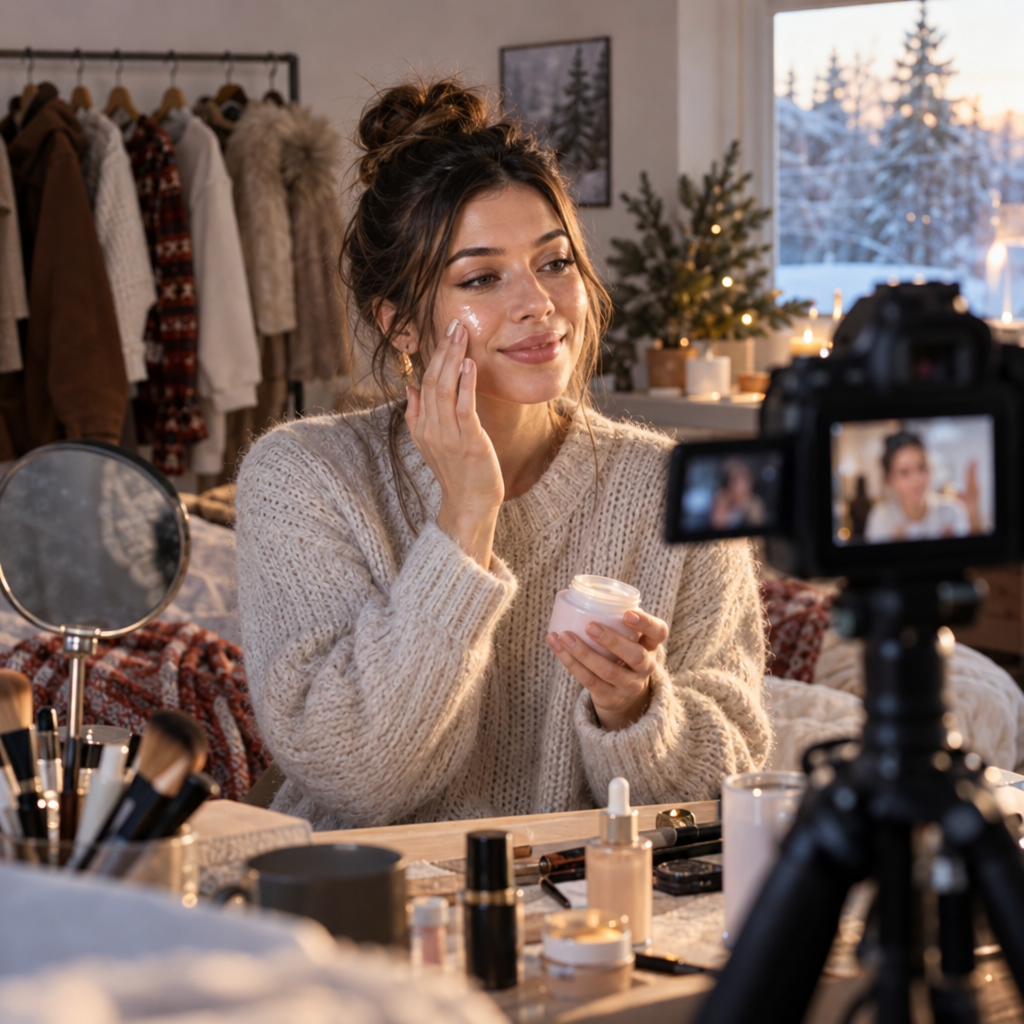
Nearly four in ten viewers abandon a sponsored Get Ready With Me video the moment they spot a branded plug, according to creator economy research from eMarketer. Winter GRWM videos pull huge seasonal traffic, layered coats, dewy winter skincare, the cocoa mug in frame, but the format’s real enemy isn’t audience fatigue. It’s cringe. Brands that get seasonal product integration right treat the product as plot, not an interruption.
Why Winter GRWM Content Still Converts
Routines change with the weather, and that’s exactly why winter GRWM videos keep performing. Cold air dries out skin. Layering replaces single outfits. Hot drinks replace iced ones. Viewers aren’t just watching a creator get dressed, they’re watching a problem get solved in real time, which is why the format still beats static product shots on completion rate.
Winter also overlaps with resolution season, when audiences are primed for self-improvement content anyway. If your brand already has January campaigns in motion, pairing GRWM content with that narrative arc compounds reach instead of competing for it. Our breakdown on scripting January content covers how to sequence that timing before the quarter even starts.
What Actually Makes a Placement Feel Like an Ad?
Cringe has a pattern. It’s the pause before the creator holds a product directly to the lens. It’s dialogue that sounds like it was lifted from a brand brief rather than said out loud. It’s the tonal whiplash when a casual winter routine suddenly shifts into a rehearsed sales pitch.
Viewers don’t object to sponsored content. They object to sponsored content that interrupts the thing they came to watch.
That distinction matters more than any disclosure checkbox. A product mentioned mid-sentence, as part of the actual routine, reads as authentic. A product paused for and announced reads as an ad break. Audiences can tell the difference in under two seconds, which is roughly the attention window platforms like TikTok optimize for anyway.
The Narrative Placement Method
The fix isn’t subtlety for its own sake. It’s structure. Treat the product as a supporting character that solves a specific, stated problem within the routine, not a cameo that interrupts it. “My hands crack every winter, this is the only balm that doesn’t sting” does more work than ten seconds of product-forward b-roll.
This is the same principle driving long-form creator content right now. Our piece on natural product reads in vlogs walks through how top creators fold branded mentions into ongoing narration without losing retention. The winter GRWM format just compresses that same logic into sixty seconds.
One practical trick: script the problem before you script the product. If the creator states a genuine seasonal pain point first (dry scalp, static hair, cracked knuckles) the product mention becomes a relief, not a pitch.
Where in the Routine Should the Mention Land?
Placement timing matters almost as much as wording. Front-loading the product in the first three seconds kills curiosity, viewers assume it’s an ad and swipe. Burying it at the very end means most viewers never see it, since completion rates on GRWM content drop steadily after the sixty-second mark on most platforms.
The sweet spot tends to sit at the one-third mark, once the viewer is already invested in the routine but before attention starts drifting. And because a meaningful share of this content gets watched on mute in feed previews, your on-screen captions need to carry the narrative weight too. That’s covered in more depth in our guide to captions that sell without sound, which applies directly to how winter GRWM videos get discovered in autoplay feeds.
- Hook (0 to 3 seconds): establish the season-specific problem, not the product.
- Routine build (3 to 20 seconds): normal steps, no sales language.
- Integration moment (around the one-third mark): product mentioned as solution, in character voice.
- Close: return to the routine, let the CTA live in caption or pinned comment, not spoken dialogue.
Disclosure Doesn’t Have to Kill the Vibe
Here’s where a lot of brand teams get nervous. Disclosure requirements feel like they force the exact interruption creators are trying to avoid. They don’t, if you treat disclosure as part of the script rather than a bolt-on. The FTC’s endorsement guidelines require clear and conspicuous disclosure, but “clear” doesn’t mean clunky. A quick “gifted by” overlay or a natural “partnered with” line spoken in the creator’s normal cadence satisfies the requirement without breaking tone.
The mistake is treating disclosure as a separate beat, a pause, a tonal shift, a different font. Build it into the same visual language as the rest of the caption stack and it disappears into the routine instead of flagging the ad. Platforms are also tightening enforcement here, so check current labeling tools on TikTok’s advertising hub before your next brief goes out.
Measuring Whether It Actually Worked
Completion rate is the first signal, but it’s not the only one. Watch saves and shares specifically, since GRWM content that feels authentic tends to get bookmarked as a reference (“what was that lip balm again?”) rather than just liked. Comment sentiment matters too: are people asking where to buy, or are they calling out the plug?
On the commerce side, track click-through from the specific product mention, not just the overall video. If you’re running paid amplification behind organic winter GRWM content, the attribution logic looks a lot like what we cover in creator commerce teaser scripting, where hook quality directly moves retail CPC down. Benchmark against your category averages using tools like Sprout Social’s engagement reports or HubSpot’s content benchmarks, since GRWM performance varies wildly by vertical.
Common Mistakes That Tank Winter GRWM Campaigns
- Over-scripting the delivery. If the brand mention sounds memorized, it reads as an ad regardless of placement.
- Ignoring searchability. Winter GRWM videos get discovered through search as much as the feed, so caption keywords matter. See our notes on scripting search-friendly captions for how to structure them.
- One-size-fits-all briefs. A skincare brand and a coat brand need entirely different integration points in the same routine format.
- Skipping the pain point. Jumping straight to the product without establishing why it matters in winter specifically.
- Treating disclosure as an afterthought. Bolted-on disclaimers are the single biggest giveaway that content is paid.
Winter GRWM videos work when the product earns its place in the routine, not when it’s inserted into one. Brief creators on the problem first, let disclosure live in the native caption language, and measure saves and sentiment alongside completion rate before calling the campaign a win.
FAQs
What makes winter GRWM videos different from regular GRWM content?
Winter GRWM videos center on seasonal problems like dry skin, layering, and cold-weather routines, which gives brands a natural, problem-first entry point for product mentions that standard GRWM formats don’t always have.
How do I disclose a paid partnership without breaking the video’s tone?
Build the disclosure into the same caption style and voice as the rest of the video rather than treating it as a separate interruption. Short, natural phrasing like “partnered with” works better than a disconnected disclaimer, and it still satisfies FTC requirements.
Where should the product mention go in a sixty-second GRWM video?
Roughly the one-third mark tends to perform best. It gives viewers time to invest in the routine first, while still landing before attention and completion rates start to drop.
What metrics actually indicate a winter GRWM campaign worked?
Completion rate is the starting point, but saves, comment sentiment, and click-through on the specific product mention tell you whether the integration felt authentic or forced.
Can I reuse the same winter GRWM script across multiple creators?
Not word for word. The structure (problem, routine, integration moment) can be templated, but the language needs to match each creator’s natural voice or the cringe signals come right back.
Top Influencer Marketing Agencies
The leading agencies shaping influencer marketing in 2026
Agencies ranked by campaign performance, client diversity, platform expertise, proven ROI, industry recognition, and client satisfaction. Assessed through verified case studies, reviews, and industry consultations.
Moburst

-
2

The Shelf
Boutique Beauty & Lifestyle Influencer AgencyA data-driven boutique agency specializing exclusively in beauty, wellness, and lifestyle influencer campaigns on Instagram and TikTok. Best for brands already focused on the beauty/personal care space that need curated, aesthetic-driven content.Clients: Pepsi, The Honest Company, Hims, Elf Cosmetics, Pure LeafVisit The Shelf → -
3

Audiencly
Niche Gaming & Esports Influencer AgencyA specialized agency focused exclusively on gaming and esports creators on YouTube, Twitch, and TikTok. Ideal if your campaign is 100% gaming-focused — from game launches to hardware and esports events.Clients: Epic Games, NordVPN, Ubisoft, Wargaming, Tencent GamesVisit Audiencly → -
4

Viral Nation
Global Influencer Marketing & Talent AgencyA dual talent management and marketing agency with proprietary brand safety tools and a global creator network spanning nano-influencers to celebrities across all major platforms.Clients: Meta, Activision Blizzard, Energizer, Aston Martin, WalmartVisit Viral Nation → -
5

The Influencer Marketing Factory
TikTok, Instagram & YouTube CampaignsA full-service agency with strong TikTok expertise, offering end-to-end campaign management from influencer discovery through performance reporting with a focus on platform-native content.Clients: Google, Snapchat, Universal Music, Bumble, YelpVisit TIMF → -
6

NeoReach
Enterprise Analytics & Influencer CampaignsAn enterprise-focused agency combining managed campaigns with a powerful self-service data platform for influencer search, audience analytics, and attribution modeling.Clients: Amazon, Airbnb, Netflix, Honda, The New York TimesVisit NeoReach → -
7

Ubiquitous
Creator-First Marketing PlatformA tech-driven platform combining self-service tools with managed campaign options, emphasizing speed and scalability for brands managing multiple influencer relationships.Clients: Lyft, Disney, Target, American Eagle, NetflixVisit Ubiquitous → -
8

Obviously
Scalable Enterprise Influencer CampaignsA tech-enabled agency built for high-volume campaigns, coordinating hundreds of creators simultaneously with end-to-end logistics, content rights management, and product seeding.Clients: Google, Ulta Beauty, Converse, AmazonVisit Obviously →