


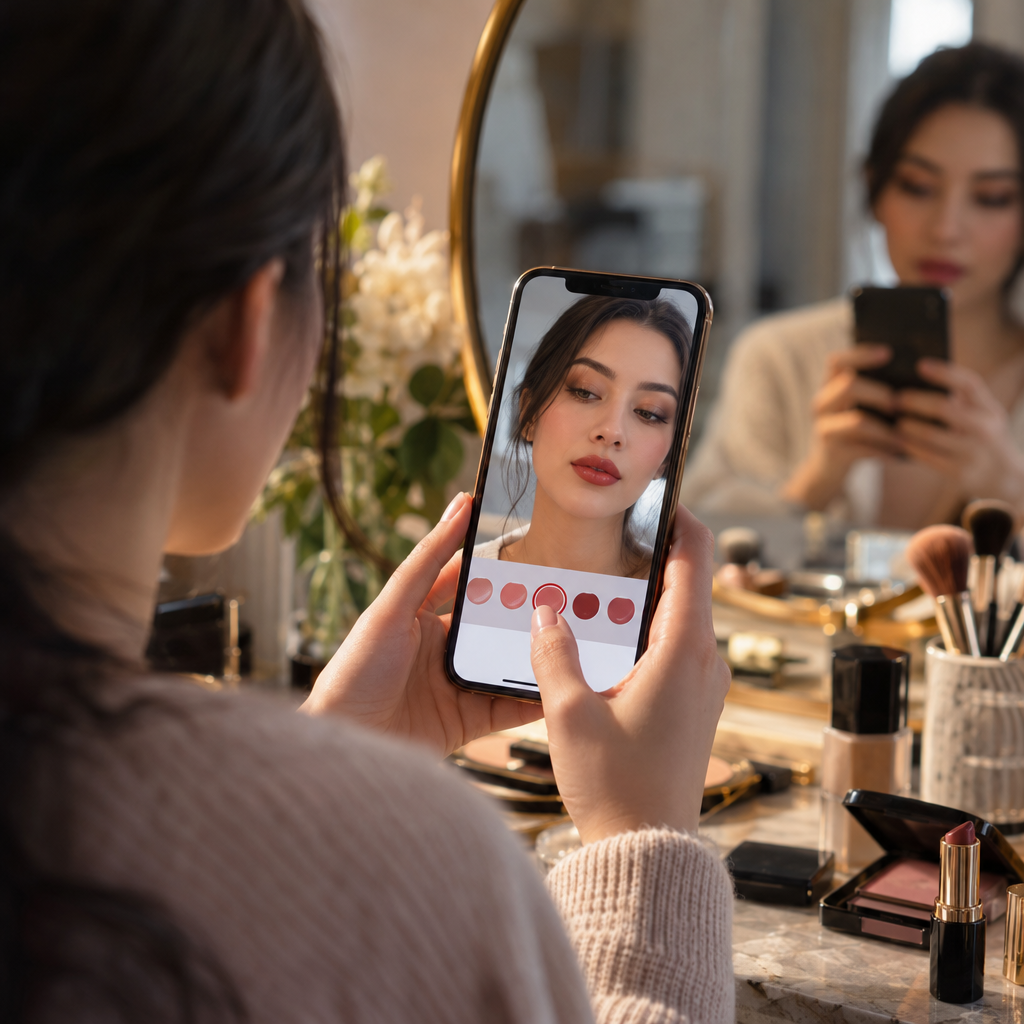
Shoppers who use AR try on tools convert up to 94% more often than those who don’t, according to Meta’s own commerce data. Yet most beauty brands still treat AR try on filters like a novelty add-on instead of a scripted conversion asset. That gap is where the money gets left on the table. If you’re briefing filters the same way you brief a TikTok video, you’re building a toy, not a sales tool.
Why AR Filters Are a Scripting Problem, Not Just a Tech Problem
Here’s the thing marketing teams get wrong: they hand the AR build to a dev team or a third party platform like Perfect Corp or ModiFace, wait for a demo, slap it on a product page, and call it done. No narrative. No path to purchase. No reason for a shopper to linger past the first swipe.
An AR try on filter is a piece of interactive content. It needs a beginning, middle, and end just like a video script, except the viewer controls the pacing. That means your job isn’t writing dialogue, it’s designing decision points. Where does the shopper look first? What color loads by default? What happens the moment they tap “add to bag”? Every one of those is a scripted choice, even though no human is narrating it.
Brands that script AR filters with the same rigor as a video funnel see meaningfully higher add to cart rates than those that treat filters as a passive gimmick.
The Three Act Structure for Shoppable AR
Borrow from video scripting conventions, because they transfer surprisingly well. Think of the filter experience in three acts: discovery, exploration, and conversion.
- Act one, discovery: the first shade or look that loads should be your bestseller or the one you’re pushing hardest this season. First impressions anchor the entire session.
- Act two, exploration: this is the swipe-through phase. Order shades from most universally flattering to more editorial or bold options. You’re building momentum, not randomizing choices.
- Act three, conversion: the shopping cart integration needs to appear at the exact moment a shopper lingers on a shade, not buried in a menu three taps away. Friction here kills intent that took real effort to build.
This mirrors the logic behind a strong unboxing to review arc, where structure, not spontaneity, drives the sale. AR just compresses that arc into seconds instead of minutes.
What Copy Still Matters Inside an AR Experience
People assume AR removes the need for scripting because there’s no voiceover. Wrong. Microcopy carries enormous weight. “Your most-tried shade” under a product thumbnail does more conversion work than a 30 second paid video in some cases, because it personalizes a static interaction in real time.
Write microcopy that does three things: names the shade in sensory language (“terracotta flush” beats “shade 04”), signals social proof (“most saved this week”), and nudges urgency without sounding desperate (“limited restock”). Keep it under six words per prompt. Shoppers in an AR session are scanning, not reading.
Briefing Creators to Drive Filter Adoption
Here’s a mistake I see constantly: brands build a gorgeous AR filter, then fail to brief creators on how to actually demonstrate it. A filter sitting on a product page gets a fraction of the usage it could get if a creator shows the “before you buy” moment on camera first.
Your creator brief needs to include a specific call to action: “open the link, try three shades, screen record your top pick.” That’s it. Don’t overdirect the performance, but do overdirect the mechanical steps. This is the same discipline behind a tight one page creator brief, where clarity on the ask shortens revision cycles and gets usable content faster.
Pair that with a scripted hook. Something like “I didn’t believe this filter was accurate until I saw it next to my actual skin” works because it preempts the biggest objection shoppers have with AR: does it actually look like this in real life? Address the skepticism inside the hook itself, the way you would in a comparison format video.
Matching Filters to Platform Mechanics
TikTok’s AR effects, Instagram’s Spark AR successor tools, and Snapchat’s Lens Studio all handle shoppable integration differently, and your script needs to account for that before a single asset is built.
On Instagram, filters tie more cleanly into shopping tags and product catalogs through Meta’s commerce tools, which means your “act three” conversion moment can be a direct tap-to-cart. On TikTok, the handoff is often softer, a bio link or a pinned comment, so your script needs a stronger verbal or on-screen prompt pushing the viewer there since the platform itself won’t do as much lifting. Snapchat skews younger and more playful, so filters that lean into transformation or surprise outperform ones that feel like straight product demos.
This is the same logic behind matching one shoot to multiple output specs, which we broke down in shoppable video specs. The underlying content concept can stay consistent. The conversion mechanics cannot.
Measuring What Actually Converts (Not Just Tries)
Try-on count is a vanity metric if you stop there. The number that matters is tries-to-cart ratio, and ideally cart-to-purchase after that. If your filter gets thousands of sessions but a tiny fraction add to bag, the problem isn’t awareness, it’s the script. Something in the shade ordering, the microcopy, or the conversion prompt placement is leaking intent.
Run this like an A/B test, not a one-and-done build. Test shade order. Test whether the cart button appears after three seconds of dwell versus immediately. Test whether a creator-recorded overlay (someone narrating “watch this”) boosts completion versus a silent, self-guided filter. eMarketer’s commerce research has repeatedly shown that incremental interface tweaks move conversion more than wholesale redesigns, and AR filters are no exception.
Treat your AR filter’s shade order and prompt timing as living creative, not a one-time build. Small sequencing changes often move conversion more than a full redesign.
Also track return rates by shade. If a specific color has high try-on numbers but disproportionate returns, that’s a signal the AR rendering is overpromising accuracy on that particular tone, which is a trust problem, not just a merchandising one.
Compliance Is Not Optional Here
Beauty is one of the categories regulators watch closely for deceptive advertising, and AR try on filters sit right in that crosshair because they visually promise a result. If your filter renders skin smoother or shade payoff more vivid than the actual product delivers, you’re exposed. The FTC’s endorsement and advertising guidance applies to AR rendering claims the same way it applies to filtered video content. Brief your AR vendor to calibrate against real swatch photography, not idealized lighting, and keep documentation of that calibration process. It’s cheap insurance against a much more expensive problem later.
Where This Fits Into a Broader Creator Strategy
AR filters work best as one node in a larger content system, not a standalone tactic. Pair the filter launch with creator content that references it directly, similar to how brands sync multiple creators around a single drop in multi creator collab videos. The filter becomes the shared prop, each creator brings a different entry point (a GRWM, a comparison, a first impression), and the collective volume signals relevance to the platform’s algorithm faster than a single asset ever could.
If budget is tight, you don’t need a custom-built filter from scratch for every launch. Modular approaches, where a base filter template gets reskinned with new shade data each season, cut both cost and development time significantly. That’s the same cost logic behind modular UGC assets built for multi-market reuse.
FAQs
Frequently Asked Questions
Do AR try on filters actually increase beauty sales, or just engagement?
They do both when scripted properly, but engagement without a clear conversion path tends to inflate try-on counts without moving revenue. The brands seeing real sales lift are the ones that script the handoff from try-on to cart deliberately, rather than assuming the novelty alone will drive purchase.
What platform is best for launching a shoppable AR beauty filter?
Instagram currently offers the tightest native integration between AR effects and product catalogs through Meta’s commerce tools, making it the easiest starting point for direct tap-to-cart flows. TikTok and Snapchat can still drive strong trial, but typically require a stronger external prompt (bio link, pinned comment) to complete the sale.
How accurate do AR shade matching filters need to be legally?
There’s no single bright-line rule, but regulators including the FTC treat overpromising visual results as a deceptive advertising risk. Calibrate your AR rendering against real product swatches under neutral lighting and keep records of that process in case claims are ever challenged.
Should creators use the AR filter in their content, or just mention it?
Using it on camera performs significantly better than a verbal mention. Seeing a real creator swipe through shades in real time builds the trust that a filter alone, without a human demonstrating it, often fails to establish.
How much does it cost to build a shoppable AR beauty filter?
Costs vary widely based on complexity and vendor, but modular templates that get reskinned per launch are considerably cheaper than fully custom builds each time. Brands prioritizing frequent seasonal drops should budget for a reusable base filter rather than one-off productions.
Start by auditing your current filter’s tries-to-cart ratio this week. If it’s low, don’t rebuild the whole experience, rescript the shade order, the microcopy, and the conversion prompt first, then measure again before you spend on anything new.
Top Influencer Marketing Agencies
The leading agencies shaping influencer marketing in 2026
Agencies ranked by campaign performance, client diversity, platform expertise, proven ROI, industry recognition, and client satisfaction. Assessed through verified case studies, reviews, and industry consultations.
Moburst

-
2

The Shelf
Boutique Beauty & Lifestyle Influencer AgencyA data-driven boutique agency specializing exclusively in beauty, wellness, and lifestyle influencer campaigns on Instagram and TikTok. Best for brands already focused on the beauty/personal care space that need curated, aesthetic-driven content.Clients: Pepsi, The Honest Company, Hims, Elf Cosmetics, Pure LeafVisit The Shelf → -
3

Audiencly
Niche Gaming & Esports Influencer AgencyA specialized agency focused exclusively on gaming and esports creators on YouTube, Twitch, and TikTok. Ideal if your campaign is 100% gaming-focused — from game launches to hardware and esports events.Clients: Epic Games, NordVPN, Ubisoft, Wargaming, Tencent GamesVisit Audiencly → -
4

Viral Nation
Global Influencer Marketing & Talent AgencyA dual talent management and marketing agency with proprietary brand safety tools and a global creator network spanning nano-influencers to celebrities across all major platforms.Clients: Meta, Activision Blizzard, Energizer, Aston Martin, WalmartVisit Viral Nation → -
5

The Influencer Marketing Factory
TikTok, Instagram & YouTube CampaignsA full-service agency with strong TikTok expertise, offering end-to-end campaign management from influencer discovery through performance reporting with a focus on platform-native content.Clients: Google, Snapchat, Universal Music, Bumble, YelpVisit TIMF → -
6

NeoReach
Enterprise Analytics & Influencer CampaignsAn enterprise-focused agency combining managed campaigns with a powerful self-service data platform for influencer search, audience analytics, and attribution modeling.Clients: Amazon, Airbnb, Netflix, Honda, The New York TimesVisit NeoReach → -
7

Ubiquitous
Creator-First Marketing PlatformA tech-driven platform combining self-service tools with managed campaign options, emphasizing speed and scalability for brands managing multiple influencer relationships.Clients: Lyft, Disney, Target, American Eagle, NetflixVisit Ubiquitous → -
8

Obviously
Scalable Enterprise Influencer CampaignsA tech-enabled agency built for high-volume campaigns, coordinating hundreds of creators simultaneously with end-to-end logistics, content rights management, and product seeding.Clients: Google, Ulta Beauty, Converse, AmazonVisit Obviously →