


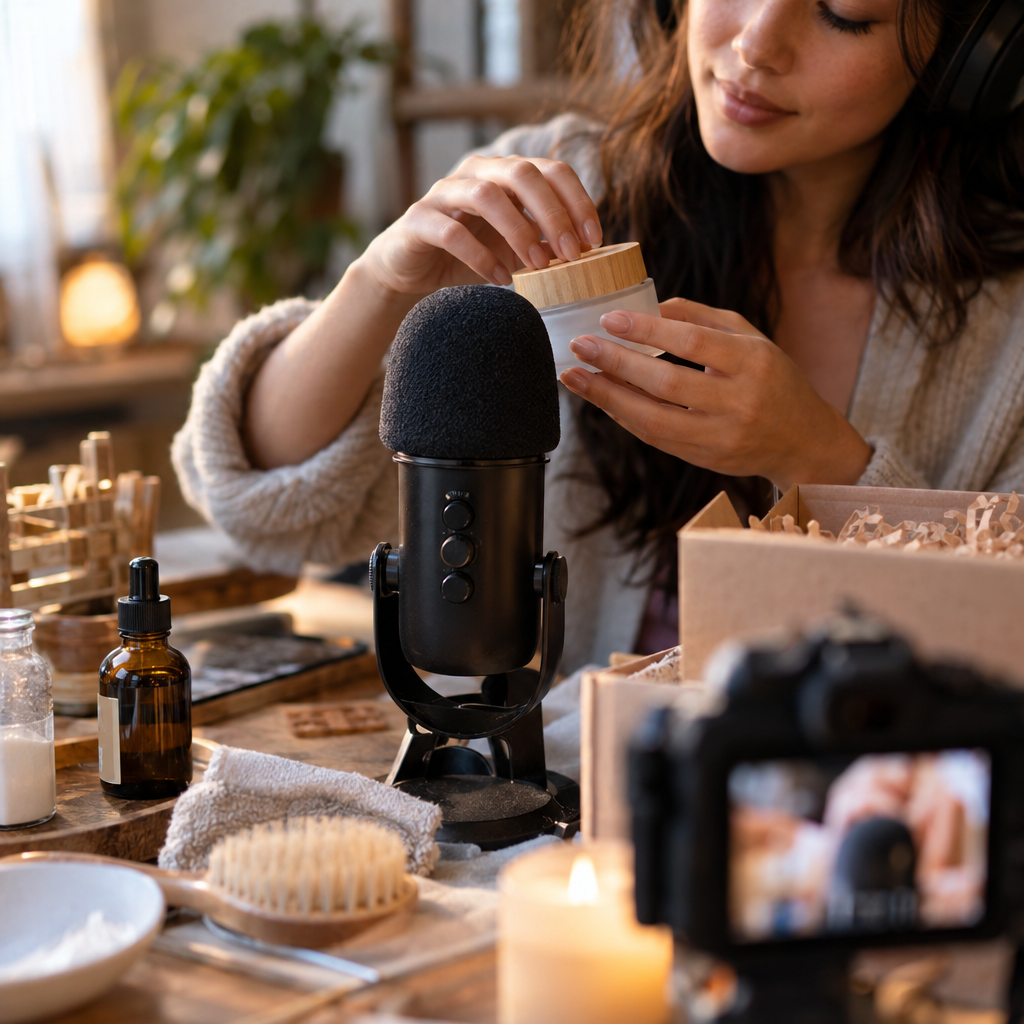
Sixty two percent of ASMR viewers say they watch to relax, but marketers who stop there are leaving money on the table. The quiet crinkle of packaging, the snap of a lid, the pour of a liquid: these sounds trigger a physiological response that keeps thumbs still and attention locked. ASMR product sound isn’t a niche aesthetic anymore. It’s a conversion mechanic hiding inside a wellness trend, and brands that script it deliberately are seeing add to cart rates that outperform voiceover-heavy content by wide margins.
Why Silence Sells Harder Than a Script
Most branded video still leans on talking heads and value-prop voiceovers. ASMR content strips that away. No narration, no music bed, just the product’s own sound signature doing the selling. That absence of friction is exactly why it works. Viewers aren’t being told why they should want something, they’re hearing physical proof it exists, that it’s tactile, that it’s real.
This matters more in an attention economy where skepticism toward ads keeps climbing. Sproutsocial’s consumer research has repeatedly found that audiences trust peer-style content over polished brand messaging. ASMR content reads as unscripted even when it’s meticulously planned, which is precisely the paradox that makes it effective. You can read more on how trust signals shift purchase behavior at Sprout Social’s research hub.
ASMR product content doesn’t ask for belief, it offers evidence. The sound of a seal breaking or a texture compressing does more persuasive work in three seconds than a thirty second pitch.
What Counts as “Product Sound” Anyway?
Not every quiet video qualifies. Effective ASMR product sound content isolates a specific sonic moment tied to the product’s function or quality. Think about the categories that already dominate the format:
- Packaging sounds: box lid snaps, tissue paper crinkle, tape peeling, foil seals breaking.
- Texture sounds: cream whipping, powder scooping, fabric rubbing, slime stretching.
- Mechanism sounds: click closures, pump dispensers, zipper pulls, button presses.
- Consumption sounds: pouring liquids, crunching food, fizzing carbonation.
Each of these maps to a trust signal. Crisp packaging sounds imply quality control. Satisfying mechanism clicks imply durability. A clean pour implies freshness. Scripting ASMR isn’t about picking a trendy sound, it’s about picking the sound that proves the specific claim your product needs to make.
The Script Is Invisible, But It’s Still a Script
Here’s the part brands get wrong constantly: they assume ASMR content needs no planning because there’s no dialogue. Wrong. The absence of spoken words means every other variable, mic placement, pacing, shot sequence, has to carry the entire persuasive load. A weak ASMR edit feels aimless. A strong one has a structure almost identical to a direct response ad, just translated into sound beats instead of sentences.
A tight ASMR product script typically follows four beats:
- Anticipation: the viewer sees the product before any sound starts, building a half second of expectation.
- Reveal sound: the first unboxing or unsealing noise, timed for maximum crispness.
- Texture or function sound: the core sensory payoff, usually the longest beat.
- Resolution sound: a closing click, cap, or set-down noise that signals completion.
This structure borrows heavily from hook and retention logic used across short form formats. If you’re building a broader retention framework for your creator briefs, the breakdown in hook and retention scripting applies directly to how ASMR beats should be sequenced for skip resistance.
Microphone Setup Is a Budget Line, Not an Afterthought
Brands routinely underfund the one thing that makes ASMR content work: audio capture. A binaural mic or a quality shotgun mic positioned close to the sound source isn’t optional gear, it’s the entire product. Creators who already specialize in ASMR usually own this equipment, which is one reason briefs should favor creators with a documented ASMR portfolio over generalists willing to “try it.”
When evaluating creator partners for this format, ask for raw audio samples before committing to a contract. Flat, roomy, or echo-heavy audio kills the sensory effect instantly, and no amount of editing fixes it in post. If you’re structuring briefs around specific technical deliverables, the approach outlined in vertical video briefing is a useful template for locking in technical specs without flattening creator style.
Where ASMR Fits in the Funnel
ASMR product sound performs best at the top and mid funnel, where the job is building desire and trust rather than closing a hard sell. It’s not a direct response format in the traditional sense, there’s rarely a call to action spoken aloud. Instead, the format relies on native product tagging and shoppable overlays to convert passive sensory pleasure into a transaction.
That’s why pairing ASMR content with clean, unobtrusive product tags matters so much. A clunky checkout overlay breaks the spell the sound just built. The principles in native checkout tagging are especially relevant here: the tag needs to feel like a natural extension of the sensory experience, not an interruption to it.
Brands running paid amplification on top of organic ASMR content should also test multiple cuts for different placements. A longer, slower cut may hold attention on TikTok, while a tighter fifteen second version performs better as a Reels ad. The multi-format shooting approach detailed in shoppable video specs saves production budget by capturing all the footage variants in a single session.
Does ASMR Actually Move Add to Cart Numbers?
This is the question finance teams ask, and fairly so. eMarketer and other industry trackers have noted rising engagement rates for sensory and “satisfying” content categories across TikTok and Instagram Reels, with completion rates often exceeding standard product demo formats. You can review broader platform engagement benchmarks through eMarketer’s research and TikTok’s own advertiser resources at TikTok for Business.
Completion rate alone isn’t revenue, though. Brands need to connect watch time to downstream action. The cleanest way to do that is tying ASMR creative to thumb stop and hook retention metrics before scaling spend, rather than assuming high view counts automatically translate to sales. The measurement framework in thumb stop measurement gives a practical model for validating creative before committing ad dollars.
High completion rate is not the same as high conversion intent. ASMR content earns attention easily, the real test is whether that attention survives the transition to a product page.
Compliance Isn’t Optional Just Because There’s No Spoken Claim
One mistake brands make: assuming that because ASMR content has no dialogue, there’s nothing to disclose. Wrong again. If a creator is paid or gifted product to produce ASMR content, standard disclosure rules still apply, regardless of whether the audio contains a single word. The FTC’s endorsement guidance applies to any paid influencer content, sound-based or not, and brands should build disclosure checks into every ASMR brief the same way they would for a spoken review. Review the current guidance directly at the FTC’s endorsement resources, and for UK-facing campaigns, consult ICO guidance on data and marketing compliance where applicable.
Legal teams sometimes overlook ASMR content during review because there’s “nothing to fact check.” That’s a gap worth closing before it becomes a liability.
Scaling Without Losing the Sensory Edge
Once a brand finds an ASMR format that converts, the instinct is to replicate it across every SKU immediately. Resist that urge. Sound signatures differ by product, and forcing a crinkle-heavy script onto a product with no meaningful packaging sound produces flat, forced content that audiences can smell from a mile away.
Instead, build a library of sound-first briefs by product category, similar to how high volume UGC programs avoid repetition fatigue. The scaling logic in high volume UGC scripting translates well to ASMR: vary the sensory hook, the pacing, and the creator voice even while keeping the underlying structure consistent.
Brands should also budget for creator diversity within the ASMR niche itself. Different creators emphasize different sound textures, some lean into crisp high frequency sounds, others favor deep, resonant tones. Testing a roster rather than a single creator prevents the content from feeling like a single formula run on repeat.
Next Step
Pick one SKU with a genuinely satisfying sound signature, brief one specialist ASMR creator with the four beat structure above, and run it against your current top performing demo ad for two weeks before scaling spend. Let the data, not the aesthetic appeal, decide if it earns a permanent slot in your content mix.
Frequently Asked Questions
What makes ASMR product content different from a standard unboxing video?
Standard unboxing videos usually include narration and commentary. ASMR product content removes spoken explanation entirely and isolates the raw sound of the packaging, texture, or mechanism to create a sensory, trust-building effect.
Which product categories perform best with ASMR content?
Beauty, skincare, food and beverage, and packaging-heavy consumer goods tend to perform best, since they naturally produce distinct sounds like pouring, crinkling, or texture manipulation that translate well to the format.
Do I need a professional studio to produce ASMR product content?
No, but you do need quality audio capture equipment, such as a binaural or close-proximity shotgun mic. Studio polish matters less than clean, close, echo-free sound recording.
How do I measure ROI on ASMR product sound content?
Track completion rate alongside downstream metrics like product page clicks and add to cart actions, rather than relying on views or watch time alone as a success indicator.
Is disclosure required for ASMR content with no spoken claims?
Yes. If a creator is compensated or gifted product, standard endorsement disclosure rules apply regardless of whether the content includes spoken language.
Top Influencer Marketing Agencies
The leading agencies shaping influencer marketing in 2026
Agencies ranked by campaign performance, client diversity, platform expertise, proven ROI, industry recognition, and client satisfaction. Assessed through verified case studies, reviews, and industry consultations.
Moburst

-
2

The Shelf
Boutique Beauty & Lifestyle Influencer AgencyA data-driven boutique agency specializing exclusively in beauty, wellness, and lifestyle influencer campaigns on Instagram and TikTok. Best for brands already focused on the beauty/personal care space that need curated, aesthetic-driven content.Clients: Pepsi, The Honest Company, Hims, Elf Cosmetics, Pure LeafVisit The Shelf → -
3

Audiencly
Niche Gaming & Esports Influencer AgencyA specialized agency focused exclusively on gaming and esports creators on YouTube, Twitch, and TikTok. Ideal if your campaign is 100% gaming-focused — from game launches to hardware and esports events.Clients: Epic Games, NordVPN, Ubisoft, Wargaming, Tencent GamesVisit Audiencly → -
4

Viral Nation
Global Influencer Marketing & Talent AgencyA dual talent management and marketing agency with proprietary brand safety tools and a global creator network spanning nano-influencers to celebrities across all major platforms.Clients: Meta, Activision Blizzard, Energizer, Aston Martin, WalmartVisit Viral Nation → -
5

The Influencer Marketing Factory
TikTok, Instagram & YouTube CampaignsA full-service agency with strong TikTok expertise, offering end-to-end campaign management from influencer discovery through performance reporting with a focus on platform-native content.Clients: Google, Snapchat, Universal Music, Bumble, YelpVisit TIMF → -
6

NeoReach
Enterprise Analytics & Influencer CampaignsAn enterprise-focused agency combining managed campaigns with a powerful self-service data platform for influencer search, audience analytics, and attribution modeling.Clients: Amazon, Airbnb, Netflix, Honda, The New York TimesVisit NeoReach → -
7

Ubiquitous
Creator-First Marketing PlatformA tech-driven platform combining self-service tools with managed campaign options, emphasizing speed and scalability for brands managing multiple influencer relationships.Clients: Lyft, Disney, Target, American Eagle, NetflixVisit Ubiquitous → -
8

Obviously
Scalable Enterprise Influencer CampaignsA tech-enabled agency built for high-volume campaigns, coordinating hundreds of creators simultaneously with end-to-end logistics, content rights management, and product seeding.Clients: Google, Ulta Beauty, Converse, AmazonVisit Obviously →