


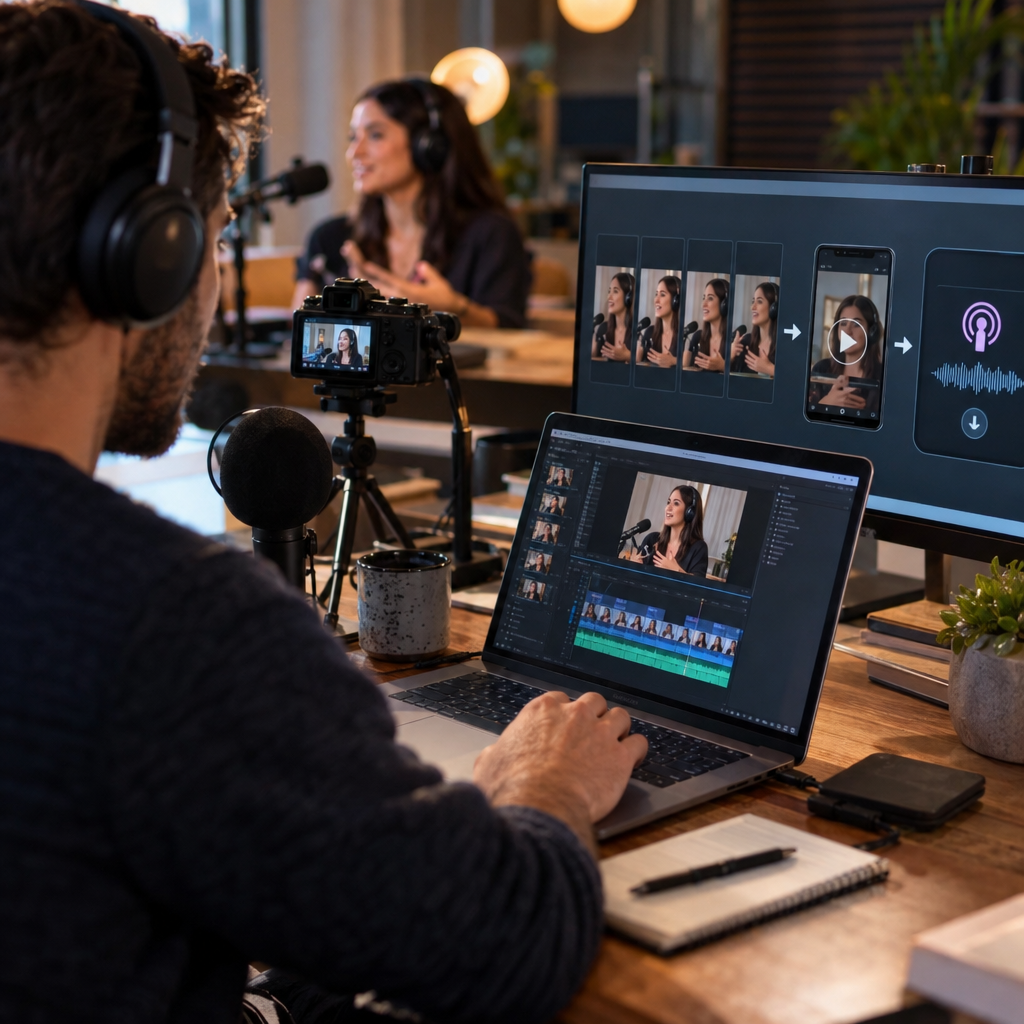
Ninety-four percent of podcast clips on social media get watched, liked, maybe shared. And then: nothing. The viewer scrolls on. A podcast clip funnel script is the difference between a highlight reel that entertains for fifteen seconds and one that actually moves a listener into your full episode, your feed, your audience. Most shows never build that bridge on purpose.
Why Most Podcast Clips Dead End
Here’s the uncomfortable truth: clipping a podcast is easy. Structuring that clip to convert is not. Most teams hand editing software to an intern, tell them to “find the funny part,” and post whatever comes out. The clip gets views because the moment was genuinely good. But views aren’t the goal. Downloads are.
The gap is structural, not creative. A great thirty-second moment pulled straight from a two-hour conversation often works precisely because it’s self-contained. It has a beginning, middle, and punchline. Which means it satisfies curiosity instead of provoking it. The viewer gets the joke, nods, moves on. No reason to open Spotify.
A clip that fully resolves its own story is a dead end by design. The funnel only works when the clip creates a question the full episode is the only place to answer.
This is the same principle that governs hook-driven podcast clips built for acquisition: the hook has to open a loop, not close one. Clip funnels are just that idea applied across an entire content pipeline instead of one video.
The Four-Part Script Structure That Actually Drives Listens
Forget “just post the best bit.” A clip funnel script needs four deliberate beats, in order, every time. Skip one and the conversion rate drops off a cliff.
- The cold open hook (0 to 3 seconds): A bold claim, a disagreement, or an incomplete thought. No intro music, no “hey guys welcome back.” The viewer should land mid-tension.
- The setup (3 to 15 seconds): Just enough context for the clip to make sense standalone, but not enough to fully satisfy. This is the hardest part to script and the part most editors get wrong by over-explaining.
- The escalation (15 to 40 seconds): The actual substance, the tension rising, the guest or host getting more specific, more emotional, or more controversial.
- The cutoff (the final 2 to 5 seconds): This is where the funnel lives or dies. The clip ends on a cliffhanger line, an unanswered question, or a visible on-screen prompt like “the full breakdown is in episode 142, link in bio.”
That cutoff beat is non-negotiable. Editors trained on general short-form best practices tend to want a satisfying ending because that’s what algorithms reward for watch-through rate. But a satisfying ending kills the funnel. You need a cut that feels almost rude, like someone pulled the plug mid-sentence. Annoyance, used correctly, drives clicks.
Picking the Right Moments Before You Even Open the Editor
Script structure only works if you’re clipping the right source material. Scrubbing through a ninety-minute episode looking for “good parts” is a waste of a producer’s afternoon. Instead, build a tagging system during recording or review: mark timestamps where a guest contradicts conventional wisdom, where the host pushes back hard, or where a number or stat gets dropped that most listeners wouldn’t have guessed.
Those three moment types consistently outperform generic “funny” or “wholesome” clips for funnel purposes, because they’re inherently incomplete. A contradiction begs the question “wait, why?” A pushback begs “who won that argument?” A surprising stat begs “where did that come from?” Each of those questions can only be answered by listening further, which is exactly the behavior you’re scripting for.
Compare this to compilation formats built for streaming audiences, where the goal is pure entertainment density rather than funneling toward a single destination. The structure in stream clip compilation scripts works differently because the business objective is different: sign-ups from volume and energy, not deep engagement with one piece of long-form content. Know which objective you’re scripting for before you pick your moments.
Writing the On-Screen Prompt Without Killing the Vibe
This is where most brands overcorrect. They get nervous that a text overlay saying “full episode link in bio” will feel like an ad, so they either skip it entirely or bury it in tiny text at the bottom corner for half a second. Both choices tank conversion.
The prompt needs to feel like part of the content, not an interruption to it. Treat it the way you’d treat a caption in a text-overlay storytime format: integrated, timed to a beat, and worded like a tease rather than an instruction. “What he said next got the whole room silent, full convo linked” performs better than “LISTEN TO THE FULL EPISODE NOW.” The former preserves narrative momentum. The latter reminds the viewer they’re being marketed to, which is the fastest way to lose them.
For teams scripting these overlays at scale, the first-three-seconds discipline covered in text overlay hook scripting applies just as much to the closing seconds as the opening ones. Viewers decide whether to act in the final beat just as fast as they decide whether to keep watching in the first.
Treat the call to action like a plot twist, not a disclaimer. If it reads like an ad, the funnel breaks before it starts.
Platform-Specific Funnel Mechanics
Not every platform sends traffic the same way, and your script needs to account for that before you even film.
- TikTok and Instagram Reels: Link-in-bio is still the primary mechanism, though Instagram’s native episode and audio features have narrowed the gap somewhat. The structure covered in Instagram episode feature scripting is directly relevant here if you’re trying to keep viewers inside the Meta ecosystem instead of bouncing them to a podcast app.
- YouTube Shorts: Comment pinning and end-screen cards to the long-form upload outperform verbal callouts, since viewers are already in a YouTube mindset and more willing to click through to a full video.
- Spotify and Apple clips: These live inside the listening ecosystem already, so the “funnel” is shorter: a single tap from clip to episode. Script for immediate curiosity resolution rather than a multi-step journey.
Platform mechanics matter because they change where your cutoff beat needs to point. A TikTok clip pointing to “link in bio” needs a stronger verbal and visual cue than a YouTube Short, which can lean on a visible end card the viewer is already trained to tap.
Measuring Whether the Funnel Is Actually Working
Vanity metrics lie here more than almost anywhere else in content marketing. A clip with three million views and a two percent click-through to the full episode is a worse funnel asset than a clip with eighty thousand views and a twelve percent click-through. Track click-through rate to episode listens as your primary metric, not raw view count.
Most podcast hosting platforms, along with link tools like those tracked through Sprout Social’s analytics suite, let you attribute downloads back to specific clip sources using UTM-tagged bio links. Set this up before you launch a clip campaign, not after. Retroactively trying to figure out which clip drove which spike in downloads is a guessing game nobody wins.
According to eMarketer’s research on podcast audience behavior, discovery through social clips has become one of the fastest-growing entry points into podcast listenership, outpacing traditional search and directory browsing for younger audiences. That shift alone justifies treating clip scripting as a core acquisition channel rather than a nice-to-have promotional afterthought.
This same measurement discipline applies to the early-funnel hook testing described in thumb-stop metric tracking. Before you scale a clip format across an entire back catalog, validate it on a handful of episodes and watch the click-through data, not just the engagement numbers.
A Quick Script Template You Can Reuse
Here’s a bare-bones structure a producer can apply to almost any podcast episode without reinventing the wheel each week:
- Scan the episode transcript for contradiction, pushback, or surprising stat moments.
- Clip 30 to 50 seconds around that moment, starting mid-sentence if needed.
- Trim the setup to the minimum context required for a cold viewer to follow along.
- End on the most incomplete, most tension-filled line available, even if it feels abrupt.
- Overlay a tease-style prompt in the final three seconds, timed to a visual beat, not just text sitting static on screen.
- Tag the bio link or end card with episode-specific UTM parameters.
- Review click-through rate within 48 hours and adjust the cutoff point for the next clip if conversion is weak.
Run this loop consistently and the funnel compounds. Each clip isn’t just promoting one episode, it’s training your audience to expect that every short clip is a door into something longer, which raises baseline click-through rates across your entire catalog over time.
FAQs
Frequently Asked Questions
How long should a podcast clip be to drive episode downloads?
Most effective funnel clips run between 30 and 60 seconds. Shorter clips struggle to build enough tension for a true cliffhanger, while longer clips risk fully resolving the viewer’s curiosity before the cutoff.
Should every clip end with a call to action?
Yes, but it should be implicit through the cutoff point and a brief on-screen tease rather than a hard verbal sell. The goal is to make the viewer feel like they’re missing something, not like they’re being pitched.
What’s the biggest mistake brands make with podcast clip funnels?
Ending clips on a satisfying note. A clip that resolves its own tension gives viewers no reason to seek out the full episode, even if the moment itself performed well on views and likes.
How do I track which clips actually drive full episode listens?
Use UTM-tagged bio links or platform-specific end cards tied to individual episodes, and measure click-through rate rather than view count. Most hosting platforms support this kind of source-level attribution.
Does this structure work the same across TikTok, Instagram, and YouTube Shorts?
The core four-part script stays consistent, but the call-to-action mechanism should shift by platform, since link-in-bio, comment-pinned links, and end cards all convert differently depending on where the viewer already is.
Build your next clip batch around one rule: never let the clip finish the story. Script the cutoff first, then work backward, and track click-through rate as ruthlessly as you track views.
Top Influencer Marketing Agencies
The leading agencies shaping influencer marketing in 2026
Agencies ranked by campaign performance, client diversity, platform expertise, proven ROI, industry recognition, and client satisfaction. Assessed through verified case studies, reviews, and industry consultations.
Moburst

-
2

The Shelf
Boutique Beauty & Lifestyle Influencer AgencyA data-driven boutique agency specializing exclusively in beauty, wellness, and lifestyle influencer campaigns on Instagram and TikTok. Best for brands already focused on the beauty/personal care space that need curated, aesthetic-driven content.Clients: Pepsi, The Honest Company, Hims, Elf Cosmetics, Pure LeafVisit The Shelf → -
3

Audiencly
Niche Gaming & Esports Influencer AgencyA specialized agency focused exclusively on gaming and esports creators on YouTube, Twitch, and TikTok. Ideal if your campaign is 100% gaming-focused — from game launches to hardware and esports events.Clients: Epic Games, NordVPN, Ubisoft, Wargaming, Tencent GamesVisit Audiencly → -
4

Viral Nation
Global Influencer Marketing & Talent AgencyA dual talent management and marketing agency with proprietary brand safety tools and a global creator network spanning nano-influencers to celebrities across all major platforms.Clients: Meta, Activision Blizzard, Energizer, Aston Martin, WalmartVisit Viral Nation → -
5

The Influencer Marketing Factory
TikTok, Instagram & YouTube CampaignsA full-service agency with strong TikTok expertise, offering end-to-end campaign management from influencer discovery through performance reporting with a focus on platform-native content.Clients: Google, Snapchat, Universal Music, Bumble, YelpVisit TIMF → -
6

NeoReach
Enterprise Analytics & Influencer CampaignsAn enterprise-focused agency combining managed campaigns with a powerful self-service data platform for influencer search, audience analytics, and attribution modeling.Clients: Amazon, Airbnb, Netflix, Honda, The New York TimesVisit NeoReach → -
7

Ubiquitous
Creator-First Marketing PlatformA tech-driven platform combining self-service tools with managed campaign options, emphasizing speed and scalability for brands managing multiple influencer relationships.Clients: Lyft, Disney, Target, American Eagle, NetflixVisit Ubiquitous → -
8

Obviously
Scalable Enterprise Influencer CampaignsA tech-enabled agency built for high-volume campaigns, coordinating hundreds of creators simultaneously with end-to-end logistics, content rights management, and product seeding.Clients: Google, Ulta Beauty, Converse, AmazonVisit Obviously →