


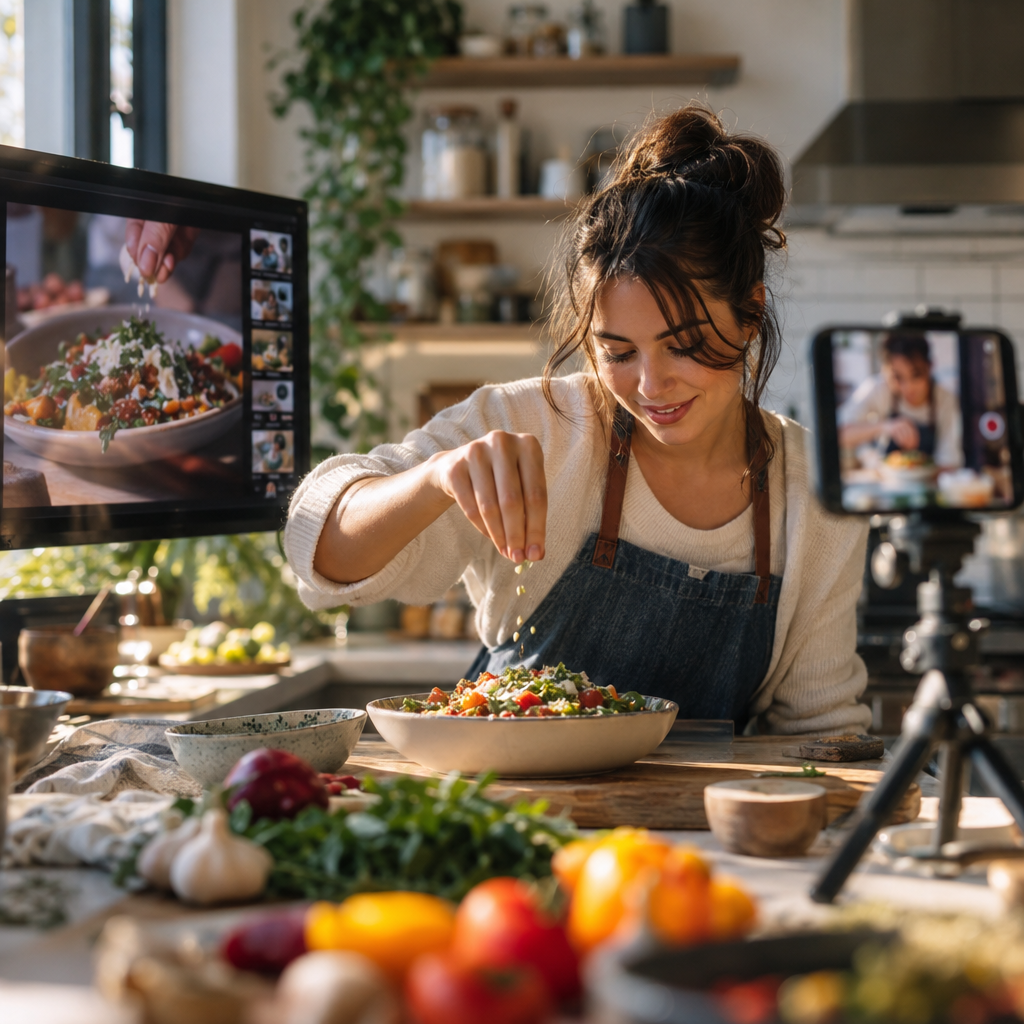
A single recipe clip can generate dozens of derivative versions within days, each one carrying a brand’s product into a new creator’s feed for free. That is the entire premise behind recipe remix videos, and it is why CPG and food brand managers are quietly reallocating budget toward the format. Short-form recipe videos generate on average 2.7 times more social shares and 43% higher return visit rates than static text recipes. If your content calendar still treats recipes as a once-a-month blog asset, you are leaving reach on the table.
What Counts as a Recipe Remix Video, Exactly?
A recipe remix video is any piece of content built directly on top of an existing recipe clip, whether that is a brand’s own post, a trending creator’s technique, or a viral food hack. On TikTok, that means Duet (side by side reaction) or Stitch (clipping a few seconds and continuing from it). On Instagram and YouTube Shorts, the mechanic is Remix. The creator takes someone else’s cooking moment, a sauce reduction, a crispy edge, a dramatic reveal, and layers their own version on top: a swapped ingredient, a faster method, a budget hack, or a straight-up correction.
For brands, this is different from a standard influencer recipe post. You are not commissioning a video from scratch. You are either seeding the original clip for others to build on, or you are paying creators to remix an already-trending piece of food content and pull your product into the frame. Either way, the production lift is lower and the built-in algorithmic distribution is higher, because platforms reward derivative formats that keep users scrolling through a thread of related clips.
Why Recipe Content Converts Saves Into Sales
Recipes work on social platforms for a reason that has nothing to do with trend cycles: they are useful. A viewer who saves a recipe video is signaling intent to actually make the dish, which means intent to buy the ingredients. That behavioral signal is why platforms treat recipe content so favorably in distribution, and why advertisers pay a premium to sit next to it. Advertising revenue per thousand impressions on video recipe content commands premiums of 45 to 60% over standard display advertising, making video a key financial driver alongside its engagement benefits.
Recipe remix content does not just borrow a trend’s reach. It inherits the viewer’s buying intent, because anyone who finishes watching a recipe video has already mentally added the ingredients to their cart.
This is also why remix formats outperform a standalone branded recipe video. A single studio-produced recipe post has one shot at resonance. A remix thread has dozens of shots, each one filtered through a different creator’s audience, aesthetic, and trust relationship. One version might land with a grocery-budget audience, another with a protein-focused fitness crowd, another with a parent trying to get picky kids to eat vegetables. The core brand asset stays the same; the framing multiplies.
Duet, Stitch, Remix: A Field Guide for Brand Teams
Treat the three mechanics as three different briefs, not one generic “make a recipe video” ask:
- Reaction-style Duet: a creator watches your product demo or recipe side by side and reacts in real time. Works well for surprising reveals, blind taste tests, or before/after transformations.
- Stitch for continuation or correction: a creator clips a few seconds of a trending recipe and continues it with your product, a better method, or an expert fix. This is the strongest format for CPG because it lets a food creator demonstrate real expertise, not just enthusiasm.
- Remix for parallel takes: used more on Instagram and YouTube Shorts, where the creator’s version runs alongside the original rather than cutting into it.
The brief matters more than the mechanic. A good remix brief identifies what the creator should preserve from the original (the hook, the format, the pacing) and what they should change (the product, the twist, the punchline). This is the same discipline used in challenge-style video briefs, where the structure stays fixed and the variation drives the shares.
One operational wrinkle brand teams miss: enabling Duet and Stitch on a brand’s own posts is a settings decision, not a legal one, and it has to be made before the video goes live. If you want organic creators to build on your seeded recipe clip, the reuse setting has to be open. If your content involves a sponsored creator’s original post, that same openness means anyone, including critics, can clip and respond to it. Borrowing from someone else’s video carries its own exposure too. If a remix pulls audio, a branded set, or a competitor’s packaging into frame, you inherit the same risk profile covered in split-screen reaction formats and copyright traps.
Does This Actually Move Product, Not Just Views?
Views are the easy metric. Saves and shares are the ones that correlate with purchase intent, since a saved recipe is a planned grocery trip. Brand managers evaluating a recipe remix campaign should weight saves and shares above raw view count, and track whether the remix thread produces a sustained tail of organic Duets and Stitches after the paid creators stop posting. A thread that keeps generating unpaid derivative content three or four weeks after launch is the clearest signal that the format earned its budget. A thread that goes quiet the day the paid posts stop is a sign the brief was too narrow to invite genuine remixing. This is the same durability test used for serialized content built to earn repeat views, where the goal is a format other creators or the same creator want to return to.
The Compliance Trap: Who’s Liable When a Remix Goes Off Script
Recipe remix campaigns create a disclosure problem most brand teams have not fully priced in. Standard FTC guidance already requires that your endorsement message should make it obvious when you have a relationship with the brand, including a personal, family, or employment relationship or a financial relationship such as the brand paying you or giving you free or discounted products or services. That obligation does not weaken just because the content is a Stitch instead of a standalone post.
Three specific risks show up in remix campaigns more than in standard influencer posts:
- Gifted product seeding. Many brands seed free product to dozens of creators hoping for organic remixes, then treat the resulting content as unpaid and undisclosed. If a brand gives you free or discounted products or other perks and then you mention one of its products, make a disclosure even if you weren’t asked to mention that product.
- Multi-post threads. A remix campaign often spans several creators and several posts over weeks. An influencer can’t assume that followers will read more than one of their posts and associate them with each other, which means every Duet, Stitch, or remix in the sequence needs its own disclosure, not just the first one.
- Buried or missing disclosure in derivative clips. Disclosures are likely to be missed if they appear only on an ABOUT ME or profile page, at the end of posts or videos, or anywhere that requires a person to click MORE, and if making an endorsement in a video, the disclosure should be in the video and not just in the description, since viewers are more likely to notice disclosures made in both audio and video. When a creator Stitches or remixes an already-sponsored clip, that disclosure does not automatically travel with it; the new post needs its own.
Brand teams running remix campaigns should write disclosure instructions directly into the creator brief, the same way they would for a comparison video naming a competitor or a myth-busting reel correcting a viral claim. In both cases, legal review happens before the clip goes live, not after it starts circulating.
A Practical Checklist Before You Brief a Remix Campaign
- Confirm Duet and Stitch reuse settings on any brand-owned seed video before publishing.
- Write platform-specific disclosure language into every creator contract, not just a general FTC clause.
- Prioritize saves and shares over view count when evaluating performance.
- Pre-approve the recipe hack, claim, or technique with your food science or legal team if it involves a health, safety, or nutrition claim.
- Track the organic tail. If unpaid remixes stop within days of the paid wave ending, the format needs a sharper hook next time.
Recipe remix videos reward brands that treat the format as a system, not a single asset: seed a strong original, brief creators on what to preserve and what to change, and build disclosure into the brief from day one rather than fixing it after a creator’s Stitch goes viral without it.
FAQs
What is a recipe remix video?
A recipe remix video is content built on top of an existing recipe clip using features like TikTok Duet, TikTok Stitch, or Instagram Remix, where a creator adds their own reaction, twist, correction, or product swap to a trending recipe format.
Why do recipe remix videos perform better than standard branded recipe posts?
Because the format inherits distribution from an already-trending clip and multiplies framing across many creators instead of relying on a single produced video. Short-form recipe videos also generate higher shares and return visits than static recipe content, which signals strong purchase intent to viewers who save them.
Do brands need to disclose sponsorship on a Duet or Stitch video?
Yes. Every post that endorses a product needs its own clear disclosure. Followers cannot be assumed to connect one disclosed post to a later, undisclosed Duet or Stitch in the same campaign.
Does gifting free product for a remix video require disclosure?
Yes. If a creator receives free or discounted product and then mentions it, a disclosure is required even if the brand never explicitly asked for that specific post.
What metrics should brand managers track for recipe remix campaigns?
Prioritize saves and shares over raw views, since saves indicate a viewer plans to actually make the recipe and buy the ingredients. Also track whether the campaign generates unpaid, organic remixes after the paid creator wave ends.
Can a brand stop creators from remixing a sponsored video?
Reuse settings for Duet and Stitch sit on the original poster’s account or individual video, so a brand cannot disable the feature externally. It has to be agreed with the creator and set before the video is published.
Top Influencer Marketing Agencies
The leading agencies shaping influencer marketing in 2026
Agencies ranked by campaign performance, client diversity, platform expertise, proven ROI, industry recognition, and client satisfaction. Assessed through verified case studies, reviews, and industry consultations.
Moburst

-
2

The Shelf
Boutique Beauty & Lifestyle Influencer AgencyA data-driven boutique agency specializing exclusively in beauty, wellness, and lifestyle influencer campaigns on Instagram and TikTok. Best for brands already focused on the beauty/personal care space that need curated, aesthetic-driven content.Clients: Pepsi, The Honest Company, Hims, Elf Cosmetics, Pure LeafVisit The Shelf → -
3

Audiencly
Niche Gaming & Esports Influencer AgencyA specialized agency focused exclusively on gaming and esports creators on YouTube, Twitch, and TikTok. Ideal if your campaign is 100% gaming-focused — from game launches to hardware and esports events.Clients: Epic Games, NordVPN, Ubisoft, Wargaming, Tencent GamesVisit Audiencly → -
4

Viral Nation
Global Influencer Marketing & Talent AgencyA dual talent management and marketing agency with proprietary brand safety tools and a global creator network spanning nano-influencers to celebrities across all major platforms.Clients: Meta, Activision Blizzard, Energizer, Aston Martin, WalmartVisit Viral Nation → -
5

The Influencer Marketing Factory
TikTok, Instagram & YouTube CampaignsA full-service agency with strong TikTok expertise, offering end-to-end campaign management from influencer discovery through performance reporting with a focus on platform-native content.Clients: Google, Snapchat, Universal Music, Bumble, YelpVisit TIMF → -
6

NeoReach
Enterprise Analytics & Influencer CampaignsAn enterprise-focused agency combining managed campaigns with a powerful self-service data platform for influencer search, audience analytics, and attribution modeling.Clients: Amazon, Airbnb, Netflix, Honda, The New York TimesVisit NeoReach → -
7

Ubiquitous
Creator-First Marketing PlatformA tech-driven platform combining self-service tools with managed campaign options, emphasizing speed and scalability for brands managing multiple influencer relationships.Clients: Lyft, Disney, Target, American Eagle, NetflixVisit Ubiquitous → -
8

Obviously
Scalable Enterprise Influencer CampaignsA tech-enabled agency built for high-volume campaigns, coordinating hundreds of creators simultaneously with end-to-end logistics, content rights management, and product seeding.Clients: Google, Ulta Beauty, Converse, AmazonVisit Obviously →