


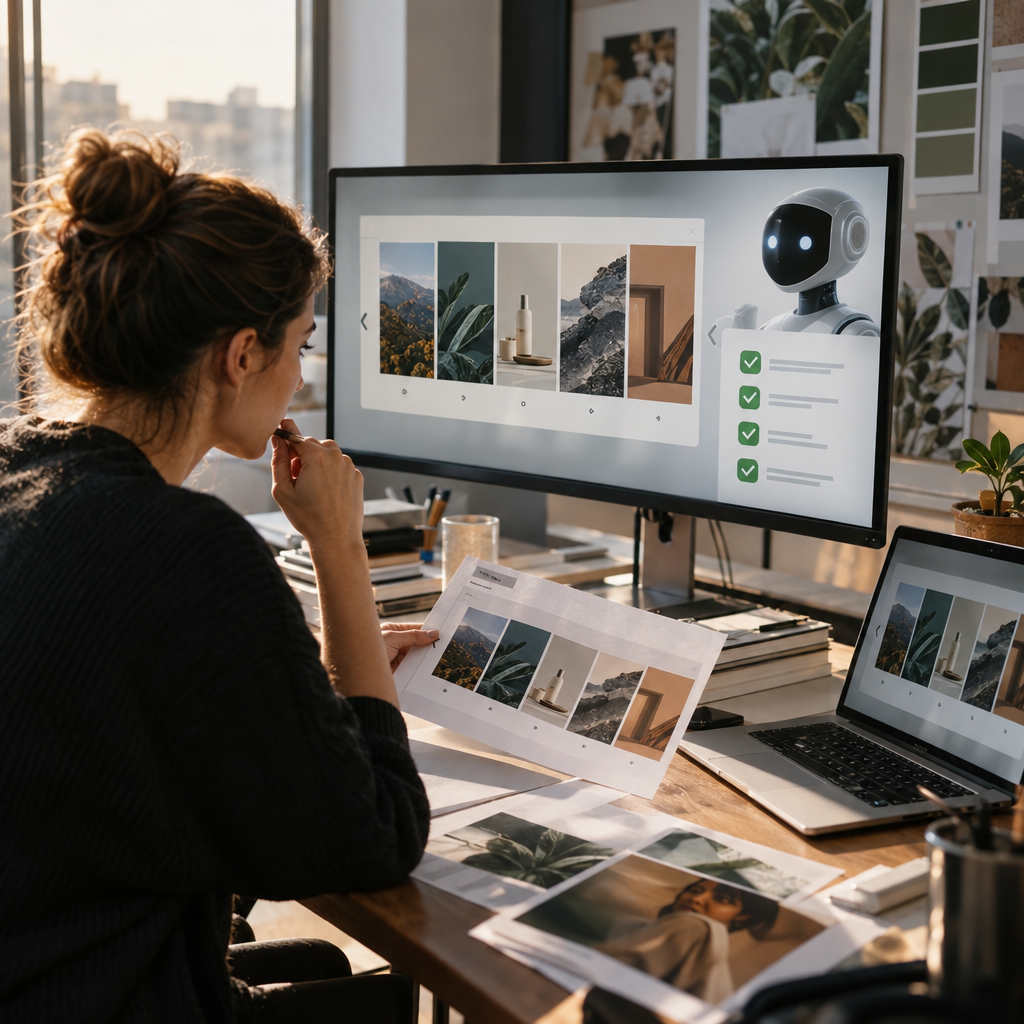
Seventy percent of consumers say they can usually spot an AI-generated ad because something feels missing. For teams producing AI co-written carousel scripts, it raises a hard question. Are you saving hours or spending trust?
The speed is real. So is the sameness.
A carousel is a tempting target for AI. It has a fixed structure: hook slide, three to eight payload slides, a closing call to action. Large language models handle that kind of scaffolding well. A first draft that took a strategist two hours now takes ten minutes.
The trouble starts at approval. Drafts look clean, so they get waved through. Nobody checks whether slide four sounds like your brand or like every other brand with the same prompt.
CXL’s analysis argues the problem is rarely the tool itself. The failure usually comes from generic prompts, thin examples of the brand’s real writing, and no one accountable for review. That diagnosis matches what most agency leads see in practice.
The same piece cites survey data showing the audience side of the cost. The audience cost shows up as fatigue with generic AI-made brand content and weaker trust in the messaging behind it.
Speed is no longer the competitive advantage. Every competitor has it. Recognizable voice is the scarce asset, and it is the one AI cannot supply on its own.
Where AI belongs in the carousel workflow
Not every stage of scripting carries equal voice risk. Split the work accordingly.
- Let AI lead: competitor slide audits, alternate hook options, slide-count restructuring, character-limit trimming, and repurposing a long creator transcript into slide beats.
- Co-write: the body slides, with a human setting the argument and AI generating phrasing options.
- Keep human: the hook, the proof claims, the closing line, and anything that quotes a customer, creator, or executive.
Why the hook? Because it is the slide a stranger judges you on. If it reads like a template, the swipe never happens, and no downstream slide matters.
For B2B plays, pair this with a tight slide-level brief. Our guide to LinkedIn carousel scripting covers how to brief for saves and shares, which gives the AI a far better target than “make it engaging.”
Build a voice kit before you write a single prompt
Most teams paste a tone description into the prompt and call it done. “Confident but approachable” means nothing to a model. Give it evidence instead.
A workable voice kit for carousel work has five parts:
- Five to ten approved samples. Real carousels, captions, or creator scripts that performed and passed review.
- A banned-phrase list. The filler your brand never says (“game-changer,” “unlock,” “dive in”). Update it monthly as you spot new tics.
- Sentence rules. Average slide length, how you handle numbers, whether you use questions, contractions, or emoji.
- A claims register. Pre-cleared product claims with the source for each. The AI may only draw from this list.
- A named reviewer. One person owns final voice approval. Shared ownership means no ownership.
This mirrors the CXL recommendation to ground tools in your best content, set shared writing rules, and check output against positioning and customer expectations. It also takes about half a day to assemble. That half day pays back on the first campaign.
What if the creator has their own voice?
This is the question agencies skip. In influencer work, you are balancing two voices: the brand’s and the creator’s. Audiences follow the creator for a reason.
Run the AI against the creator’s recent captions and past scripts, not just your brand book. Then let the creator rewrite at least the hook and the closing slide in their own words. A carousel that sounds like your legal team wearing a creator’s face performs like one.
If you are adapting one creator asset across many surfaces, the same principle applies. See how native platform adaptation preserves creator personality while changing format.
Compliance does not pause for AI
AI drafts invent things. A model will happily write “clinically proven” or “results in seven days” because those phrases are common in its training data. In a sponsored carousel, that is your liability, not the model’s.
The regulatory backdrop is tightening. A carousel that omits a clear paid-partnership disclosure on slide one, or buries it on the last slide, invites that exposure.
Responsibility also does not stop with the creator. A law firm’s overview of FTC influencer guidelines stresses that brands and creators both must disclose material relationships and avoid deceptive endorsements. Treat AI-assisted scripts as brand-authored copy, because legally that is what they are.
Build three checks into the workflow:
- Every factual or performance claim traces to your claims register.
- Disclosure appears early and visibly, in the creator’s natural phrasing.
- If AI-generated imagery or a synthetic persona appears in the carousel, flag it for legal. Our pieces on AI avatar presenters and AI chatbot post disclosure go deeper on both.
A review loop that keeps the speed
The fear is that guardrails kill the time savings. They do not, if you design the loop well.
Step one: The strategist writes a one-paragraph argument and the hook. No AI yet.
Step two: AI drafts three body-slide variants from the voice kit and claims register.
Step three: The strategist picks, edits, and rewrites any slide that fails a read-aloud test. If you would not say it in a client meeting, cut it.
Step four: The reviewer checks voice, claims, and disclosure in a single pass using a short checklist.
Total time lands well under a fully manual process, and the output is noticeably less generic. Track two numbers for a month: revision rounds per carousel and saves or shares per post. If revisions climb, your voice kit is too thin. If saves drop against human-only baselines, your editors are approving too fast.
One more tactic: use a myth-busting angle for hooks when your category is crowded. A specific, opinionated first slide is the hardest thing for a generic model to fake, which makes it the best place to invest human effort.
FAQs
Can AI write a full carousel script without human editing?
It can produce a usable draft, but publishing it unedited is risky. Generic phrasing erodes voice, and invented claims create compliance exposure. Keep humans on the hook, proof claims, and closing slide at minimum.
How do I train an AI tool to match my brand voice?
Feed it real examples of approved writing, a banned-phrase list, and specific sentence rules rather than adjectives like “friendly.” Then assign one named reviewer to check output against that kit.
Who is responsible if an AI-written carousel makes a false claim?
The brand and, often, the creator. Regulators treat AI-assisted copy as advertiser-authored. Require every claim to trace to a pre-cleared source before the script goes to the creator.
Do I need to disclose that a carousel was AI-assisted?
Paid-partnership disclosure is required regardless of how the script was written. Extra disclosure becomes a concern when the content features a synthetic persona or AI-generated likeness. Confirm specifics with legal counsel and platform policy.
Which carousel slides should always stay human-written?
The hook, any slide containing a claim or testimonial, and the final call to action. These carry the most voice, trust, and legal weight per word.
How do I measure whether AI is hurting my carousel performance?
Compare saves, shares, and revision rounds on AI-assisted carousels against a human-only baseline over four to six weeks. Falling saves with fewer revisions usually means reviewers are approving too quickly.
This week, pull your five best-performing carousels, build a one-page voice kit and claims register from them, and run your next script through the four-step loop above.
Top Influencer Marketing Agencies
The leading agencies shaping influencer marketing in 2026
Agencies ranked by campaign performance, client diversity, platform expertise, proven ROI, industry recognition, and client satisfaction. Assessed through verified case studies, reviews, and industry consultations.
Moburst

-
2

The Shelf
Boutique Beauty & Lifestyle Influencer AgencyA data-driven boutique agency specializing exclusively in beauty, wellness, and lifestyle influencer campaigns on Instagram and TikTok. Best for brands already focused on the beauty/personal care space that need curated, aesthetic-driven content.Clients: Pepsi, The Honest Company, Hims, Elf Cosmetics, Pure LeafVisit The Shelf → -
3

Audiencly
Niche Gaming & Esports Influencer AgencyA specialized agency focused exclusively on gaming and esports creators on YouTube, Twitch, and TikTok. Ideal if your campaign is 100% gaming-focused — from game launches to hardware and esports events.Clients: Epic Games, NordVPN, Ubisoft, Wargaming, Tencent GamesVisit Audiencly → -
4

Viral Nation
Global Influencer Marketing & Talent AgencyA dual talent management and marketing agency with proprietary brand safety tools and a global creator network spanning nano-influencers to celebrities across all major platforms.Clients: Meta, Activision Blizzard, Energizer, Aston Martin, WalmartVisit Viral Nation → -
5

The Influencer Marketing Factory
TikTok, Instagram & YouTube CampaignsA full-service agency with strong TikTok expertise, offering end-to-end campaign management from influencer discovery through performance reporting with a focus on platform-native content.Clients: Google, Snapchat, Universal Music, Bumble, YelpVisit TIMF → -
6

NeoReach
Enterprise Analytics & Influencer CampaignsAn enterprise-focused agency combining managed campaigns with a powerful self-service data platform for influencer search, audience analytics, and attribution modeling.Clients: Amazon, Airbnb, Netflix, Honda, The New York TimesVisit NeoReach → -
7

Ubiquitous
Creator-First Marketing PlatformA tech-driven platform combining self-service tools with managed campaign options, emphasizing speed and scalability for brands managing multiple influencer relationships.Clients: Lyft, Disney, Target, American Eagle, NetflixVisit Ubiquitous → -
8

Obviously
Scalable Enterprise Influencer CampaignsA tech-enabled agency built for high-volume campaigns, coordinating hundreds of creators simultaneously with end-to-end logistics, content rights management, and product seeding.Clients: Google, Ulta Beauty, Converse, AmazonVisit Obviously →