


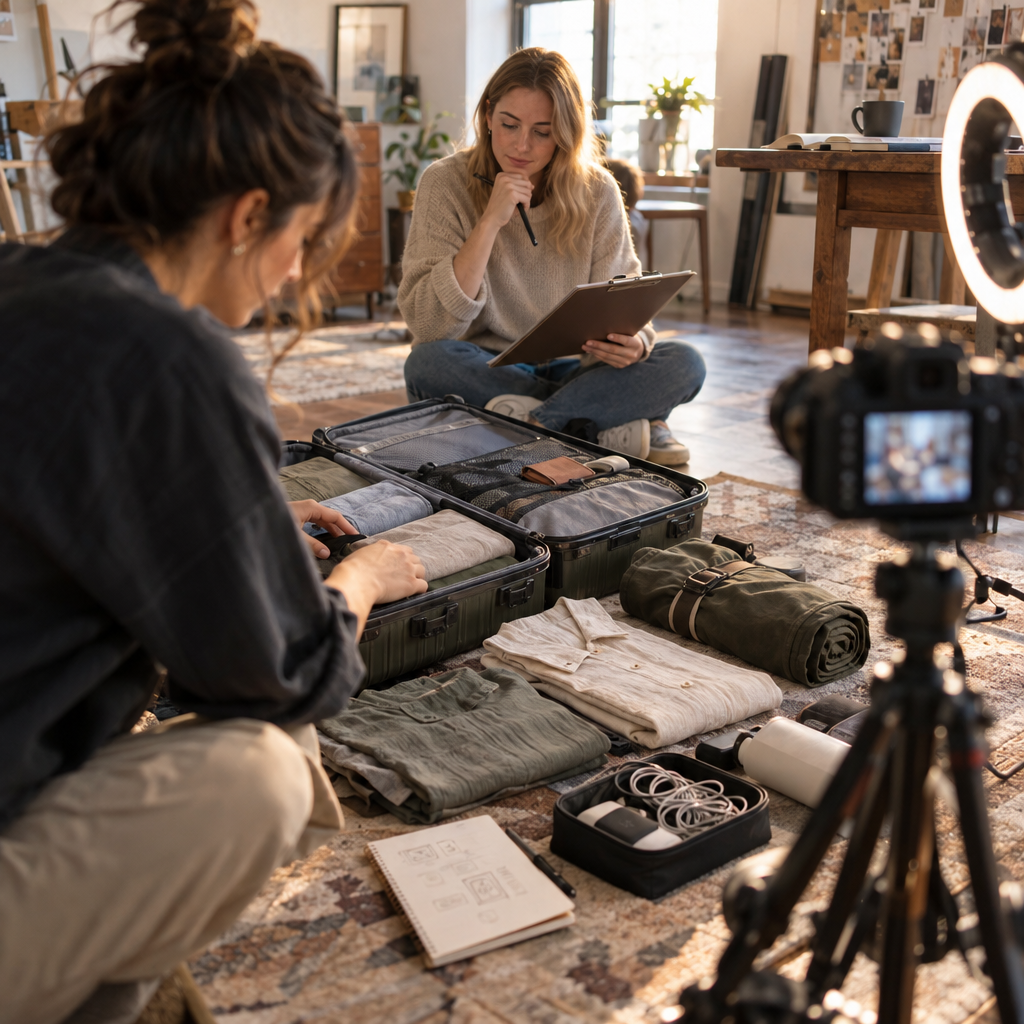
Two-thirds of Gen Z travelers use social media for trip inspiration, and a packing list is the most natural format for putting your suitcase in front of them. Yet most packing list and travel content treats luggage as a prop. Scripting placement order is how luggage and travel gear brands turn a pretty flat lay into a product that gets bought.
Why the packing list is a sales format, not a vibe
Travel planning is a research task. People are comparing, checking, and building lists. A packing video matches that behavior, which is why it earns saves and shares that a generic “my trip” vlog rarely does.
The demand side is documented. In a Data Axle survey of 1,000 U.S. adults fielded by Dynata, 41% of consumers use social media to research and discover destinations, and 39% say travel influencers have some sway over their choices. Word of mouth still ranked first, with 55% of respondents saying it is how they discover destinations, so the creator needs to sound like a friend who has done the trip, not a catalog.
Older data points the same way. An Expedia study covered by Marketing Dive found that 84% of Gen Z travelers said social media can be influential on travel. That was 2018, so treat it as direction, not a current benchmark.
A packing list is a decision tool. Script it like one, and the order your products appear in becomes your conversion path.
The placement order that mirrors how people actually pack
Here is the mistake I see most. The brief says “show the carry-on in the first three seconds,” and the creator dumps the bag on the bed, zips it, and moves on. Nothing about it feels like packing.
Real packing has a sequence. You pick the container first, then the big stuff, then the small stuff, then the things you forget. Script your products into that sequence and the placement feels earned.
- The container (0-5 seconds). Open on the empty luggage with a stated constraint: “one carry-on, ten days.” The constraint is the hook and the bag is the hero.
- The bulky layer. Packing cubes, compression bags, shoe pouches. These are your highest-margin add-ons and the easiest to show working, so give them real screen time.
- The system moment. Show the organization working: a toiletry bag that hangs, a laptop sleeve that slides out at security. This is where features become visible.
- The small-gear layer. Adapters, tags, locks, chargers, neck pillows. Quick cuts, one line each.
- The closing test. Zip it, lift it, wheel it, or fit it under a seat. End on proof, not a logo.
Why this order? Because viewers who watch to the end have seen your hero product twice: once as the starting container and once as the finished result. For a deeper take on the same logic in a related format, see our guide to placement order scripting for bag-reveal videos.
Where does each product earn its slot?
Not every SKU deserves equal airtime. Rank by role, then brief accordingly.
- Anchor product: the luggage piece you want sold. It appears at the start and the end, and is touched at least three times.
- Proof products: cubes, organizers, and sleeves that make the anchor look smart. Each gets one demonstrated benefit.
- Cart-fillers: small accessories mentioned in one breath. They lift average order value without slowing the video.
A cheap trick that works: have the creator name a problem before showing the product. “I always lose my charger cable at the gate” then the pouch appears. Problem first, product second. Reverse it and it sounds like an ad.
Proof beats adjectives
Luggage claims are easy to make and easy to doubt. “Durable,” “lightweight,” and “fits everything” are the three words buyers skip past.
Script observable moments instead. A bag dropped from waist height. A scale reading shown on screen. A carry-on sliding into a sizer. Each of those is a claim the viewer can verify with their own eyes. If you are comparing against a competitor or a previous model, our breakdown of comparison video proof covers how to keep that side-by-side fair.
Be careful with durability and capacity claims. If the creator says it “never breaks” or “fits a week of clothes,” someone on your legal team should have a substantiation file behind it. Our piece on claims that survive review shows how to build that file without slowing production.
Safer phrasing for common luggage claims
- Instead of “indestructible,” script “I have taken this on eleven flights” (if true and documented).
- Instead of “fits everything,” script “this held what you see here” while showing the contents.
- Instead of “airline approved,” script the specific airline and dimension limits, and tell viewers to check their own carrier.
That last one matters. Carry-on rules vary by airline and change often. A creator who tells viewers to confirm sizing is more credible, and your brand avoids a returns headache.
Disclosure: build it into the script, not the caption
Travel creators often receive free gear plus a trip. That is a material connection, and it has to be visible. The FTC’s guidance says that for video endorsements, the disclosure should be in the video and not just in the description. It also notes that viewers are more likely to notice disclosures delivered in both audio and video.
Packing videos make this awkward, because the products appear across a long sequence. The fix is simple. Put a spoken disclosure at the opening (“this bag was sent to me by the brand”) and a text overlay on the first anchor appearance. If the video is long or livestreamed, repeat it.
Who owns this? The brand does, at least in practice. Add it to the brief as a required line, not a suggestion. If your team is scaling creator volume, a tiered review process keeps disclosure checks from becoming the bottleneck.
Briefing the creator without killing the trip
Over-scripted packing videos feel staged because they are. Give creators the structure and the must-say proof points, then let them choose the trip, the clothes, and the phrasing.
A workable brief has five parts:
- The anchor product and the one benefit it must demonstrate.
- The placement order above, as a suggested flow rather than a shot list.
- Two or three approved claims with substantiation notes.
- The disclosure wording and where it appears.
- A request for a real-use follow-up (the unpack, or the return flight), which often builds more trust than the pre-trip video.
Then test. You do not need one perfect video. Shoot once, cut several openers, and see which constraint hook holds attention. Our guide to scripting multiple hooks from a single shoot walks through the method.
How to measure whether the order worked
Views are a weak signal here. Track these instead:
- Saves and shares: a packing list gets saved for the trip. This is your intent signal.
- Click-through by product slot: if links or product tags are used, compare the anchor against cart-fillers.
- Average order value: did accessory attach rates rise on days the video peaked?
- Comment questions: “does it fit under a Ryanair seat?” is a sign to script that proof into the next cut.
Be honest about attribution. A packing video planted months before a trip may convert long after posting, so use longer windows than you would for a flash sale.
Next step: take your best-selling bag and rewrite one creator brief this week using the five-step order above, with one demonstrated proof moment and a spoken disclosure in the first ten seconds.
FAQs
What is the best placement order for luggage in a packing list video?
Open with the empty luggage and a clear constraint, such as one carry-on for ten days. Then move through bulky items, organization systems, small accessories, and finish with a closing test like zipping, lifting, or fitting the bag in a sizer. The hero product appears at the start and the end.
How many products should appear in one packing video?
Pick one anchor product, two to four proof products, and a handful of cart-fillers mentioned briefly. More than that dilutes attention. If your range is broad, split it across several videos rather than crowding one.
Do travel creators have to disclose gifted luggage?
Yes, if there is a material connection such as free product, payment, or a sponsored trip. The FTC advises that video disclosures belong in the video itself, not only in the description. Build the exact wording into your brief.
Which claims are risky in luggage content?
Absolute claims like “indestructible,” “never breaks,” or “fits everything” need substantiation you can produce on request. Airline compliance claims are also risky because carrier rules vary. Script observable demonstrations and tell viewers to verify with their airline.
Which metrics matter most for packing list content?
Saves, shares, product-slot click-through, accessory attach rate, and average order value tell you more than views. Use a longer attribution window, since viewers often save the list and buy closer to their trip.
Should the brand script the whole video?
No. Lock the claims, the disclosure, and the proof moments, then let the creator choose the trip, outfits, and voice. Audiences discover travel through trusted voices, and a rigid script erodes that trust.
Top Influencer Marketing Agencies
The leading agencies shaping influencer marketing in 2026
Agencies ranked by campaign performance, client diversity, platform expertise, proven ROI, industry recognition, and client satisfaction. Assessed through verified case studies, reviews, and industry consultations.
Moburst

-
2

The Shelf
Boutique Beauty & Lifestyle Influencer AgencyA data-driven boutique agency specializing exclusively in beauty, wellness, and lifestyle influencer campaigns on Instagram and TikTok. Best for brands already focused on the beauty/personal care space that need curated, aesthetic-driven content.Clients: Pepsi, The Honest Company, Hims, Elf Cosmetics, Pure LeafVisit The Shelf → -
3

Audiencly
Niche Gaming & Esports Influencer AgencyA specialized agency focused exclusively on gaming and esports creators on YouTube, Twitch, and TikTok. Ideal if your campaign is 100% gaming-focused — from game launches to hardware and esports events.Clients: Epic Games, NordVPN, Ubisoft, Wargaming, Tencent GamesVisit Audiencly → -
4

Viral Nation
Global Influencer Marketing & Talent AgencyA dual talent management and marketing agency with proprietary brand safety tools and a global creator network spanning nano-influencers to celebrities across all major platforms.Clients: Meta, Activision Blizzard, Energizer, Aston Martin, WalmartVisit Viral Nation → -
5

The Influencer Marketing Factory
TikTok, Instagram & YouTube CampaignsA full-service agency with strong TikTok expertise, offering end-to-end campaign management from influencer discovery through performance reporting with a focus on platform-native content.Clients: Google, Snapchat, Universal Music, Bumble, YelpVisit TIMF → -
6

NeoReach
Enterprise Analytics & Influencer CampaignsAn enterprise-focused agency combining managed campaigns with a powerful self-service data platform for influencer search, audience analytics, and attribution modeling.Clients: Amazon, Airbnb, Netflix, Honda, The New York TimesVisit NeoReach → -
7

Ubiquitous
Creator-First Marketing PlatformA tech-driven platform combining self-service tools with managed campaign options, emphasizing speed and scalability for brands managing multiple influencer relationships.Clients: Lyft, Disney, Target, American Eagle, NetflixVisit Ubiquitous → -
8

Obviously
Scalable Enterprise Influencer CampaignsA tech-enabled agency built for high-volume campaigns, coordinating hundreds of creators simultaneously with end-to-end logistics, content rights management, and product seeding.Clients: Google, Ulta Beauty, Converse, AmazonVisit Obviously →