


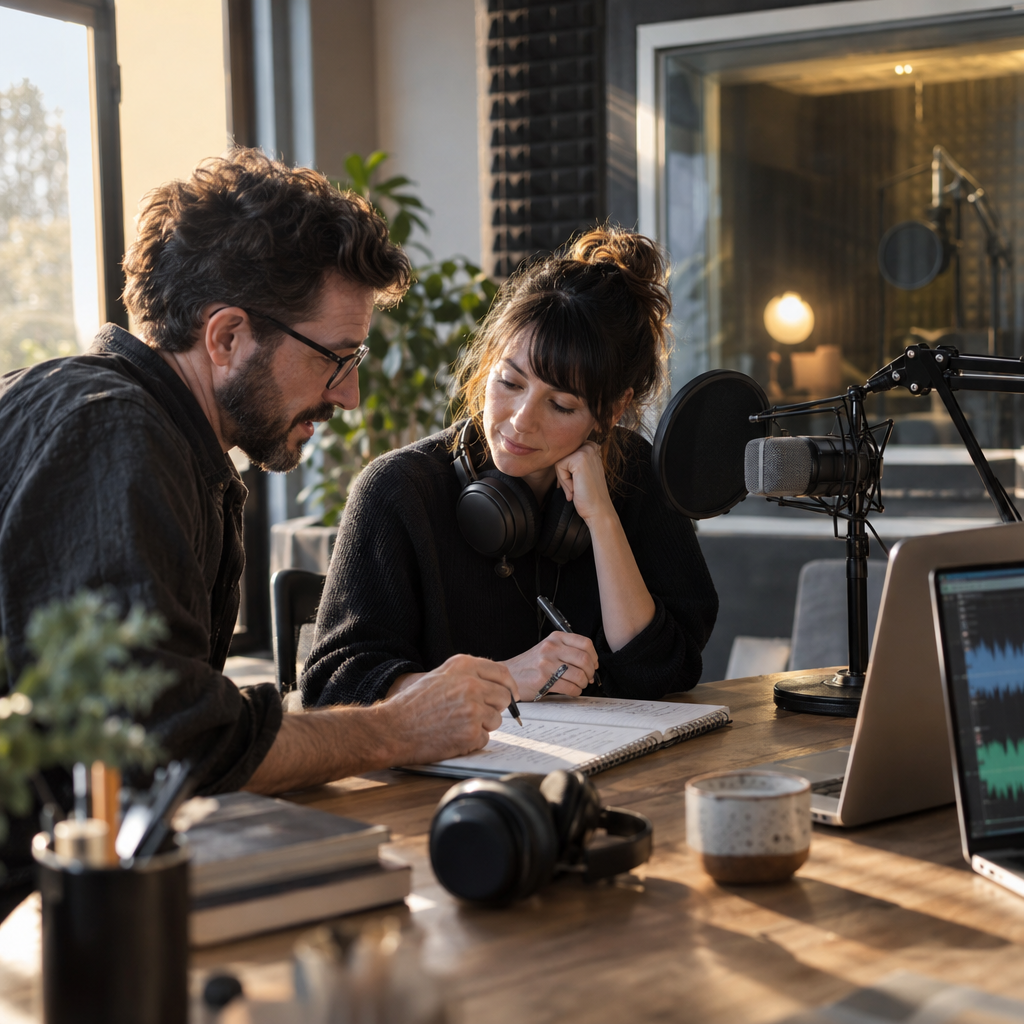
Seven in ten Americans aged 12+ have listened to a podcast, and your creator briefs probably still read like storyboards. Audio first content flips the job. The voice carries the ad, and the visuals are optional. Brands that brief voice note and podcast-style ads like polished video scripts get stiff reads, weak recall and compliance gaps. Here is a briefing system that avoids all three.
Why audio-first deserves its own brief
The audience is already there. Edison Research’s Infinite Dial report found that 70% of Americans age 12+ have listened to a podcast, and 55% are now monthly consumers. So “audio first” does not mean “audio only.” It means the audio has to work even when the screen is a static thumbnail or a phone in a pocket.
Trust is the other half of the case. In Harris Poll research on podcast advertising, 68% of podcast listeners said they are likely to trust recommendations from podcast hosts, and 67% found host-read ads effective. Also, 49% said they took some action after hearing a podcast ad, according to the same Harris Poll survey. Those are survey claims, not guarantees, but they point the same way: a familiar voice sounding like itself is the asset you are buying.
In audio, the creator’s natural voice is the media buy. Every line of your brief that makes them sound like a brand spokesperson is wasted spend.
Voice note ads vs. podcast-style ads: pick the format first
These are not the same thing, and briefs that blur them confuse creators.
- Voice note ads are short, intimate and first person. Think 20 to 45 seconds, spoken as if to one friend, often layered over a simple visual or a captioned waveform on Instagram, TikTok or Stories. The pitch is one idea.
- Podcast-style ads run longer (60 to 90 seconds is a sensible range to test) and can sit inside a creator’s own show or be produced as a standalone conversational spot. They can carry a short story, a personal result and a clear offer.
Choose based on the job. Awareness and consideration usually suit voice notes. Considered purchases and anything needing proof suit the longer format. If you are weighing whether the audio should carry the whole message or share it with on-screen text, the thinking in our guide to sound-off video captions applies in reverse. Plan for both listening modes.
What goes in the brief (and what stays out)
Creators doing audio hate scripts. Listeners hear them instantly. So brief outcomes and guardrails, not sentences.
- One message, ranked proof points. Give the single thing a listener should remember, plus two or three supporting facts the creator can choose from.
- Must-say lines, kept tiny. Brand name pronunciation, the offer and code, the disclosure. That is usually it. Three must-say items is plenty.
- Story prompts instead of copy. “Tell us about the last time you ran out of this at the worst moment” gets a better read than a drafted paragraph.
- Banned claims. List what cannot be promised, especially health, earnings or comparative claims.
- Audio specs. Quiet room, no music beds under the speech unless approved, a clean file at consistent volume, and a clear call to action placed twice (mid-read and at the close).
Does a no-script approach raise risk? Yes, which is why the banned-claims list and the approval step matter more here, not less. For claims-heavy categories, borrow the discipline from briefing product claims before anyone presses record.
The disclosure problem nobody budgets for
Here is where audio campaigns quietly go wrong. A text disclosure in show notes or a caption does not cover a spoken ad. A spoken ad calls for a spoken disclosure, and a line in the show notes alone is a risky way to cover it. Note that it is a law firm’s reading of the rules, so have your own counsel confirm for your markets.
In practice, write the disclosure into the brief as a required spoken line near the start of the read, not buried at the end. Something as simple as “This is a paid partnership with [Brand]” works. Gifted product, affiliate links and commissions each need the same treatment. Then add a post-delivery check: someone on your team listens to the file and confirms the line is present and audible. Treat it like a QA gate, because it is one.
Keeping the voice human
As synthetic voices get cheaper, authenticity becomes a differentiator you can write into contracts. Some brands are tempted to clone a creator’s voice for fast variants. That is a separate permission, a separate fee and a separate disclosure conversation. Our pieces on human voice clauses and proving human presence cover the wording in more depth.
Operationally, ask for raw takes. Imperfect breaths, a half-laugh, a self-correction: those are proof of a real person, and listeners respond to them. Do not request “clean it up” edits that sand away the very thing you paid for.
Distribution and rights: where the audio will live
A great voice note that cannot be amplified is half a campaign. Decide before contracting whether you will run the audio as paid media from the creator’s handle. If so, your agreement needs usage windows and permissions spelled out, and the process in whitelisting permissions is a useful checklist. Also confirm whether you can cut the audio into 15-second pieces, add captions or reuse it on other channels. Creators will price those rights differently, and surprises here sour relationships fast.
How do you measure an ad people can’t click?
Audio drives action, but rarely in a trackable straight line. The same Harris Poll research found that among listeners who acted after a podcast ad, 23% visited a website or social page and 20% made a purchase. That tells you to build for the visit and the search, not only the click.
- Vanity URLs and promo codes unique to each creator, spoken slowly and repeated.
- Post-purchase surveys with a “where did you hear about us” option that names podcasts and creators.
- Branded search lift tracked in the weeks after launch.
- Holdout comparisons where one creator’s audio runs without the code, to estimate baseline lift.
Be honest with stakeholders about attribution. Audio is a trust channel, and trust shows up in lagging indicators. The market is also growing, and more advertisers chasing the same listeners means more clutter. More money means more clutter, which makes a distinctive, human read more valuable.
FAQs
What is the ideal length for a voice note ad?
Start with 20 to 45 seconds and test. The goal is one idea delivered like a message to a friend. If the creator needs more time to prove a claim, move to a podcast-style format instead of stretching a voice note.
Should I give creators a script for audio ads?
Give them a message hierarchy, a few must-say lines and a list of banned claims, then let them write the read. Scripted audio tends to sound scripted, and listeners value the host’s own voice and tone. Keep approval rights for compliance, not for phrasing.
How should sponsorship disclosure work in audio ads?
Include a spoken disclosure early in the read, and repeat it in the written description where one exists. Show notes alone are not enough for a spoken ad. Confirm requirements with your legal team for each market.
Can I turn a podcast-style ad into paid social media?
Yes, if your contract grants the rights. Specify paid usage, duration, edit permissions (such as cutting down or adding captions) and whether the ad runs from the creator’s handle or the brand’s account.
How do I track results from audio-first content?
Use unique codes and vanity URLs, add a “heard it on” option to post-purchase surveys, and monitor branded search. Expect some effect to be indirect, so compare against a baseline rather than demanding last-click proof.
Is it acceptable to use an AI-cloned creator voice?
Only with explicit written consent, separate compensation and clear disclosure. Treat it as a different deliverable from a human recording, and spell it out in the contract.
Your next step: take one live creator brief this week, cut it to a single message, three must-say lines (including a spoken disclosure) and a banned-claims list, then run it as a two-creator test with unique codes.
Top Influencer Marketing Agencies
The leading agencies shaping influencer marketing in 2026
Agencies ranked by campaign performance, client diversity, platform expertise, proven ROI, industry recognition, and client satisfaction. Assessed through verified case studies, reviews, and industry consultations.
Moburst

-
2

The Shelf
Boutique Beauty & Lifestyle Influencer AgencyA data-driven boutique agency specializing exclusively in beauty, wellness, and lifestyle influencer campaigns on Instagram and TikTok. Best for brands already focused on the beauty/personal care space that need curated, aesthetic-driven content.Clients: Pepsi, The Honest Company, Hims, Elf Cosmetics, Pure LeafVisit The Shelf → -
3

Audiencly
Niche Gaming & Esports Influencer AgencyA specialized agency focused exclusively on gaming and esports creators on YouTube, Twitch, and TikTok. Ideal if your campaign is 100% gaming-focused — from game launches to hardware and esports events.Clients: Epic Games, NordVPN, Ubisoft, Wargaming, Tencent GamesVisit Audiencly → -
4

Viral Nation
Global Influencer Marketing & Talent AgencyA dual talent management and marketing agency with proprietary brand safety tools and a global creator network spanning nano-influencers to celebrities across all major platforms.Clients: Meta, Activision Blizzard, Energizer, Aston Martin, WalmartVisit Viral Nation → -
5

The Influencer Marketing Factory
TikTok, Instagram & YouTube CampaignsA full-service agency with strong TikTok expertise, offering end-to-end campaign management from influencer discovery through performance reporting with a focus on platform-native content.Clients: Google, Snapchat, Universal Music, Bumble, YelpVisit TIMF → -
6

NeoReach
Enterprise Analytics & Influencer CampaignsAn enterprise-focused agency combining managed campaigns with a powerful self-service data platform for influencer search, audience analytics, and attribution modeling.Clients: Amazon, Airbnb, Netflix, Honda, The New York TimesVisit NeoReach → -
7

Ubiquitous
Creator-First Marketing PlatformA tech-driven platform combining self-service tools with managed campaign options, emphasizing speed and scalability for brands managing multiple influencer relationships.Clients: Lyft, Disney, Target, American Eagle, NetflixVisit Ubiquitous → -
8

Obviously
Scalable Enterprise Influencer CampaignsA tech-enabled agency built for high-volume campaigns, coordinating hundreds of creators simultaneously with end-to-end logistics, content rights management, and product seeding.Clients: Google, Ulta Beauty, Converse, AmazonVisit Obviously →