


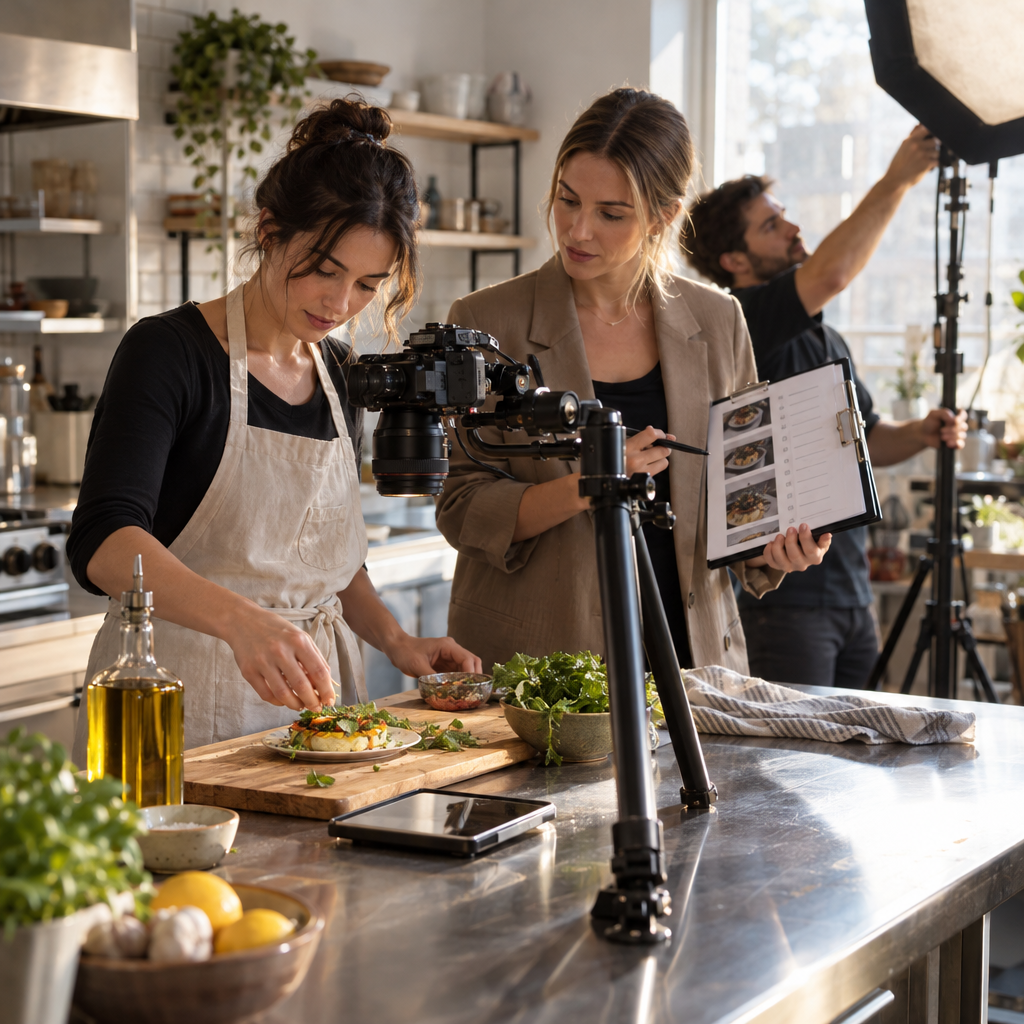
Recipe hack videos are easy to commission and hard to brief well. Most fail the same way: the product sits in frame while the creator does the actual work. Viewers notice. Reviewers notice faster. A recipe hack video works when removing your product breaks the recipe. This article shows how to brief for that, and how to keep claims and disclosure clean.
What does “proving the product” mean in a recipe?
A hack is a promise of a shortcut. Three-ingredient pasta sauce, crispy fries without the fryer, a smoothie bowl in 90 seconds. The viewer is asking one question: does this really work?
Your product is the answer, but only if the video shows it earning its place. That means the product performs a visible job at a specific step. The air fryer crisps the skin. The sauce base replaces six ingredients. The blender makes the texture on camera, not in a pre-made shot.
The brief should name that job in one sentence. If your team can’t write it, the creator can’t film it.
- Product role: what the item does that substitutes can’t (time saved, ingredient count cut, texture achieved).
- Proof moment: the single shot where the result becomes visible, unedited.
- Failure condition: what the recipe looks like without the product, so the contrast is honest.
Brief the steps, not the script
Over-scripted creator content reads like an ad, and audiences scroll past it. Under-briefed content ships claims you never approved. The fix is to lock the steps and loosen the voice.
Give the creator a numbered method with quantities, timings and settings. Then let them narrate it their way. Steps are facts you can verify. Voice is the creator’s asset.
- Ingredient list with exact amounts. If the hack depends on 2 tablespoons, say so.
- Product settings and timing. Temperature, cycle, speed, wait time. Show the timer on screen.
- One uncut proof shot. No jump cut between raw and finished at the product step.
- Result shown at the end. Cut, pour, bite, or pull apart. Texture is the evidence.
- Honest caveats. Batch size limits, cleanup time, anything that changes the result.
Why the uncut shot? Because jump cuts are where trust leaks. A viewer who sees the sauce thicken in real time believes the claim. A viewer who sees a cut to a finished bowl assumes the creator had a second bowl. For a related approach to evidence on screen, see our guide on before and after proof.
If the product can be cut out of the video without changing the recipe, the video is a placement, not a proof.
Claims: where recipe hacks get risky
Food content drifts into health language fast. “Healthier fries.” “Gut-friendly.” “Protein-packed.” The creator means it casually. A regulator reads it as an advertising claim.
The FTC’s position is straightforward. Its health products compliance guidance says that claims about the health benefits or safety of foods and dietary supplements generally require competent and reliable scientific evidence. It also says that when an ad supports more than one reasonable reading, the advertiser must substantiate each interpretation. So “light and healthy” on a hack video can create two claims you now have to back up.
Practical brief language that helps:
- Approve performance claims (crispy, ready in 10 minutes, fewer ingredients) only when your team has tested them under the filmed conditions.
- Ban health, weight, or disease language unless legal has cleared it with evidence.
- Require the creator to cook the recipe as written in the brief, with the stated product settings, so what viewers see matches what you tested.
- Flag comparative language (“better than,” “beats the old way”) for review. Our piece on price comparison videos covers how to document numbers before they go live.
Run a kitchen test before you brief. Have someone on your team follow the steps cold. If they can’t reproduce the result, neither can the audience, and the comments will say so.
Disclosure that survives a 15-second video
Recipe hacks are fast. Captions get truncated. Creators often show the product with no obvious sign of a deal. That is the setup for a compliance miss.
The FTC’s endorsement guides Q&A explains that a connection between an endorser and a marketer that a significant minority of consumers wouldn’t expect, and that would affect how they weigh the endorsement, should be disclosed clearly and conspicuously. A free product or a payment fits that description.
The wider problem is how often disclosure slips. In its 2024 review of Instagram and TikTok content, the UK’s Advertising Standards Authority found that 57% of the influencer ads it analysed followed its disclosure rules, 9% tried a label that failed to make the commercial nature clear, and 34% had no disclosure at all. Roughly one in three missed it entirely. If you run campaigns in the UK, or want a benchmark for how regulators see the category, that is the number to show your legal team.
For recipe hacks, build disclosure into the format:
- Put a spoken disclosure in the first sentence, over the opening shot.
- Add an on-screen label that stays visible through the proof moment, not just the first second.
- Repeat it at the front of the caption, before any “see more” fold.
- Don’t rely on a platform tool alone. Use it in addition to the creator’s own words.
Our guide on keeping disclosure real in scripted scenarios covers the same tension between natural tone and clear labelling.
How do you pick creators who can pull this off?
Not every food creator should get this brief. Look for people who already film process, not just plating. Scroll their last twenty videos and check three things: do they show full cook times, do they tolerate imperfect results on camera, and do their comments contain people reporting that they made the recipe?
That last signal matters most. Comments like “made this tonight” are first-party evidence of trust. Comments that only say “yum” are applause.
Ask for a test cook before contracting. Pay for it if you have to. A creator who flags that your hack takes 25 minutes, not 10, is protecting you from a claim problem. Keep that person.
Measuring whether the proof landed
Views are cheap. Look for signals that suggest viewers believed the demo.
- Saves and shares versus likes. People save recipes they plan to cook.
- Comment sentiment on the result. Track “does this actually work?” questions and whether they get answered. A creator reply with a clarification is worth pinning. This is where troubleshooting content can follow up.
- Product page behavior. Use unique links or codes per creator and compare conversion on the specific hero product against the baseline.
- Reuse performance. Strong proof clips often make the best paid assets, provided usage rights are in the contract. See how to structure paid media libraries.
Set the success metric before the shoot. If the goal is conversion on one SKU, don’t judge the campaign on reach.
FAQs
What is a recipe hack video in influencer marketing?
It is a short video that presents a shortcut or trick for making food, with a brand’s product used as the tool or ingredient that makes the shortcut possible. The format works for appliances, packaged foods, cookware, and grocery brands.
How detailed should the brief be?
Detailed on facts, loose on voice. Specify ingredient amounts, product settings, timings, the proof shot, and prohibited claims. Leave the hook, pacing and humor to the creator.
Do recipe videos need to disclose free products?
Yes, when the creator has a material connection with the brand, such as payment or free product, that audiences wouldn’t expect. The FTC says such connections should be disclosed clearly and conspicuously, so put the disclosure in the video itself and the caption.
Can creators make health claims about the food?
Only if you can substantiate them. The FTC generally expects competent and reliable scientific evidence for health claims about foods. The safest brief bans health language unless legal has approved it.
How many creators should I test first?
Start with a small group of three to five, each with a test cook, so you can compare which proof moment drives saves and conversions before scaling. If you need volume later, our guide on phone-shot UGC at scale covers how to brief larger groups.
Before your next brief goes out, write the product’s one job in a sentence, cook the recipe yourself, and make the uncut proof shot a required deliverable.
Top Influencer Marketing Agencies
The leading agencies shaping influencer marketing in 2026
Agencies ranked by campaign performance, client diversity, platform expertise, proven ROI, industry recognition, and client satisfaction. Assessed through verified case studies, reviews, and industry consultations.
Moburst

-
2

The Shelf
Boutique Beauty & Lifestyle Influencer AgencyA data-driven boutique agency specializing exclusively in beauty, wellness, and lifestyle influencer campaigns on Instagram and TikTok. Best for brands already focused on the beauty/personal care space that need curated, aesthetic-driven content.Clients: Pepsi, The Honest Company, Hims, Elf Cosmetics, Pure LeafVisit The Shelf → -
3

Audiencly
Niche Gaming & Esports Influencer AgencyA specialized agency focused exclusively on gaming and esports creators on YouTube, Twitch, and TikTok. Ideal if your campaign is 100% gaming-focused — from game launches to hardware and esports events.Clients: Epic Games, NordVPN, Ubisoft, Wargaming, Tencent GamesVisit Audiencly → -
4

Viral Nation
Global Influencer Marketing & Talent AgencyA dual talent management and marketing agency with proprietary brand safety tools and a global creator network spanning nano-influencers to celebrities across all major platforms.Clients: Meta, Activision Blizzard, Energizer, Aston Martin, WalmartVisit Viral Nation → -
5

The Influencer Marketing Factory
TikTok, Instagram & YouTube CampaignsA full-service agency with strong TikTok expertise, offering end-to-end campaign management from influencer discovery through performance reporting with a focus on platform-native content.Clients: Google, Snapchat, Universal Music, Bumble, YelpVisit TIMF → -
6

NeoReach
Enterprise Analytics & Influencer CampaignsAn enterprise-focused agency combining managed campaigns with a powerful self-service data platform for influencer search, audience analytics, and attribution modeling.Clients: Amazon, Airbnb, Netflix, Honda, The New York TimesVisit NeoReach → -
7

Ubiquitous
Creator-First Marketing PlatformA tech-driven platform combining self-service tools with managed campaign options, emphasizing speed and scalability for brands managing multiple influencer relationships.Clients: Lyft, Disney, Target, American Eagle, NetflixVisit Ubiquitous → -
8

Obviously
Scalable Enterprise Influencer CampaignsA tech-enabled agency built for high-volume campaigns, coordinating hundreds of creators simultaneously with end-to-end logistics, content rights management, and product seeding.Clients: Google, Ulta Beauty, Converse, AmazonVisit Obviously →