


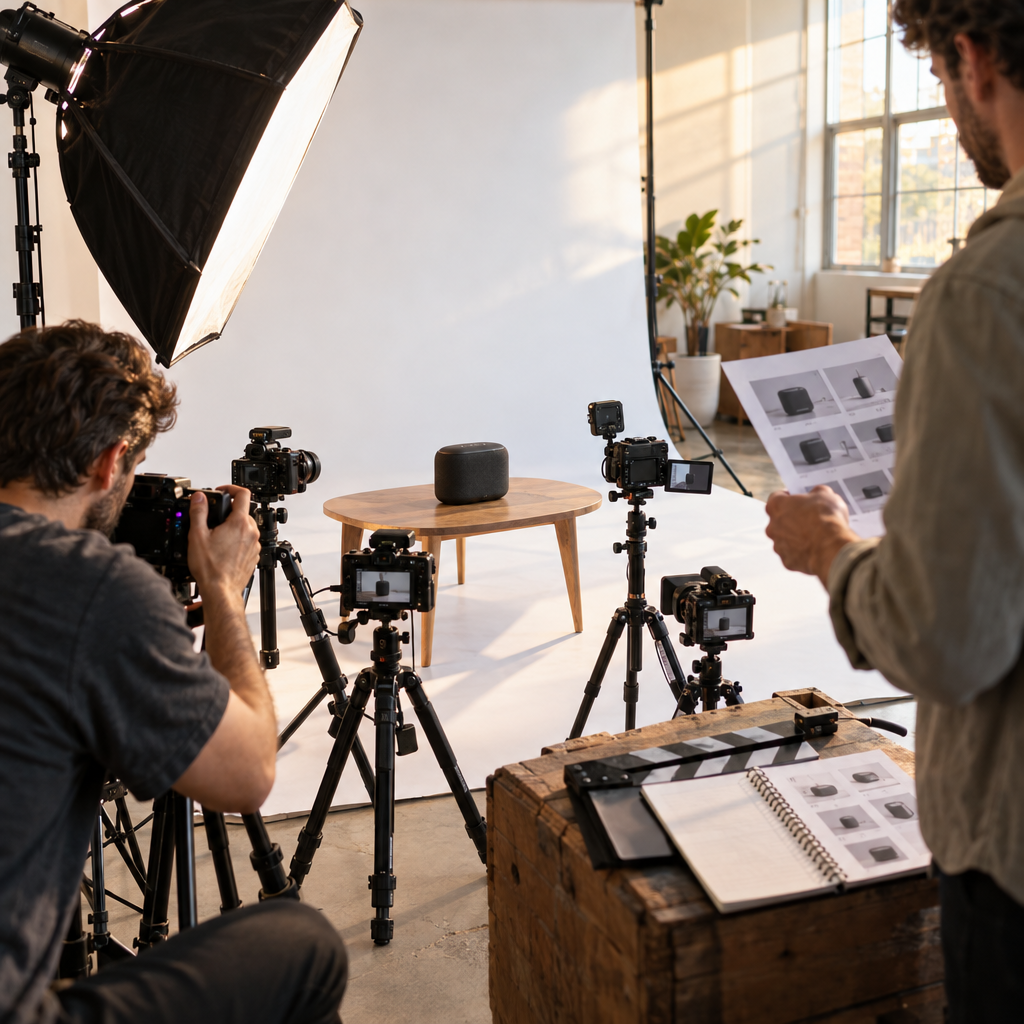
Most brands brief one demo video and then wonder why paid testing tells them nothing. One video is one data point. Multi-angle product demos flip that: a single shoot produces footage you can recut into distinct, testable ads. The brief is where it succeeds or fails, so here is how to write one that gives your media buyers real variables to test.
Why one demo cut can’t carry a test
A creator films a demo. The editor cuts it. Paid social runs it. It underperforms, and nobody knows why. Was it the opening, the product close-up, the pacing, the voiceover?
When the footage exists in only one edit, you can’t answer that. You are testing a finished ad, not a hypothesis.
Multi-angle briefing changes the unit of work. You stop ordering a video and start ordering a library of shots, each tagged to a purpose. The creator is still the face and voice. But the deliverable is raw material designed for recombination, which is the same logic behind modular asset shoots.
The economics are simple. Creator day rates, product shipping, and usage rights are the expensive parts. Extra camera angles during an existing shoot cost almost nothing by comparison. You pay once and test many times.
The angle set worth briefing
Don’t ask for “lots of angles.” That produces redundant footage and a messy folder. Name each angle and say what job it does.
- Hero wide: the creator and product in one frame, establishing context and scale. This is your safe baseline.
- Over-the-shoulder POV: the viewer sees the product as the user does. It works well for apps, tools, and anything with a workflow.
- Macro close-up: texture, mechanism, ingredients, stitching. Proof of quality without a single claim.
- Face-to-camera reaction: the creator’s expression during first use. Hard to fake, and often your strongest hook.
- Screen or surface capture: for digital products, the actual interface. For physical goods, the countertop or table view of the process.
- In-context lifestyle: the product in a real room, car, gym bag, or desk. It answers “would this fit my life?”
Six angles is plenty. More than that and creators rush each one.
Brief for variables, not vibes
Here is the mistake I see most. Brands ask for angle variety but give no instruction on what stays constant. Then the creator changes the lighting, the script, and the energy between takes, and every difference is confounded.
Write it into the brief: same script, same demo sequence, same lighting, same outfit, different camera positions. Hold the product action identical across takes. If the creator pours, twists, and taps in that order on the hero wide, they do it in that order on the macro.
Then separate the two test layers.
- Angle test: same audio and edit pace, different dominant visual (POV vs. wide vs. macro).
- Opener test: same body of the ad, different first three seconds, pulled from different angles.
The opener layer usually moves results most, so it deserves its own planning. Our guides on first three second hooks and hook rate benchmarks cover how to set targets for that layer.
Angle variety only becomes insight when everything else stays fixed. Brief the constants as firmly as you brief the camera positions.
Shot list and file discipline
Raw footage without structure is a liability. Your editor will lose hours hunting for the right take, and your media buyer won’t know which clip fed which ad.
Put three operational rules in the brief:
- Naming convention: creator, product, angle, take number (for example, JMartin_Serum_Macro_T2). Reject deliveries that don’t follow it.
- Clean takes: require two to three full passes of the demo per angle, plus a short slate or clap so audio and picture sync.
- Handles: ask creators to hold the first and last moments of each action for a beat. Editors need that room to cut cleanly.
Specify capture format too. Shoot vertical at 9:16 as the primary, but frame with a safe center so you can crop to 4:5 and 1:1 for feed placements. If retail media or connected TV is on the plan, request a few horizontal passes as well. The 16:9 spec guide explains what reviewers look for there.
Keep captions and platform interface zones in mind. Bottom-third text collides with the buttons and caption fields on most short-form platforms, so tell creators to keep key product action in the middle of the frame.
Where does the script fit?
Multi-angle shooting needs a script spine. Without one, each angle captures a different improvised performance and recombination becomes impossible.
Use a beat structure: problem, first touch, demonstration, proof moment, outcome. Each beat gets filmed from at least two angles. Our breakdown of demo script formats shows how to build beats that convert and still survive legal review.
Leave room for the creator’s own phrasing within each beat. Audiences punish stiffness, and creators know their followers’ language. Lock the claims, not the cadence.
What about silent viewing? Plan for it. Many viewers watch with sound off, so the macro and POV angles should communicate the demo visually, with on-screen text carrying the key point. The proof map approach is a useful template.
Compliance travels with the footage
Multiple angles mean multiple edits, and every edit is an ad that must stand on its own. That is where brands get exposed.
The FTC’s guidance is direct on the core principle: endorsements must reflect the endorser’s honest experience, and a brand supplying pre-written content or standard images is not prohibited per se, but the content cannot convey something untrue, such as use the creator never had. For demo footage, that has a practical consequence. If you recut a creator’s footage into a new ad, the edit can’t imply results, usage, or experiences that the original take didn’t show.
Disclosure needs the same rigor. The FTC’s Disclosures 101 for influencers advises against burying a disclosure in a pile of hashtags and says that for picture-based endorsements, the disclosure should be superimposed with enough time to read. Apply that to every cut. A disclosure that appears in the hero wide but vanishes in the macro recut is a gap, not a variant.
Build this into the brief:
- A disclosure overlay template that editors apply to every variant, with minimum on-screen duration.
- A claims sheet listing what the creator may and may not say or show, approved before filming.
- A rule that any recut which changes meaning goes back to the creator and legal for sign-off.
Usage rights matter just as much. Paid testing means whitelisting or licensing, and the contract should explicitly cover raw footage, derivative edits, and the length of the paid window.
Reading the results without fooling yourself
Run angle tests with equal budget and the same audience, and let each variant gather enough impressions to compare hook rate, hold rate, and cost per outcome. Don’t call a winner off a few hundred views.
Two traps to watch. First, a high hook rate with weak conversion often means the opener is promising something the demo doesn’t deliver. Second, platforms may favor visually near-identical ads in delivery, so make sure your angles look genuinely different, not like slight crops of the same frame.
Feed what you learn back into the next brief. If POV demos beat wides for a product category, the next shoot weights time toward POV. Over a few cycles, you stop guessing and start briefing from your own data. For related approaches, see how one shoot becomes five assets.
Next step: before your next creator shoot, add a one-page shot list naming six angles, locking the script and lighting, and requiring a disclosure overlay for every recut.
FAQs
What are multi-angle product demos?
They are demo shoots where the same product action is filmed from several planned camera positions, such as wide, POV, macro, and reaction. The goal is to produce footage that can be recut into different ads for paid testing.
How many angles should I ask a creator to film?
Four to six named angles is a practical range. Beyond that, creators tend to rush and the footage becomes redundant. Give each angle a specific job in the brief.
Does extra footage raise creator fees?
Often modestly, since the main costs are the creator’s time, product, and usage rights. Negotiate the angle set and the derivative-edit rights up front, so the added scope is priced into the original agreement.
How do I keep recut ads compliant?
Treat each edit as its own ad. Apply a standard disclosure overlay, keep claims within the approved sheet, and never let a recut imply an experience the creator did not have. The FTC’s endorsement guidance stresses honest, truthful endorsements.
What should I test first: angles or openers?
Start with openers, since the first seconds usually decide whether anyone watches. Once you have a strong opener, test which dominant angle carries the body of the ad.
Do I need to shoot horizontal footage too?
Only if your plan includes placements that use 16:9, such as connected TV or retail media. Otherwise, shoot vertical with a safe center that crops to 4:5 and 1:1.
Can I give creators a pre-written script?
Yes, but the content must still reflect their genuine experience. Lock the claims and beats, and let creators use their own phrasing.
Top Influencer Marketing Agencies
The leading agencies shaping influencer marketing in 2026
Agencies ranked by campaign performance, client diversity, platform expertise, proven ROI, industry recognition, and client satisfaction. Assessed through verified case studies, reviews, and industry consultations.
Moburst

-
2

The Shelf
Boutique Beauty & Lifestyle Influencer AgencyA data-driven boutique agency specializing exclusively in beauty, wellness, and lifestyle influencer campaigns on Instagram and TikTok. Best for brands already focused on the beauty/personal care space that need curated, aesthetic-driven content.Clients: Pepsi, The Honest Company, Hims, Elf Cosmetics, Pure LeafVisit The Shelf → -
3

Audiencly
Niche Gaming & Esports Influencer AgencyA specialized agency focused exclusively on gaming and esports creators on YouTube, Twitch, and TikTok. Ideal if your campaign is 100% gaming-focused — from game launches to hardware and esports events.Clients: Epic Games, NordVPN, Ubisoft, Wargaming, Tencent GamesVisit Audiencly → -
4

Viral Nation
Global Influencer Marketing & Talent AgencyA dual talent management and marketing agency with proprietary brand safety tools and a global creator network spanning nano-influencers to celebrities across all major platforms.Clients: Meta, Activision Blizzard, Energizer, Aston Martin, WalmartVisit Viral Nation → -
5

The Influencer Marketing Factory
TikTok, Instagram & YouTube CampaignsA full-service agency with strong TikTok expertise, offering end-to-end campaign management from influencer discovery through performance reporting with a focus on platform-native content.Clients: Google, Snapchat, Universal Music, Bumble, YelpVisit TIMF → -
6

NeoReach
Enterprise Analytics & Influencer CampaignsAn enterprise-focused agency combining managed campaigns with a powerful self-service data platform for influencer search, audience analytics, and attribution modeling.Clients: Amazon, Airbnb, Netflix, Honda, The New York TimesVisit NeoReach → -
7

Ubiquitous
Creator-First Marketing PlatformA tech-driven platform combining self-service tools with managed campaign options, emphasizing speed and scalability for brands managing multiple influencer relationships.Clients: Lyft, Disney, Target, American Eagle, NetflixVisit Ubiquitous → -
8

Obviously
Scalable Enterprise Influencer CampaignsA tech-enabled agency built for high-volume campaigns, coordinating hundreds of creators simultaneously with end-to-end logistics, content rights management, and product seeding.Clients: Google, Ulta Beauty, Converse, AmazonVisit Obviously →