


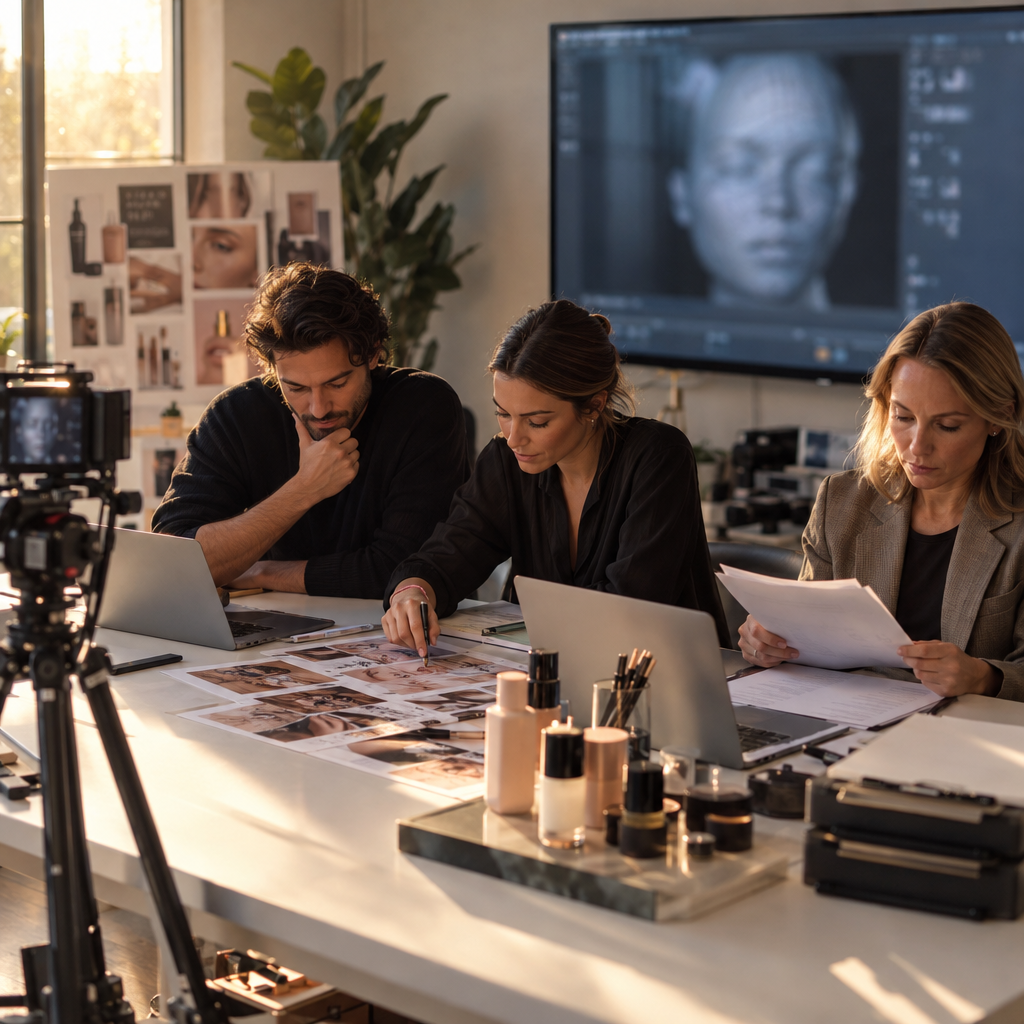
A beauty shade that exists only in a render can still sit on a real creator’s cheekbone in the same frame. That is the promise and the problem of CGI-human hybrid creator content. The format blends a real face, real opinions and computer-generated elements, and most briefs aren’t built for it. This guide covers how to split roles, lock claims, handle disclosure and approve work without killing the creator’s voice.
What exactly is a hybrid, and why does beauty keep reaching for it?
Hybrid content puts a human creator and synthetic elements in one story. Think of a creator doing a real morning routine while a CGI skin layer visualizes how an active ingredient works. Or a real creator talking to camera beside a rendered brand mascot. Or a fully virtual persona fronting a campaign with a human voice behind it.
Beauty is the natural home for this. The category sells invisible things: penetration depth, pigment payoff, hydration over eight hours. CGI makes them visible. The creator makes them believable. Neither does both jobs alone.
Here’s the catch. The more convincing the blend, the more it looks like a claim. A render of a serum “working” reads as evidence to a scrolling viewer, whether you meant it as illustration or not.
Split the roles in writing before anyone opens software
The most common failure I see is a brief that treats the CGI as a visual style note. It isn’t. It’s a second production stream with its own owner, its own approvals and its own legal exposure.
Write the brief around three lanes:
- The creator lane. First-person experience, voice, reactions, results on their own skin. Nothing here can be rendered or faked.
- The synthetic lane. Mechanism visuals, product animations, environments, texture close-ups. Each asset gets a label: illustrative, representative or literal.
- The seam. Every moment where the two touch. This is where viewers get confused and where regulators look.
Spend most of your brief time on the seam. Specify which shots mix real skin and rendered effects, and what the creator says out loud at that moment. A line like “this animation shows how the ingredient is designed to work, my results are what you see on my face” costs two seconds and saves a rewrite.
If a viewer can’t tell which pixels are the creator’s skin and which are a render, your brief has failed before legal ever sees it.
Claims: the render is not a clinical result
Beauty teams already know claim substantiation. Hybrids add a new trap: visuals that imply substantiation you don’t have. A CGI cross-section showing a peptide reaching the dermis implies a mechanism. If your testing supports only surface hydration, that frame is a claim you can’t back.
Build a claim table into the brief. Each row lists the on-screen element, the claim it implies, the evidence file that supports it and the approved caption or voiceover. Our guide to locking claims across outputs covers how to keep that table consistent when one asset becomes six cutdowns.
A few rules that hold up in practice:
- No synthetic before-and-after imagery. Ever. Results shown must be the creator’s real, unretouched outcome.
- Rendered textures and shades must match the physical product under the lighting shown, and the creator should swatch the real thing on camera.
- Mechanism visuals carry an on-screen “illustration” tag for their full duration, not just the first frame.
- The creator never voices a sensory claim about a product experience they didn’t have. That matters most for virtual personas.
Disclosure: three layers, not one
Hybrid campaigns carry more than one disclosure duty, and teams routinely cover only the first.
Layer one is the paid relationship. That’s standard ad disclosure, in the video itself and not buried in a caption. The FTC’s revised Endorsement Guides also changed the definition of endorsements to address virtual influencers and fake reviews. The same announcement added a definition of “clear and conspicuous” and said a platform’s built-in disclosure tool might not be enough on its own. So your paid-partnership toggle is a supplement, not a plan.
Layer two is the synthetic nature of what viewers see. If a virtual persona fronts the content, say so in the profile and in the post. If synthetic elements could change how a viewer reads the result, label them. Our piece on AI-generated B-roll standards offers a workable labeling approach you can adapt.
Layer three is the regional rulebook. In the EU, the Commission’s AI transparency guidelines state that Article 50 of the AI Act applies from 2 August 2026, and that deployers of AI systems must inform individuals when they are exposed to deepfakes. Whether a given beauty render counts as a deepfake is a question for your counsel, not your creative team. But if your hybrid uses a realistic likeness of a real person, put it on the legal review list early.
In the UK, the ASA has been blunt. The same summary stresses that advertisers stay responsible for biased or stereotyped AI output. For beauty, that last point matters. Rendered faces and bodies skew toward narrow ideals unless someone briefs against it.
Does this hurt creator trust?
It can. Audiences forgive artifice when they’re told about it and punish it when they find it. The fix isn’t less CGI. It’s less ambiguity.
Give the creator a real role in the story, not a talking-head wrapper around your animation. Let them react to the render, question it or poke fun at it. A creator who says “okay, the animation is dramatic, here’s what I actually noticed after two weeks” earns more trust than ten seconds of polished mechanism footage.
This is the same logic that makes lo-fi phone camera ads work. Imperfection signals honesty. In a hybrid, the human segments should carry that signal while the synthetic segments carry the clarity. Don’t polish the creator to match the render. Let the contrast be visible.
A brief template you can steal
Here is the skeleton I’d put in every hybrid brief:
- Objective and single message. One thing the viewer should believe after watching.
- Role split. What the creator owns, what the studio owns, and who signs off on the seam.
- Claim table. Element, implied claim, evidence, approved wording.
- Asset labels. Illustrative, representative or literal, per shot.
- Disclosure script. Exact on-screen text and spoken line for the ad relationship and the synthetic elements.
- Likeness and rights. Whose face, voice or body data is used, under what license, for how long.
- Review gates. Storyboard, rough cut with placeholder renders, final cut. Legal sees the second one, not just the last.
- Kill criteria. What would pull the asset, such as a viewer-confusion signal in comments.
Budget the review gates honestly. Renders are expensive to redo, which is why teams wave questionable frames through at the end. Catching a claim problem at storyboard stage costs an afternoon. Catching it at final cut costs a production week.
How do you measure whether it worked?
Don’t stop at views. Hybrid content has a specific risk profile, so measure against it:
- Comment sentiment on authenticity, tracked with a simple tag set (confused, skeptical, impressed).
- Save and share rate on mechanism segments versus pure-creator segments.
- Click-through and conversion from the hybrid cut compared with a creator-only control.
- Return and complaint rates tied to shade or texture, which tell you whether the render oversold the product.
That last one is underrated. If rendered shades drive purchases and then returns, the CGI is borrowing against your future margin.
If you plan a recurring format, think in arcs rather than one-offs. A consistent hybrid look compounds, the way a well-run serialized creator series builds familiarity. Consistency also makes disclosure habits easier for audiences to learn.
FAQs
What is CGI-human hybrid creator content?
It’s content in which a real creator and computer-generated elements share one story. The CGI might be a product animation, a mechanism visual, a rendered environment or a virtual persona alongside a human. The creator supplies real experience and voice, and the synthetic layer supplies visuals that are hard to film.
Do virtual influencers need to be disclosed as paid endorsements?
Yes. The FTC’s revised Endorsement Guides address virtual influencers in the definition of endorsements, so the brand relationship must be disclosed clearly and conspicuously. Treat the synthetic nature of the persona as a separate disclosure on top of the paid relationship.
Can we show CGI before-and-after results in a beauty campaign?
Avoid it. Synthetic results imply an outcome you can’t substantiate. Show the creator’s own unretouched results, and keep any rendered visuals clearly labeled as illustration of how a product is designed to work.
Which rules apply in the EU and UK?
In the EU, Article 50 of the AI Act brings transparency obligations from 2 August 2026, including for deepfakes. In the UK, the ASA applies the CAP Code to AI-generated ads and holds advertisers responsible for the output. Have counsel confirm how each applies to your specific renders.
Who should approve hybrid content?
Assign one owner for the seam between human and synthetic footage, and bring legal in at the rough cut with placeholder renders. Waiting for the final cut makes fixes costly and invites rubber-stamping.
Next step: take your last beauty brief and add the claim table and asset labels, then send the rough cut to legal before any render is finalized.
Top Influencer Marketing Agencies
The leading agencies shaping influencer marketing in 2026
Agencies ranked by campaign performance, client diversity, platform expertise, proven ROI, industry recognition, and client satisfaction. Assessed through verified case studies, reviews, and industry consultations.
Moburst

-
2

The Shelf
Boutique Beauty & Lifestyle Influencer AgencyA data-driven boutique agency specializing exclusively in beauty, wellness, and lifestyle influencer campaigns on Instagram and TikTok. Best for brands already focused on the beauty/personal care space that need curated, aesthetic-driven content.Clients: Pepsi, The Honest Company, Hims, Elf Cosmetics, Pure LeafVisit The Shelf → -
3

Audiencly
Niche Gaming & Esports Influencer AgencyA specialized agency focused exclusively on gaming and esports creators on YouTube, Twitch, and TikTok. Ideal if your campaign is 100% gaming-focused — from game launches to hardware and esports events.Clients: Epic Games, NordVPN, Ubisoft, Wargaming, Tencent GamesVisit Audiencly → -
4

Viral Nation
Global Influencer Marketing & Talent AgencyA dual talent management and marketing agency with proprietary brand safety tools and a global creator network spanning nano-influencers to celebrities across all major platforms.Clients: Meta, Activision Blizzard, Energizer, Aston Martin, WalmartVisit Viral Nation → -
5

The Influencer Marketing Factory
TikTok, Instagram & YouTube CampaignsA full-service agency with strong TikTok expertise, offering end-to-end campaign management from influencer discovery through performance reporting with a focus on platform-native content.Clients: Google, Snapchat, Universal Music, Bumble, YelpVisit TIMF → -
6

NeoReach
Enterprise Analytics & Influencer CampaignsAn enterprise-focused agency combining managed campaigns with a powerful self-service data platform for influencer search, audience analytics, and attribution modeling.Clients: Amazon, Airbnb, Netflix, Honda, The New York TimesVisit NeoReach → -
7

Ubiquitous
Creator-First Marketing PlatformA tech-driven platform combining self-service tools with managed campaign options, emphasizing speed and scalability for brands managing multiple influencer relationships.Clients: Lyft, Disney, Target, American Eagle, NetflixVisit Ubiquitous → -
8

Obviously
Scalable Enterprise Influencer CampaignsA tech-enabled agency built for high-volume campaigns, coordinating hundreds of creators simultaneously with end-to-end logistics, content rights management, and product seeding.Clients: Google, Ulta Beauty, Converse, AmazonVisit Obviously →