


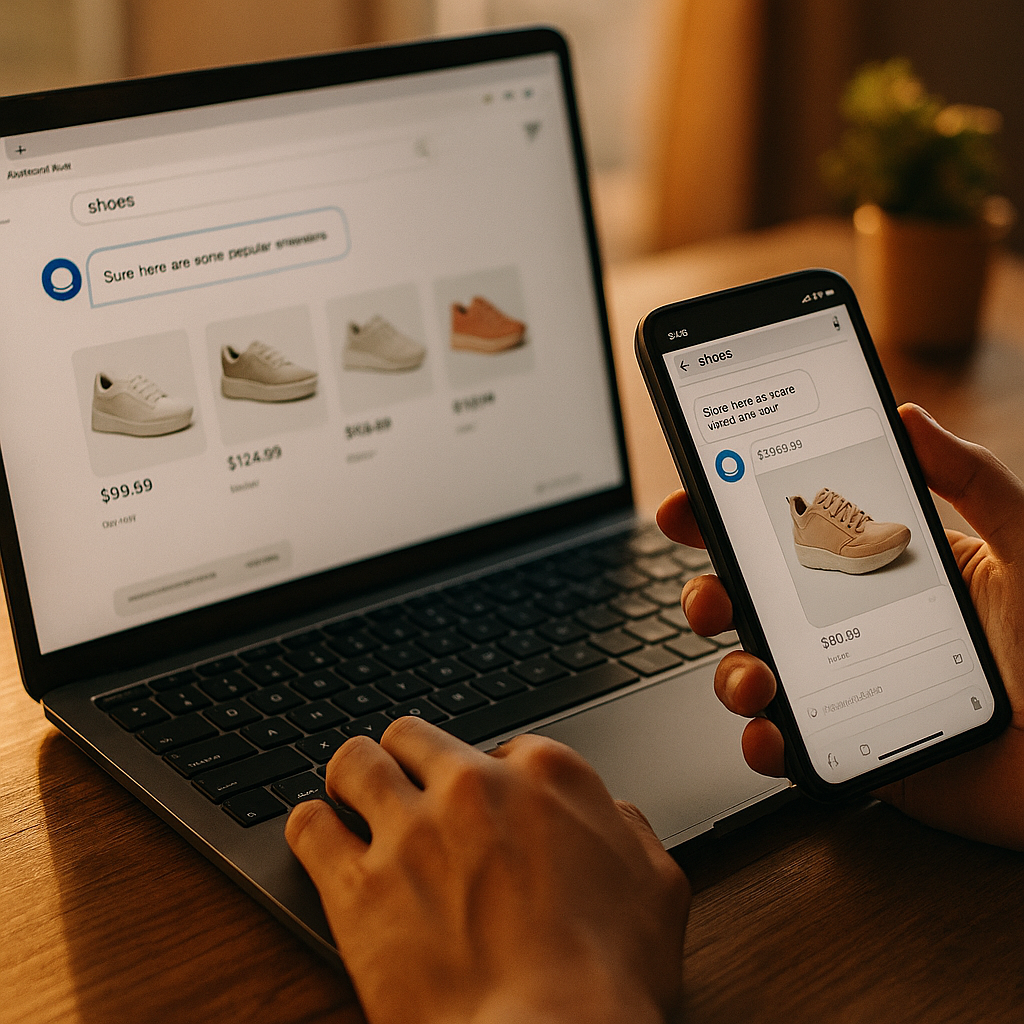
Agentic SEO is reshaping how shoppers discover brands as personal AI shopping assistants move from novelty to default. Instead of scrolling search results, people ask assistants to compare, filter, and buy. That changes what “ranking” means: you must be the best answer, not the loudest ad. Ready to make your products the assistant’s first recommendation?
Personal AI shopping assistants: how discovery and ranking really work
Personal AI shopping assistants increasingly act like procurement agents: they interpret intent, gather options, evaluate tradeoffs, and recommend (or complete) a purchase. They pull from multiple sources—your website, product feeds, reviews, marketplace listings, and third-party content—and then synthesize an answer that fits a user’s constraints (budget, delivery window, sustainability preferences, compatibility, returns policy, and more).
To “rank” in this environment, your brand needs to be:
- Legible to machines: clear product data, consistent identifiers, and accessible policies.
- Trustworthy to humans and systems: verifiable claims, strong reviews, and transparent support.
- Comparable: structured information that makes it easy to evaluate against alternatives.
- Available: accurate inventory, shipping estimates, and regional pricing.
The ranking moment often happens after the assistant has narrowed the field. If your product data is incomplete, your policies are hidden, or your claims are hard to verify, the assistant may filter you out before a user even sees your name. This is why optimization shifts from keywords alone to decision readiness: giving the agent everything it needs to confidently recommend you.
Practical implication: treat every product page and supporting asset as an input to an agent’s decision model—features, constraints, proof, and after-sale experience. If you answer those systematically, the assistant can cite you accurately and recommend you more often.
AI shopping optimization: build machine-readable product truth
Start with one principle: the assistant can only recommend what it can understand. “Understand” means your data is consistent, structured, and complete across your website, feeds, and third-party surfaces.
1) Create a single source of truth for product data. Maintain canonical values for:
- Brand, model name, and model number (or SKU/MPN)
- GTIN/UPC/EAN (when applicable)
- Variants (size, color, material) with distinct identifiers
- Dimensions, weight, compatibility, and included accessories
- Warranty length, what’s covered, and claims process
2) Make comparisons effortless. Assistants often assemble comparison tables. Help them by using consistent labels (battery life, capacity, noise level, waterproof rating) and writing precise ranges and units. Avoid “up to” claims without context; specify the conditions and typical performance.
3) Keep pricing, inventory, and shipping accurate. Agents optimize for outcomes like “arrives by Friday” or “under $100 delivered.” If your shipping times or stock status are unreliable, the assistant will downgrade your suitability. Publish:
- Real delivery estimates by region
- Cutoff times
- Shipping costs and thresholds
- Backorder rules and expected restock windows
4) Surface policies in plain language. Returns, exchanges, cancellation windows, and support hours should be easy to parse. Put key policy summaries near the buy box and include detailed policy pages. Assistants value clarity because it reduces user risk.
5) Strengthen your multimedia evidence. Provide original photos, dimension diagrams, and short demonstration videos. Where relevant, add manuals and spec sheets. Assistants increasingly incorporate multimodal signals; clear visuals reduce uncertainty and boost confidence.
Answering the likely follow-up: Do you need to rebuild your entire site? Usually not. Most brands see big gains by fixing product detail completeness, adding clear policy summaries, and standardizing identifiers across feeds and pages.
Generative search visibility: earn citations with authoritative content
Agents and generative search systems prefer sources that are easy to cite and hard to dispute. That is your opportunity: publish content that resolves uncertainty and demonstrates expertise.
Focus on “decision content,” not filler. Build content that directly supports purchase decisions:
- Buyer’s guides that map needs to models (with clear criteria)
- Compatibility and fit guides (especially for parts, apparel, accessories)
- “X vs Y” comparisons grounded in measurable specs
- Use-case pages: “best for small apartments,” “best for travel,” “best for sensitive skin”
- Troubleshooting, maintenance, and lifecycle cost guidance
Make claims verifiable. If you state “clinically tested,” “BPA-free,” “IPX7,” or “carbon-neutral shipping,” link the proof on-site and summarize it clearly. Use precise language, not marketing fog. Assistants penalize ambiguity because it increases the risk of a wrong recommendation.
Write for extractability. Agents often quote short spans. Include concise, scannable answers within your pages:
- One-sentence product positioning (“Best for…”) that matches real constraints
- Bulleted specs with units
- Clear compatibility statements (“Works with… / Does not work with…”)
Strengthen topical authority. Cover the full journey: choosing, using, maintaining, and returning. When assistants see depth across related topics, they treat your site as a safer primary source.
Likely follow-up: Will AI replace traditional rankings? Not entirely. Many assistants still rely on traditional indexing and ranking signals. The difference is that your content must also be ready to be summarized, compared, and cited accurately.
EEAT for AI agents: prove trust with reviews, policies, and real experts
In 2025, helpful content wins when it demonstrates experience, expertise, authoritativeness, and trustworthiness—especially for products tied to health, safety, finances, or children. AI shopping assistants behave similarly: they prefer lower-risk recommendations backed by evidence.
Show real experience. Add content that reflects hands-on use:
- Original product testing notes (methods, what you measured, what you observed)
- Real photos and videos from your team or creators you disclose
- Common mistakes and how to avoid them
Use qualified experts when it matters. For sensitive categories (supplements, skincare, baby products, electronics safety), have relevant professionals review key pages. Include clear author and reviewer attribution on-site and keep bios specific: credentials, scope, and what they reviewed.
Build trust through transparency. Assistants look for straightforward signals that reduce customer risk:
- Prominent contact options (not hidden behind forms)
- Clear warranty and returns language
- Accurate business details and support hours
- Secure checkout and privacy practices explained in plain language
Leverage third-party reputation without gaming it. Encourage authentic reviews, respond to negatives with solutions, and avoid review gating. A strong pattern of resolved issues is a trust signal: it shows you stand behind your products.
Likely follow-up: Does “EEAT” apply to product pages? Yes. Agents evaluate product pages as decision documents. Proof, transparency, and clear accountability raise your odds of being recommended.
Structured data and feeds: make assistants compare you correctly
If assistants misunderstand your price, variant, or compatibility, you lose recommendations. Structured data and clean feeds reduce those errors.
Prioritize high-impact structured elements. Ensure your pages and feeds consistently express:
- Product name, brand, identifiers (GTIN/MPN/SKU)
- Variant relationships (color/size tied to unique IDs)
- Price, currency, availability, and shipping details
- Key attributes used for comparison (materials, capacity, energy use, ratings)
Unify data across channels. Your website, merchant feeds, marketplaces, and retail partners should not contradict one another. Agents will detect mismatches (for example, “in stock” on your site but “out of stock” elsewhere) and reduce confidence.
Design product pages for extraction. Keep critical information in HTML text, not only in images. Use consistent labels, tables where appropriate, and concise summaries. When you update a spec, update it everywhere—especially in manuals, PDFs, and FAQs that agents may pull from.
Publish compatibility and exclusions. Assistants aim to prevent returns. If a product does not fit certain devices, sizes, or standards, state it clearly. This can increase recommendations because it signals honesty and reduces risk.
Likely follow-up: What if your catalog is huge? Start with the 20% of products that drive 80% of revenue or returns. Fix identifiers, variants, and policy clarity first; then expand.
Agentic SEO strategy: measure, iterate, and win assistant recommendations
You can’t manage what you can’t observe. Agentic search introduces new “visibility” metrics beyond clicks and rankings, so your measurement approach must evolve.
1) Track assistant-driven discovery. Watch for signals such as:
- Shifts in branded search and direct traffic
- Referral patterns from comparison and discovery surfaces
- Increases in “best for” and compatibility queries in Search Console
- Customer support logs mentioning “my assistant recommended…”
2) Create a recommendation readiness checklist. For each top product, confirm:
- Complete specs with units and test conditions
- Clear price, stock, shipping, and delivery promise
- Plain-language returns and warranty summary near purchase CTAs
- Authentic reviews and common Q&A addressed on-page
- Accurate variant mapping and identifiers
3) Optimize for conversion after the recommendation. Assistants may send fewer but more qualified visits. Remove friction:
- Fast pages, stable UX, and transparent total cost
- Quick “does this fit me?” guidance
- Clear trust cues: guarantees, support access, and shipping timelines
4) Build defensible differentiation. Agents love clear tradeoffs. Make yours explicit: longer warranty, better materials, lower operating cost, verified certifications, or faster delivery. If you can’t prove a differentiator, don’t lead with it.
5) Run controlled content experiments. Update one product line at a time: add comparison-ready specs, improve policy clarity, and publish decision content. Then monitor returns rate, conversion rate, and customer satisfaction. Improvements here often correlate with more agent recommendations because the assistant prioritizes lower-risk outcomes.
FAQs about ranking for AI shopping assistants
-
What is the difference between traditional SEO and optimizing for AI shopping assistants?
Traditional SEO focuses on ranking webpages for queries. AI shopping optimization focuses on being the most reliable option an assistant can compare and recommend—based on structured product data, clear policies, verified claims, and strong reputation signals.
-
Do personal AI shopping assistants use my product reviews?
Yes. They consider review volume, recency, sentiment patterns, and how you respond to issues. Authenticity matters; incentivized or manipulated reviews can reduce trust and hurt recommendations.
-
How can I help assistants recommend the right variant (size/color/model)?
Use unique identifiers per variant, keep variant attributes consistent across your site and feeds, and place variant-specific specs (dimensions, compatibility, included items) directly on the page in text. Ambiguous variant data is a common reason assistants avoid recommending a brand.
-
What content is most likely to be cited by generative systems?
Content that answers decision questions with evidence: comparison pages, buyer’s guides with clear criteria, compatibility notes, policy summaries, and tested performance claims with defined conditions.
-
Should I block AI crawlers to protect my content?
Blocking may reduce the chance your brand is cited or recommended. If you choose to restrict access, balance that decision against lost discovery, and focus on publishing unique, high-value content that still performs through standard search and partner channels.
-
How long does it take to see results from agentic SEO work?
Catalog and policy fixes can improve recommendation eligibility quickly, while authority-building content and reputation improvements usually take longer. Many brands see early gains by fixing product data completeness and shipping/returns clarity on top-selling items first.
Agentic SEO changes the goal from winning a blue-link click to earning a confident recommendation from personal AI shopping assistants. In 2025, the brands that win make products easy to understand, compare, and trust—through clean data, transparent policies, verifiable claims, and expert-backed guidance. Build recommendation-ready pages and feeds, then measure outcomes like conversions and returns to keep improving.