


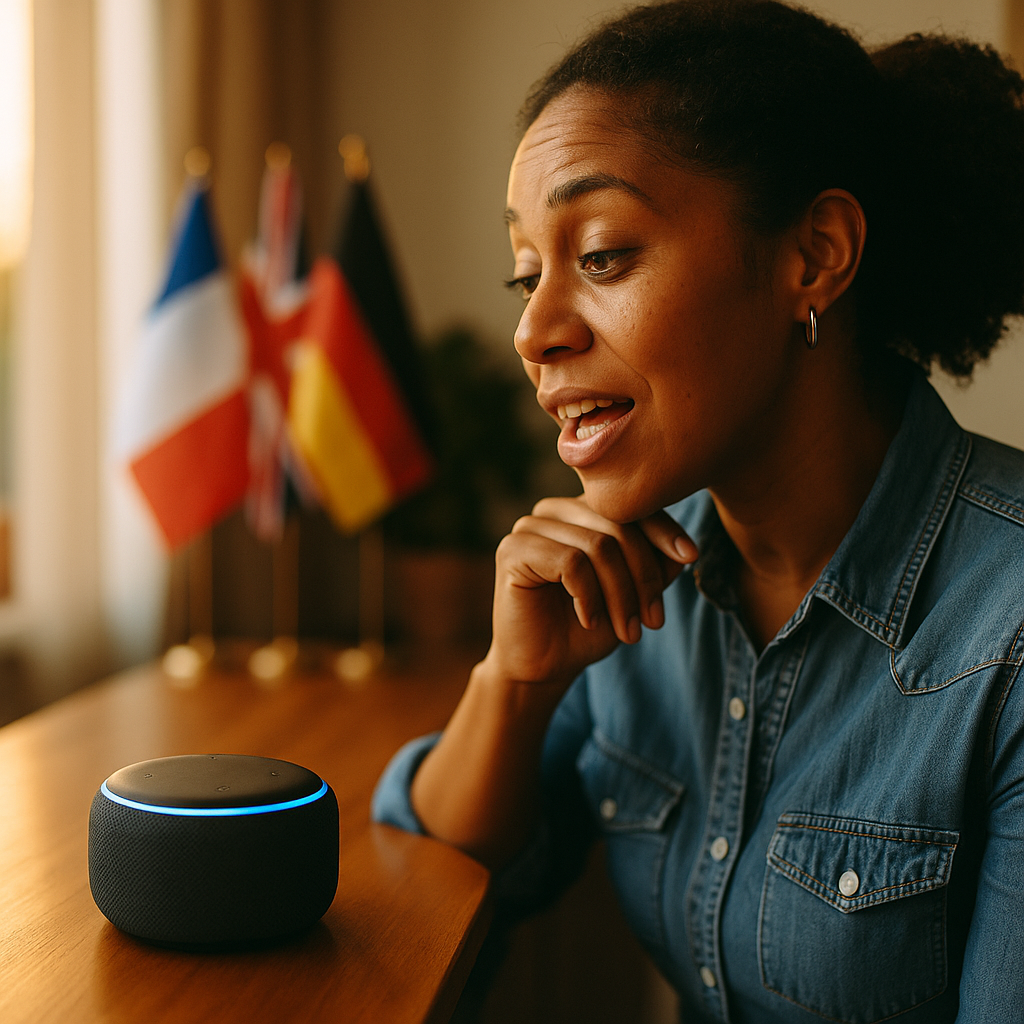
Using AI to personalize voice assistant brand personas for different accents has moved from novelty to competitive necessity in 2025. Customers expect a voice that sounds familiar, respectful, and consistent with your brand—whether they speak with a Glasgow lilt or a Kenyan English cadence. With modern speech models, you can localize without fragmenting identity. The real question is: how do you do it well?
Why accent localization matters for voice assistant personalization
Accent is not a cosmetic layer; it influences comprehension, trust, and perceived warmth. If users struggle to understand your assistant, they blame the brand, not the model. If the assistant mishears users with specific accents, people experience it as exclusion—especially in customer service, banking, healthcare, and public services.
Voice assistant personalization improves outcomes in three practical ways:
- Higher task success: Clearer pronunciation and rhythm reduce repeats and failed intents.
- Stronger brand affinity: A voice that “fits” local norms feels intentional, not generic.
- Lower support cost: Fewer misunderstandings reduce escalations to human agents.
Readers often ask, “Isn’t one neutral accent good enough?” In global products, “neutral” typically maps to one region’s prestige accent, which can alienate others. The goal is not to stereotype, but to meet users where they are—while maintaining a unified brand personality.
How AI voice cloning and brand voice design work together
AI voice cloning and brand persona design solve different problems. Cloning reproduces a voice’s acoustic signature (timbre, pitch patterns, breathiness). Persona design defines behavior: vocabulary, pacing, empathy, humor boundaries, and escalation style. For accent localization, you need both, and you need them governed by the same brand standards.
In practice, teams use two complementary approaches:
- Multi-voice casting: Select different voice talents per region, then use AI to scale consistent delivery and maintain the same persona rules.
- Single “core” voice with accent variants: Use authorized voice transformation or region-specific synthetic voices that preserve persona traits (energy, clarity, warmth) while adapting phonology and prosody.
Brand voice design is where you prevent “accent drift” from becoming “brand drift.” A helpful framework is to document:
- Persona pillars: e.g., direct, calm, optimistic; never sarcastic; avoids slang unless user initiates.
- Conversational defaults: greeting style, confirmation phrasing, repair strategies (“Sorry—did you mean…?”), and turn-taking.
- Do-not-say list: regionally sensitive terms, prohibited impersonations, and anything that may read as parody.
Follow-up question: “Do accents require different personalities?” Not necessarily. Keep the same personality and adapt only what affects understanding and cultural appropriateness: intonation, pacing, idioms, and formality levels.
Accent adaptation in TTS and ASR: what to tune for real-world accuracy
Most failures blamed on “accent” are actually pipeline mismatches between automatic speech recognition (ASR), natural language understanding, and text-to-speech (TTS). Accent adaptation works best when you treat input and output as a single user experience.
For ASR (understanding users):
- Accent-balanced training data: Ensure representation across accents, ages, and speaking styles (fast speech, code-switching, background noise).
- Domain tuning: Local business names, addresses, slang, and product-specific vocabulary must be in the model’s language model or biasing list.
- Robust error recovery: When confidence drops, ask targeted clarifying questions rather than repeating generic prompts.
For TTS (speaking to users):
- Prosody control: The same words can feel abrupt or overly casual depending on intonation patterns typical to a region.
- Phoneme and lexicon localization: Pronunciation dictionaries should include local place names and common terms (e.g., “schedule,” “route,” or regional brand names).
- Pacing and pause strategy: Some accents are perceived as clearer with slightly longer inter-phrase pauses; others sound unnatural if over-separated.
Teams also ask, “Should we let users pick accents?” Yes—when it’s presented as a preference, not a forced categorization. Offer options like “Voice style” or “Regional voice,” and remember that users may live in one country and prefer another accent.
Multilingual voice assistant strategy: avoiding stereotypes while building trust
A multilingual voice assistant often needs both language switching and accent variation within a language. The risk is creating voices that feel caricatured or “tourist mode.” The remedy is to focus on authenticity, consent, and user benefit.
Use these guardrails:
- Design for clarity first: If an accent variant reduces intelligibility for a significant segment, it’s not ready.
- Avoid exaggerated markers: Don’t “turn up” accent features to signal region. Aim for natural speech, not an audio costume.
- Local copywriting review: Have native or near-native linguists review prompts for tone, politeness norms, and unintended meanings.
- Respect code-switching: Many users mix languages. Support it in ASR and in responses when appropriate, especially for proper nouns and short confirmations.
Another common question: “Can we reuse the same scripts globally?” You can reuse intent logic, but you should localize surface form: idioms, currency, measurement units, date/time formats, and politeness markers. That’s how you keep one brand persona while speaking in a way that feels local.
Ethical AI voice synthesis: consent, transparency, and compliance
Ethical AI voice synthesis is central to EEAT in voice: your users must be able to trust that the voice is legitimate, safe, and respectful. This is especially important when accent personalization could be misused for impersonation or manipulation.
Operational best practices:
- Explicit consent for any cloned voice: Use written contracts defining permitted use, duration, territories, and revocation terms.
- Clear disclosure: In settings or onboarding, state when a voice is synthetic and how customization works.
- Security controls: Restrict who can generate audio, log generations, and implement watermarking or provenance tooling when available.
- Bias and fairness testing: Evaluate ASR error rates across accents and demographics; set thresholds and remediation timelines.
- Content policy enforcement: Prevent harmful requests (impersonation, harassment) at both text and audio layers.
Readers often ask, “Will transparency reduce adoption?” In practice, transparent systems tend to earn trust faster, especially in regulated sectors. Treat it like accessibility: it signals competence and respect.
Measuring success with voice UX testing and continuous improvement
Voice UX testing is where accent personalization proves its value. You need metrics that reflect real conversations, not just lab demos.
Use a balanced scorecard:
- Task completion rate: Can users finish top tasks without fallback channels?
- Turns-to-completion: Fewer turns often indicates clearer prompts and better recognition.
- ASR word error rate by accent group: Track distribution and close gaps, not just overall averages.
- User satisfaction and trust: Short post-interaction surveys or in-app ratings tied to specific flows.
- Escalation rate: How often users abandon or request a human agent?
For EEAT-aligned rigor, document your methodology: recruitment criteria, accent self-identification options, device/environment variability, and how you handle privacy. Also test edge cases users care about: names, addresses, payment confirmations, medical instructions, and time-sensitive alerts.
To keep personalization sustainable, establish a release process:
- Accent regression tests: Ensure improvements for one variant don’t degrade another.
- Prompt library governance: Centralize prompt templates so tone stays consistent across markets.
- Ongoing lexicon updates: Local events, new neighborhoods, and new product names must be added continuously.
FAQs
What’s the difference between an accent and a dialect in voice assistant design?
An accent mainly affects pronunciation and prosody, while a dialect can include vocabulary, grammar, and idioms. For brand personas, you can often localize accent for clarity without changing dialect; dialect changes require deeper linguistic review to avoid tone or meaning issues.
Do I need different brand personas for each accent?
Usually no. Keep one core persona (values, helpfulness, boundaries) and implement accent variants as delivery styles. Localize only what impacts comprehension and cultural appropriateness, such as politeness strategies and region-specific references.
How much voice data is required to create an accent variant?
It depends on the model and whether you’re cloning a specific talent or using a vendor’s synthetic voice. High-quality, consented recordings with varied phonetic coverage generally produce more natural results. Plan additional data for local names and domain-specific terms.
How can we avoid sounding like we’re imitating or stereotyping users?
Avoid exaggeration, use native reviewer feedback, and prioritize intelligibility and respect. Let users opt in to regional voices, and never use accents as a proxy for user identity or assumptions about preferences.
What’s the biggest technical cause of “accent problems”?
Mismatch between ASR training data and real user speech in noisy environments, plus missing local vocabulary (names, places, brands). Fixing recognition and repair strategies often improves perceived accent support more than changing the assistant’s speaking voice.
How do we ensure legal and ethical compliance when using AI voices?
Secure explicit consent for any cloned voice, disclose synthetic usage, implement access controls, and run fairness testing across accent groups. Maintain audit logs and enforce policies against impersonation and harmful content.
AI-driven accent personalization works when it protects the brand and respects the user. Build one clear persona, then localize pronunciation, prosody, and language conventions based on real testing—not assumptions. Pair accent-aware ASR with region-tuned TTS, and back it with consent, transparency, and fairness metrics. In 2025, the winning assistants don’t just talk; they communicate with precision and care.
Top Influencer Marketing Agencies
The leading agencies shaping influencer marketing in 2026
Agencies ranked by campaign performance, client diversity, platform expertise, proven ROI, industry recognition, and client satisfaction. Assessed through verified case studies, reviews, and industry consultations.
Moburst

-
2

The Shelf
Boutique Beauty & Lifestyle Influencer AgencyA data-driven boutique agency specializing exclusively in beauty, wellness, and lifestyle influencer campaigns on Instagram and TikTok. Best for brands already focused on the beauty/personal care space that need curated, aesthetic-driven content.Clients: Pepsi, The Honest Company, Hims, Elf Cosmetics, Pure LeafVisit The Shelf → -
3

Audiencly
Niche Gaming & Esports Influencer AgencyA specialized agency focused exclusively on gaming and esports creators on YouTube, Twitch, and TikTok. Ideal if your campaign is 100% gaming-focused — from game launches to hardware and esports events.Clients: Epic Games, NordVPN, Ubisoft, Wargaming, Tencent GamesVisit Audiencly → -
4

Viral Nation
Global Influencer Marketing & Talent AgencyA dual talent management and marketing agency with proprietary brand safety tools and a global creator network spanning nano-influencers to celebrities across all major platforms.Clients: Meta, Activision Blizzard, Energizer, Aston Martin, WalmartVisit Viral Nation → -
5

The Influencer Marketing Factory
TikTok, Instagram & YouTube CampaignsA full-service agency with strong TikTok expertise, offering end-to-end campaign management from influencer discovery through performance reporting with a focus on platform-native content.Clients: Google, Snapchat, Universal Music, Bumble, YelpVisit TIMF → -
6

NeoReach
Enterprise Analytics & Influencer CampaignsAn enterprise-focused agency combining managed campaigns with a powerful self-service data platform for influencer search, audience analytics, and attribution modeling.Clients: Amazon, Airbnb, Netflix, Honda, The New York TimesVisit NeoReach → -
7

Ubiquitous
Creator-First Marketing PlatformA tech-driven platform combining self-service tools with managed campaign options, emphasizing speed and scalability for brands managing multiple influencer relationships.Clients: Lyft, Disney, Target, American Eagle, NetflixVisit Ubiquitous → -
8

Obviously
Scalable Enterprise Influencer CampaignsA tech-enabled agency built for high-volume campaigns, coordinating hundreds of creators simultaneously with end-to-end logistics, content rights management, and product seeding.Clients: Google, Ulta Beauty, Converse, AmazonVisit Obviously →