


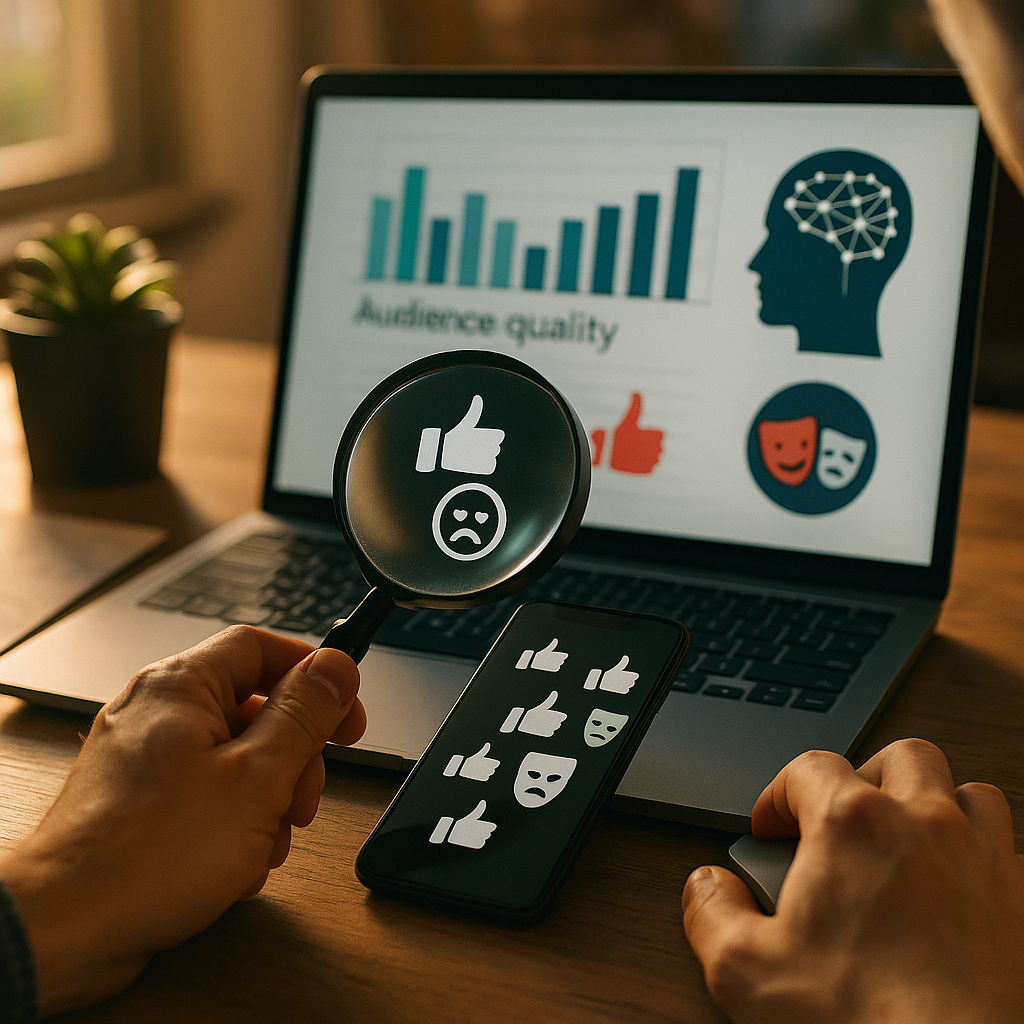
Roughly 15% of engagement on major social platforms is estimated to come from bot activity or fraud rings, according to industry fraud-detection vendors — yet most brands still greenlight influencer deals based on follower counts and engagement rates alone. If your media buyers wouldn’t accept unverified impressions on a programmatic buy, why accept them on a creator contract? AI-driven audience quality scoring is supposed to fix this. But not all scoring platforms measure the same thing, and some are barely better than the metrics they claim to replace.
Why Engagement Rate Alone Stopped Meaning Anything
Engagement rate used to be the north star. Divide likes and comments by followers, compare across creators, pick the winner. Simple.
Then the follower farms showed up. Comment pods. Engagement groups. Bots that like within seconds of a post going live. Suddenly a 6% engagement rate could mean genuine community, or it could mean a creator paid $200 for 10,000 “active” followers from a click farm in a low-cost region. Both show up identically in a basic analytics dashboard.
Brands got burned enough times that the industry built an entire category around the problem: AI-driven audience quality scoring. These platforms promise to look past the surface-level numbers and assess whether an audience is real, relevant, and capable of driving action. The pitch is compelling. The execution varies wildly.
A creator with 50,000 followers and a quality score of 40 will almost always outperform a creator with 500,000 followers and a quality score of 15 — but only if brands actually check the score before signing the contract.
What “Audience Quality Scoring” Actually Measures
Not every platform scores the same inputs, which is exactly why side-by-side comparisons get messy. Broadly, the credible tools evaluate some combination of:
- Follower authenticity — device fingerprinting, account creation date clustering, and behavioral patterns that flag bot networks or purchased followers.
- Engagement velocity patterns — organic engagement tends to spike and decay in predictable curves; bought engagement often arrives in unnatural bursts.
- Audience overlap and duplication — how much of a creator’s following also appears across a suspicious cluster of other accounts (a hallmark of pod-based inflation).
- Comment sentiment and relevance — natural language processing to distinguish genuine commentary (“this saved my skin”) from generic bot filler (“nice post!” repeated across thousands of accounts).
- Geographic and demographic consistency — does the claimed audience location match where engagement is actually originating?
The platforms worth paying for combine at least four of these signals. The ones worth skipping usually lean on one or two, then wrap the output in a slick dashboard and call it “AI-powered.”
The Vendor Landscape Is Fragmented, and That’s the Point
There’s no single dominant player the way there might be in, say, email deliverability scoring. Some tools are standalone fraud detection specialists. Others are embedded features inside broader influencer platforms. This matters because bundled scoring tends to prioritize speed and coverage over depth — you get a quick red/yellow/green flag rather than a granular breakdown of why an account was flagged.
Our own analysis of bundled influencer fraud detection found that accuracy drops noticeably when fraud checks are an afterthought bolted onto a discovery tool, versus a purpose-built scoring engine. If your platform vendor added fraud detection as a checkbox feature in the last product cycle, ask hard questions about the underlying data sources.
Real Engagement vs. Inflated Metrics: A Practical Test
Here’s a exercise every brand team should run before their next campaign brief goes out: pull the last ten creators you worked with and check whether their reported engagement rate correlates with actual conversion or click-through data. If it doesn’t, the engagement was likely inflated, misattributed, or simply irrelevant to your funnel.
A creator can have real engagement that’s still useless to you. Someone with a highly engaged audience of teenagers isn’t going to move the needle for a B2B SaaS product, no matter how authentic those likes are. Quality scoring has to account for relevance, not just authenticity.
This is where a lot of brands get the evaluation backwards. They ask “is this audience real?” when they should be asking “is this audience real and aligned with my buyer?” A platform that only answers the first question is solving half the problem.
Questions to Ask Every Scoring Vendor
- What data sources feed the model — platform APIs, third-party panels, or proprietary crawling?
- How often is the model retrained, and does it adapt to new fraud tactics (like AI-generated fake accounts, which are getting harder to distinguish from real ones)?
- Can the score be broken down by individual metric, or is it a single opaque number?
- Does the platform flag false positives — creators penalized for regional audience patterns that look unusual but aren’t fraudulent?
- What’s the false negative rate on sophisticated fraud, like engagement pods that mimic organic timing?
Vendors that dodge the third and fourth questions are usually hiding a black box. That’s a red flag in an era where FTC disclosure enforcement already puts brands on the hook for influencer misconduct. You need to be able to show your work if a partnership gets questioned.
The AI Detection Arms Race Is Getting Harder to Win
Here’s the uncomfortable truth nobody in the vendor sales deck wants to say out loud: fraud is getting more sophisticated faster than detection is improving. Generative AI can now create synthetic profile photos, write plausible comment text, and simulate human-like posting cadence. The bot farms of a few years ago were sloppy. The ones operating now are not.
This means a scoring platform that worked well two years ago might be meaningfully less accurate today, simply because the fraud tactics evolved and the model didn’t keep pace. Ask vendors directly: when was your fraud model last retrained on current-generation synthetic account behavior? If they can’t answer specifically, assume it’s been a while.
This arms-race dynamic is also why standalone fraud detection increasingly gets paired with payment automation and workflow tools, so that suspicious accounts get flagged before a contract is even signed rather than after a campaign underperforms. Our review of how fraud detection meets payment automation covers this convergence in more depth, including where it genuinely reduces risk and where it’s mostly marketing.
Building an Evaluation Framework That Doesn’t Rely on Vendor Claims
Marketing teams shouldn’t take a vendor’s accuracy claims at face value — that’s like letting a media agency grade its own campaign performance. Build a lightweight internal audit instead:
- Run a controlled test. Score 20-30 known creators (a mix of ones you trust and ones you suspect of inflation) across two or three platforms and compare outputs.
- Check for consistency over time. Re-score the same creators 60 days later. Wild swings without an obvious cause suggest an unstable model.
- Correlate scores with campaign outcomes. This is the real test. Did high-scoring creators actually drive better click-through, conversion, or brand lift than low-scoring ones? If there’s no correlation, the score isn’t predictive of anything that matters to your business.
- Get a second opinion for high-spend deals. For six-figure creator contracts, it’s worth paying for an independent audit rather than relying solely on the platform baked into your discovery tool.
This kind of rigor mirrors what’s already standard in adjacent parts of the marketing stack. Brands wouldn’t accept a programmatic ad buy without viewability verification; there’s no good reason influencer spend should get a pass. Platforms like Sprout Social and other social analytics providers have pushed the industry toward more transparent reporting standards, and audience quality scoring needs to hold itself to the same bar.
Where This Fits Into the Bigger Platform Decision
Audience quality scoring rarely gets evaluated in isolation. It’s usually one line item in a much bigger platform decision — alongside discovery accuracy, payment workflows, and reporting depth. If you’re in the middle of a broader vendor evaluation, it’s worth reviewing how quality scoring stacks up against competing priorities like matching accuracy, which we cover in our AI matching accuracy comparison across GRIN, Upfluence, and CreatorIQ. Teams renewing contracts this cycle should also check our platform consolidation vendor map before signing anything, since fraud detection capabilities are shifting fast across the vendor landscape and last year’s leader isn’t guaranteed to hold that position.
None of this means brands need to become data scientists. It means treating audience quality as a line item worth the same scrutiny as media spend, not a checkbox a platform vendor fills in for you.
Next Step
Before your next renewal or RFP, ask every scoring vendor to run a live test on five creators you already know well — three trustworthy, two you suspect are inflated — and see if the platform gets it right before you sign anything.
FAQs
What is AI-driven audience quality scoring?
It’s a set of tools that use machine learning to assess whether a creator’s followers and engagement are authentic, relevant, and likely to convert, rather than relying on raw follower counts or engagement rates alone.
How accurate are these platforms at detecting fake engagement?
Accuracy varies significantly by vendor and by how many data signals the model combines. Platforms using four or more signals (authenticity, velocity, overlap, sentiment, geography) tend to outperform single-signal tools, but no platform is immune to sophisticated, AI-generated fraud.
Can inflated engagement metrics still convert real sales?
Rarely. Inflated engagement typically comes from bots or pods with no purchasing intent. Even if some inflated accounts are technically real people, they’re often disengaged users clicking for incentives rather than genuine interest.
Should brands rely on a single scoring platform or cross-check multiple tools?
For high-spend campaigns, cross-checking is worth the extra cost. Scores can diverge meaningfully between vendors, and a second opinion catches false positives and false negatives that a single tool might miss.
How often should brands re-evaluate their scoring vendor?
At least annually, given how quickly fraud tactics evolve. If a vendor hasn’t disclosed a model retraining or update in the last twelve months, that’s worth questioning during contract renewal.
Top Influencer Marketing Agencies
The leading agencies shaping influencer marketing in 2026
Agencies ranked by campaign performance, client diversity, platform expertise, proven ROI, industry recognition, and client satisfaction. Assessed through verified case studies, reviews, and industry consultations.
Moburst

-
2

The Shelf
Boutique Beauty & Lifestyle Influencer AgencyA data-driven boutique agency specializing exclusively in beauty, wellness, and lifestyle influencer campaigns on Instagram and TikTok. Best for brands already focused on the beauty/personal care space that need curated, aesthetic-driven content.Clients: Pepsi, The Honest Company, Hims, Elf Cosmetics, Pure LeafVisit The Shelf → -
3

Audiencly
Niche Gaming & Esports Influencer AgencyA specialized agency focused exclusively on gaming and esports creators on YouTube, Twitch, and TikTok. Ideal if your campaign is 100% gaming-focused — from game launches to hardware and esports events.Clients: Epic Games, NordVPN, Ubisoft, Wargaming, Tencent GamesVisit Audiencly → -
4

Viral Nation
Global Influencer Marketing & Talent AgencyA dual talent management and marketing agency with proprietary brand safety tools and a global creator network spanning nano-influencers to celebrities across all major platforms.Clients: Meta, Activision Blizzard, Energizer, Aston Martin, WalmartVisit Viral Nation → -
5

The Influencer Marketing Factory
TikTok, Instagram & YouTube CampaignsA full-service agency with strong TikTok expertise, offering end-to-end campaign management from influencer discovery through performance reporting with a focus on platform-native content.Clients: Google, Snapchat, Universal Music, Bumble, YelpVisit TIMF → -
6

NeoReach
Enterprise Analytics & Influencer CampaignsAn enterprise-focused agency combining managed campaigns with a powerful self-service data platform for influencer search, audience analytics, and attribution modeling.Clients: Amazon, Airbnb, Netflix, Honda, The New York TimesVisit NeoReach → -
7

Ubiquitous
Creator-First Marketing PlatformA tech-driven platform combining self-service tools with managed campaign options, emphasizing speed and scalability for brands managing multiple influencer relationships.Clients: Lyft, Disney, Target, American Eagle, NetflixVisit Ubiquitous → -
8

Obviously
Scalable Enterprise Influencer CampaignsA tech-enabled agency built for high-volume campaigns, coordinating hundreds of creators simultaneously with end-to-end logistics, content rights management, and product seeding.Clients: Google, Ulta Beauty, Converse, AmazonVisit Obviously →