


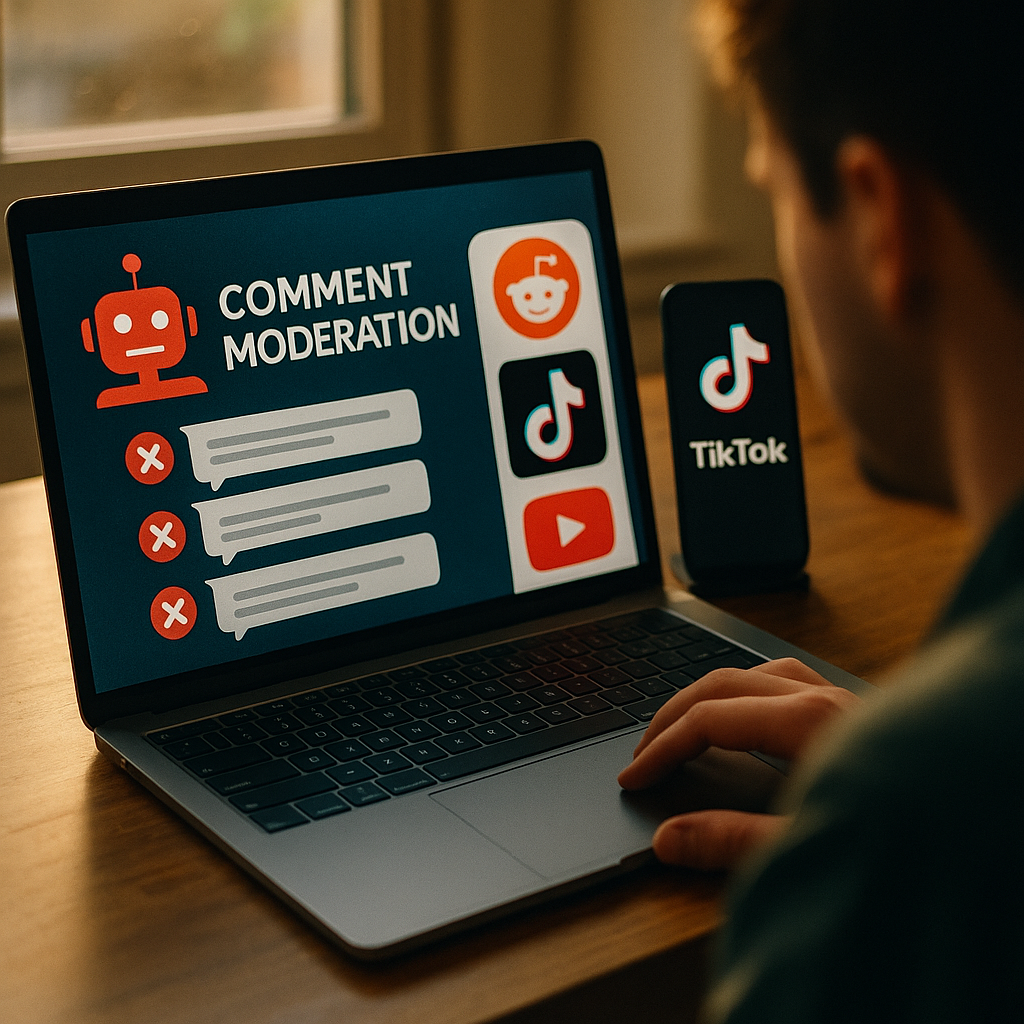
A single unmoderated comment thread can undo a six-figure campaign in under an hour. That’s not hyperbole, it’s what happened to multiple CPG brands whose TikTok posts got hijacked by coordinated comment brigading last year. If you’re not evaluating AI-powered brand safety tools for comment sections right now, you’re managing risk with a blindfold on.
Comment moderation used to be an afterthought bolted onto social listening dashboards. Not anymore. Reddit’s anonymity culture, TikTok’s algorithmic comment surfacing, and YouTube’s sheer volume have turned comment sections into the most volatile, least-governed part of the influencer marketing stack. Brands are finally waking up to it, and vendors are racing to fill the gap with AI classifiers that promise to catch hate speech, spam, scams, and reputational landmines before a human even sees them.
The problem: most of these tools were built for one platform’s quirks and are being awkwardly retrofitted for others. Here’s how to actually evaluate them.
Why Comment Sections Became a Brand Safety Battlefield
Three years ago, brand safety meant keyword blocklists next to pre-roll ads. Today it means monitoring thousands of live, user-generated replies underneath sponsored content, replies your brand didn’t write but will absolutely be blamed for. Reddit threads can surface a decade-old controversy about your CEO within minutes of a sponsored AMA going live. TikTok comment sections get review-bombed by coordinated groups using slang and emoji code that slips past traditional keyword filters. YouTube’s comment volume on creator videos can hit tens of thousands within a day, far more than any human moderation team can review in real time.
Gartner and multiple industry surveys have flagged brand safety as a top-three concern for CMOs allocating influencer budgets, right alongside measurement and disclosure compliance. That tracks with what we’re hearing from agency contacts: comment moderation is now a line item in creator contracts, not an afterthought.
The real risk isn’t the offensive comment itself, it’s the screenshot of that comment sitting under your logo, recirculating on X three days later with your brand tagged.
What “AI-Powered” Actually Means Here
Vendors throw around “AI-powered” loosely. Worth unpacking what’s actually happening under the hood before you sign a contract.
- Toxicity classifiers: Models trained to score comments for hate speech, harassment, or explicit content. Google’s Perspective API pioneered this approach and still underpins several third-party tools.
- Contextual sentiment models: These attempt to understand sarcasm, coded language, and platform-specific slang, TikTok’s “corn” for porn or “unalive” for suicide are classic examples of why keyword-only systems fail.
- Coordinated behavior detection: Pattern recognition that flags brigading, bot networks, and astroturfing campaigns, particularly relevant on Reddit where vote manipulation and coordinated downvoting are common attack vectors.
- Generative AI summarization: Newer tools use LLMs to summarize comment sentiment trends for human reviewers, rather than flagging individual comments. Useful for scale, less useful for catching the one comment that actually matters.
Most platforms on the market today combine two or three of these approaches. None of them do all four well. That’s the first thing to test for, not the marketing copy.
The Platform-Specific Trap Vendors Don’t Mention
Here’s where most brand safety evaluations go wrong: teams buy a single tool and assume it works uniformly across Reddit, TikTok, and YouTube. It doesn’t, because the platforms themselves are structurally different.
Reddit is pseudonymous and community-governed. Subreddit-specific norms mean the same comment can be perfectly acceptable in one community and bannable in another. A tool that doesn’t ingest subreddit context, upvote velocity, and moderator history is flying blind. Reddit’s own API changes have also made third-party data access more expensive and complicated, so verify your vendor’s access is compliant and stable, not scraping in a gray area that could get shut off overnight.
TikTok comments are short, emoji-heavy, and trend-driven. Slang rotates weekly. A classifier trained on last quarter’s data will miss this quarter’s coded harassment terms. TikTok’s own moderation tools have improved, but third-party brand safety vendors need continuous retraining cycles, not annual model refreshes, to keep pace.
YouTube comment sections are the most volume-heavy and the most susceptible to spam and scam links (fake giveaways, crypto scams, phishing). Google’s own creator tools offer baseline moderation, but brand-side teams typically need a layer above that, one that can flag reputational risk specific to the sponsor, not just platform policy violations.
If your shortlist includes a vendor pitching one model across all three platforms, ask pointed questions about training data provenance per platform. Vague answers are a red flag.
A Practical Evaluation Framework
Skip the demo theater. Run every vendor through these six checks before signing anything.
- False positive rate on your own historical data. Feed the vendor a sample of your brand’s actual comment history (with permission) and see what gets flagged. Overzealous tools that flag every mild criticism as “toxic” create moderation fatigue and erode trust with your community team.
- Latency. Ask for real numbers on time-to-flag. A tool that takes six hours to surface a coordinated attack is functionally useless against a fast-moving brigade.
- Human-in-the-loop workflow. Every credible vendor should offer an escalation path where flagged content routes to a human reviewer, not full autonomous deletion. Full automation without review creates its own PR risk (wrongful censorship accusations are their own headache).
- Multilingual coverage. If your campaigns run internationally, verify the model’s non-English performance. Most classifiers are English-first and degrade badly in other languages, particularly for coded slang.
- Audit trail and reporting. Compliance and legal teams will want documentation. Does the tool log flagged content, moderation decisions, and timestamps in a format that survives a regulatory inquiry?
- Integration with existing creator workflows. Does it plug into your creator matching or campaign dashboard, or does it live in a silo your team has to check manually? Tools that integrate with platforms covered in our creator discovery evaluation guide tend to reduce operational overhead significantly.
If a vendor can’t show you a false positive rate on real data, they don’t have one worth sharing. Insist on the number before you insist on the price.
Cost Versus Risk: The ROI Conversation Nobody Wants to Have
Brand safety tools aren’t cheap. Enterprise-tier comment moderation platforms can run into six figures annually depending on comment volume and platform coverage. The pushback from finance is predictable: “We haven’t had an incident yet, why pay for this now?”
Flip the framing. The cost of a single viral moderation failure, agency fees for crisis PR, paid media pulled mid-flight, a creator partnership severed, dwarfs the annual license fee of most credible tools. This is the same logic brands apply to AI disclosure compliance settings: the upfront cost of doing it right is trivial next to the downstream cost of an FTC inquiry or platform penalty.
Run the math with your own numbers. Estimate average campaign spend per creator partnership, then estimate the reputational cost of a single mishandled comment crisis (lost media spend, PR retainer hours, potential creator contract renegotiation). Most teams find the breakeven point arrives faster than expected, often within two or three flagged incidents avoided per year.
Where Governance Fits Into the Bigger Picture
Comment moderation shouldn’t sit in isolation from your broader creator governance strategy. If you’re already stress-testing vendors on media buying or attribution claims, the same rigor applies here. Our agentic AI vendor scorecard framework, originally built for procurement teams evaluating media-buying platforms, translates well to brand safety tools: demand transparency on training data, insist on audit logs, and never accept a vendor’s self-reported accuracy metrics without independent verification.
It’s also worth coordinating comment moderation policy with your creator partnership governance. Brands increasingly bake moderation SLAs into creator contracts directly, specifying response times for flagged comments and who’s responsible for escalation. That’s the model outlined in our look at creator campaign governance frameworks, and it applies just as cleanly to comment risk as it does to media spend.
One more thing worth flagging: don’t let brand safety tooling become a substitute for a documented escalation policy. Software catches the comment. Humans decide what happens next. Teams that skip the second half of that sentence tend to overcorrect, either censoring too aggressively or freezing when a real crisis hits because nobody defined who has authority to pull an ad or pause a partnership.
Vendor Landscape Snapshot
Without endorsing specific products, here’s the rough category breakdown as of now:
- Platform-native tools (YouTube Studio moderation, TikTok’s Comment Filters): Free, baseline coverage, insufficient for brand-specific reputational risk.
- Social listening incumbents expanding into comment moderation: Sprout Social and similar platforms have added AI moderation features to existing listening suites, useful if you’re already in their ecosystem.
- Specialist brand safety vendors: Smaller, more focused tools built specifically for comment-level risk, often stronger on coordinated behavior detection but weaker on broader campaign integration.
- LLM-based custom builds: Some larger brands are fine-tuning their own models on proprietary comment history. Expensive, but gives full control over false positive tuning and data ownership.
Check vendor claims against independent benchmarks where possible. eMarketer and Statista both publish periodic creator economy and platform trust data that’s useful for benchmarking vendor claims against broader industry trends. Google’s own support documentation on comment moderation policy is also worth reviewing directly, vendors sometimes overstate what’s actually possible within platform API constraints.
FAQ
Common questions from brand and agency teams evaluating this category.
Frequently Asked Questions
What’s the difference between platform-native moderation and third-party brand safety tools?
Platform-native tools (YouTube Studio, TikTok’s built-in filters) enforce platform policy, not brand-specific risk. Third-party tools add a layer tuned to your brand’s reputational sensitivities, industry context, and campaign-specific keywords that platform defaults won’t catch.
Can AI brand safety tools fully replace human moderators?
No, and vendors who claim otherwise should raise concern. The credible standard is human-in-the-loop: AI flags and prioritizes, humans make final calls on ambiguous or high-stakes content, especially anything touching legal or PR risk.
How do these tools handle non-English comments?
Coverage varies significantly by vendor and language. Most classifiers perform best in English and degrade in accuracy for other languages, particularly with slang or coded terms. Always request language-specific performance data before committing to a global rollout.
Is Reddit harder to moderate than TikTok or YouTube?
In some ways, yes. Reddit’s pseudonymity, subreddit-specific norms, and community-driven moderation culture mean context matters more than on TikTok or YouTube. Tools that ignore subreddit-level context tend to perform worse there.
How much should a mid-size brand budget for comment moderation tools?
Costs vary widely based on comment volume and platform coverage, but mid-market tools often range from low five figures to low six figures annually. Weigh that against the potential cost of a single unmanaged moderation crisis, which typically exceeds the license fee.
Do these tools help with FTC disclosure compliance too?
Some overlap exists, since comment-level monitoring can surface disclosure violations in creator responses, but brand safety tools aren’t a substitute for dedicated disclosure compliance workflows. Treat them as complementary, not interchangeable.
Next step: pull your last two quarters of comment data from your highest-risk creator campaigns, run it through two vendor demos side by side, and compare false positive rates before you compare price sheets. The tool that flags fewer real problems is the expensive one, regardless of what it costs.
Frequently Asked Questions
What’s the difference between platform-native moderation and third-party brand safety tools?
Platform-native tools (YouTube Studio, TikTok’s built-in filters) enforce platform policy, not brand-specific risk. Third-party tools add a layer tuned to your brand’s reputational sensitivities, industry context, and campaign-specific keywords that platform defaults won’t catch.
Can AI brand safety tools fully replace human moderators?
No, and vendors who claim otherwise should raise concern. The credible standard is human-in-the-loop: AI flags and prioritizes, humans make final calls on ambiguous or high-stakes content, especially anything touching legal or PR risk.
How do these tools handle non-English comments?
Coverage varies significantly by vendor and language. Most classifiers perform best in English and degrade in accuracy for other languages, particularly with slang or coded terms. Always request language-specific performance data before committing to a global rollout.
Is Reddit harder to moderate than TikTok or YouTube?
In some ways, yes. Reddit’s pseudonymity, subreddit-specific norms, and community-driven moderation culture mean context matters more than on TikTok or YouTube. Tools that ignore subreddit-level context tend to perform worse there.
How much should a mid-size brand budget for comment moderation tools?
Costs vary widely based on comment volume and platform coverage, but mid-market tools often range from low five figures to low six figures annually. Weigh that against the potential cost of a single unmanaged moderation crisis, which typically exceeds the license fee.
Do these tools help with FTC disclosure compliance too?
Some overlap exists, since comment-level monitoring can surface disclosure violations in creator responses, but brand safety tools aren’t a substitute for dedicated disclosure compliance workflows. Treat them as complementary, not interchangeable.
Top Influencer Marketing Agencies
The leading agencies shaping influencer marketing in 2026
Agencies ranked by campaign performance, client diversity, platform expertise, proven ROI, industry recognition, and client satisfaction. Assessed through verified case studies, reviews, and industry consultations.
Moburst

-
2

The Shelf
Boutique Beauty & Lifestyle Influencer AgencyA data-driven boutique agency specializing exclusively in beauty, wellness, and lifestyle influencer campaigns on Instagram and TikTok. Best for brands already focused on the beauty/personal care space that need curated, aesthetic-driven content.Clients: Pepsi, The Honest Company, Hims, Elf Cosmetics, Pure LeafVisit The Shelf → -
3

Audiencly
Niche Gaming & Esports Influencer AgencyA specialized agency focused exclusively on gaming and esports creators on YouTube, Twitch, and TikTok. Ideal if your campaign is 100% gaming-focused — from game launches to hardware and esports events.Clients: Epic Games, NordVPN, Ubisoft, Wargaming, Tencent GamesVisit Audiencly → -
4

Viral Nation
Global Influencer Marketing & Talent AgencyA dual talent management and marketing agency with proprietary brand safety tools and a global creator network spanning nano-influencers to celebrities across all major platforms.Clients: Meta, Activision Blizzard, Energizer, Aston Martin, WalmartVisit Viral Nation → -
5

The Influencer Marketing Factory
TikTok, Instagram & YouTube CampaignsA full-service agency with strong TikTok expertise, offering end-to-end campaign management from influencer discovery through performance reporting with a focus on platform-native content.Clients: Google, Snapchat, Universal Music, Bumble, YelpVisit TIMF → -
6

NeoReach
Enterprise Analytics & Influencer CampaignsAn enterprise-focused agency combining managed campaigns with a powerful self-service data platform for influencer search, audience analytics, and attribution modeling.Clients: Amazon, Airbnb, Netflix, Honda, The New York TimesVisit NeoReach → -
7

Ubiquitous
Creator-First Marketing PlatformA tech-driven platform combining self-service tools with managed campaign options, emphasizing speed and scalability for brands managing multiple influencer relationships.Clients: Lyft, Disney, Target, American Eagle, NetflixVisit Ubiquitous → -
8

Obviously
Scalable Enterprise Influencer CampaignsA tech-enabled agency built for high-volume campaigns, coordinating hundreds of creators simultaneously with end-to-end logistics, content rights management, and product seeding.Clients: Google, Ulta Beauty, Converse, AmazonVisit Obviously →