


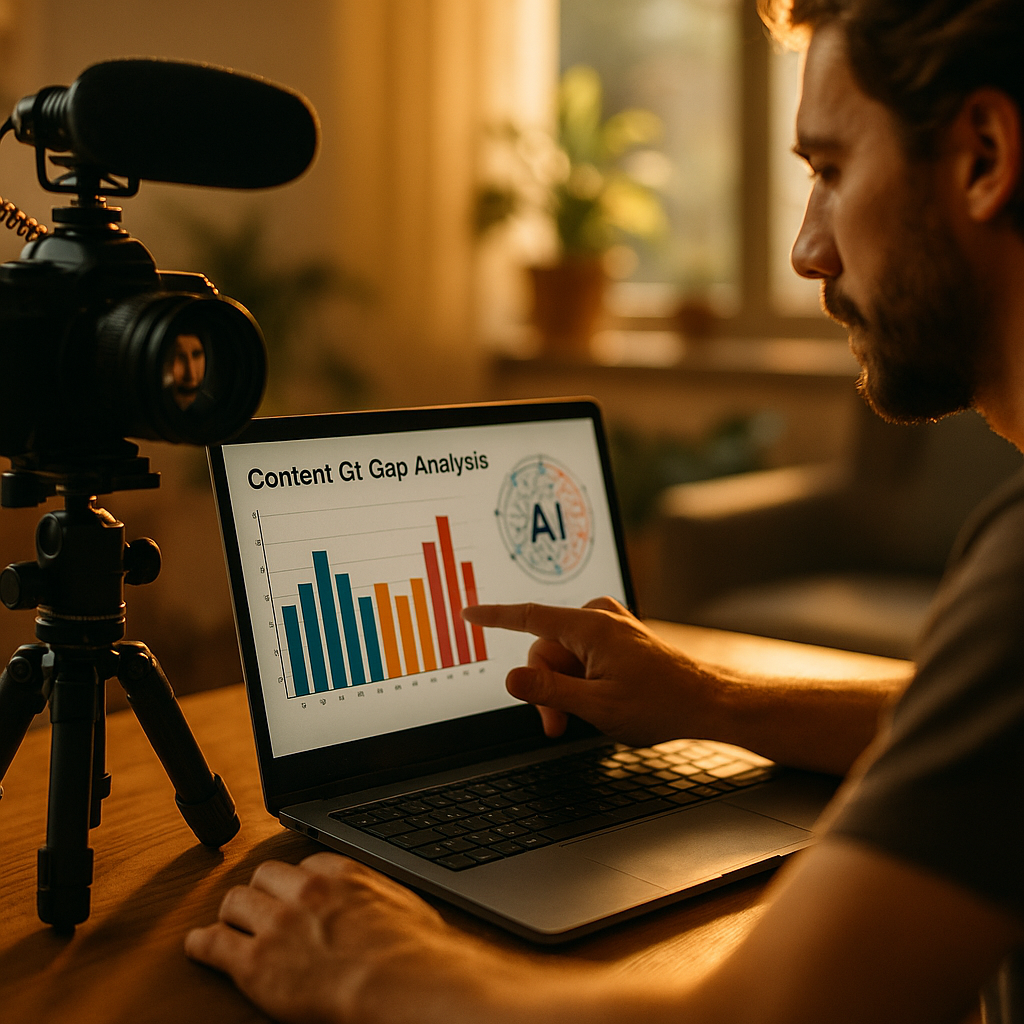
Using AI to identify white space in saturated video content niches is now the most reliable way to grow when “obvious” ideas feel exhausted. In 2025, platforms reward retention, relevance, and consistency, not just novelty. The advantage comes from spotting unmet viewer intent, underserved formats, and overlooked audiences faster than competitors. The question is: where exactly is that gap hiding?
AI content gap analysis for video niches: what “white space” really means
In saturated niches, “white space” is not an empty topic. It is an underserved combination of audience, intent, format, and distribution. Creators often misread saturation because they only count how many videos exist on a subject, not whether those videos solve the viewer’s job-to-be-done.
Think of white space as one of these patterns:
- Unanswered intent: Viewers search or browse for a specific outcome, but available videos are vague, outdated, or too advanced.
- Format mismatch: Great information exists, but not in the format viewers prefer (e.g., a 35-minute tutorial when viewers want a 4-minute checklist or a 60-second decision tree).
- Audience mismatch: Content targets “everyone,” but beginners, intermediates, or professionals need different explanations and proof levels.
- Context gap: Advice exists but doesn’t reflect constraints like budget, region, device, disability access, or time.
- Trust gap: Viewers want evidence, demos, or transparent testing rather than opinion or recycled tips.
AI helps because it can systematically scan language patterns, topics, thumbnails/titles, comments, and search behavior signals to reveal recurring needs competitors miss. The goal is not to “find a new niche,” but to reframe a crowded niche into neglected micro-problems you can own.
Audience intent mining with AI: extracting demand signals from search, comments, and forums
The strongest white space starts with demand. AI can triage thousands of viewer statements into themes that point to specific video opportunities. Your most useful sources:
- Platform search suggestions: Autocomplete terms and related searches show phrasing real people use.
- Comments on top videos: Requests, confusion, disagreements, and “can you also…” questions reveal unmet needs.
- Community posts and Q&A threads: Forums and niche communities often surface problems before they trend on video platforms.
- Reviews and app store feedback: Great for tool- and product-driven niches; viewers often want tutorials that match their exact pain.
Practical AI workflow (no guesswork):
- Collect text: Export comments from the top 20–50 videos in your niche; copy search suggestions; gather 50–200 forum questions.
- Cluster with AI: Ask an LLM to group questions by intent and difficulty level (beginner/intermediate/advanced), and to label each cluster with a “job-to-be-done.”
- Score for opportunity: Prioritize clusters that show high emotional intensity (frustration, urgency), repeated wording, and low satisfaction in existing videos.
- Translate into video promises: Turn each cluster into a specific outcome with constraints (“in 10 minutes,” “on mobile,” “without paid tools”).
To align with Google’s helpful content expectations, ensure your AI-assisted insights are grounded in real viewer language. Quote the question, not the competitor. Then answer it better with clear steps, proof, and examples.
Follow-up question you’ll have: “How do I avoid chasing tiny subtopics?” The answer is to build content families: one anchor video for the main problem plus 5–12 supporting videos addressing variations, mistakes, and edge cases. AI helps you map those variations quickly.
Competitor mapping with AI: finding patterns in thumbnails, titles, and formats
In saturated niches, competitors converge on the same framing. AI can spot sameness at scale and highlight the formats and claims that dominate the feed. This matters because white space often appears where creators repeat what works instead of what viewers still need.
Use AI to audit competitors across four layers:
- Title claims: “Beginner guide,” “Top 10,” “How to,” “Mistakes,” “X vs Y.” AI can quantify overused angles.
- Thumbnail semantics: Faces vs screenshots, “before/after,” big numbers, red arrows, brand colors; repetition signals creative sameness.
- Video structure: Long intro vs immediate demo; listicles vs case studies; theory-heavy vs step-by-step.
- Proof style: Opinions, personal experience, experiments, client results, citations, or live walk-throughs.
What to look for:
- High-volume topics with low specificity: Many videos on the “what,” few on the “how,” “when,” and “if.”
- Over-optimized sameness: Similar thumbnails and titles indicate a crowded angle; differentiation can be format-based (e.g., “live teardown,” “audit,” “experiment”).
- Missing segments: Competitors talk to beginners, but not to the “stuck intermediate” who has tried three times and failed.
Then build a “differentiation matrix”:
- Same topic, different promise: “How to meal prep” becomes “Meal prep for night shift workers with 15-minute breaks.”
- Same topic, different proof: Replace advice with a timed, measurable experiment or a real breakdown.
- Same topic, different constraints: No expensive gear, no paid apps, low bandwidth, small kitchen, older laptop.
EEAT note: If you critique competitor advice, do it responsibly. State assumptions, show your method, and avoid making claims you can’t demonstrate. Viewers reward honesty and specificity, and so do algorithms that measure satisfaction through retention and engagement.
Semantic clustering and long-tail video keywords: building a white-space keyword map
White space is often buried in long-tail phrasing. AI excels at building a semantic map of “topic neighborhoods” so you can target discoverable queries without guessing. The objective is not keyword stuffing; it is intent alignment that leads to higher satisfaction.
Here is how to create a white-space keyword map:
- Start with seed topics: 10–30 core phrases in your niche (products, problems, outcomes).
- Expand with AI: Generate hundreds of related queries, including “for [audience],” “without [tool],” “on [device],” “under [time],” “fix [error],” “why [problem].”
- Cluster by intent: AI groups them into categories like “choose,” “set up,” “troubleshoot,” “improve,” “compare,” “advanced.”
- Assign a format: Match clusters to the best video type: tutorial, checklist, teardown, reaction, experiment, story case study, short FAQ.
- Validate quickly: Search each cluster on the platform. If results are broad, repetitive, or outdated, you likely found white space.
What creators often miss is the value of problem-first keywords. Many niches overproduce aspirational topics (“get better at X”) while underproducing pain topics (“why X isn’t working,” “fix this issue,” “avoid this mistake”). AI can surface those pain queries by analyzing complaint language in comments and forums.
Follow-up question: “Should I target only low-competition phrases?” No. In saturated niches, you want a blend:
- Anchor topics: Competitive, high-interest themes that establish relevance.
- Support topics: Long-tail, specific problems that build authority and session time.
- Conversion topics: Comparisons, tool walkthroughs, and “best for” that capture decision-stage intent.
Predictive trend detection with AI: spotting micro-shifts before the niche reacts
Saturated niches still change. Tools update, policies shift, features launch, and audience expectations evolve. AI can help you detect early micro-trends so you publish first, earn initial watch history, and become the reference point others cite.
Ways to use AI for predictive detection:
- Monitor update logs and release notes: AI summarizes changes and suggests video angles by user impact (setup changes, new workflows, deprecated features).
- Track language drift: AI compares new comment phrasing month over month to spot rising problems (“keeps crashing,” “new UI,” “pricing changed”).
- Identify emerging comparisons: When viewers start asking “X vs Y” frequently, you can own the comparison early with a fair test.
- Detect format fatigue: If top creators lean hard into one style, there is room for an alternate presentation (short labs, visual explainers, decision trees).
Convert a micro-shift into an “ownable” series:
- Rapid response: A short video addressing what changed and who it affects.
- Deep fix: A longer tutorial with troubleshooting steps and common pitfalls.
- Proof episode: A real-world test, benchmark, or case study showing outcomes.
EEAT best practice: when covering changes, show your source (on-screen citations, links in description, or clear attribution). If you don’t have complete certainty, say what you observed, what you tested, and what remains unknown. That transparency increases trust and reduces backlash in volatile updates.
EEAT-driven production and measurement: turning AI insights into videos that win
AI can reveal white space, but execution decides whether you keep it. In 2025, the winning pattern is high trust + high clarity. Use AI to support your expertise, not replace it.
Build EEAT into every video:
- Experience: Show real usage, real footage, real constraints. If it’s a tutorial, complete the task on camera.
- Expertise: Explain the “why” behind steps, not just the steps. Provide decision rules, not only instructions.
- Authoritativeness: Reference credible sources when relevant, and invite peer critique by sharing your method.
- Trust: Disclose sponsorships, list assumptions, and correct errors publicly.
How AI helps at the production stage:
- Outline generation: Turn intent clusters into tight structures with clear checkpoints and recaps.
- Clarity editing: Rewrite confusing sections, simplify jargon, and add definitions for beginners.
- Visual planning: Suggest b-roll, screen recordings, comparison tables, and on-screen prompts tied to retention points.
- Repurposing: Extract shorts from the “mistakes,” “quick wins,” and “myth bust” moments that match micro-intents.
Measurement that actually confirms white space:
- Search-to-watch alignment: Are viewers who arrive from search staying? If not, your title/thumbnail promise may be mismatched.
- Audience retention at the first minute: White space videos should reduce early drop-off because they match a specific need.
- Comment quality: Look for “this fixed it,” “finally,” and detailed follow-ups. AI can categorize comments into success, confusion, and next requests.
- Series pull-through: If supporting videos gain views without heavy promotion, your topic family is coherent.
A common follow-up: “How many videos before I know it worked?” If you publish a coherent cluster (an anchor plus 5–8 support videos) and still see weak retention and low helpful comments, revisit the intent. You may have targeted the wrong audience level, or your proof wasn’t strong enough. AI can re-cluster feedback and show where viewers got stuck.
FAQs: Using AI to identify white space in saturated video content niches
What is the fastest way to find white space in a crowded niche?
Mine viewer intent. Export comments from top-performing videos, collect platform search suggestions, and use AI to cluster recurring questions into specific problems. Prioritize clusters where viewers express frustration and existing videos fail to give actionable steps or clear outcomes.
Which AI tools should I use for content gap analysis?
Use an LLM for clustering and summarization, a keyword research tool for query expansion, and a simple spreadsheet or database to score opportunities. The best stack is the one you will use weekly: collect data, cluster intent, validate on-platform, then produce.
How do I validate that a “white space” idea has demand?
Check whether the query appears in autocomplete or related searches, whether similar questions repeat in comments and forums, and whether existing results feel generic or outdated. Then publish a tightly aligned video and watch retention and comment sentiment for evidence of satisfaction.
How do I avoid making repetitive content if the niche is saturated?
Differentiate on constraints and proof. Address a specific audience and scenario, use a distinct format (audit, experiment, teardown), and demonstrate results. AI helps you identify which angles competitors repeat so you can choose a fresher framing.
Can AI help with titles and thumbnails without making them look generic?
Yes, if you constrain it. Provide your unique promise, audience, and proof, then ask AI for multiple variations that keep the claim accurate. Reject clickbait. The best titles and thumbnails clearly state the outcome and the constraint that makes your video different.
Is it risky to rely on AI for topic selection?
It can be if you treat AI outputs as truth. Use AI to organize signals, then apply human judgment and real testing. When your videos include transparent demos, sources, and clear assumptions, you reduce the risk of publishing misleading or low-value content.
AI doesn’t remove competition in 2025; it makes the playing field more measurable. When you combine intent mining, competitor pattern detection, semantic keyword clustering, and trend monitoring, you can consistently spot under-served viewer needs inside crowded niches. The clear takeaway is simple: use AI to find a precise problem, then earn trust by solving it with proof, clarity, and repeatable series.
Top Influencer Marketing Agencies
The leading agencies shaping influencer marketing in 2026
Agencies ranked by campaign performance, client diversity, platform expertise, proven ROI, industry recognition, and client satisfaction. Assessed through verified case studies, reviews, and industry consultations.
Moburst

-
2

The Shelf
Boutique Beauty & Lifestyle Influencer AgencyA data-driven boutique agency specializing exclusively in beauty, wellness, and lifestyle influencer campaigns on Instagram and TikTok. Best for brands already focused on the beauty/personal care space that need curated, aesthetic-driven content.Clients: Pepsi, The Honest Company, Hims, Elf Cosmetics, Pure LeafVisit The Shelf → -
3

Audiencly
Niche Gaming & Esports Influencer AgencyA specialized agency focused exclusively on gaming and esports creators on YouTube, Twitch, and TikTok. Ideal if your campaign is 100% gaming-focused — from game launches to hardware and esports events.Clients: Epic Games, NordVPN, Ubisoft, Wargaming, Tencent GamesVisit Audiencly → -
4

Viral Nation
Global Influencer Marketing & Talent AgencyA dual talent management and marketing agency with proprietary brand safety tools and a global creator network spanning nano-influencers to celebrities across all major platforms.Clients: Meta, Activision Blizzard, Energizer, Aston Martin, WalmartVisit Viral Nation → -
5

The Influencer Marketing Factory
TikTok, Instagram & YouTube CampaignsA full-service agency with strong TikTok expertise, offering end-to-end campaign management from influencer discovery through performance reporting with a focus on platform-native content.Clients: Google, Snapchat, Universal Music, Bumble, YelpVisit TIMF → -
6

NeoReach
Enterprise Analytics & Influencer CampaignsAn enterprise-focused agency combining managed campaigns with a powerful self-service data platform for influencer search, audience analytics, and attribution modeling.Clients: Amazon, Airbnb, Netflix, Honda, The New York TimesVisit NeoReach → -
7

Ubiquitous
Creator-First Marketing PlatformA tech-driven platform combining self-service tools with managed campaign options, emphasizing speed and scalability for brands managing multiple influencer relationships.Clients: Lyft, Disney, Target, American Eagle, NetflixVisit Ubiquitous → -
8

Obviously
Scalable Enterprise Influencer CampaignsA tech-enabled agency built for high-volume campaigns, coordinating hundreds of creators simultaneously with end-to-end logistics, content rights management, and product seeding.Clients: Google, Ulta Beauty, Converse, AmazonVisit Obviously →