


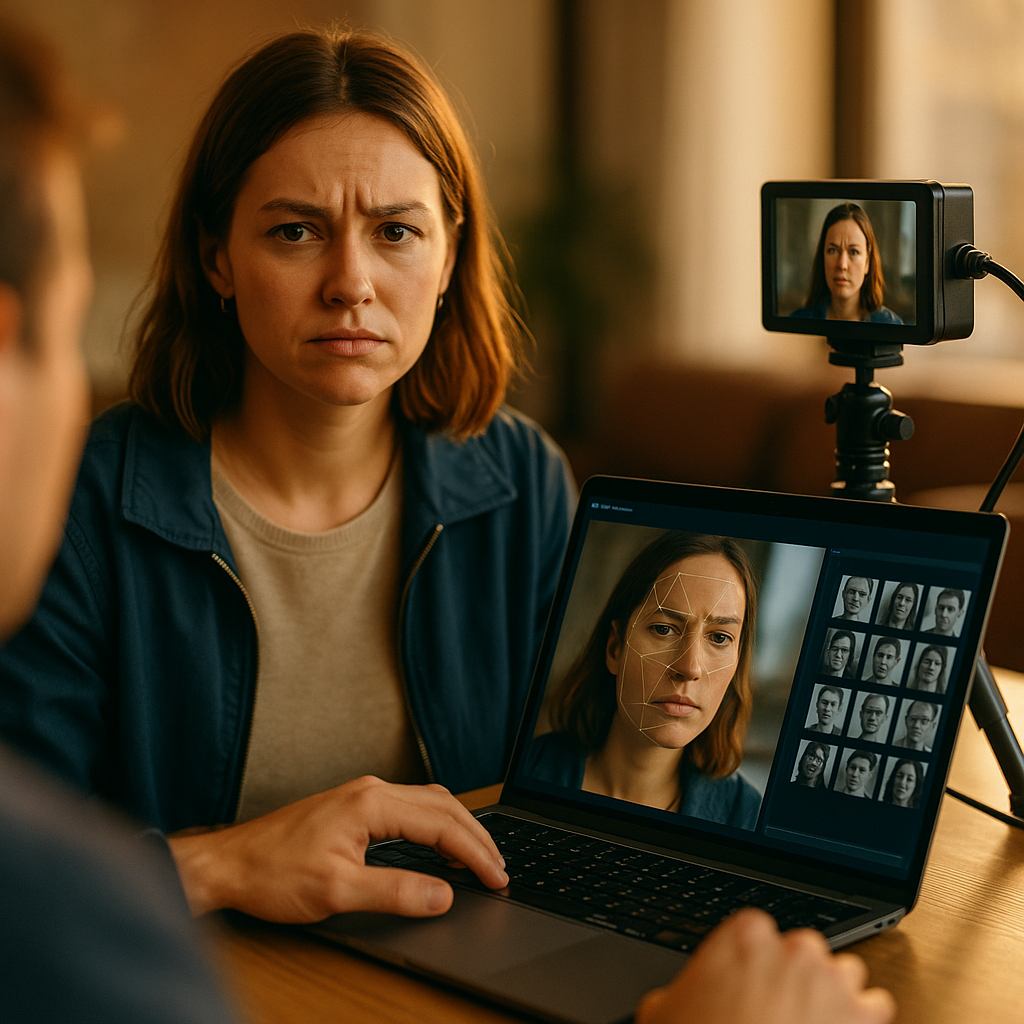
In 2025, using AI to analyze micro-expressions in consumer video interviews is moving from a niche technique to a practical research advantage. Subtle facial changes can reveal uncertainty, delight, or confusion that participants never verbalize. When used responsibly, AI helps teams scale observation without losing nuance. But what should you measure, how do you validate it, and where can it go wrong?
Micro-expressions analysis for consumer research: what it is and why it matters
Micro-expressions are brief, involuntary facial movements that can occur when people react emotionally—sometimes before they find words or even notice their response. In consumer interviews, these tiny signals often appear when participants encounter a surprising price, a confusing feature, an unexpected claim, or a design that triggers instant preference or doubt.
Micro-expressions analysis for consumer research does not replace what people say. It adds an additional layer to interpret how they say it and whether their nonverbal reactions align with their stated opinion. For example, a participant may say a new packaging looks “premium,” while a fleeting expression suggests skepticism at the moment they read an ingredient list or see the weight.
Researchers value micro-expression signals because they can:
- Flag moments worth probing (“I saw a micro-reaction when you read that line—what went through your mind?”).
- Reduce recall bias by capturing immediate reactions during exposure, not after the fact.
- Support triangulation alongside interview transcripts, click paths, task completion, and survey responses.
A practical expectation matters: micro-expressions rarely provide a single “truth.” They offer probabilistic clues. The value comes from pattern detection across participants and scenes, paired with skilled interviewing and sound study design.
Facial coding AI in video interviews: how the technology works in 2025
Facial coding AI in video interviews typically uses computer vision models to detect faces, track facial landmarks (brows, eyelids, nose, mouth corners), and classify movements into expression-related features. Many systems map movements to recognized facial action units and then infer likely emotional states or arousal levels. In 2025, common capabilities include:
- Frame-level landmark tracking to quantify subtle movement timing and intensity.
- Quality scoring (lighting, occlusion, camera angle) to mark unreliable segments.
- Speaker separation and timestamp alignment to connect reactions to specific prompts or stimuli.
- Multimodal fusion with voice tone, speech rate, and transcript sentiment to improve interpretability.
To be useful for product and marketing decisions, the system should output more than an “emotion label.” Look for outputs that support analysis:
- Time-coded events (e.g., “surprise-like movement at 03:12–03:13”).
- Confidence ranges rather than absolute statements.
- Per-participant baselines that compare reactions to their own neutral state.
- Stimulus annotations that link reactions to exact on-screen moments (pricing reveal, claim, feature demo).
Answering a frequent follow-up: Do you need specialized cameras? Usually no—standard webcam footage can work if you set minimum requirements for resolution, frame rate, and lighting. However, micro-expressions are brief; higher frame rates and stable lighting improve sensitivity and reduce false signals.
Emotion AI for market research: best-fit use cases and decision value
Emotion AI for market research is strongest when the business question depends on moment-to-moment reactions. It can add clarity in situations where participants rationalize after the fact or struggle to articulate feelings. High-value use cases include:
- Concept testing: Identify which claim, benefit, or proof point triggers immediate doubt or interest, then refine messaging and order.
- Packaging and shelf-sim interviews: Pinpoint where consumers pause or react when scanning key information (size, price-per-unit, ingredients, sustainability marks).
- Ad and creative testing: Time-align emotional peaks and drops to scenes, voiceovers, or on-screen text, then edit for stronger pacing.
- UX and product walkthroughs: Detect confusion spikes during onboarding, settings, or checkout even when users “push through” verbally.
- Pricing and value perception: Compare reactions at price reveal versus after justification, separating initial instinct from post-hoc reasoning.
Teams get the most decision value when they treat micro-expression signals as diagnostic markers, not scorecards. A clear workflow looks like this:
- Detect reaction moments (AI flags segments).
- Interpret in context (researcher reviews the clip with transcript, stimulus, and participant history).
- Probe and confirm (in-session follow-up questions or post-session recall using the exact timestamp).
- Aggregate patterns across segments and personas to produce actionable recommendations.
Another common question: Will this work across cultures? Culture influences expressiveness and display rules. That does not make the method unusable, but it requires careful validation, representative sampling, and a preference for within-group comparisons rather than sweeping cross-cultural claims.
AI sentiment analysis from facial expressions: accuracy, validation, and bias controls
AI sentiment analysis from facial expressions can be misunderstood as “mind reading.” In reality, it is a set of statistical inferences that can fail for predictable reasons: poor video quality, partial occlusion, atypical expressiveness, neurodiversity, cultural display rules, facial hair, and lighting that distorts landmarks.
To align with Google’s EEAT expectations, emphasize validation, transparency, and limitations. A reliable research approach includes:
- Pre-study calibration: Record a short neutral baseline and simple prompts to check that tracking is stable for each participant.
- Holdout human review: Have trained coders review a subset of sessions and compare agreement with AI flags. Use this to set confidence thresholds.
- Error-aware reporting: Report results as “increased likelihood of reaction” or “notable nonverbal response” instead of definitive emotions.
- Stratified performance checks: Test whether the model’s confidence drops for certain skin tones, age groups, camera setups, or accessibility conditions.
- Context-first interpretation: Treat facial signals as one input alongside language, behavior, and task outcomes.
Bias control is not optional. If a system systematically under-detects expressions for certain demographics, your conclusions can become skewed. Mitigation steps include using vendors that publish evaluation summaries, setting minimum-quality gates, and avoiding “emotion scoring” comparisons across groups unless you can justify measurement equivalence.
Answering another follow-up: Should you use micro-expressions to select or exclude participants? No. Use them to improve analysis, not to police credibility. Excluding participants based on inferred emotional states introduces ethical and methodological risk.
Consumer behavior insights with computer vision: study design and interview tactics
Consumer behavior insights with computer vision improve when you plan the interview for measurable moments. AI performs best when stimuli exposures are clearly timed, and the moderator’s prompts are structured to elicit comparable reactions across participants.
Design your study so analysis is straightforward:
- Standardize stimulus timing: Use the same order, same on-screen duration, and consistent reveal moments for price, claims, and features.
- Instrument key events: Mark timestamps for “first view,” “price shown,” “ingredient list shown,” “CTA shown,” and “competitor comparison.”
- Use paired tasks: Combine “think-aloud” with short silent viewing segments to separate verbalization from immediate reactions.
- Capture decision points: Ask for a choice (which would you buy?) and a confidence rating right after key exposures.
- Plan confirmation prompts: When the AI flags a reaction, ask a neutral question: “What are you noticing here?” rather than “You looked worried—why?”
Operational details matter. Provide participants with a simple setup checklist: camera at eye level, stable device, bright face lighting, no backlight, and minimal face occlusion. In remote interviews, use a short “tech check” before the formal session to reduce unusable footage and avoid awkward interruptions.
On the analysis side, a helpful practice is a moment library: a shared repository of flagged clips mapped to themes (price sensitivity, trust in claims, confusion, delight). This makes insights easier to socialize with stakeholders and increases repeatability across studies.
Privacy and ethics in emotion recognition: consent, governance, and compliance
Privacy and ethics in emotion recognition determine whether your program is trustworthy and sustainable. Video of faces is sensitive data; inferred emotional signals can be even more sensitive. In 2025, the safest approach is to treat micro-expression analysis as a high-impact research method that requires explicit participant understanding and strict governance.
Put these guardrails in place:
- Explicit informed consent: Clearly state that video will be analyzed for facial movements to understand reactions, what outputs are produced, and how results will be used.
- Purpose limitation: Use the data only for the research objectives participants agreed to. Do not repurpose for performance monitoring or identity verification.
- Data minimization: Store only what you need. When feasible, keep derived features and delete raw video after quality review and audit windows.
- Retention and access controls: Define who can access raw video, for how long, and under what approval process.
- De-identification practices: When sharing clips internally, use short excerpts, remove names, and avoid combining with unnecessary personal data.
- Human oversight: Keep a qualified researcher accountable for interpretation. AI should assist analysis, not make participant-level judgments.
Participants should also have a clear path to ask questions, opt out of AI analysis while still completing the interview (when possible), and request deletion according to your privacy policy and applicable regulation. Ethical practice is not only compliance; it strengthens data quality because participants feel safe and behave more naturally.
FAQs
What are micro-expressions, and how long do they last?
They are brief, involuntary facial movements linked to emotional reactions. They can occur very quickly, sometimes within fractions of a second, which is why stable video, good lighting, and frame-level analysis improve detection.
Can AI accurately detect specific emotions from facial expressions?
AI can detect facial movement patterns with varying reliability, but mapping those patterns to a specific emotion is more uncertain and context-dependent. The most defensible use is to flag reaction moments and interpret them alongside speech, tasks, and stimuli.
Do I need participants in a lab for this to work?
No. Remote webcam interviews can work well if you standardize setup guidance, run a quick tech check, and enforce minimum video quality. Lab settings can improve consistency but are not mandatory.
How do you validate AI micro-expression findings?
Use human review on a subset of sessions, compare agreement rates, set confidence thresholds, and report uncertainty. Validation should also include checks for performance differences across demographics and recording conditions.
Is it ethical to analyze facial expressions without telling participants?
No. You should obtain explicit informed consent and explain what is being analyzed, what is produced, and how it will be used. Facial video and inferred signals are sensitive and require transparent governance.
How should teams report results to stakeholders?
Use time-coded clips, aggregated patterns, and clear language about limitations. Focus on actionable moments (where confusion spikes, where trust drops, where interest rises) and connect them to concrete recommendations for messaging, UX, or product changes.
AI-based micro-expression analysis can strengthen consumer video interviews when it is used as an evidence layer, not a verdict machine. Combine time-coded facial signals with transcripts, tasks, and smart probing to pinpoint the moments that drive preference or doubt. Validate models, monitor bias, and prioritize informed consent and data minimization. Done well, you get faster, clearer insight into what consumers feel before they explain it.