


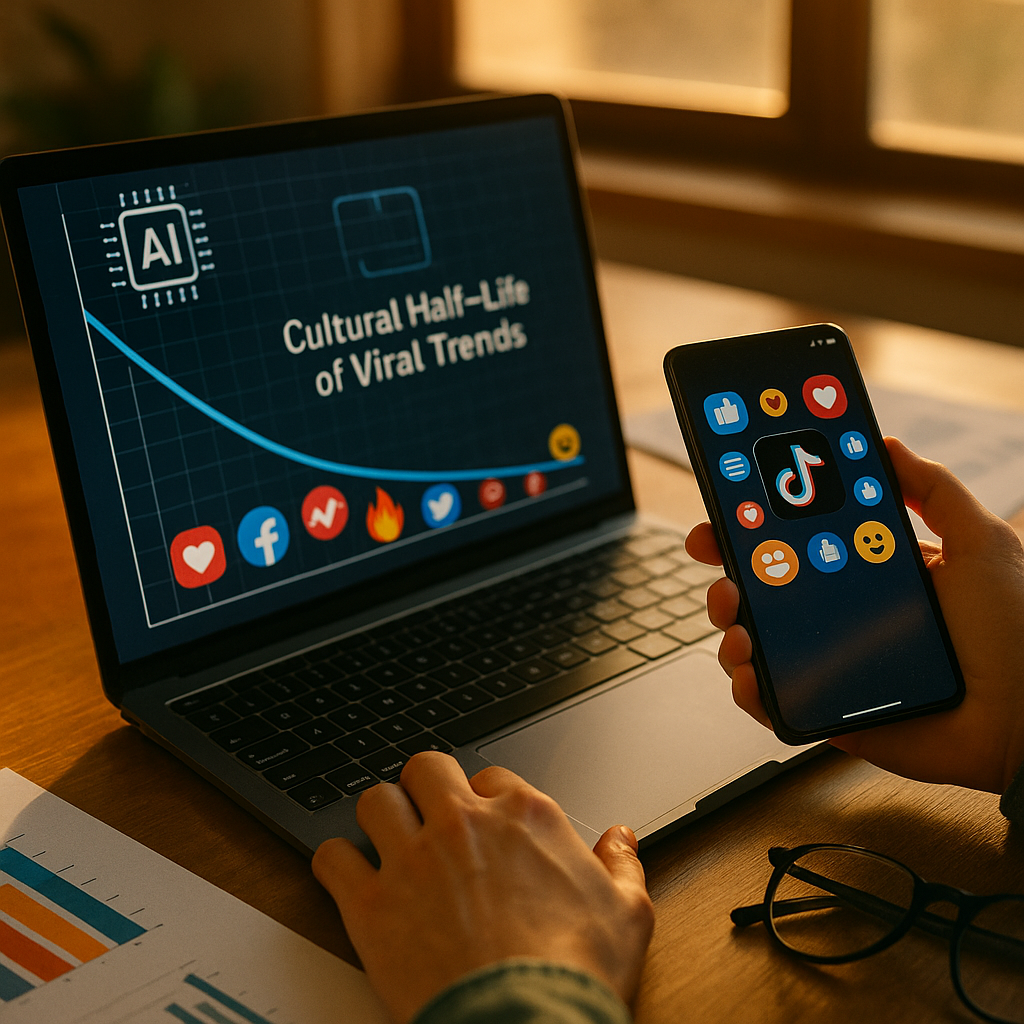
In 2025, brands, creators, and researchers face a shared problem: today’s viral hit can vanish tomorrow. Using AI to predict the cultural half-life of viral trends turns that uncertainty into measurable signals, helping teams decide when to amplify, adapt, or exit a moment. The goal isn’t fortune-telling; it’s disciplined forecasting that respects context, platforms, and people. So what really determines longevity?
What “cultural half-life” means in viral trend forecasting
Cultural half-life describes the time it takes for a viral trend’s relevance to decline by roughly half in a target audience or channel. Unlike “reach” or “views,” half-life focuses on durability: how long a trend continues to generate attention, participation, or cultural reference without needing constant paid support.
To make this measurable, teams typically define a trend’s “signal” using one or more of these observable outputs:
- Engagement velocity: changes in comments, shares, saves, stitches/duets, and re-posts over time (not just totals).
- Search and discovery behavior: growth and decay patterns in query volume and “related searches.”
- Creator adoption and remixing: number and diversity of creators reusing the format, audio, or meme structure.
- Language and cultural references: frequency of mentions, slang uptake, and off-platform references (e.g., news, forums).
- Conversion or downstream impact: click-through, sign-ups, sales lifts, or footfall when relevant.
A practical half-life model begins by choosing the signal that matches your goal. A fashion retailer may care about “time-to-wardrobe adoption,” while a streaming service may care about “time-to-binge intent.” Getting this definition right prevents the common mistake of optimizing for vanity metrics that decay differently than cultural relevance.
AI trend prediction models: data sources and feature engineering
AI trend prediction models work best when they combine behavioral data with context. In 2025, most reliable pipelines use a layered approach: platform data (what people do), content data (what the trend is), and network data (how it spreads).
Key data sources teams use, with practical guardrails:
- Platform analytics and public signals: view/engagement time series, hashtag usage, audio reuse, creator graphs. Use approved APIs and respect platform terms.
- Search interest: query trend lines and related-topic expansion. Use this to detect “intent maturation” beyond passive scrolling.
- Text and comment streams: sentiment, topic shifts, sarcasm markers, and emergent sub-memes. This helps distinguish “laughing with” vs “laughing at.”
- Video and image embeddings: visual motifs, on-screen text patterns, editing styles, and product/category cues.
- News and forum references: off-platform diffusion can extend half-life, but can also accelerate backlash.
Feature engineering is where prediction becomes credible. Useful features tend to be interpretable, stable, and causally plausible:
- Early-shape features: slope, curvature, and acceleration in the first hours/days; “peak sharpness” often predicts short half-lives.
- Remix depth: proportion of derivative posts vs originals; deep remixing often signals a format that can persist.
- Audience breadth: diversity across regions, languages, and age cohorts; broader audiences can extend half-life but may dilute subcultural cachet.
- Creator diversity: adoption by micro-creators vs celebrity accounts; grassroots spread can be steadier.
- Sentiment volatility: rapid swings or polarization can predict abrupt drop-offs.
- Context overlap: alignment with seasonal moments, major releases, or public events that can either sustain or crowd out attention.
Readers often ask, “Can we do this without massive data science resources?” Yes: start with a small set of time-series features, basic NLP for comment sentiment and topic drift, and a transparent model. Complexity is optional; measurement discipline is not.
Predicting trend decay curves with machine learning methods
Predicting trend decay curves is typically a time-to-event or time-series forecasting problem. The most practical output isn’t a single date; it’s a curve with uncertainty bounds that informs decisions like content cadence, spend allocation, and creative refresh timing.
Common modeling approaches used in 2025 production settings:
- Survival analysis: models time until a trend drops below a relevance threshold. It handles censoring (trends still active) and produces interpretable hazard rates.
- State-space and Bayesian time-series: separates underlying momentum from noise, especially useful when platforms change distribution suddenly.
- Gradient-boosted models: strong performance using engineered features from early data windows; easier to deploy and explain than many deep models.
- Sequence models: can learn complex temporal patterns, but require careful monitoring to avoid overfitting to platform-specific artifacts.
- Hybrid models: combine mechanistic diffusion assumptions (e.g., saturation effects) with learned residuals from ML.
What “half-life” looks like mathematically in practice: teams set a relevance threshold (for example, engagement rate relative to baseline) and estimate the time when the trend’s signal falls to 50% of its peak or of a rolling maximum. Some organizations also track second half-life (from 50% to 25%) to detect long-tail persistence.
How to avoid false confidence:
- Use prediction intervals, not point estimates, and tie actions to ranges (e.g., “refresh creative between day 5–8”).
- Validate on out-of-sample trends by category and platform, since decay patterns differ across entertainment, politics, beauty, and gaming.
- Monitor distribution shifts when platforms alter ranking or when a trend migrates to another app.
A likely follow-up: “Why not just watch the metrics and react?” Because by the time a decline is obvious, the optimal window for adaptation may already be gone. Forecasting gives you lead time to plan creative iterations and inventory or staffing decisions.
Social media analytics signals that extend or shorten trend lifespan
Social media analytics can reveal why two trends with similar early growth end up with radically different half-lives. AI models become more useful when paired with explanatory signals that humans can act on.
Signals associated with longer cultural half-life:
- Format elasticity: the template supports many “inputs” (different jokes, contexts, or identities) without breaking.
- Low production friction: easy participation increases sustained volume and remixing.
- Cross-community translation: the trend makes sense in multiple niches without heavy explanation.
- Positive or playful sentiment: not simply “positive,” but stable—less prone to backlash cycles.
- Off-platform anchoring: references in podcasts, newsletters, or mainstream media can create a second wave.
Signals associated with shorter half-life:
- High novelty, low reuse: impressive once, boring quickly.
- Over-saturation: too many near-identical posts, especially from large accounts and ads, can trigger fatigue.
- Meaning collapse: comment analysis shows confusion (“what does this mean?”) as the trend spreads.
- Controversy spikes: rapid polarity increases the chance of moderation, brand safety issues, or community rejection.
- Platform dependency: the trend relies on a specific feature (filter, sound, recommendation quirk) that can change overnight.
Actionable insight: if your model predicts a short half-life but your team still wants to engage, treat it like a sprint. If it predicts longer durability, invest in creative variants and partnerships that deepen the format rather than repeating it.
Marketing strategy for viral trends: planning content, budgets, and timing
Marketing strategy for viral trends improves when half-life predictions are connected to clear operational decisions. The best teams predefine playbooks for short-, medium-, and long-half-life scenarios, then let AI forecasts route trends into the right playbook.
A practical decision framework:
- Short half-life: prioritize speed, authenticity, and minimal production. Use rapid creative testing, avoid heavy brand overlays, and cap paid spend to prevent waste during decline.
- Medium half-life: plan 2–3 creative iterations, coordinate creator collaborations, and schedule posts to match predicted inflection points.
- Long half-life: build a content series, develop a brand-owned angle, and consider product or landing-page alignment if the trend maps to sustained intent.
How to time creative refreshes: use your predicted decay curve to schedule “format evolution” before fatigue sets in. For example, if the model shows a steep drop after the first peak, introduce a twist (new narrative, duet prompt, or community challenge) while engagement is still high enough to carry the update.
How to connect forecasts to budgets:
- Set spend triggers based on forecast ranges (e.g., increase spend only if predicted half-life exceeds a minimum and sentiment stability stays within bounds).
- Allocate to learning: reserve budget for experiments that improve your model, such as A/B testing different creative “mutations” of the same trend.
- Plan inventory and customer support: if a trend likely drives demand, forecast not just clicks but operational impact.
A common follow-up: “Will AI make our content feel generic?” It shouldn’t. Forecasting guides timing and risk; humans still decide voice, humor, and cultural fit. Use AI to reduce waste, not to replace taste.
AI ethics and trend intelligence: privacy, bias, and transparency
AI ethics and trend intelligence determines whether prediction systems are safe, compliant, and trustworthy. In 2025, teams that treat ethics as a core design constraint produce models that decision-makers actually rely on.
Privacy and data governance best practices:
- Prefer aggregated, de-identified signals and avoid collecting unnecessary personal data.
- Respect platform policies and user expectations; do not scrape where it violates terms or norms.
- Define retention limits and document how data is used, especially for comment text.
Bias and cultural context:
- Audit by community: a model trained on dominant-language trends may misread minority communities and predict “decay” when the trend is simply moving off mainstream platforms.
- Separate “harmful” from “controversial”: sentiment models can over-penalize reclaimed language, irony, or coded speech.
- Use human review for brand safety and cultural nuance, especially when forecasts would influence amplification.
Transparency that supports EEAT:
- Explain inputs and limitations in plain language: what you measure, what you don’t, and why.
- Track model performance over time with dashboards that show calibration and drift.
- Document decisions: when you follow or override the forecast, record the rationale to improve future modeling.
When readers ask, “Can forecasting become manipulation?” It can if used to engineer attention without regard for harm. A responsible approach uses prediction to manage timing and resources while maintaining disclosure standards, avoiding deceptive tactics, and prioritizing audience trust.
FAQs
What is the cultural half-life of a viral trend?
It’s the time it takes for a trend’s cultural relevance or measurable engagement signal to drop by about half within a defined audience and channel. Teams choose the signal (engagement rate, search interest, participation volume) based on their goal.
How accurate is AI at predicting when a trend will die?
Accuracy depends on data quality, platform stability, and how you define “death” (a threshold). The most useful systems provide a decay curve with uncertainty ranges, validate on out-of-sample trends, and update forecasts as new data arrives.
Which early indicators best predict a trend’s half-life?
Early growth shape (sharp spikes often fade faster), remix depth (derivative participation sustains formats), creator diversity, sentiment volatility, and cross-community spread are consistently useful indicators when measured cleanly and compared to baselines.
Can small teams use AI for trend half-life forecasting?
Yes. Start with platform analytics exports, simple time-series features, and an interpretable model such as gradient boosting or survival analysis. Pair it with a clear playbook for actions tied to forecast ranges.
How do you avoid chasing every trend the model flags?
Define eligibility rules: brand fit, audience relevance, safety checks, and a minimum predicted half-life. Then prioritize trends where your creative angle is distinctive and operationally feasible.
What are the biggest risks of AI trend prediction?
Privacy violations, biased interpretations of community language, overfitting to one platform’s algorithm, and false certainty. Mitigate with aggregated data, audits, human review, monitoring for drift, and transparent documentation.
AI-based half-life prediction helps you treat virality as a managed lifecycle, not a surprise. When you define relevance clearly, use ethical data, and model decay with uncertainty, you gain lead time to create smarter content and spend less wastefully. The best results come from pairing forecasts with human cultural judgment and a playbook for action. In a faster attention economy, timing is strategy.