


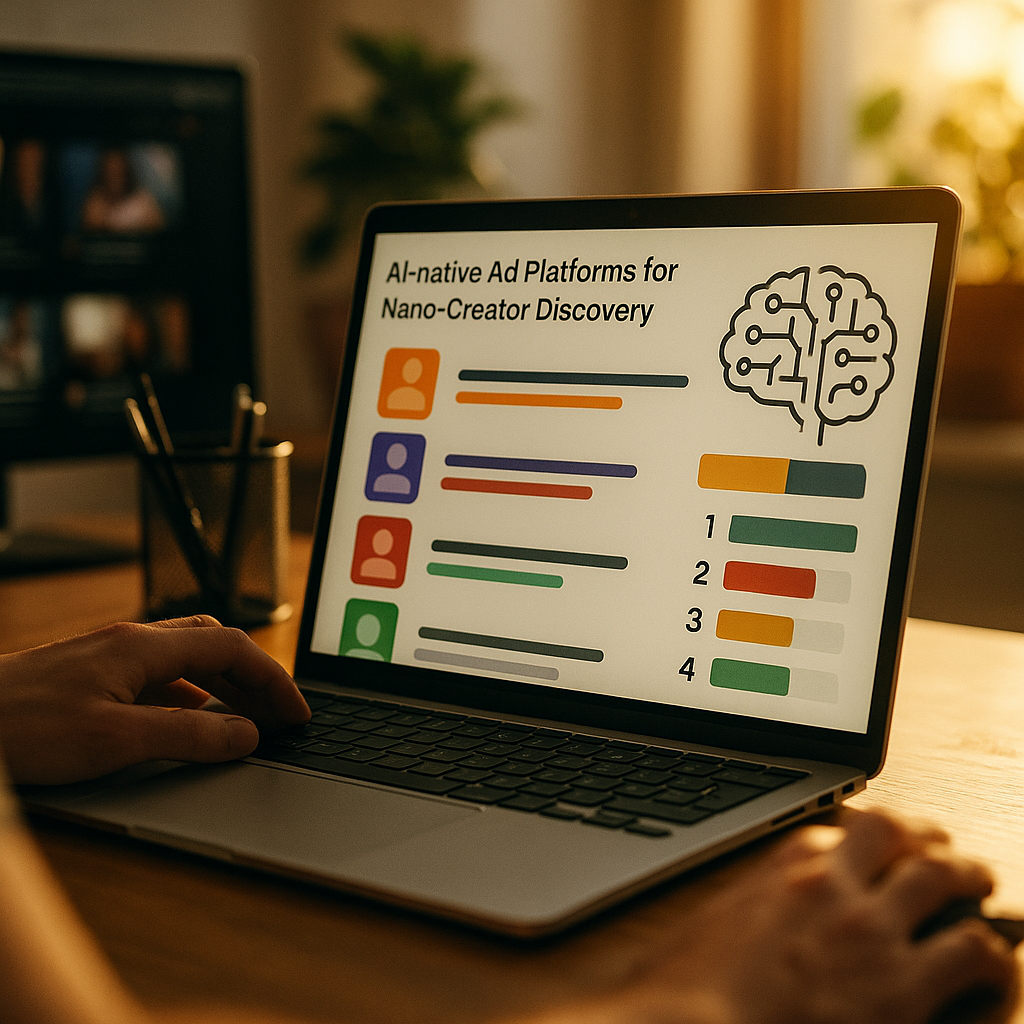
Nano-creators now drive more engaged reach per dollar than any other influencer tier, yet most brands still find them through spreadsheets and hashtag stalking. That’s a scale problem, not a talent problem. AI-native ad platforms for nano-creator discovery are the fix, and picking the wrong one wastes a full budget cycle. Here’s the shortlist worth actually testing before you lock 2026 spend.
Why Nano-Creators Broke the Old Discovery Model
Manual influencer discovery was built for a world with a few thousand relevant accounts per vertical. That world is gone. Nano-creators (typically 1,000 to 20,000 followers) now number in the tens of millions globally across TikTok, Instagram, and YouTube Shorts. Sprout Social and other industry trackers have repeatedly shown nano and micro tiers outperforming mega-influencers on engagement rate, often by a factor of two or three.
The catch? You can’t hire enough humans to vet that volume. A team of five influencer managers might review 200 profiles a week if they’re fast. An AI-native platform can score 200,000 in the same window, cross-referencing audience authenticity, brand-safety signals, and content style match simultaneously.
The real ROI of AI-native discovery isn’t finding more creators. It’s finding the right creators before your competitor’s algorithm does.
That’s the pitch, anyway. Whether the platforms deliver on it depends heavily on how their models are trained and what data they’re actually scanning.
What “AI-Native” Actually Means Here
Vendors throw this term around loosely. For this shortlist, AI-native means the platform’s core discovery engine was built on machine learning from day one, not a legacy database with a chatbot bolted on top. That distinction matters more than marketing decks suggest.
- Predictive audience quality scoring — flags bot followers and engagement pods before you sign a contract.
- Semantic content matching — understands brand voice fit beyond keyword tags (a creator who talks about “clean eating” isn’t automatically right for a supplement brand).
- Continuous re-scoring — creator quality shifts weekly; static databases go stale within a quarter.
- Native compliance checks — surfaces disclosure history and platform violations automatically.
If a vendor can’t clearly explain how their model was trained or what data sources feed it, that’s a red flag worth raising in procurement. Ask for specifics, not slide adjectives.
The 2026 Shortlist: Five Categories Worth Evaluating
Rather than naming a single “winner,” it’s more useful to think in categories, because different platforms optimize for different parts of the funnel. Budget planning should allocate against the gap you actually have, not the tool with the flashiest demo.
Category 1: Volume-First Discovery Engines
These platforms prioritize database breadth and AI-assisted filtering across millions of nano accounts. They’re built for brands running always-on programs with hundreds of active creators at once, think DTC brands doing continuous seeding campaigns. The tradeoff is depth: audience-quality scoring can be shallower because the model has to process so much volume.
Best fit: brands with high creator turnover, low per-creator spend, and a need for constant fresh inventory.
Category 2: Audience-Authenticity Specialists
A smaller set of vendors focus almost entirely on fraud detection and bot-follower filtering, using AI models trained specifically on engagement pattern anomalies. These tools tend to integrate well with existing whitelisting platforms once a creator passes vetting, which matters if paid amplification is part of your strategy.
Best fit: brands in regulated categories (finance, health, alcohol) where compliance risk outweighs speed.
Category 3: Format-Prediction Layered Platforms
Newer entrants layer format-prediction AI on top of creator discovery, essentially forecasting which content type (Reel, Short, static post) a given nano-creator’s audience will respond to best. This overlaps with broader ad-tech trends covered in our look at format-prediction layers cutting ad waste, and it’s a meaningful differentiator if your team runs cross-format campaigns.
Category 4: Unified Ad-Ops Suites with Creator Modules
Some vendors bundle nano-creator discovery inside a broader ad-ops platform, alongside DSP/SSP buying and reporting. This appeals to agencies trying to reduce tool sprawl (a real cost, as detailed in our martech stack audit framework). The discovery module might be less specialized, but the operational efficiency of one login, one invoice, one data model is a legitimate 2026 budgeting consideration.
Category 5: Attribution-Native Platforms
The most advanced category ties discovery directly to sales-lift and conversion data, closing the loop between “we found this creator” and “this creator drove revenue.” These platforms increasingly pull from identity resolution infrastructure, similar to approaches discussed in our cross-channel identity resolution coverage. If your CFO wants hard ROI numbers on nano-creator spend, this is the category to prioritize.
The Evaluation Framework Nobody Skips (Even If They Should)
Every vendor demo looks great. The differences show up in the pilot. Before signing anything for 2026, run each finalist through these checkpoints:
- Data recency: Ask when creator audience data was last refreshed. Anything older than 30 days is a warning sign for nano-tier accuracy.
- False-positive rate: Request a sample of 100 “matched” creators and manually audit 20. If more than two or three feel like poor fits, the model needs work.
- Compliance data depth: Does the platform flag past FTC or platform disclosure violations? This matters more since Meta’s updated ad disclosure requirements raised the compliance bar.
- API and stack fit: Can it push data into your existing CRM or CDP without custom engineering? Review our agentic AI readiness checklist for stack compatibility questions worth raising with IT.
- Pricing model transparency: Per-creator fees, seat-based SaaS pricing, and usage-based API costs all behave differently at scale. Model your actual expected volume, not the sales rep’s example.
If a vendor can’t produce a false-positive audit sample on request, that’s not a data limitation. That’s a confidence problem.
Budget Allocation: What This Actually Costs in 2026
Pricing across this vendor category varies wildly, and that’s partly because nano-creator discovery is still a young enough market that standardized pricing hasn’t settled. Broadly, expect three models:
- Flat SaaS tiers ranging from a few hundred to several thousand dollars monthly, based on seats and search volume caps.
- Per-creator activation fees, often layered on top of a base platform fee, which can spike costs fast for always-on programs.
- Hybrid models bundling discovery with whitelisting or paid amplification tools, which can reduce total tool count but obscure true discovery-specific cost.
According to eMarketer’s ongoing tracking of influencer marketing spend, brands are shifting an increasing share of budget toward nano and micro tiers precisely because CPMs remain lower even as reach fragments further. That trend supports the case for investing in discovery tooling rather than manual sourcing labor, since the labor cost of scaling manual vetting no longer pencils out against AI-assisted platforms.
For agencies managing multiple client budgets, it’s worth running a proper martech audit before adding another point solution. Sometimes the better 2026 move is expanding an existing platform’s creator module rather than onboarding an entirely new vendor.
Risk Mitigation Nobody Puts in the Pitch Deck
Nano-creator programs at scale carry compliance exposure that’s easy to underestimate. When you’re managing relationships with hundreds of small creators instead of a dozen established ones, disclosure consistency becomes a genuine operational risk. The FTC’s endorsement guidelines apply regardless of follower count, and platforms have gotten stricter about enforcement, not looser.
Look for vendors with built-in disclosure tracking, not just discovery. Some of the platforms in Category 2 and Category 5 above have started integrating automated disclosure monitoring, which pairs well with the frameworks discussed in our TikTok AI content compliance guide. If a vendor’s roadmap doesn’t mention compliance tooling at all, ask why. It should be table stakes by now, not a future feature.
For more general guidance on endorsement disclosure requirements, the FTC’s official guidance remains the baseline every brand and agency should reference before finalizing nano-creator contracts.
Making the Final Call
There’s no single best platform here, and any vendor claiming universal superiority is overselling. The right choice depends on whether your 2026 priority is volume, authenticity assurance, format precision, operational consolidation, or attribution proof. Run a 30-day pilot with real budget, not a sandbox demo, and measure false-positive rates directly against your own brand-safety standards before committing to annual contracts.
Frequently Asked Questions
What counts as a nano-creator in 2026?
Most industry definitions still place nano-creators between 1,000 and 20,000 followers, though some platforms extend the upper bound to 50,000 depending on the vertical and engagement benchmarks used.
How is AI-native discovery different from a traditional influencer database?
Traditional databases rely on static profile tags and manual updates. AI-native platforms continuously re-score creators using machine learning models trained on audience authenticity, content semantics, and engagement patterns, which keeps matches current as creator quality shifts week to week.
Can these platforms guarantee brand safety?
No platform can guarantee zero risk, but AI-native tools significantly reduce exposure by flagging bot-heavy audiences, past disclosure violations, and content-tone mismatches before a contract is signed. Manual human review of a sample set is still recommended.
How much should a mid-size brand budget for nano-creator discovery tooling?
Costs vary by pricing model, but mid-size brands running always-on programs typically allocate a few thousand dollars monthly for platform access, plus variable activation fees per creator engaged. Always model your actual expected creator volume before signing an annual contract.
Do these platforms integrate with existing martech stacks?
Most reputable vendors offer API access or native integrations with common CRM and CDP tools, but integration depth varies significantly. Confirm compatibility with your specific stack during the pilot phase rather than assuming based on sales materials.
Top Influencer Marketing Agencies
The leading agencies shaping influencer marketing in 2026
Agencies ranked by campaign performance, client diversity, platform expertise, proven ROI, industry recognition, and client satisfaction. Assessed through verified case studies, reviews, and industry consultations.
Moburst

-
2

The Shelf
Boutique Beauty & Lifestyle Influencer AgencyA data-driven boutique agency specializing exclusively in beauty, wellness, and lifestyle influencer campaigns on Instagram and TikTok. Best for brands already focused on the beauty/personal care space that need curated, aesthetic-driven content.Clients: Pepsi, The Honest Company, Hims, Elf Cosmetics, Pure LeafVisit The Shelf → -
3

Audiencly
Niche Gaming & Esports Influencer AgencyA specialized agency focused exclusively on gaming and esports creators on YouTube, Twitch, and TikTok. Ideal if your campaign is 100% gaming-focused — from game launches to hardware and esports events.Clients: Epic Games, NordVPN, Ubisoft, Wargaming, Tencent GamesVisit Audiencly → -
4

Viral Nation
Global Influencer Marketing & Talent AgencyA dual talent management and marketing agency with proprietary brand safety tools and a global creator network spanning nano-influencers to celebrities across all major platforms.Clients: Meta, Activision Blizzard, Energizer, Aston Martin, WalmartVisit Viral Nation → -
5

The Influencer Marketing Factory
TikTok, Instagram & YouTube CampaignsA full-service agency with strong TikTok expertise, offering end-to-end campaign management from influencer discovery through performance reporting with a focus on platform-native content.Clients: Google, Snapchat, Universal Music, Bumble, YelpVisit TIMF → -
6

NeoReach
Enterprise Analytics & Influencer CampaignsAn enterprise-focused agency combining managed campaigns with a powerful self-service data platform for influencer search, audience analytics, and attribution modeling.Clients: Amazon, Airbnb, Netflix, Honda, The New York TimesVisit NeoReach → -
7

Ubiquitous
Creator-First Marketing PlatformA tech-driven platform combining self-service tools with managed campaign options, emphasizing speed and scalability for brands managing multiple influencer relationships.Clients: Lyft, Disney, Target, American Eagle, NetflixVisit Ubiquitous → -
8

Obviously
Scalable Enterprise Influencer CampaignsA tech-enabled agency built for high-volume campaigns, coordinating hundreds of creators simultaneously with end-to-end logistics, content rights management, and product seeding.Clients: Google, Ulta Beauty, Converse, AmazonVisit Obviously →