


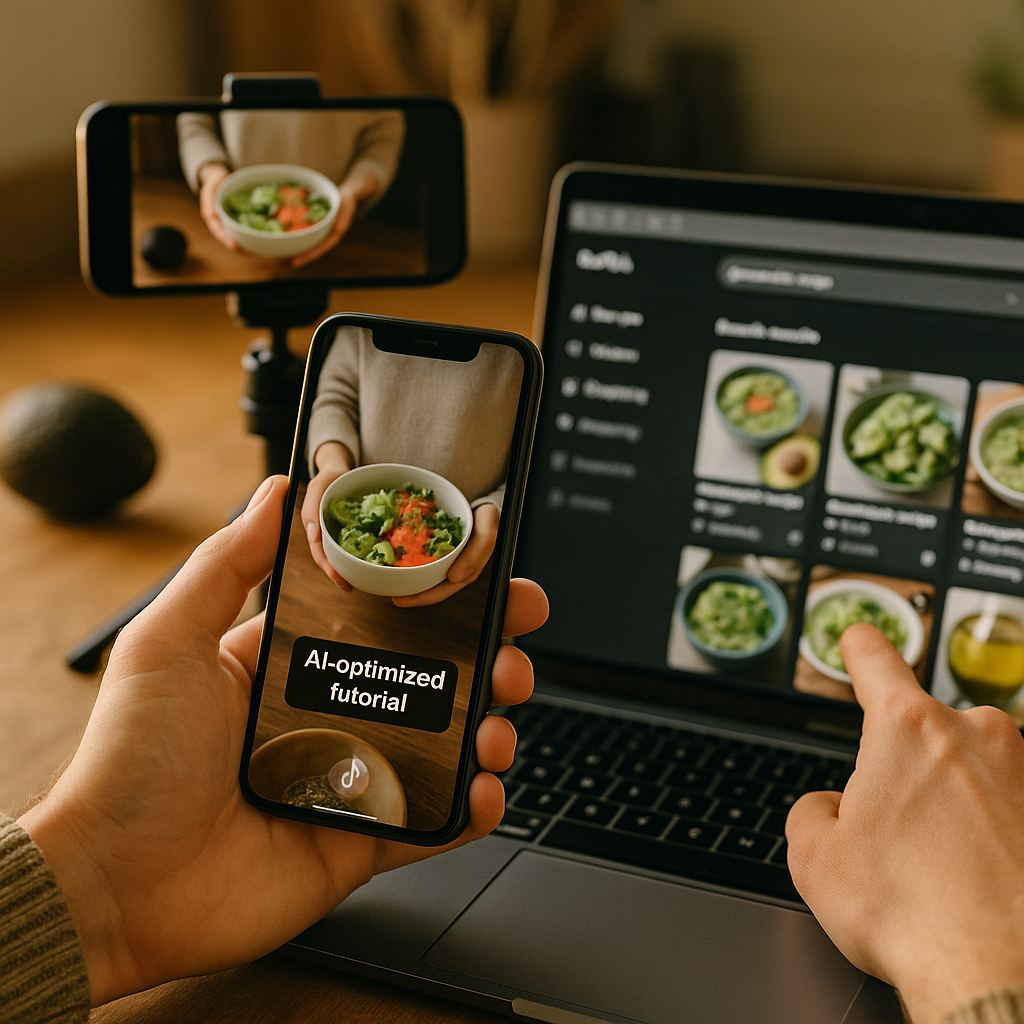
Most Tutorial Briefs Are Built for One Job. That’s Why They Fail.
Brands investing in how-to content are leaving serious distribution on the table. A well-structured tutorial asset can simultaneously rank in AI search results on Perplexity and ChatGPT, earn algorithmic push on TikTok and Instagram Reels discovery feeds, and convert a viewer directly to purchase. Getting all three requires a creative brief written with that specific architecture in mind from the start.
The Three-Surface Problem Most Strategists Ignore
Here’s what’s changed: tutorial content no longer lives on a single surface. A skincare how-to filmed for TikTok now gets indexed by AI answer engines, saved in Pinterest boards, reshared as YouTube Shorts, and cited in AI-generated shopping guides on Google’s AI Overviews. The brief that tells a creator to “show how to use the product in under 60 seconds” was never designed to serve that distribution map.
Brand strategists need to think in terms of three simultaneous distribution surfaces: algorithmic social feeds (TikTok For You, Instagram Reels, YouTube Shorts), AI search citation layers (ChatGPT Shopping, Perplexity AI, Google AI Overviews), and direct commerce touchpoints (TikTok Shop, shoppable Reels, affiliate checkout). Each surface has distinct content requirements. The brief must encode all three without making the production feel engineered.
A tutorial brief that only optimizes for social algorithms will earn views but miss AI citations and purchase conversion. All three surfaces require deliberate production direction from the first line of the brief.
What Goes into the Brief: A Surface-by-Surface Breakdown
Start with the algorithmic surface. TikTok’s feed algorithm rewards completion rate, replay value, and saves. That means the brief must specify a hook structure in the first two seconds that creates a knowledge gap (“You’ve been applying retinol wrong”) and a payoff that rewards watching to the end. The brief should also direct the creator toward a specific “save-worthy” moment: a tip that viewers will want to return to. These aren’t soft suggestions. They’re production requirements with measurable downstream impact on reach.
For the AI search surface, the logic is different. AI answer engines pull from transcripts, on-screen text, captions, and metadata. The brief must specify spoken keywords that match how users query AI tools. If someone asks ChatGPT “how do I layer niacinamide and vitamin C,” the tutorial that gets cited is the one where the creator says those exact words in sequence, clearly, on camera. That’s a scripting instruction, not a creative preference. Strategists writing briefs for AI citation should consult the emerging framework around AI answer engine citations to understand how content structure affects retrieval.
The commerce surface requires its own brief layer. This means specifying where the product link appears (pinned comment, overlay sticker, in-caption), when the creator references the link verbally (after the demonstration, not before), and what the call-to-action frame looks like. TikTok Shop integration data from TikTok for Business consistently shows that CTAs placed after the demonstration phase convert at significantly higher rates than pre-demo CTA placement. The brief should encode this as a timing instruction.
Structural Mandates: What the Brief Must Specify Line by Line
A practical AI-optimized tutorial brief for this format contains at least six discrete production direction elements:
- Hook frame (0–2 seconds): A spoken or on-screen question/claim that names the exact problem the viewer has.
- Spoken keyword sequence: Three to five natural-language phrases drawn from AI search query data, not SEO keyword tools. Perplexity and ChatGPT search differently than Google.
- Demonstration structure: Step numbers spoken aloud on camera (“Step one, step two”) improve AI transcript parsing and increase save rates on social feeds.
- On-screen text reinforcement: Key steps displayed as captions or overlays are indexed separately from spoken audio in some AI retrieval systems. Specify what text appears and when.
- Commerce trigger placement: Exact timing for product mention, link reference, and verbal CTA relative to content arc.
- Closing summary statement: A single sentence summarizing the tutorial outcome. This is the sentence AI engines are most likely to quote. Write it for them.
This level of production direction is not micromanagement. It’s the same discipline applied to brief architecture for algorithm reach in any high-performing creator program. The brief protects the creator’s editorial voice while encoding the structural signals that drive distribution.
Tone, Authenticity, and the Algorithmic Tension
There’s a legitimate creative tension here. Over-scripted tutorials feel like instructional videos from 2009, and both algorithms and audiences penalize them. The brief’s job is to set structural guardrails, not to write the creator’s script for them.
The right model: brief the structure, free the delivery. Specify that the creator must open with a problem statement, but let them choose their own language. Require a three-step demonstration sequence, but allow improvisation within each step. This approach aligns with what high-performing creator programs are already doing around briefing short-form series that build audience over time rather than burning it with single-use content.
Creators who feel the brief is a creative collaboration rather than a compliance checklist produce better content. That’s not an opinion. It’s visible in engagement data across every major platform’s creator insights dashboard.
Format Variants That Extend the Asset’s Reach
A well-produced tutorial doesn’t have to be a single asset. The brief should anticipate derivative formats from the start. A 60-second TikTok tutorial can be stripped to a 15-second product-focused Reel, expanded to a three-minute YouTube Short with additional context, and reformatted as a Pinterest Idea Pin with step text overlays. Building this modular logic into the original brief costs nothing and multiplies the asset’s distribution surface area substantially.
For brands running paid amplification bundles alongside organic creator content, the tutorial format is particularly efficient. The same asset can serve as organic feed content, whitelisted paid creative, and an AI-indexed reference piece simultaneously, provided the brief was built to enable all three from the production stage.
The tutorial format is the most efficient creative asset in the current ecosystem because it serves search intent, social discovery, and purchase intent at once. That efficiency only materializes when the brief is built to unlock it.
Compliance, Disclosure, and the FTC Dimension
Tutorial content that drives direct commerce conversion sits squarely in FTC disclosure territory. The brief must specify where and how disclosure appears, particularly when affiliate links or TikTok Shop commissions are involved. Disclosure placed only in captions is insufficient for AI-indexed content where captions may not be retrieved. Verbal disclosure in the first 30 seconds is now the standard the brief should encode. This isn’t optional legal boilerplate; it’s production direction that protects both the brand and the creator from enforcement risk.
Measuring Whether the Brief Actually Worked
Set measurement criteria before production, not after. An AI-optimized tutorial brief should specify expected signals across all three surfaces: algorithmic (completion rate target, save rate benchmark, Reels/TikTok algorithmic push score), AI search (manual citation tracking via Perplexity and ChatGPT queries related to the tutorial topic, 30 days post-publish), and commerce (click-through rate from shoppable link, conversion rate from link click to purchase). Sprout Social and native platform analytics cover the social layer; AI citation monitoring requires manual query testing or emerging tools like Brand24’s AI mention tracking or Semrush’s AI search visibility features.
Connecting those three measurement streams to a single asset is how you build the attribution argument for tutorial content investment internally. Without it, the tutorial is just a video. With it, it’s a multi-surface distribution engine with a measurable ROI case.
The next brief your team writes for a how-to asset should include a measurement annex with surface-specific KPIs attached to each production direction element. That single change will force the right strategic conversation before a single frame gets shot.
Frequently Asked Questions
What makes a creative brief “AI-optimized” for tutorial content?
An AI-optimized creative brief includes production direction that encodes spoken keyword sequences matching natural-language AI search queries, on-screen text that reinforces key steps for transcript indexing, and a closing summary sentence structured to be retrievable by AI answer engines like Perplexity, ChatGPT, and Google AI Overviews. It goes beyond traditional SEO instruction to account for how AI systems parse video transcripts and metadata.
How do you balance creative freedom with algorithmic production requirements in a tutorial brief?
The brief should specify structural requirements (hook format, step sequence, CTA timing, closing summary) while leaving delivery language and style open to the creator. This preserves authenticity and audience trust while encoding the algorithmic signals that drive discovery distribution. Over-scripting kills completion rates; under-specifying structure sacrifices AI indexing and commerce conversion.
Which platforms should a TikTok-style tutorial brief account for beyond TikTok itself?
A well-structured tutorial brief should account for TikTok’s For You feed, Instagram Reels discovery, YouTube Shorts, Pinterest Idea Pins, and AI search surfaces including Perplexity, ChatGPT Shopping, and Google AI Overviews. Building modular derivative formats into the brief from the start (15-second cut, 3-minute expansion, static step overlay) maximizes distribution reach without additional production costs.
Where should FTC disclosure appear in an AI-optimized tutorial with commerce conversion?
Verbal disclosure within the first 30 seconds of the video is the recommended standard, in addition to caption and overlay disclosure. For AI-indexed content, caption-only disclosure is insufficient because captions may not be retrieved by AI answer engines. The brief must specify disclosure format, placement, and timing as explicit production direction, not as a post-production afterthought.
How do you measure the performance of a tutorial brief across all three distribution surfaces?
Set surface-specific KPIs before production: completion rate and save rate for algorithmic social feeds; manual citation tracking via targeted AI queries (Perplexity, ChatGPT) 30 days post-publish for AI search performance; and click-through and conversion rates from shoppable links for commerce. Connecting these three measurement streams to a single asset builds the attribution case for tutorial content investment across your marketing organization.
Top Influencer Marketing Agencies
The leading agencies shaping influencer marketing in 2026
Agencies ranked by campaign performance, client diversity, platform expertise, proven ROI, industry recognition, and client satisfaction. Assessed through verified case studies, reviews, and industry consultations.
Moburst

-
2

The Shelf
Boutique Beauty & Lifestyle Influencer AgencyA data-driven boutique agency specializing exclusively in beauty, wellness, and lifestyle influencer campaigns on Instagram and TikTok. Best for brands already focused on the beauty/personal care space that need curated, aesthetic-driven content.Clients: Pepsi, The Honest Company, Hims, Elf Cosmetics, Pure LeafVisit The Shelf → -
3

Audiencly
Niche Gaming & Esports Influencer AgencyA specialized agency focused exclusively on gaming and esports creators on YouTube, Twitch, and TikTok. Ideal if your campaign is 100% gaming-focused — from game launches to hardware and esports events.Clients: Epic Games, NordVPN, Ubisoft, Wargaming, Tencent GamesVisit Audiencly → -
4

Viral Nation
Global Influencer Marketing & Talent AgencyA dual talent management and marketing agency with proprietary brand safety tools and a global creator network spanning nano-influencers to celebrities across all major platforms.Clients: Meta, Activision Blizzard, Energizer, Aston Martin, WalmartVisit Viral Nation → -
5

The Influencer Marketing Factory
TikTok, Instagram & YouTube CampaignsA full-service agency with strong TikTok expertise, offering end-to-end campaign management from influencer discovery through performance reporting with a focus on platform-native content.Clients: Google, Snapchat, Universal Music, Bumble, YelpVisit TIMF → -
6

NeoReach
Enterprise Analytics & Influencer CampaignsAn enterprise-focused agency combining managed campaigns with a powerful self-service data platform for influencer search, audience analytics, and attribution modeling.Clients: Amazon, Airbnb, Netflix, Honda, The New York TimesVisit NeoReach → -
7

Ubiquitous
Creator-First Marketing PlatformA tech-driven platform combining self-service tools with managed campaign options, emphasizing speed and scalability for brands managing multiple influencer relationships.Clients: Lyft, Disney, Target, American Eagle, NetflixVisit Ubiquitous → -
8

Obviously
Scalable Enterprise Influencer CampaignsA tech-enabled agency built for high-volume campaigns, coordinating hundreds of creators simultaneously with end-to-end logistics, content rights management, and product seeding.Clients: Google, Ulta Beauty, Converse, AmazonVisit Obviously →