


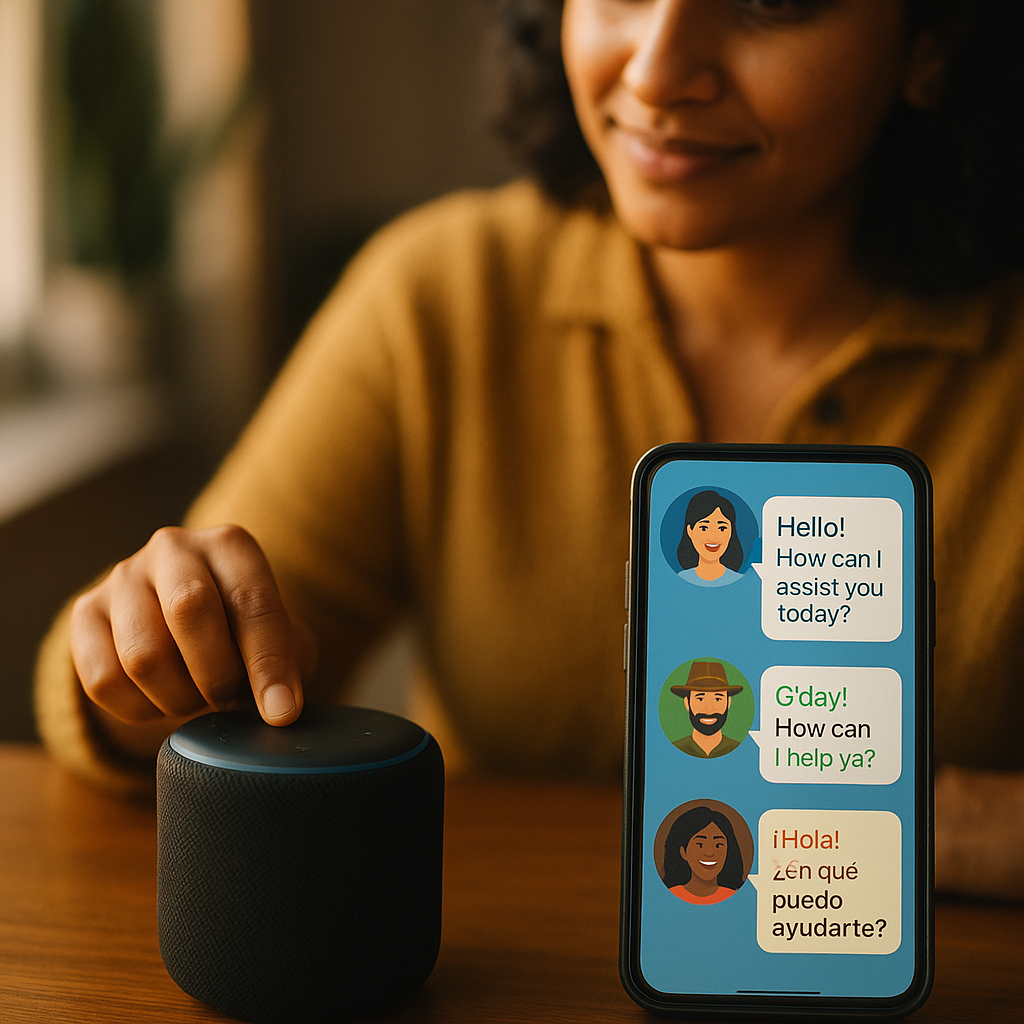
In 2025, global brands compete on voice experiences that feel local, not generic. Using AI to Personalize Voice Assistant Brand Personas By Region has become a practical way to improve trust, comprehension, and conversion across markets. The challenge is balancing cultural nuance with consistent brand values while staying compliant and safe. Get it right, and your assistant stops sounding translated—and starts sounding native.
Regional voice personalization strategies
Regional personalization is not “add an accent and change a few phrases.” It is a structured design approach that adapts how a voice assistant speaks, behaves, and resolves problems based on regional expectations—without changing what your brand stands for.
Start with a brand persona “core” and a regional “layer.” Define immutable attributes (tone: calm; values: transparent; stance: helpful; boundaries: no medical diagnosis) and then localize adjustable attributes (formality, humor tolerance, small talk, greetings, pace, idioms, examples, units, and local service norms).
Design for the full voice journey. Regional persona work should cover:
- Discovery: wake word experience, initial greeting, and expectation setting.
- Task execution: confirmations, error recovery, and handoff to human support.
- Trust moments: explaining why data is needed, repeating back sensitive details safely, and consent prompts.
- Edge cases: complaints, cancellations, and safety-related queries.
Answer the follow-up question: “How many personas do we need?” In practice, you rarely need a different persona for every country. Many organizations succeed with a hub-and-spoke model: one global persona core, then 5–15 regional clusters (for example: UK/Ireland, North America, Gulf Arabic, Levant Arabic, Brazilian Portuguese, European Spanish, Mexican Spanish, etc.), plus niche variants where regulation or service etiquette differs significantly.
Use measurable outcomes. Tie regional persona changes to KPIs such as task completion rate, containment rate, recontact rate, escalation reasons, and CSAT by locale. This prevents “local flavor” from becoming subjective debate.
Localized conversational design and cultural nuance
Localized conversational design is where regional persona decisions become concrete. The goal is to sound natural while being predictable and accessible. AI helps, but design leadership ensures the assistant stays coherent and safe.
Localize what users actually notice. High-impact elements include:
- Formality and pronouns: formal vs informal address and regional norms for politeness.
- Turn-taking and pacing: some regions prefer brisk, minimal prompts; others expect more context before confirmation.
- “Yes/no” behavior: indirect refusals, hedging language, or explicit confirmations.
- Repair strategies: how the assistant recovers from misunderstanding (rephrase vs ask targeted questions).
- Local examples: landmarks, common payment methods, delivery expectations, and time/date formats.
Handle dialects without stereotyping. Dialect support should be based on real usage data and user choice. Offer voice and dialect preferences in settings, and avoid caricature. Make the assistant competent across accents, not performative.
Answer the follow-up question: “Do we translate scripts?” Translation alone is usually insufficient. Use a “transcreate” process: preserve intent and brand posture, but rewrite for naturalness. Pair local linguists with conversation designers, then validate with usability testing in-region.
Optimize for accessibility. Regionalization should not reduce clarity. Maintain plain-language alternatives, avoid idioms in critical flows (payments, identity verification), and keep confirmation steps consistent.
Generative AI voice persona modeling
Generative AI accelerates regional persona creation by producing candidate phrasing, alternative tones, and style-consistent responses at scale. The key is to treat AI as a controlled writing and testing engine, not an autonomous brand voice.
Build a persona specification the model can follow. A practical spec includes:
- Persona traits: warmth level, directness, humor, empathy style, and taboo topics.
- Regional linguistic rules: preferred vocabulary, formality, idioms allowed, and banned expressions.
- Domain constraints: what the assistant can and cannot claim; escalation triggers; compliance language.
- Response patterns: greeting templates, confirmation phrasing, apology standards, and concise summaries.
Use retrieval and grounding for accuracy. For brand and policy questions, ground responses in approved knowledge (product docs, policies, price lists) so the assistant doesn’t improvise. For regional tone, allow the model flexibility within guardrails.
Implement structured generation. Instead of free-form text, generate:
- Intent-level variants: 5–10 regional phrasings per intent.
- Slot prompts: region-appropriate ways to request addresses, IDs, or payment info.
- Error messages: brief, actionable recovery prompts with regional politeness norms.
Answer the follow-up question: “How do we keep consistency across regions?” Maintain a shared “brand voice library” of do/don’t examples, plus automated checks that score outputs for tone, length, prohibited language, and policy compliance. Regional teams can add local examples without changing the core rules.
Multilingual NLP and accent adaptation
Multilingual NLP is the foundation for region-aware voice assistants: speech recognition, language understanding, and speech synthesis must work together under real conditions—background noise, code-switching, and regional pronunciations.
Prioritize recognition accuracy before personality. If automatic speech recognition struggles with local accents, a charming persona won’t help. Improve performance through:
- Locale-specific acoustic models: trained on regional speech samples and device conditions.
- Custom language models: incorporating local entities (cities, names), slang, and brand-specific terms.
- Code-switching support: especially in regions where users mix languages within a sentence.
Adapt text-to-speech without “acting.” Modern neural TTS can deliver regional voices with natural prosody. Choose voices that match your brand attributes (calm, energetic, premium, etc.) and test for:
- Intelligibility: clear consonants, stable pace, and appropriate emphasis.
- Prosody fit: natural question intonation, numbers, and addresses.
- Consistency: similar perceived personality across locales even with different voices.
Answer the follow-up question: “Do we need one voice per region?” Not always. Many brands use a small set of voices and adjust prosody, lexicon, and phrasing per locale. Use separate voices when users strongly associate a voice with “outsider” speech or when regulatory requirements demand local language support.
Measure with real utterances. Evaluate with in-market data: word error rate by accent group, intent accuracy, slot-filling success, and fallback rates. If privacy constraints apply, collect consented, anonymized samples or synthetic augmentation validated by local reviewers.
AI governance, privacy, and brand safety
Regional personalization increases risk if you treat it as purely creative work. In 2025, brands must show disciplined governance: how the assistant learns, what data it uses, and how it avoids harmful or misleading outputs. This is central to EEAT—users trust assistants that are accurate, transparent, and accountable.
Establish a safety and compliance baseline for every locale. Create a checklist that includes:
- Data minimization: collect only what’s needed to complete the task.
- Consent and transparency: explain recording, storage, and personalization choices in plain language.
- Local regulation mapping: align retention, deletion, and user rights to applicable rules.
- High-stakes boundaries: medical, legal, financial advice policies and escalation paths.
Prevent persona drift. When models learn from interactions, regional assistants can gradually change tone or adopt undesirable phrasing. Mitigate with:
- Human-in-the-loop review: sampling and auditing responses by locale.
- Policy and style classifiers: automated detection of disallowed content, sensitive attributes, and toxic language.
- Versioning: track persona specs, prompt changes, and model updates with rollback capability.
Answer the follow-up question: “How do we localize safely?” Give regional teams autonomy over language choices, but keep global control over safety rules, claims policy, and escalation triggers. This preserves brand integrity while respecting local norms.
Document expertise and sources. Maintain internal references for product facts, pricing, and policy statements used by the assistant. This improves accuracy and simplifies audits, partner reviews, and future updates.
Testing, metrics, and continuous optimization
Regional persona work is never “done.” You need an experimentation loop that connects conversation quality to business outcomes while protecting user trust.
Run locale-specific evaluation. A strong testing plan includes:
- Scenario testing: top intents, error cases, and escalations in each region.
- Linguistic QA: local reviewers score naturalness, politeness, and clarity.
- Safety QA: red-teaming for prompt injection, sensitive topics, and misinformation.
- Accessibility QA: speech rate options, pronunciation of names, and clarity for non-native speakers.
Use the right metrics. Track both experience and business indicators by locale:
- Task completion rate and time-to-complete
- Fallback rate and top misunderstanding reasons
- Escalation rate with categorized drivers (policy, confusion, trust)
- CSAT/NPS by region and intent category
- Compliance incidents and safety flag rates
Answer the follow-up question: “How do we prove personalization works?” Use A/B or multivariate tests at the intent level. For example, compare a global phrasing set versus a regionalized set for the same intents, keeping everything else constant (ASR model, backend latency, and routing). Require statistically meaningful lifts before expanding changes.
Keep humans close to the loop. The best teams pair AI speed with local expertise: conversation designers, linguists, support leads, and compliance owners. This improves quality and reduces the risk of cultural missteps.
FAQs
What does “brand persona” mean for a voice assistant?
A brand persona is the consistent way your assistant speaks and behaves: tone, word choice, level of empathy, directness, and how it handles errors and sensitive requests. It should reflect brand values and remain stable across channels, while allowing regional adjustments for natural communication.
How is regional personalization different from translation?
Translation changes language. Regional personalization adapts language, etiquette, pacing, examples, and conversation patterns to local expectations. A translated script can still sound unnatural; a localized design sounds native while preserving intent and brand standards.
What data is needed to personalize voice personas by region?
You need aggregated analytics (top intents, fallbacks), locale-specific language patterns, and curated examples from local experts. When using user utterances, collect them with informed consent, minimize identifiers, and follow local retention and deletion requirements.
Can one AI model serve multiple regions safely?
Yes, if you use strong guardrails: grounded knowledge for facts, regional persona specifications, automated policy checks, and continuous auditing. Many brands run one primary model with region-specific prompts, tools, and retrieval sources.
How do we avoid stereotypes when adding local flavor?
Base decisions on user research and local reviewer feedback, not assumptions. Offer user-controlled options (voice, formality), avoid exaggerated dialect performances, and keep critical flows plain and unambiguous.
What’s the fastest way to start without risking brand safety?
Begin with a limited set of high-volume intents, apply a persona core plus regional layer, ground responses in approved content, and run controlled A/B tests by locale. Expand only after quality and safety metrics meet defined thresholds.
Regional voice assistants win when they feel familiar, accurate, and respectful in every market. The best approach in 2025 is a stable global persona core, augmented by AI-generated regional variations that are validated by local experts and governed by strong safety rules. Measure outcomes by locale, iterate with real user signals, and keep personalization transparent. Do that, and your assistant earns trust—and business—region by region.