


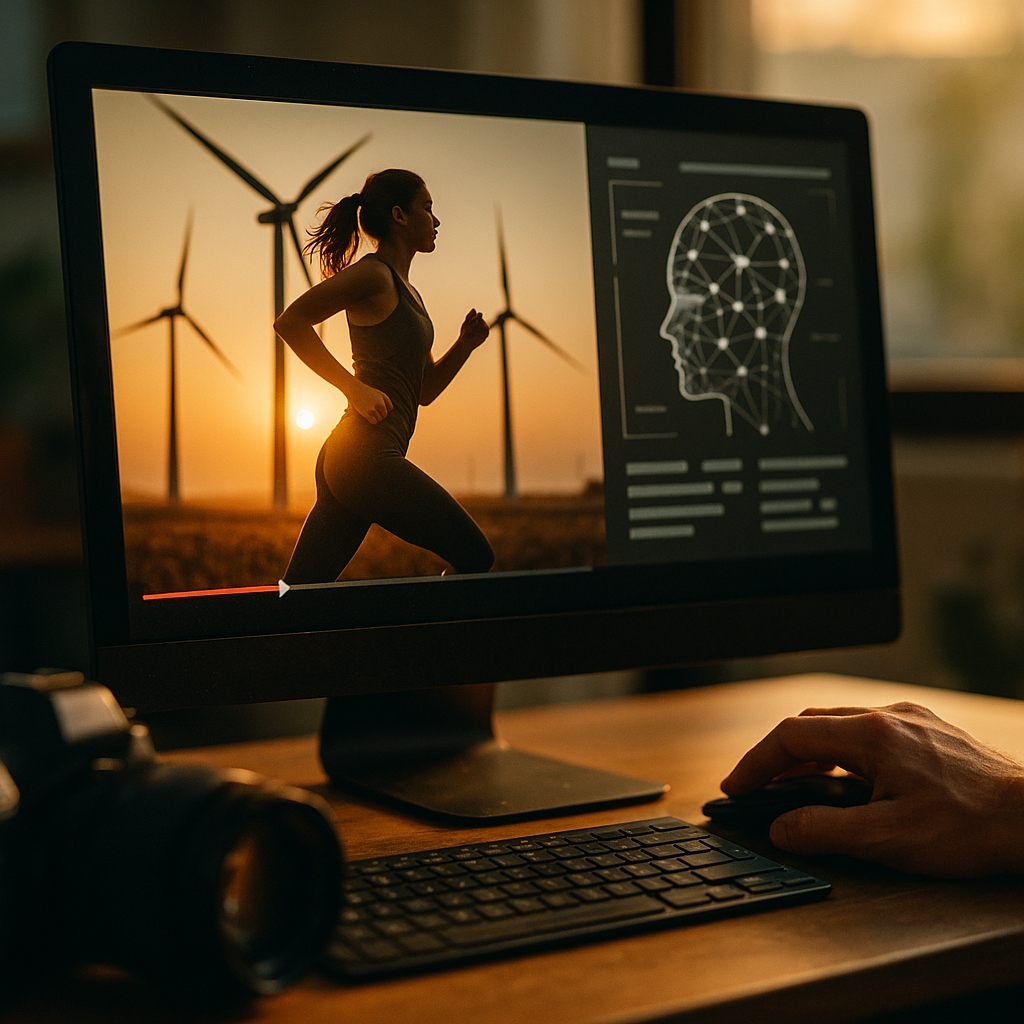
In 2026, attention is expensive, and the first seconds of a video decide whether viewers stay or swipe. Using AI to analyze the kinetic energy and retention of video hooks gives marketers a faster way to measure motion, pacing, and audience drop-off before budget is wasted. But what exactly should AI measure to predict a winning hook?
Why video hook retention matters for audience attention
Video platforms reward content that keeps viewers watching. That makes the opening seconds more than a creative flourish; they are a measurable performance lever tied to watch time, completion rate, clicks, and downstream conversion. A strong hook creates immediate cognitive momentum. A weak one forces the audience to work too hard to understand the value of staying.
Retention in the hook phase usually reflects a blend of factors:
- Visual momentum: how quickly the scene establishes movement, contrast, or novelty
- Narrative clarity: whether viewers understand what they are watching and why it matters
- Audio alignment: how voice, music, and sound effects support the first visual beat
- Expectation setting: whether the hook promises a payoff that feels worth the time investment
AI helps because these signals are difficult to judge consistently by instinct alone. Creative teams often have strong opinions, but human review is subjective and slow. Machine learning systems can scan frame-by-frame motion, speech cadence, subtitle timing, visual saliency, and historical retention patterns to identify which hook attributes correlate with stronger viewer hold.
That does not mean AI replaces creative judgment. It means teams can make decisions using evidence instead of taste alone. When used well, AI narrows the gap between what feels exciting and what actually earns attention in the feed.
How AI video analytics measures kinetic energy in hooks
Kinetic energy in video is not literal physics. In marketing analysis, it refers to the perceived force and momentum of a clip: camera movement, subject motion, edit velocity, visual change, and rhythm. AI video analytics can quantify these elements at scale and tie them to retention outcomes.
Common signals AI models evaluate include:
- Motion intensity: pixel movement across consecutive frames
- Shot frequency: how often cuts occur during the opening sequence
- Scene change magnitude: the degree of visual difference between shots
- Object movement: speed and direction of faces, hands, products, or backgrounds
- Typography entry: timing, size, and readability of on-screen text
- Audio energy: changes in volume, beat density, and vocal urgency
These metrics matter because viewers respond to change. If nothing meaningful changes in the first seconds, attention drifts. If too much changes without clarity, the result can feel chaotic. AI helps locate the productive middle: enough motion to signal relevance, enough structure to preserve understanding.
For example, a model may detect that hooks with a clear focal subject, one fast cut, and immediate text payoff outperform hooks with four rapid edits and delayed context. Another model may reveal that product demos retain better when the hand-to-product interaction happens in the first second rather than after an intro animation.
This is where experience and expertise matter. Analysts should not treat a single metric as truth. High motion does not always equal high retention. Educational content, luxury branding, and thought leadership often perform better with controlled motion and a confident opening line. The useful question is not “How energetic is this video?” but “Is the kinetic profile aligned with viewer intent and platform behavior?”
Using retention analysis to find where hooks lose viewers
Retention analysis shows what happens after the video starts. Instead of guessing why audiences leave, teams can inspect second-by-second drop-off and compare it with visual and verbal events. This is where AI becomes especially practical.
Modern systems can map retention curves against specific hook elements, such as:
- The first spoken phrase
- The time to product reveal
- The delay before showing a human face
- The duration of logo screens
- The moment captions appear
- The first major camera move or cut
Once those events are tagged, AI can identify recurring patterns across many videos. You might learn that viewers leave when the opening starts with a broad claim instead of a concrete outcome. You might find that retention improves when subtitles appear immediately, especially for silent autoplay placements. Or you may discover that the audience tolerates rapid pacing only when the first line explains the benefit in plain language.
To make retention analysis useful, organize your findings around practical creative questions:
- What is the first payoff? Viewers should get a reason to stay almost instantly.
- How long does confusion last? If context arrives too late, retention drops.
- Where does friction appear? Long intros, cluttered visuals, and weak audio often create exits.
- Which segments recover attention? Recovery moments can teach you what the audience values.
Strong teams combine AI outputs with real-world validation. Review comments, click-through data, hold rate, and conversion behavior. A hook with slightly lower retention but much higher qualified engagement may still be the better business asset. Helpful analysis connects audience behavior to the intended goal, not just vanity metrics.
Best practices for predictive video performance modeling
Predictive modeling uses historical content and engagement data to forecast how a hook may perform before large-scale distribution. In 2026, that workflow is increasingly accessible, but results still depend on data quality, testing discipline, and context.
To build useful predictive video performance models, follow these best practices:
- Train on comparable content: Separate short-form social ads, creator-style videos, organic explainers, and branded storytelling. Different formats behave differently.
- Include platform context: A hook built for vertical silent autoplay should not be scored by the same assumptions as a horizontal pre-roll placement.
- Use multimodal inputs: The strongest models evaluate visuals, speech, text overlays, audio, and interaction data together.
- Score early-sequence features: The first one to three seconds deserve dedicated weighting because they disproportionately affect retention.
- Validate against outcomes that matter: Watch time is useful, but pair it with conversion, click quality, or brand lift where possible.
- Retrain often: Audience behavior shifts quickly, especially when platform norms change.
Predictive models are most valuable when they support decisions such as:
- Which of three hook variants should enter paid testing first
- Whether a video needs a faster cold open
- If a text-first opening will outperform a face-first opening for a specific audience
- How much motion is optimal before clarity begins to suffer
There is also an EEAT consideration here. If you publish advice or claim performance improvements, explain your methodology. Readers trust content that shows how conclusions were reached. Describe what data was analyzed, what sample types were included, and what limitations exist. That transparency makes the content more helpful and more credible.
Creative optimization with machine learning for stronger hooks
AI is most useful when it drives action. Once the system identifies patterns in kinetic energy and retention, the next step is creative optimization with machine learning. This means turning analysis into edits, variants, and production rules your team can apply repeatedly.
Practical optimization tactics include:
- Move the payoff forward: Show the result, transformation, or key problem in the first second.
- Reduce dead frames: Cut empty lead-ins before the meaningful action begins.
- Clarify the visual hierarchy: Make sure viewers instantly know where to look.
- Tighten spoken language: Replace vague setup with direct, audience-specific value.
- Test text timing: Early subtitles and bold opening statements often improve comprehension.
- Match energy to intent: Fast cuts work for urgency; slower authority works for trust-driven topics.
AI can also suggest variant directions. If the model sees that videos with hands-on product interaction retain better than talking-head intros, it may recommend opening with use-in-action. If it detects that retention improves when surprise appears before explanation, it may prioritize reveal-first hooks.
Still, optimization should protect brand integrity. A high-retention hook that misleads viewers can damage trust, comments, and conversion quality. The best hooks create momentum without deception. They promise a payoff the video actually delivers.
This is another place where expertise matters. A knowledgeable strategist knows that retention is not a universal goal in isolation. For a product launch ad, the best hook may emphasize clear utility. For a founder narrative, credibility may matter more than visual speed. AI can surface the pattern, but experienced marketers interpret it within the brand, audience, and funnel stage.
Building a video testing framework with AI insights
One video can teach something. A structured testing framework teaches patterns you can scale. If you want repeatable gains from AI, build a process that links creative hypotheses, kinetic measurements, retention outcomes, and business results.
A simple framework looks like this:
- Define the hook hypothesis. Example: “Showing the outcome first will improve three-second hold rate.”
- Create controlled variants. Change one major element at a time: opening line, first shot, text placement, or cut speed.
- Measure kinetic attributes. Use AI to score motion density, edit velocity, text timing, and audio energy.
- Track retention and post-hook behavior. Analyze hold rate, completion, click-through, and conversion quality.
- Document platform-specific learnings. What works on one placement may fail on another.
- Feed results back into the model. Over time, the system becomes more useful for your specific brand and audience.
Teams often ask how much data they need. The answer depends on variance, distribution, and audience segmentation, but the principle is simple: do not treat tiny samples as universal truth. Use AI to generate directional confidence, then confirm with disciplined experimentation.
You should also protect against common mistakes:
- Overfitting to one winning ad
- Ignoring audience differences
- Confusing correlation with causation
- Optimizing only for cheap views instead of quality attention
- Applying social-video rules to every channel
When this framework is in place, AI becomes a force multiplier. It reduces review time, surfaces hidden patterns, and helps creative teams focus on decisions that move performance. More importantly, it creates a shared language between editors, strategists, media buyers, and stakeholders. Instead of debating whether a hook feels stronger, teams can discuss why one version retains more viewers and what to test next.
FAQs about AI video hook analysis
What is kinetic energy in a video hook?
It is the perceived motion and momentum of the opening seconds, shaped by movement, cuts, framing, text animation, and audio rhythm. It is a practical marketing concept used to describe how dynamic and attention-grabbing a hook feels.
Can AI really predict which video hook will perform best?
AI can improve prediction by analyzing historical patterns across creative features and audience behavior. It does not guarantee a winner, but it helps teams prioritize stronger variants and reduce guesswork before paid distribution or large-scale publishing.
What metrics should I track when analyzing video hooks?
Track early retention, hold rate, average watch time, completion rate, click-through rate, conversion quality, and the timing of drop-off points. Pair those outcomes with creative signals like motion intensity, cut speed, subtitle timing, and first-line clarity.
Does more motion always improve retention?
No. Too much motion can create confusion or fatigue. The right level depends on the platform, audience intent, brand style, and content type. AI is useful because it helps identify the motion profile that supports clarity rather than undermines it.
How do I use AI without hurting creativity?
Use AI as a decision-support tool, not a creative replacement. Let it reveal patterns, highlight drop-off moments, and suggest tests. Then apply human judgment to shape ideas that fit the brand, message, and audience context.
What is the ideal length for a video hook?
There is no single ideal length, but the first one to three seconds are usually decisive in short-form environments. The key is not duration alone; it is how quickly the video delivers relevance, clarity, and a reason to keep watching.
Is retention more important than conversion?
No. Retention is valuable because it signals attention, but conversion and quality engagement reflect business impact. The best analysis connects hook strength to the outcome your campaign is actually designed to achieve.
Using AI to assess kinetic energy and retention gives video teams a practical edge in 2026. It helps quantify motion, locate drop-off moments, and turn creative debate into informed testing. The clearest takeaway is simple: optimize hooks for both momentum and meaning. When AI insights are paired with sound strategy and honest experimentation, stronger retention becomes a repeatable outcome.
Top Influencer Marketing Agencies
The leading agencies shaping influencer marketing in 2026
Agencies ranked by campaign performance, client diversity, platform expertise, proven ROI, industry recognition, and client satisfaction. Assessed through verified case studies, reviews, and industry consultations.
Moburst

-
2

The Shelf
Boutique Beauty & Lifestyle Influencer AgencyA data-driven boutique agency specializing exclusively in beauty, wellness, and lifestyle influencer campaigns on Instagram and TikTok. Best for brands already focused on the beauty/personal care space that need curated, aesthetic-driven content.Clients: Pepsi, The Honest Company, Hims, Elf Cosmetics, Pure LeafVisit The Shelf → -
3

Audiencly
Niche Gaming & Esports Influencer AgencyA specialized agency focused exclusively on gaming and esports creators on YouTube, Twitch, and TikTok. Ideal if your campaign is 100% gaming-focused — from game launches to hardware and esports events.Clients: Epic Games, NordVPN, Ubisoft, Wargaming, Tencent GamesVisit Audiencly → -
4

Viral Nation
Global Influencer Marketing & Talent AgencyA dual talent management and marketing agency with proprietary brand safety tools and a global creator network spanning nano-influencers to celebrities across all major platforms.Clients: Meta, Activision Blizzard, Energizer, Aston Martin, WalmartVisit Viral Nation → -
5

The Influencer Marketing Factory
TikTok, Instagram & YouTube CampaignsA full-service agency with strong TikTok expertise, offering end-to-end campaign management from influencer discovery through performance reporting with a focus on platform-native content.Clients: Google, Snapchat, Universal Music, Bumble, YelpVisit TIMF → -
6

NeoReach
Enterprise Analytics & Influencer CampaignsAn enterprise-focused agency combining managed campaigns with a powerful self-service data platform for influencer search, audience analytics, and attribution modeling.Clients: Amazon, Airbnb, Netflix, Honda, The New York TimesVisit NeoReach → -
7

Ubiquitous
Creator-First Marketing PlatformA tech-driven platform combining self-service tools with managed campaign options, emphasizing speed and scalability for brands managing multiple influencer relationships.Clients: Lyft, Disney, Target, American Eagle, NetflixVisit Ubiquitous → -
8

Obviously
Scalable Enterprise Influencer CampaignsA tech-enabled agency built for high-volume campaigns, coordinating hundreds of creators simultaneously with end-to-end logistics, content rights management, and product seeding.Clients: Google, Ulta Beauty, Converse, AmazonVisit Obviously →