


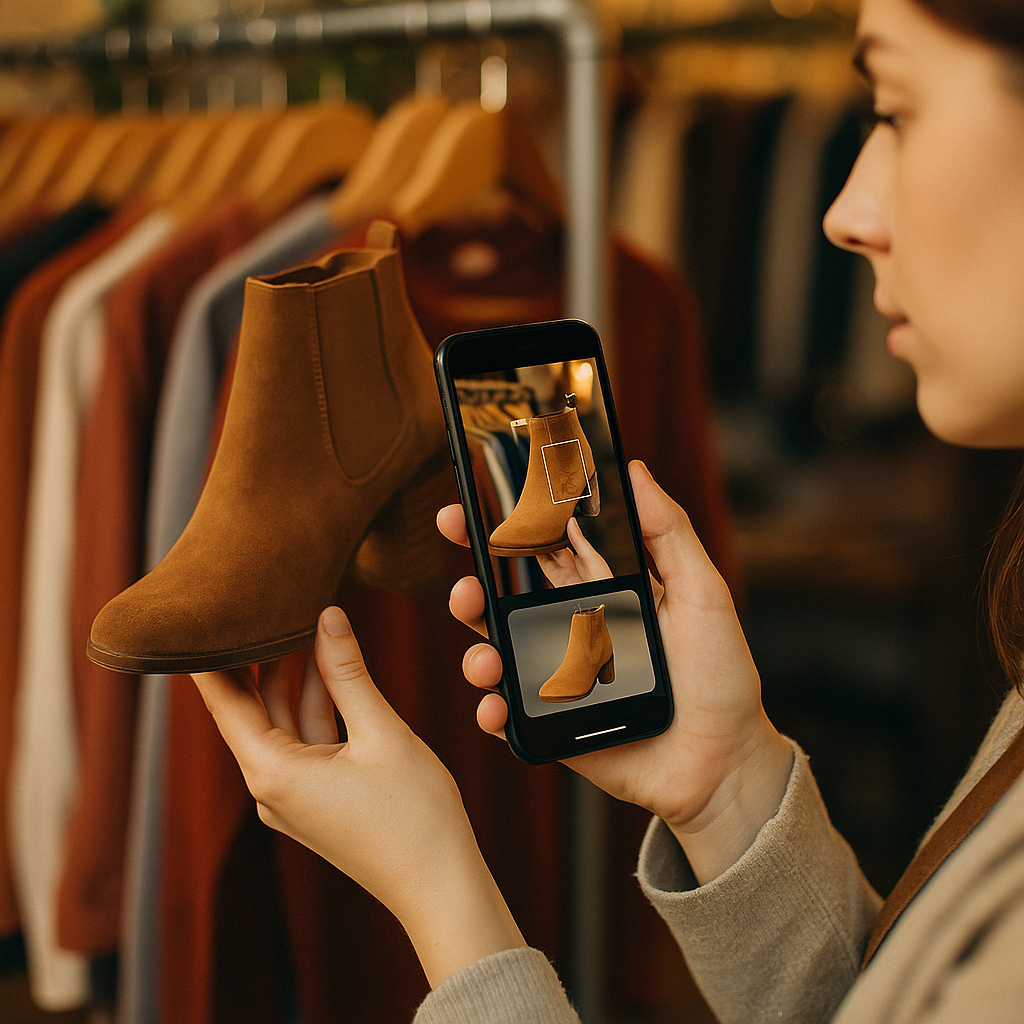
AI-Powered Visual Search is changing how shoppers find products without typing long queries. In 2025, cameras and screenshots act like search bars, turning real-world inspiration into clickable results that feel natural and fast. For brands, the opportunity is bigger than novelty: visual discovery can surface items people didn’t know how to describe. The question is, will your products be found?
How visual search technology works for product discovery
Visual search lets a user submit an image—taken with a phone camera, uploaded from a gallery, or captured as a screenshot—and receive product results that “look like” the object in the image. Unlike text search, which depends on the user’s vocabulary, visual search starts with pixels and patterns.
Most commerce-grade systems combine several AI components:
- Object detection to identify the main item (for example, a shoe in a street photo) and separate it from the background.
- Feature extraction using deep learning to encode shape, color, texture, and style cues into a searchable vector.
- Vector similarity search to match the query vector to catalog vectors, retrieving visually similar products quickly at scale.
- Attribute and metadata fusion to refine results using signals such as brand, category, price, availability, and location.
- Ranking and personalization to prioritize items based on user intent, past behavior, and constraints (sizes, shipping speed, budget).
Organic product discovery happens when the system surfaces items that genuinely match the shopper’s visual intent—even if the shopper did not mention a brand, material, or exact style. This also reduces “search friction”: fewer failed queries, fewer vague keywords, and fewer bounces from irrelevant results.
If you’re wondering whether this replaces text SEO, it doesn’t. It shifts the input. The shopper still ends up on product pages, category pages, or listings that need clear content, accurate attributes, and strong UX to convert.
Organic product discovery benefits for shoppers and brands
Organic discovery means customers find products through relevance rather than paid placement. Visual search supports that by capturing intent earlier—at the moment of inspiration—before the shopper has formed a keyword query.
For shoppers, the benefits are direct:
- They can search what they see—street style, home decor, outfits in videos, or items in a friend’s photo.
- They get faster path-to-product when text is hard (unknown terms, misspellings, multilingual situations).
- They discover alternatives (similar silhouettes, patterns, or finishes) without starting over.
- They find long-tail items that rarely appear for generic text queries, like “sage green boucle accent chair with oak legs.”
For brands and retailers, visual search strengthens organic growth in several ways:
- Higher-intent entry points because the image already narrows the product space.
- New discovery surfaces through “similar items” modules, camera search, and screenshot search.
- Better catalog monetization by exposing depth items that don’t rank well for broad keywords but match visual intent perfectly.
- Lower dependency on paid ads when relevant items are surfaced organically within your own search experience and product recommendations.
A common follow-up question is whether visual search only helps fashion. It performs strongly in fashion and home due to style-driven intent, but it also works in beauty (shade matching), automotive parts (component identification), consumer electronics (model recognition), and even grocery (packaging recognition), as long as the catalog images and attributes are consistent.
Image SEO and product data requirements for visual search
Visual search is only as accurate as the inputs you provide. That means your images, structured data, and product attributes act as the “training set” your own site relies on for matching and ranking. If you want to be discoverable organically, treat image and product data quality as an SEO discipline, not just creative output.
Prioritize catalog image consistency:
- Use multiple angles and include close-ups for texture, logos, and key details.
- Keep background rules consistent for primary images (clean backgrounds for commerce listings; lifestyle images as secondary).
- Maintain color accuracy with calibrated workflows; small shifts can change match quality and returns.
- Avoid heavy filters that distort pattern, contrast, or true tone—especially for fashion and beauty.
Make your product data “machine readable”:
- Write precise titles that combine type + differentiator (material, cut, fit, finish) without keyword stuffing.
- Fill attribute fields (color, pattern, material, dimensions, heel height, neckline, compatible models) consistently.
- Use unique, stable IDs for product variants (size/color) so results don’t collapse into the wrong SKU.
- Connect images to variants so the user who searched a “black” item lands on the black variant, not a random colorway.
Apply structured data thoughtfully: Mark up products so search engines and platforms can interpret key commerce signals. Structured data doesn’t “power” the computer vision match, but it supports eligibility, rich results, and accurate indexing of product pages that visual search can route traffic to.
Another likely question: “Do I need alt text if visual search uses AI?” Yes. Alt text and captions still matter for accessibility, indexing, and disambiguation, especially when the image contains multiple objects. Use descriptive alt text that reflects what the product is, not marketing language.
Visual commerce strategy for retail SEO and content
Visual search changes which pages win. Shoppers arriving from a camera query typically want confirmation and options: “Is this the same?” and “Show me similar.” Your content should answer both.
Build landing experiences that convert visual intent:
- Dedicated visual-search entry pages that show “closest match” plus a grid of similar items with filters.
- Clear comparison cues such as key attributes near the top: material, dimensions, fit notes, compatibility, and care.
- Robust “similar products” modules driven by both visual similarity and attributes (don’t recommend a “similar sofa” that’s a different size class).
- Fast image loading so users can scan alternatives quickly; speed supports organic performance and reduces bounce.
Reframe category content for visual discovery: Traditional category pages often rely on text filters and broad keywords. Visual-driven shoppers benefit from:
- Curated visual clusters like “chunky knit,” “minimalist hardware,” “mid-century legs,” or “square-toe.”
- Style guides with shoppable imagery that teach users how to refine visually (silhouette, pattern family, finish).
- UGC and real-life images that expand what the model can match and what customers can recognize.
Answer follow-up questions in-page: Visual search often starts with appearance but ends with practicality. Include fit and sizing guidance, measurement visuals, compatibility lists, and “how it looks in different lighting” for color-sensitive categories. These reduce returns and build trust—important for EEAT because they demonstrate real product expertise.
Trust, privacy, and EEAT in AI shopping experiences
In 2025, trust determines whether users adopt camera-based shopping. Visual search inherently involves user images, and shoppers want to know what happens to those images, how results are ranked, and whether recommendations are biased.
Demonstrate trustworthiness with clear policies and product truth:
- Explain image handling in plain language: whether images are stored, how long, and for what purpose.
- Offer user control such as deleting search history, turning off personalization, and opting out of data retention.
- Avoid deceptive ranking by clearly distinguishing sponsored placements from organic visual matches.
- Keep product claims accurate (materials, country of origin, certifications, compatibility). AI will not fix misleading copy; it amplifies exposure.
Strengthen EEAT signals through evidence of expertise:
- Use specialist review for technical categories (skincare, supplements, electronics parts) where incorrect matches can harm users.
- Include measurable specs and verified details over vague descriptors (“premium,” “luxury,” “best”).
- Show real-world validation with verified reviews, Q&A, and customer photos that confirm color and scale.
A practical concern is bias: visual systems can underperform on certain lighting conditions, skin tones, or image quality. Reduce this risk by testing with diverse images and ensuring your catalog includes varied on-body or in-context photography where appropriate.
Measuring visual search ROI with analytics and testing
You can’t optimize what you can’t measure. Visual search introduces new user paths that standard SEO reporting may miss unless you instrument them properly.
Track the right events and funnels:
- Visual search starts (camera open, image upload, screenshot paste) and completion rate.
- Result interaction (click-through on top match, use of filters, scroll depth).
- Downstream outcomes (add-to-cart, conversion rate, returns, exchanges) segmented by visual-search users.
- “No match” frequency to identify catalog gaps, image quality issues, or model limitations.
Optimize with controlled experiments:
- Ranking tests comparing pure visual similarity vs. hybrid ranking (visual + price + availability + margin constraints).
- UI tests for how you present matches: “closest match” first vs. a blended grid.
- Attribute tests to see which filters matter most after a visual query (size, color family, material, brand).
Make insights operational: When you see frequent searches for a style you don’t stock, feed that into merchandising and content planning. When “no match” clusters around one category, review photography standards or add missing attributes. This is where organic discovery becomes a durable advantage: your catalog and content evolve based on real visual intent.
FAQs about AI visual search and organic discovery
-
Does visual search help SEO, or does it replace it?
It complements SEO. Visual search changes how users express intent, but they still land on pages that need strong on-page content, clear product data, fast performance, and trustworthy signals to rank and convert.
-
What products work best with visual search?
Items with distinct visual attributes—fashion, home decor, furniture, accessories, beauty packaging, and many consumer goods. It also works for parts and electronics when images and compatibility attributes are precise.
-
How can a small retailer compete in visual search?
Focus on image consistency, complete attributes, and variant accuracy. Small catalogs can outperform large ones when photography is clean and metadata is reliable, because matching quality improves and “no match” rates drop.
-
What image practices improve match accuracy the most?
High-resolution images, consistent lighting, minimal background clutter for primary images, multiple angles, and close-ups of defining features (logos, textures, stitching, hardware). Avoid filters that change the true color.
-
How do you handle privacy concerns with camera search?
Be explicit about whether images are stored, for how long, and why. Provide controls to delete history and opt out of personalization. Clearly label sponsored results to protect trust.
-
What’s the difference between visual similarity and “same product” matching?
Visual similarity finds items that look alike (same silhouette or style cues). “Same product” matching tries to identify an exact SKU or model. Many shoppers want both: an exact match if available, plus similar alternatives.
AI-powered visual search turns real-world inspiration into organic product discovery by letting shoppers search with images instead of words. In 2025, brands that win focus on disciplined photography, complete attributes, and trustworthy experiences that respect privacy and label rankings clearly. Treat visual search as a data-and-content program, not a gadget. Improve inputs, measure outcomes, and your catalog becomes easier to find.