


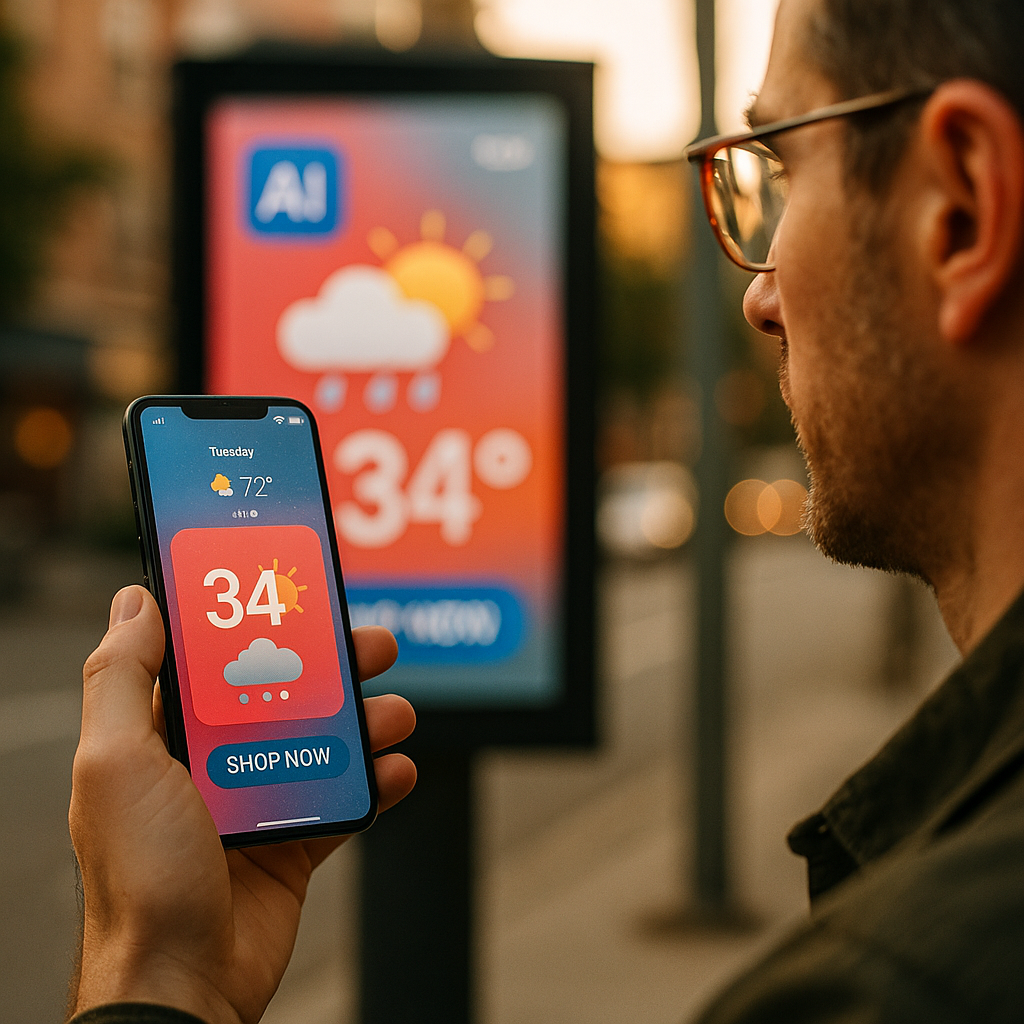
Using AI to personalize dynamic creative based on live weather data has moved from a niche tactic to a practical growth lever in 2025. When temperature, precipitation, and UV index shift by the hour, your customers’ needs shift with them. AI can translate those signals into timely messages, images, and offers across channels—without overwhelming your team. What if your ads always matched the forecast?
AI-driven creative personalization: what it is and why it works
AI-driven creative personalization combines three capabilities: real-time context (weather), dynamic creative (modular assets that can change), and decisioning (models that pick the best combination for each viewer and moment). Instead of running one static campaign for “spring,” you serve variants that align with what people experience right now: a sudden cold snap, an unexpected heatwave, or a week of heavy rain.
It works because weather is a universal, high-signal context. People don’t need to be “tracked” to benefit; they simply respond to relevance. A commuter seeing sleet cares about traction and warmth. A runner in rising humidity cares about hydration and breathable fabric. A traveler facing storms cares about flexible booking and coverage. Weather-based relevance reduces message friction and increases the odds that the next action feels natural.
Readers often ask whether this is only for retail. It is not. Weather-sensitive intent shows up in categories such as grocery, QSR, travel, insurance, home services, wellness, media streaming, and even B2B (for example, construction scheduling or logistics). The key is to define which weather conditions meaningfully change a customer’s priorities and then reflect that shift in creative and offers.
Live weather data integration: sources, signals, and data quality
Live weather data integration starts with selecting reliable data sources and deciding how granular you need to be. Most implementations use a weather API provider that offers hourly and daily forecasts, current conditions, and alerts. You can also use device-level geolocation (when consented) or approximate location (IP-based) to map a user to the nearest reporting point.
Common weather signals used for personalization include:
- Temperature (absolute, feels-like, or delta vs seasonal normal)
- Precipitation (rain/snow probability, intensity, accumulation)
- Wind (speed, gusts) and humidity
- UV index and air quality (where available and relevant)
- Severe alerts (storms, heat advisories, flooding warnings)
- Time of day and sunrise/sunset for lighting and activity cues
Data quality and governance matter as much as creative. Build rules for what happens if the API fails, if the user’s location is unknown, or if multiple stations disagree. A typical best practice is to define sensible fallbacks (for example, use regional conditions, then national seasonality) and to cache weather responses for short intervals to reduce latency and cost.
Also decide whether you are responding to current conditions, forecast conditions, or both. Forecast-based messaging can be powerful (“Rain expected after 3 PM—order delivery now”), but it should be accurate and phrased responsibly. Where severe conditions exist, avoid opportunistic language and prioritize safety-focused messages.
Dynamic creative optimization (DCO): building modular assets that adapt
Dynamic creative optimization (DCO) is the execution layer that makes weather-based personalization visible. You design a set of modular components—headlines, images, backgrounds, product tiles, CTAs, and offer badges—then let the system assemble them based on conditions and predicted performance.
How to structure weather-ready creative:
- Message modules: benefit statements that map to weather states (cooling, warming, waterproofing, hydration, comfort).
- Visual modules: imagery that matches conditions without feeling literal or repetitive (sunlight tones, rainy city scenes, cozy interiors).
- Product modules: items or services that genuinely fit the context (rain jackets, tire checks, iced beverages, dehumidifiers).
- Offer modules: promotions that remain compliant and consistent across markets (free delivery during storms, limited-time bundles during heat).
- CTA modules: actions aligned to intent (“Shop Rain Gear,” “Schedule HVAC Tune-Up,” “Get Same-Day Delivery”).
To keep brand consistency, set guardrails. Define which fonts, colors, tone-of-voice, and claims are allowed. Set limits on how frequently users can see major changes so the experience feels coherent rather than chaotic. Many teams also maintain “evergreen” versions so the system never needs to invent messaging when a condition falls outside predefined scenarios.
One frequent follow-up question is whether generative AI should create final ad copy and images. In practice, teams get the best results when generative AI assists with ideation, variant drafting, and localization, while humans approve the final library. That approach supports quality, compliance, and brand safety—especially in regulated industries.
Machine learning decisioning: predicting the best creative for each moment
Machine learning decisioning chooses which creative combination to show given weather, audience signals, and inventory constraints. At a minimum, you can use rule-based logic (for example, “if rain probability > 60%, show waterproof set”). AI improves on this by learning which combinations perform best for each segment, channel, and micro-context.
Common decisioning inputs include:
- Weather context: current/forecast conditions and severity thresholds
- Audience context: new vs returning, product affinity, lifecycle stage (where consented and permitted)
- Channel context: placement, device, format constraints, frequency exposure
- Business context: inventory, margins, delivery capacity, store hours, service availability
Practical modeling approaches:
- Multi-armed bandits to balance exploration (testing) and exploitation (winning variants) in near real time.
- Uplift modeling to estimate which users are most likely to change behavior because of weather-personalized creative.
- Propensity models to predict conversion likelihood per creative bundle and context.
To align with Google’s helpful content expectations, measure outcomes beyond clicks. Track downstream actions such as add-to-cart, quote requests, store visits (where available), and repeat purchases. Also monitor customer experience indicators: unsubscribe rates, complaint rates, and creative fatigue. AI should increase relevance, not simply chase short-term CTR.
Another key question: “Will this work with limited data?” Yes—if you start with fewer variants and clearer hypotheses. Weather is a strong contextual feature; you can often see lift by tailoring just one element (headline or product tile) before expanding to full assemblies.
Marketing automation and omnichannel activation: from ads to email and onsite
Marketing automation makes weather-based creative consistent across the customer journey. When a user sees a rain-focused ad, clicks through, and lands on a sunny-themed page, trust drops. Aim for aligned experiences across paid media, owned channels, and onsite personalization.
High-impact omnichannel use cases:
- Paid social and display: rotate weather-aware creative sets by geography and hour.
- Search and shopping: adjust ad copy extensions, promo messaging, or product prioritization based on conditions.
- Email and SMS: send forecast-triggered reminders (for example, “heat tomorrow—refill today”), with strict frequency caps.
- Onsite personalization: reorder collections (rain gear, fans, allergy relief) and update banners based on local conditions.
- App experiences: use in-app modules to recommend timely products and services, respecting user notification preferences.
Operationally, connect your weather signals to a decision layer (CDP, experimentation platform, or custom service) that outputs a small set of creative IDs and messaging tokens. Then your ad platforms, ESP, and CMS render the appropriate approved assets. This architecture keeps your system scalable and auditable.
Brands also ask about localization. Weather personalization often requires it: “free next-day delivery” may not apply everywhere, and product availability can vary by region. Integrate inventory and fulfillment constraints so the AI cannot recommend items that are out of stock locally. That single step can prevent wasted spend and protect trust.
Privacy, compliance, and measurement: applying EEAT to weather personalization
EEAT—experience, expertise, authoritativeness, and trust—shows up in how you design, govern, and evaluate the program. Weather-based personalization can be privacy-respectful because it relies on environmental context, but you still need strong standards.
Privacy and compliance practices:
- Consent-first data use: if using precise location, collect consent and provide clear controls.
- Data minimization: store only what you need (often a coarse location bucket and timestamp is enough).
- Transparent messaging: avoid implying you know personal circumstances; frame content as local relevance.
- Special category caution: treat health-related or sensitive inferences carefully (for example, asthma and air quality) and involve legal review.
- Safety during severe events: prioritize helpfulness; avoid manipulative scarcity language tied to emergencies.
Measurement framework to prove impact credibly:
- Incrementality: use geo-holdouts or time-based holdouts to isolate lift attributable to weather-personalized creative.
- Experiment design: A/B test weather-personalized vs generic creative, holding bids and targeting stable.
- Attribution realism: combine platform reporting with first-party analytics and, where possible, conversion APIs.
- Creative insights: track performance by weather state (hot, cold, rain, snow, high UV) to inform future asset production.
To demonstrate expertise internally, document your decision logic, data sources, and approval workflows. Keep an audit trail of which creatives ran under which conditions and why. This makes it easier to troubleshoot performance changes, comply with platform policies, and maintain consistent brand standards as the program scales.
FAQs: AI and weather-based dynamic creative
What is the primary benefit of combining AI with live weather data for ads?
You increase relevance at the moment of decision. Weather changes immediate needs, so matching creative to local conditions can improve engagement and conversion while reducing wasted impressions on mismatched messages.
Do I need real-time weather, or is a daily forecast enough?
Many brands start with daily forecasts because they are simpler and still effective. Real-time conditions help when demand shifts quickly (storms, heat spikes) or when you run short-cycle promotions like delivery windows.
How many creative variants should I build to start?
Start small: 3–6 weather states (hot, cold, mild, rain, snow, severe) and 2–3 variants per state for testing. Expand only after you can measure lift and manage approvals efficiently.
Is this approach compatible with privacy regulations?
Yes, when you use consented location data (or coarse regional signals), minimize data retention, and avoid sensitive inferences. Weather context itself is not personal data, but how you map it to a user can be.
Can AI generate the ad copy and images automatically?
AI can draft and localize variants quickly, but most high-performing teams keep humans in the loop for final approval to protect brand voice, accuracy, and compliance—especially for claims tied to severe weather.
How do I measure whether weather personalization is truly incremental?
Run controlled experiments such as geo-holdouts or A/B tests where one group sees generic creative and another sees weather-personalized creative. Compare conversion lift and downstream revenue, not just clicks.
What industries see the strongest results?
Retail apparel, grocery, QSR, travel, home services (HVAC, roofing), and insurance often see clear weather-driven intent shifts. Any category with weather-sensitive demand can benefit if the offer is genuinely useful.
What are common mistakes?
Over-personalizing with too many variants, ignoring inventory constraints, using inaccurate weather triggers, changing onsite experiences too slowly, and writing messages that feel invasive or opportunistic during severe events.
How quickly can I launch a pilot?
A focused pilot can launch in a few weeks if you already have modular creative and a decisioning path. The critical path is usually creative approvals, platform setup, and a clean experiment design.
What’s the clear takeaway?
In 2025, weather-aware AI personalization works best when you combine reliable live data, modular approved assets, and disciplined testing. Build a small set of weather states, activate them consistently across channels, and measure incrementality with holdouts. Keep privacy and safety guardrails in place. Done well, your creative stays relevant—because the forecast changes, and so should your message.