


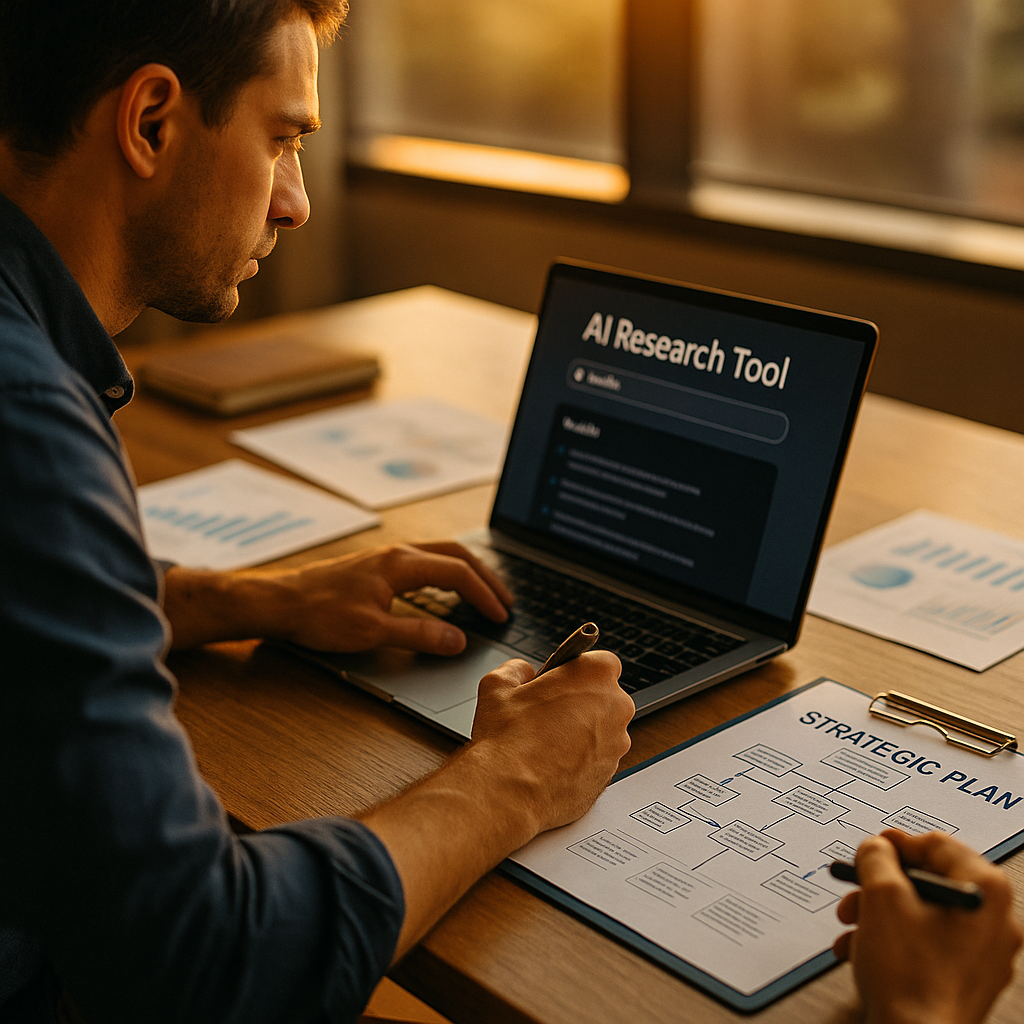
Six weeks. That used to be the standard runway for a competitive landscape brief before a major pitch or planning cycle. Now some marketing teams are turning around the same deliverable in six hours. AI-assisted slide deck and research brief generation isn’t a novelty anymore, it’s quietly resetting the clock on how strategy gets built, and the teams still working the old way are burning budget to stand still.
Why the Old Research Cycle Is Breaking
Traditional strategic planning followed a predictable rhythm: junior analysts spent days scraping earnings calls, industry reports, and competitor decks, then senior strategists spent more days synthesizing it into something a CMO could actually use. That model assumed research was scarce and expensive. It isn’t anymore. What’s scarce now is attention and judgment, the ability to know which insight actually matters.
Platforms built around large language models and structured data retrieval have inverted the equation. Instead of a team spending a week gathering inputs, a single strategist can query a system, get a synthesized answer with sourcing, and spend the freed-up time on interpretation and narrative. That’s a fundamentally different use of human hours.
AlphaSense and the New Category of Research Copilots
AlphaSense built its reputation in financial research, helping analysts search across earnings transcripts, broker reports, and filings faster than manual review ever could. That same architecture (natural language search layered over a massive, vetted corpus) is now bleeding into brand strategy, competitive intelligence, and influencer marketing planning. Marketing teams use it to pull consumer sentiment signals, track competitor positioning shifts, and generate first-draft briefs that used to require a full research sprint.
The appeal isn’t just speed. It’s traceability. Unlike a generic chatbot response, tools in this category cite sources, which matters enormously when a brief is going to legal, a client, or a CFO who wants receipts. We covered this dynamic in detail in our comparison of generative search platforms for brand research, and the sourcing gap between casual AI search and enterprise-grade research tools is exactly where budget decisions get made.
The teams winning right now aren’t the ones with the most research staff, they’re the ones who’ve compressed the distance between question and defensible answer.
What Compression Actually Looks Like in Practice
Compression sounds abstract until you map it against a real workflow. Here’s what a typical influencer campaign strategy brief looked like before and after AI-assisted research tools entered the stack:
- Before: Analyst spends 3 to 5 days manually reviewing competitor campaigns, creator performance benchmarks, and category sentiment across scattered sources.
- After: Strategist runs structured queries across a research platform, gets synthesized findings with citations in hours, and spends remaining time refining strategic recommendations.
- Before: Slide deck built manually from research notes, often losing nuance in translation between analyst and designer.
- After: AI drafts a structured outline or full deck skeleton directly from research inputs, which a strategist edits rather than builds from scratch.
That second shift, deck generation, is arguably the bigger unlock. Tools like Gamma, Tome, and even Microsoft Copilot’s PowerPoint integration now turn a research brief into a formatted, on-brand deck in minutes. Combine that with AlphaSense-style research synthesis, and the entire pitch-to-plan pipeline shrinks from weeks to days.
The ROI Case: Where the Time Savings Actually Land
Marketing leaders should be skeptical of vague productivity claims. So let’s be specific about where the value actually shows up.
First, agency margins improve because billable research hours drop without cutting the client’s perceived value. A pitch team that used to allocate 40 hours to competitive research can reallocate 25 of those hours to creative strategy, which is the part clients actually pay a premium for. Second, brands running in-house influencer programs get faster reaction time. According to eMarketer, speed to market on trend-responsive content is increasingly a differentiator, not a nice-to-have, and that same urgency applies to the strategic groundwork behind campaigns. We’ve written before about how brands beat the viral clock with faster tooling, and research compression is the upstream version of that same problem.
Third, and this is the one CFOs care about: fewer research staff hours means lower fully-loaded cost per strategic deliverable. That doesn’t mean headcount cuts across the board, it means the same team produces more strategic output without proportional cost increases.
Risk Mitigation: Where Speed Can Bite You
Faster isn’t automatically better. Compression without guardrails creates its own failure modes, and brand teams need to plan for them explicitly.
The biggest risk is source quality drift. An AI research tool is only as good as the corpus it’s pulling from, and consumer-facing tools indexed on open web content will surface stale or low-authority data mixed in with solid sources. This is precisely why enterprise research platforms differentiate themselves on curated, licensed data sets rather than open crawl. If your team can’t tell you where a stat in a slide came from, that slide shouldn’t leave the building. Our governance checklist for AI search insights is a useful starting point for building that discipline into a team’s workflow.
Second risk: over-trusting synthesis. AI-generated summaries can smooth over contradictions in the underlying data, presenting a confident narrative that hides genuine uncertainty. A senior strategist still needs to interrogate the output, not just format it. Third, there’s a compliance angle that’s easy to overlook. If AI tools are pulling from third-party research or proprietary data sets, licensing terms matter, and marketing leaders should loop in legal before these tools touch client-facing deliverables. The FTC has been increasingly attentive to AI-related disclosure and data practices, and that scrutiny isn’t going away.
Speed without a sourcing standard just means you make bad decisions faster than before.
How This Reshapes Team Structure
Compressed research cycles don’t just change timelines, they change org charts. Junior research roles that used to be about manual data gathering are shifting toward prompt design, source curation, and quality control. That’s a real skills shift, and teams that don’t invest in training will end up with strategists who can’t tell a well-sourced AI output from a hallucinated one.
Some agencies are restructuring pitch teams entirely, collapsing what used to be separate research and strategy functions into a single “insight to narrative” role supported by AI tooling. This mirrors a broader trend we’ve tracked around autonomous marketing agents reshaping org design, where the human role moves up the value chain toward judgment and away from execution. It’s not a smaller team necessarily, it’s a differently skilled one.
There’s also a governance layer worth building early. Marketing operations teams should establish which AI research tools are approved for client-facing work, what citation standards are mandatory, and how outputs get reviewed before they reach a deck. Without that structure, you get inconsistent quality across teams, which undermines the credibility gains these tools are supposed to deliver. For teams building this monitoring layer, our piece on continuous AI data monitoring lays out a practical framework.
What to Actually Evaluate Before Buying
If you’re weighing a research copilot investment, skip the vendor demo theater and focus on four things: source transparency (can it cite specifically, not just generally), data freshness (how current is the underlying corpus), integration with your existing deck and document tools, and audit trail capability for compliance review. Pricing models vary widely, some platforms charge per seat, others per query volume, and enterprise contracts often bundle in dedicated support for onboarding research teams. According to HubSpot‘s marketing technology research, tool consolidation is a growing priority, so also weigh whether a new research platform adds redundancy to your stack or genuinely replaces slower manual processes.
FAQs
Frequently Asked Questions
What is AI-assisted slide deck and research brief generation?
It refers to software tools that use AI to gather, synthesize, and format research into strategic documents like briefs or presentation decks, dramatically reducing the manual hours needed to produce them.
How is AlphaSense different from a general AI chatbot?
AlphaSense searches a curated, licensed corpus of financial and business documents rather than the open web, and it provides direct citations back to source material, which makes its output more defensible for professional use.
Can AI-generated research briefs replace human strategists?
No. These tools accelerate data gathering and first-draft synthesis, but interpreting findings, applying brand context, and making strategic recommendations still require experienced human judgment.
What are the main risks of using AI for strategic research?
The main risks are source quality drift, over-trusting synthesized summaries that mask underlying contradictions, and compliance issues tied to data licensing when third-party research feeds into client-facing work.
How should marketing teams evaluate AI research tools before adopting them?
Prioritize source transparency, data freshness, integration with existing workflows, and audit trail capability, then confirm the tool actually reduces redundancy in your current technology stack rather than adding to it.
Frequently Asked Questions
What is AI-assisted slide deck and research brief generation?
It refers to software tools that use AI to gather, synthesize, and format research into strategic documents like briefs or presentation decks, dramatically reducing the manual hours needed to produce them.
How is AlphaSense different from a general AI chatbot?
AlphaSense searches a curated, licensed corpus of financial and business documents rather than the open web, and it provides direct citations back to source material, which makes its output more defensible for professional use.
Can AI-generated research briefs replace human strategists?
No. These tools accelerate data gathering and first-draft synthesis, but interpreting findings, applying brand context, and making strategic recommendations still require experienced human judgment.
What are the main risks of using AI for strategic research?
The main risks are source quality drift, over-trusting synthesized summaries that mask underlying contradictions, and compliance issues tied to data licensing when third-party research feeds into client-facing work.
How should marketing teams evaluate AI research tools before adopting them?
Prioritize source transparency, data freshness, integration with existing workflows, and audit trail capability, then confirm the tool actually reduces redundancy in your current technology stack rather than adding to it.
The teams that win the next planning cycle won’t be the ones with the biggest research budgets, they’ll be the ones who’ve already built the governance and skills to use compression responsibly. Start by auditing one recurring deliverable, like a competitive brief or campaign pitch deck, and time how much of it could shift to an AI-assisted workflow this quarter.
Top Influencer Marketing Agencies
The leading agencies shaping influencer marketing in 2026
Agencies ranked by campaign performance, client diversity, platform expertise, proven ROI, industry recognition, and client satisfaction. Assessed through verified case studies, reviews, and industry consultations.
Moburst

-
2

The Shelf
Boutique Beauty & Lifestyle Influencer AgencyA data-driven boutique agency specializing exclusively in beauty, wellness, and lifestyle influencer campaigns on Instagram and TikTok. Best for brands already focused on the beauty/personal care space that need curated, aesthetic-driven content.Clients: Pepsi, The Honest Company, Hims, Elf Cosmetics, Pure LeafVisit The Shelf → -
3

Audiencly
Niche Gaming & Esports Influencer AgencyA specialized agency focused exclusively on gaming and esports creators on YouTube, Twitch, and TikTok. Ideal if your campaign is 100% gaming-focused — from game launches to hardware and esports events.Clients: Epic Games, NordVPN, Ubisoft, Wargaming, Tencent GamesVisit Audiencly → -
4

Viral Nation
Global Influencer Marketing & Talent AgencyA dual talent management and marketing agency with proprietary brand safety tools and a global creator network spanning nano-influencers to celebrities across all major platforms.Clients: Meta, Activision Blizzard, Energizer, Aston Martin, WalmartVisit Viral Nation → -
5

The Influencer Marketing Factory
TikTok, Instagram & YouTube CampaignsA full-service agency with strong TikTok expertise, offering end-to-end campaign management from influencer discovery through performance reporting with a focus on platform-native content.Clients: Google, Snapchat, Universal Music, Bumble, YelpVisit TIMF → -
6

NeoReach
Enterprise Analytics & Influencer CampaignsAn enterprise-focused agency combining managed campaigns with a powerful self-service data platform for influencer search, audience analytics, and attribution modeling.Clients: Amazon, Airbnb, Netflix, Honda, The New York TimesVisit NeoReach → -
7

Ubiquitous
Creator-First Marketing PlatformA tech-driven platform combining self-service tools with managed campaign options, emphasizing speed and scalability for brands managing multiple influencer relationships.Clients: Lyft, Disney, Target, American Eagle, NetflixVisit Ubiquitous → -
8

Obviously
Scalable Enterprise Influencer CampaignsA tech-enabled agency built for high-volume campaigns, coordinating hundreds of creators simultaneously with end-to-end logistics, content rights management, and product seeding.Clients: Google, Ulta Beauty, Converse, AmazonVisit Obviously →