


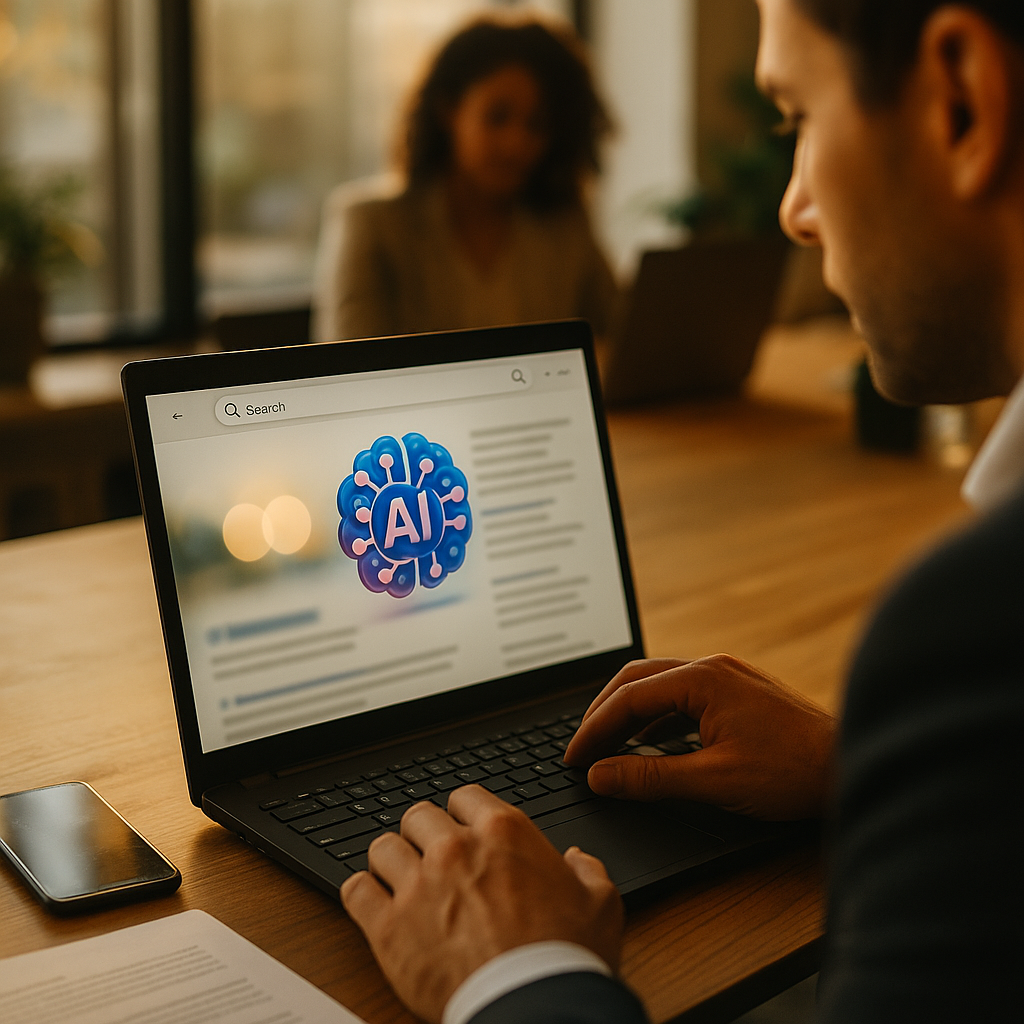
Roughly 95% of B2B buyers now use AI-powered search tools to shortlist vendors before a single sales conversation happens. If your professional services brand isn’t structured to appear in those generative results, you aren’t just losing visibility — you’re losing the shortlist entirely.
The Zero-Click Funnel Is Already Costing You Pipeline
Generative search engines — ChatGPT, Perplexity, Google’s AI Overviews, Microsoft Copilot — don’t serve ten blue links. They synthesize. They pull from sources they trust, assemble a confident answer, and move on. The prospect never needs to scroll further. That single synthesized answer is your new first impression, whether your content shaped it or your competitor’s did.
For professional services brands — consulting firms, SaaS platforms, legal tech, financial advisory, marketing agencies — this is a structural revenue problem. Your buyers are sophisticated. They run AI-assisted research before they book demos, before they read a single case study you’ve published, before they respond to a sales email. The old funnel assumed you could intercept them at multiple touchpoints. The new funnel compresses those touchpoints into one.
The brands that appear in AI-generated answers aren’t necessarily the biggest — they’re the ones whose content is structured to be cited. That’s an operational problem you can solve right now.
Why Creator Content Has Become an AI Citation Signal
Here’s what most brand teams are missing: generative AI models don’t only pull from corporate websites. They pull from wherever authoritative, structured, conversational content lives. That includes YouTube transcripts, LinkedIn long-form posts, podcast show notes, Substack newsletters, and Medium articles written by credible practitioners. Creator and expert-authored content often outperforms brand-owned pages in AI citations precisely because it sounds like a human expert explaining something, not a company selling something.
This creates a direct operational mandate for professional services brands: your creator partnerships need to be structured for AI retrievability, not just social reach. A creator who produces a 2,000-word LinkedIn article analyzing your firm’s methodology — with specific named frameworks, data citations, and clear attribution — is a far more valuable AI citation asset than a 30-second Instagram reel driving vanity engagement.
The implication is significant for how you structure creator contracts. Deliverables need to explicitly include long-form, indexable content formats. If your current briefs spec out only short-form video, you’re optimizing for a social algorithm that increasingly matters less in the research phase of a high-value B2B purchase.
The Four Content Formats AI Search Actually Cites
Not all content is equal in the eyes of a large language model retrieving sources. Based on how Google’s AI systems and platforms like Perplexity surface citations, four formats consistently outperform others for professional services visibility:
- Structured expert explainers: Long-form articles (1,500 words minimum) where a named expert — internal or creator partner — explains a specific concept with clear headings, examples, and attributed data points.
- FAQ and Q&A content: Pages with explicit question-and-answer structure, marked up with FAQ schema, that mirror the phrasing prospects actually use in AI prompts.
- Original research and benchmark data: Proprietary surveys, benchmarks, or analysis that other publishers cite. When your data gets referenced by third parties, AI models treat you as a primary source.
- Video with indexed transcripts: YouTube remains one of the most-cited sources in AI overviews. A YouTube series where your partners or internal experts answer category-level questions — fully transcribed and chaptered — is one of the highest-leverage formats available.
Notice what’s absent from that list: ungated whitepapers, gated reports, and most social-only content. If a human can’t access it without a form fill, an AI crawler almost certainly can’t retrieve it either.
Structuring Owned Content for Retrieval, Not Just Traffic
The traditional SEO playbook focused on ranking pages for keyword queries. AI search operates differently. It looks for content that answers a question completely, cites credible sources, attributes authorship clearly, and is structured in a way that makes the answer extractable.
For professional services brands, this means several specific changes to your content operations. First, every substantive article needs a named, credentialed author with a bio that includes verifiable expertise. Anonymous brand content scores low on what Google’s quality guidelines call Experience, Expertise, Authoritativeness, and Trustworthiness. Second, internal linking needs to create topical clusters, not just pass PageRank. AI models interpret a brand that covers a topic comprehensively, across multiple interlinked pieces, as an authority on that topic.
Third — and this is where most teams leave significant ground on the table — you need to be explicitly answering the questions your prospects are asking AI tools right now. Run a prompt audit: query ChatGPT and Perplexity with the exact questions your ICP asks before shortlisting vendors. Map every answer against your existing content. Where you’re not cited, you have a content gap that’s costing you pipeline.
This connects directly to how AI search reshapes brand discovery across the funnel, not just at the awareness stage.
Creator Distribution as an Authority Amplifier
There’s a compounding effect when creator content and owned content reinforce each other. A creator publishes a detailed LinkedIn article citing your firm’s original research. Your firm publishes an owned explainer that references the creator’s analysis. Both pieces get indexed. Both get retrieved. When an AI model assembles an answer about your category, it finds consistent, mutually-reinforcing signals from multiple sources — and your brand becomes the gravitational center of the answer.
This is the architecture that matters. It’s not about volume of content. It’s about coherence and cross-citation density. Professional services firms that understand this are investing in creator networks that scale systematically rather than one-off influencer activations that produce a single piece of content and go dark.
Think about what firms like McKinsey and Deloitte have done organically over decades — building a body of citable research that makes them the default answer in any consultant’s AI query. You can replicate that architecture faster now, with creator partnerships, if you structure the content correctly from the start.
AI search doesn’t reward the loudest brand. It rewards the most cited one. Your creator program needs to be an authority-building engine, not a reach play.
Budget Allocation: Where to Shift Resources
The practical budget question is where this gets operationally real. Most professional services marketing budgets are still weighted toward paid search, event sponsorships, and brand advertising. These channels matter for different funnel stages, but none of them influence what an AI model says about your firm when a prospect asks a direct question.
Reallocating even 15-20% of a content marketing budget toward AI-optimized creator content — structured explainers, original research co-authored with credentialed experts, indexed video series — can produce measurable shifts in AI citation frequency within two to three content cycles. The key is pairing that reallocation with a measurement framework that tracks citation frequency in AI tools, not just organic traffic. Tools like Semrush and emerging platforms like Brandwatch are beginning to surface AI citation tracking as a distinct metric category.
For teams navigating how to sequence AI ad spend against creator investment, the answer for professional services specifically is to front-load the creator content architecture. Paid amplification is far more efficient when the organic citation foundation already exists.
Also worth examining: how your creator contracts are written today versus what they need to include for AI visibility. Rights to republish long-form content, requirements for structured data markup, and explicit deliverables around indexed formats all need to be in scope. This is a newer consideration that most agency boilerplate doesn’t yet cover, but it’s becoming a competitive differentiator as explored in the emerging conversation around creator partnership architecture.
What to Do This Quarter
Start with a prompt audit against your top five competitor queries. Identify exactly where your brand appears (or doesn’t) in AI-generated answers. Build a content brief for each gap, assign it to either an internal expert or a creator partner with verifiable credentials in your category, and structure every piece with FAQ schema, named authorship, and cross-links to your core owned content. Measure citation frequency monthly, not quarterly — this is a fast-moving surface and the brands building authority now will be significantly harder to displace in twelve months.
Frequently Asked Questions
What does “AI search visibility” mean for professional services brands?
AI search visibility refers to how frequently and prominently your brand, methodology, or content appears in answers generated by AI-powered search tools like ChatGPT, Perplexity, Google AI Overviews, and Microsoft Copilot. For professional services, this matters because B2B buyers use these tools to research and shortlist vendors before ever visiting a brand’s website or responding to outreach.
Why does creator content help with AI search citations?
Generative AI models retrieve content from sources they consider authoritative, trustworthy, and human-readable. Creator-authored long-form content — LinkedIn articles, YouTube series with transcripts, expert newsletters — often scores higher on these signals than anonymous brand marketing copy. When a credentialed creator explains your firm’s framework or cites your original research, that creates a citable external reference that AI models are more likely to surface.
What content formats are most likely to appear in AI-generated answers?
The formats most consistently cited in AI search results include structured expert explainers with named authors, FAQ pages with schema markup, original proprietary research that other publishers reference, and indexed video content (especially YouTube) with full transcripts. Gated content, anonymous pages, and purely social-native formats are rarely retrieved.
How do I measure whether my content is appearing in AI search results?
Start by running a regular prompt audit: query tools like ChatGPT, Perplexity, and Google AI Overviews with the exact questions your target buyers are likely asking. Note which brands are cited and in what context. Emerging analytics platforms including Semrush and Brandwatch are developing AI citation tracking features that can make this more systematic. Track citation frequency monthly as a distinct KPI separate from traditional organic search metrics.
How should creator contracts change to support AI visibility?
Creator briefs and contracts need to explicitly include long-form, indexable content as a deliverable — not just short-form video or social posts. They should specify full content rights for republication on owned channels, require structured data markup on any hosted pages, mandate named expert authorship with credentialing details, and include requirements for cross-linking to relevant owned content. Most current agency boilerplate doesn’t cover these requirements yet, making this a near-term competitive differentiator for teams that address it proactively.
Top Influencer Marketing Agencies
The leading agencies shaping influencer marketing in 2026
Agencies ranked by campaign performance, client diversity, platform expertise, proven ROI, industry recognition, and client satisfaction. Assessed through verified case studies, reviews, and industry consultations.
Moburst

-
2

The Shelf
Boutique Beauty & Lifestyle Influencer AgencyA data-driven boutique agency specializing exclusively in beauty, wellness, and lifestyle influencer campaigns on Instagram and TikTok. Best for brands already focused on the beauty/personal care space that need curated, aesthetic-driven content.Clients: Pepsi, The Honest Company, Hims, Elf Cosmetics, Pure LeafVisit The Shelf → -
3

Audiencly
Niche Gaming & Esports Influencer AgencyA specialized agency focused exclusively on gaming and esports creators on YouTube, Twitch, and TikTok. Ideal if your campaign is 100% gaming-focused — from game launches to hardware and esports events.Clients: Epic Games, NordVPN, Ubisoft, Wargaming, Tencent GamesVisit Audiencly → -
4

Viral Nation
Global Influencer Marketing & Talent AgencyA dual talent management and marketing agency with proprietary brand safety tools and a global creator network spanning nano-influencers to celebrities across all major platforms.Clients: Meta, Activision Blizzard, Energizer, Aston Martin, WalmartVisit Viral Nation → -
5

The Influencer Marketing Factory
TikTok, Instagram & YouTube CampaignsA full-service agency with strong TikTok expertise, offering end-to-end campaign management from influencer discovery through performance reporting with a focus on platform-native content.Clients: Google, Snapchat, Universal Music, Bumble, YelpVisit TIMF → -
6

NeoReach
Enterprise Analytics & Influencer CampaignsAn enterprise-focused agency combining managed campaigns with a powerful self-service data platform for influencer search, audience analytics, and attribution modeling.Clients: Amazon, Airbnb, Netflix, Honda, The New York TimesVisit NeoReach → -
7

Ubiquitous
Creator-First Marketing PlatformA tech-driven platform combining self-service tools with managed campaign options, emphasizing speed and scalability for brands managing multiple influencer relationships.Clients: Lyft, Disney, Target, American Eagle, NetflixVisit Ubiquitous → -
8

Obviously
Scalable Enterprise Influencer CampaignsA tech-enabled agency built for high-volume campaigns, coordinating hundreds of creators simultaneously with end-to-end logistics, content rights management, and product seeding.Clients: Google, Ulta Beauty, Converse, AmazonVisit Obviously →