


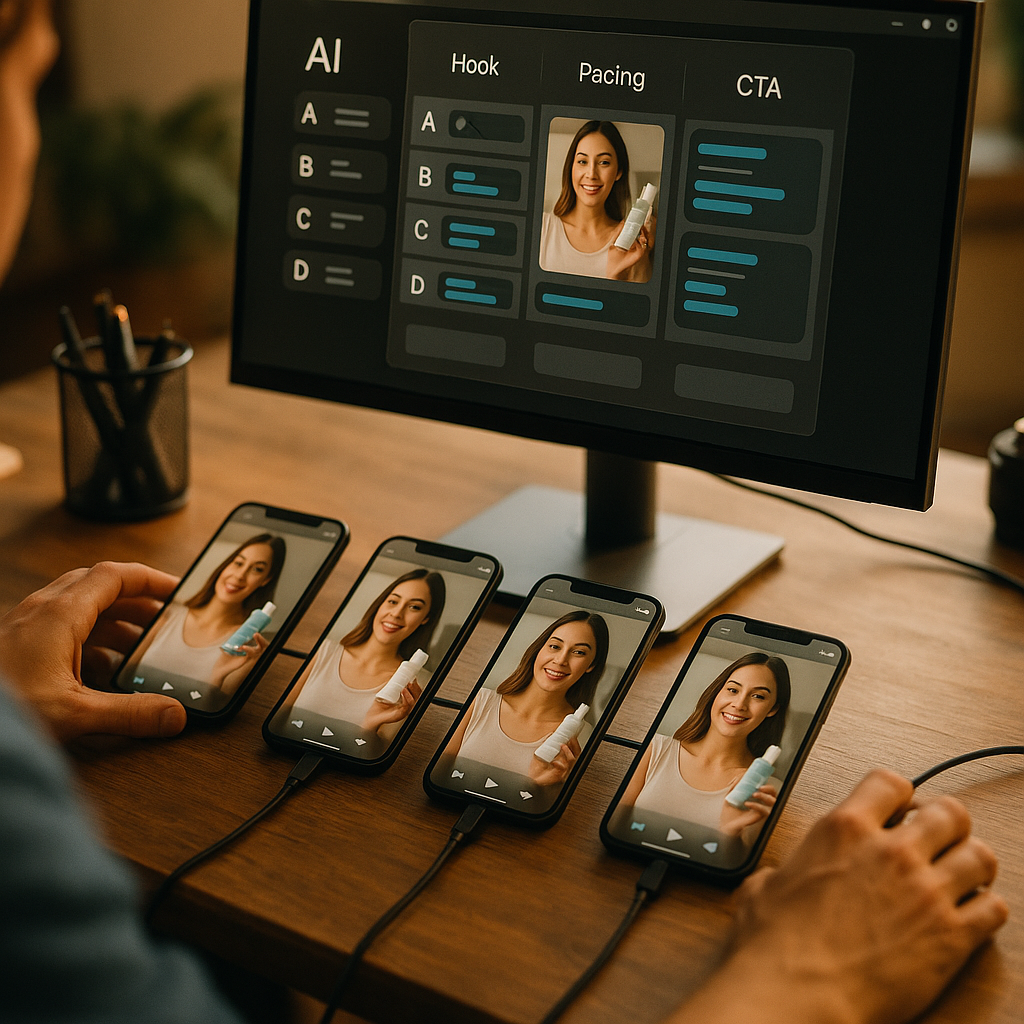
Most brands using AI for UGC are solving the wrong problem. They’re generating more content when they should be generating smarter content. The Hook-CTA-Pacing Variant Testing System flips that logic: instead of volume-first production, it builds a disciplined pipeline where every AI-generated asset exists to answer a specific creative hypothesis.
Why Volume-First UGC Production Is a Strategic Dead End
Here’s the uncomfortable truth: producing 50 AI-generated UGC videos a week means nothing if you don’t know which creative lever moved the needle. Without a structured variant framework, you’re not running creative strategy — you’re running creative lottery.
A HubSpot research report found that marketers who run structured A/B tests on creative elements see up to 49% higher click-through rates compared to non-tested campaigns. Yet most brand teams deploying AI UGC pipelines are optimizing for output speed, not test quality. That gap is where performance budget gets quietly destroyed.
The shift requires rethinking what “production efficiency” actually means. Fast is only valuable if what you’re producing is testable, attributable, and strategically differentiated. If three of your fifty videos happen to perform, but you can’t identify why, you’ve learned nothing you can systematize.
The Three Creative Levers That Actually Drive UGC Performance
Before you build the pipeline, understand what you’re testing. The Hook-CTA-Pacing framework isolates the three variables most predictive of short-form video performance:
- Hook (0-3 seconds): The opening frame that determines scroll-stop rate. This includes visual treatment, spoken line, text overlay style, and emotional register (curiosity, urgency, social proof).
- CTA (call-to-action): Not just the final ask, but placement, phrasing, and format. A spoken mid-video CTA tested against an end-screen text overlay can produce dramatically different conversion behaviors on the same audience.
- Pacing: Cut rhythm, scene length, speech rate, and information density. Pacing affects comprehension, emotional response, and completion rate — three metrics that TikTok’s ad effectiveness research consistently links to downstream purchase intent.
Each lever has enough variation space to run discrete tests without contaminating the others. That’s the structural advantage of isolating them in production, not in post-analysis.
The brands winning with AI-generated UGC aren’t producing more content — they’re producing content engineered to answer specific creative questions. Variant architecture should be designed before a single frame is generated.
Building the Pipeline: Architecture Before Automation
The temptation is to start with the AI tool. Resist it. The pipeline architecture determines what the AI produces, and without a clear variant logic upstream, the tool will default to aesthetic variation rather than strategic variation. Those are completely different things.
A functional Hook-CTA-Pacing pipeline operates across four stages:
- Creative Hypothesis Library: Before any generation begins, the team documents the specific hypothesis each variant is testing. Example: “A curiosity-gap hook will outperform a direct-benefit hook for cold audiences on Meta Reels.” This library becomes the source of truth for every production brief.
- Modular Brief Structure: Each AI production brief isolates one variable while holding the others constant. If you’re testing Hook Type A vs. Hook Type B, the CTA and pacing must remain identical across both variants. This is basic experimental design, and most brands skip it entirely.
- AI Generation with Constraint Layers: Tools like Synthesia, Runway, or Pika Labs can generate visual UGC variants at scale, but only if the brief constrains them correctly. Prompt engineering here isn’t about creativity — it’s about variable isolation.
- Tagging and Attribution Metadata: Every asset must be tagged at creation with its hypothesis ID, variable type, and intended test cell. Without this metadata, your analytics stack can’t connect performance data back to the creative hypothesis. You’re back to lottery.
For teams building this infrastructure, workflow re-engineering before automation is the prerequisite step that most skip. The AI layer should sit on top of a clean process, not compensate for a broken one.
How to Structure the Test Matrix Without Overwhelming Distribution
A common mistake: building a 40-variant test matrix and then lacking the media budget to generate statistical significance in any individual cell. Testing everything simultaneously is the same as testing nothing.
A more operational approach is a rolling sprint model. In a two-week sprint, run a maximum of three active hypotheses. Each hypothesis gets two variants (control and treatment). That’s six assets in active test. At the end of the sprint, retire the losing variant, promote the winner to evergreen creative, and introduce one new hypothesis. This cadence balances learning speed with budget discipline.
The specific A/B infrastructure matters here. Meta’s Advantage+ creative testing environment allows asset-level performance reporting that maps well to this modular structure. On TikTok, Smart Creative A/B Testing provides similar isolation at the ad set level. Neither platform will automate the hypothesis layer for you — that’s the human strategic contribution that AI can’t replace.
Teams that have built structured AI UGC pipelines report faster creative iteration cycles and cleaner performance attribution — not because AI produces better content, but because the constraint architecture forces clearer thinking upstream.
Pacing as the Under-Tested Variable
Brands test hooks obsessively. CTAs get moderate attention. Pacing is almost universally ignored, which represents a real competitive gap.
Pacing variation in short-form UGC includes: cuts-per-minute, the length of the silence before a key claim, the speech rate of the creator or AI voice, and the visual density of on-screen text. Research from EMARKETER’s video ad benchmarks consistently shows that pacing mismatches between creative and audience context (for example, a slow-burn narrative ad delivered in a high-frequency TikTok feed) are one of the top predictors of mid-video drop-off.
Building pacing variants into your AI pipeline means explicitly defining scene length targets in the brief. A “fast cut” brief might specify a maximum 2.5 seconds per scene with three visual transitions in the first five seconds. A “deliberate” brief might specify 5-7 second scenes with a single visual anchor. These aren’t aesthetic preferences — they’re testable performance hypotheses.
Governance, Compliance, and the Risk Layer
Any pipeline producing AI-generated UGC at scale needs a compliance checkpoint before distribution. The FTC’s disclosure requirements apply regardless of whether the content was human-created or AI-generated. If the content features AI-simulated creators or AI-generated voices that present as human, disclosure obligations are significant.
Build the compliance review into the pipeline architecture, not as an afterthought. A pre-distribution checklist that verifies disclosure language, brand safety parameters, and platform-specific creative policies should be a mandatory gate between asset generation and live deployment. For teams managing this at scale, having an AI content governance framework in place isn’t optional — it’s operational infrastructure. Reference FTC guidelines directly when building your disclosure standards.
AI-generated UGC that bypasses compliance review isn’t efficient production — it’s deferred liability. Governance checkpoints belong inside the pipeline, not outside it.
Additionally, ensure that your agentic AI governance protocols cover the production pipeline specifically, including who approves variant briefs, who signs off on final assets, and how errors get escalated before content reaches paid distribution.
Closing the Loop: From Test Data to Creative Intelligence
The pipeline only generates compounding value if test results feed back into the Creative Hypothesis Library. After each sprint, a structured debrief should update the hypothesis library with confirmed learnings, retired assumptions, and new questions generated by unexpected results.
Over time, this library becomes a proprietary creative intelligence asset. You’ll accumulate validated knowledge about which hook types work for which audience segments, which CTA placements drive conversion versus consideration, and which pacing signatures match specific platform contexts. That knowledge isn’t replicable by a competitor running volume-first AI production. It’s a genuine strategic moat built through systematic creative testing.
For teams integrating this with broader attribution infrastructure, layering these creative learnings into your creator campaign attribution stack creates a closed-loop system where creative performance data directly informs future brief parameters.
Start with one hypothesis, one sprint, one clear test. Build the discipline before you scale the volume, and the pipeline will compound into something your competitors can’t reverse-engineer.
Frequently Asked Questions
What is the Hook-CTA-Pacing Variant Testing System?
It is a structured framework for AI-powered UGC production that isolates three primary creative variables — the hook (opening seconds), the call-to-action, and content pacing — into discrete, testable variants. Rather than generating high volumes of content and analyzing results retroactively, the system designs creative hypotheses before production begins, ensuring every asset serves a specific testing purpose.
How is this different from standard A/B testing of UGC?
Standard A/B testing often compares two finished assets without controlling which creative variable drove the performance difference. The Hook-CTA-Pacing system enforces variable isolation at the brief level: when testing hooks, CTAs and pacing remain constant across both variants. This makes the test results directly attributable to a specific creative decision rather than an ambiguous combination of factors.
Which AI tools are best suited for building this kind of UGC production pipeline?
Tools like Synthesia, Runway, and Pika Labs are commonly used for visual UGC variant generation. The tool selection matters less than the brief structure fed into it. Each tool must receive a constrained, hypothesis-driven brief that specifies which variable is being tested and holds all others constant. Prompt engineering for variant production is a discipline distinct from general creative AI prompting.
How many variants should a brand test in a single sprint?
A two-week sprint should contain no more than three active hypotheses, with two variants per hypothesis — six total assets in active test. Running more variants simultaneously risks splitting media budget too thin to achieve statistical significance in any individual cell. A rolling sprint model with consistent hypothesis retirement and promotion keeps the learning cadence sustainable.
Do AI-generated UGC assets require FTC disclosure?
Yes. FTC disclosure requirements apply to AI-generated content, particularly when AI-simulated creators or voices are presented in ways that could be perceived as authentic human endorsement. Disclosure language must be clear and conspicuous. Brands should build compliance review as a mandatory gate within the production pipeline, not as a post-production afterthought, and reference current FTC guidelines directly when setting disclosure standards.
How does pacing affect UGC performance and why is it under-tested?
Pacing — including cuts-per-minute, scene length, speech rate, and visual text density — directly affects video completion rates, comprehension, and emotional response. It is under-tested because brands tend to focus creative testing energy on hooks and CTAs. However, a pacing mismatch between creative and platform context is one of the top predictors of mid-video drop-off. Building explicit pacing specifications into AI production briefs turns this variable into a testable, actionable performance lever.
Top Influencer Marketing Agencies
The leading agencies shaping influencer marketing in 2026
Agencies ranked by campaign performance, client diversity, platform expertise, proven ROI, industry recognition, and client satisfaction. Assessed through verified case studies, reviews, and industry consultations.
Moburst

-
2

The Shelf
Boutique Beauty & Lifestyle Influencer AgencyA data-driven boutique agency specializing exclusively in beauty, wellness, and lifestyle influencer campaigns on Instagram and TikTok. Best for brands already focused on the beauty/personal care space that need curated, aesthetic-driven content.Clients: Pepsi, The Honest Company, Hims, Elf Cosmetics, Pure LeafVisit The Shelf → -
3

Audiencly
Niche Gaming & Esports Influencer AgencyA specialized agency focused exclusively on gaming and esports creators on YouTube, Twitch, and TikTok. Ideal if your campaign is 100% gaming-focused — from game launches to hardware and esports events.Clients: Epic Games, NordVPN, Ubisoft, Wargaming, Tencent GamesVisit Audiencly → -
4

Viral Nation
Global Influencer Marketing & Talent AgencyA dual talent management and marketing agency with proprietary brand safety tools and a global creator network spanning nano-influencers to celebrities across all major platforms.Clients: Meta, Activision Blizzard, Energizer, Aston Martin, WalmartVisit Viral Nation → -
5

The Influencer Marketing Factory
TikTok, Instagram & YouTube CampaignsA full-service agency with strong TikTok expertise, offering end-to-end campaign management from influencer discovery through performance reporting with a focus on platform-native content.Clients: Google, Snapchat, Universal Music, Bumble, YelpVisit TIMF → -
6

NeoReach
Enterprise Analytics & Influencer CampaignsAn enterprise-focused agency combining managed campaigns with a powerful self-service data platform for influencer search, audience analytics, and attribution modeling.Clients: Amazon, Airbnb, Netflix, Honda, The New York TimesVisit NeoReach → -
7

Ubiquitous
Creator-First Marketing PlatformA tech-driven platform combining self-service tools with managed campaign options, emphasizing speed and scalability for brands managing multiple influencer relationships.Clients: Lyft, Disney, Target, American Eagle, NetflixVisit Ubiquitous → -
8

Obviously
Scalable Enterprise Influencer CampaignsA tech-enabled agency built for high-volume campaigns, coordinating hundreds of creators simultaneously with end-to-end logistics, content rights management, and product seeding.Clients: Google, Ulta Beauty, Converse, AmazonVisit Obviously →