


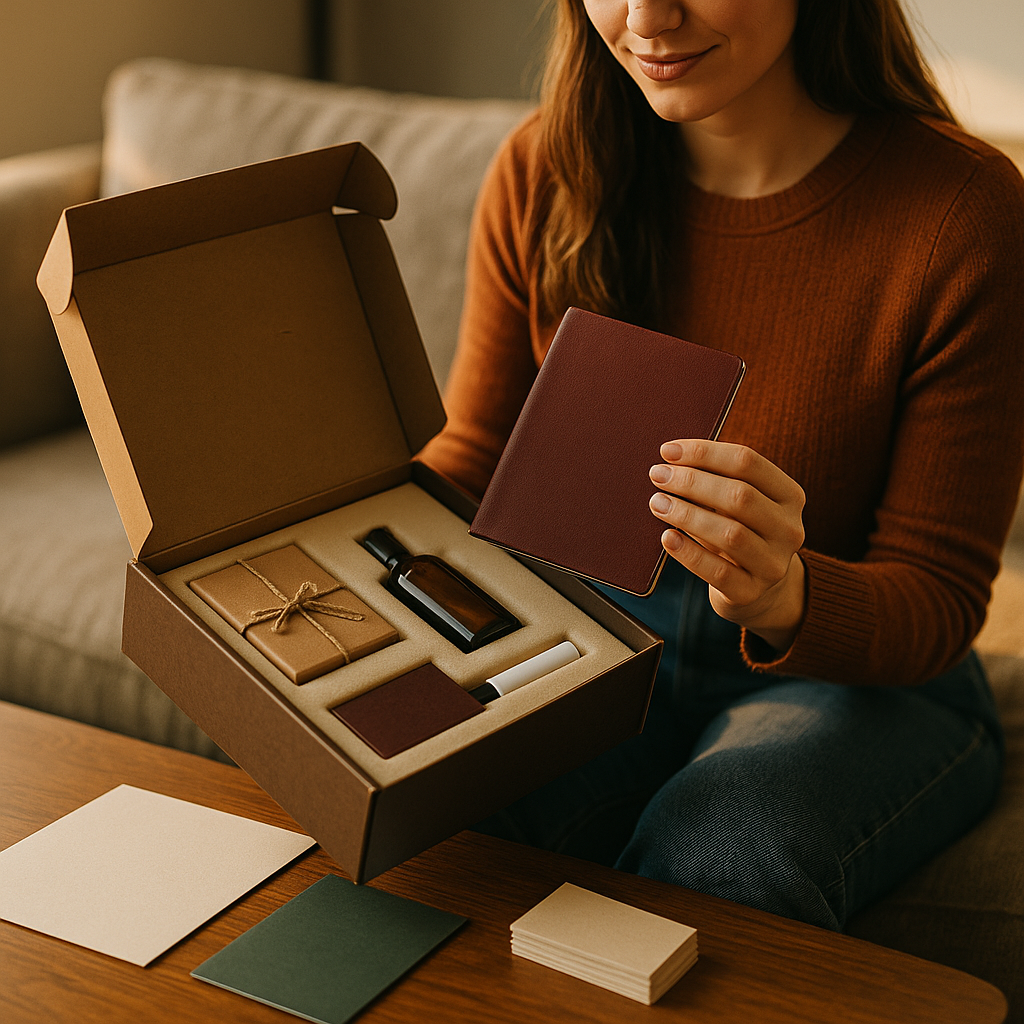
In 2025, digital fatigue is real, and brands are rediscovering the power of tactile, memorable experiences. The rise of Analog Influence is reshaping how companies win attention, build trust, and move prospects through long buying cycles. High-touch physical brand kits create a human moment in a noisy marketplace—when they’re designed with intent and measured like any campaign. Ready to see why they work?
High-touch brand kits: why physical presence wins attention
People don’t ignore digital because it’s “bad.” They ignore it because there’s too much of it. In a typical B2B journey, stakeholders receive thousands of impressions across ads, email sequences, social posts, webinars, and nurture flows. Most of those touches blur together. A well-timed physical kit breaks that pattern because it creates a different kind of attention—sensory, deliberate, and harder to multitask through.
High-touch physical brand kits work best when they do three things at once:
- Earn a pause: the package arrives as a novel event, not another tab.
- Communicate value fast: the recipient understands the point within seconds of opening.
- Guide the next step: the kit nudges a clear action that fits the buying stage.
In 2025, “high-touch” doesn’t mean “expensive swag.” It means deliberate design choices that respect the recipient’s time and context. A kit can be premium or minimal; what matters is relevance, sequencing, and how seamlessly it connects to your digital journey.
If you’re wondering whether this is only for enterprise deals, it isn’t. Smaller teams use physical kits to improve show-up rates for demos, deepen partner relationships, or increase retention for high-value customers. The deciding factor is not company size—it’s whether each shipment has a measurable job to do.
Direct mail marketing 2025: when analog beats algorithms
Direct mail marketing in 2025 has evolved from bulk postcards to highly targeted, account-specific experiences. The strongest programs are built like performance marketing: tight audience definition, controlled tests, and clear attribution.
Analog outperforms in scenarios where digital channels struggle:
- When inboxes are saturated: reply rates drop and even well-crafted emails get buried.
- When trust must be earned: regulated industries and high-stakes purchases need credibility signals.
- When multiple stakeholders influence the decision: a kit can circulate inside an office and spark internal discussion.
- When timing matters: pre-demo, pre-renewal, pre-procurement, or post-event follow-up.
To apply this intelligently, align the kit with a specific stage:
- Top of funnel: lightweight dimensional mail that gets a meeting, not a purchase.
- Mid-funnel: proof-driven assets that shorten evaluation (case study booklet, ROI snapshot, security one-pager).
- Late-funnel: stakeholder kits that reduce risk (implementation plan, references, executive note).
- Customer: onboarding kits that increase adoption and retention (quick-start guide, training map, success plan).
Many teams ask: “Will this feel intrusive?” It can—if you ship random items or ignore consent. The better approach is to use permission-based triggers: “If you’d like, we can send a kit customized to your use case,” or “We’ll mail a short executive brief for your evaluation team.” Respectful targeting turns physical mail from interruption into service.
Experiential branding: designing physical brand kits that convert
Experiential branding is not about being flashy; it’s about making the brand felt and understood. A high-performing kit has a narrative arc: it opens cleanly, explains why it exists, delivers useful assets, and ends with a single next step.
Use this practical structure:
- Outer moment: packaging that signals purpose. Avoid over-branding that screams “promo.” Let quality and restraint do the work.
- Immediate clarity: a short card that answers: “What is this?” and “Why did I receive it?”
- Core value items: tools, proof, and prompts that match the recipient’s role (economic buyer vs. technical evaluator vs. end user).
- Social proof: a compact case study, benchmark, or third-party validation relevant to their industry.
- Action device: a QR code or short URL tied to a personalized landing page with the next step.
What should you include? Choose items that carry meaning, not clutter. In 2025, recipients are more discerning about waste, so every component should either educate, enable, or reinforce trust.
Examples of high-utility kit components:
- Role-specific briefs: one-page summaries for finance, security, and operations to reduce internal friction.
- Decision tools: an ROI worksheet, evaluation checklist, or implementation timeline.
- Hands-on demo artifact: a small physical object that makes the concept tangible, paired with a guided digital walkthrough.
- Human note: a short handwritten message from a relevant person (AE, CSM, founder) that adds accountability and warmth.
Answer the follow-up question before it’s asked: “How do we avoid looking like we’re bribing prospects?” Keep gifts modest, relevant, and policy-safe. In many industries, practical items under standard compliance thresholds are acceptable, but always verify customer policies and your own legal guidance. When in doubt, make the kit informational first and experiential second.
Account-based marketing gifts: personalization without creepiness
Account-based marketing gifts are most effective when they feel considered rather than surveilled. Personalization should reflect what the prospect has explicitly shared or what is publicly relevant to their role and company—not intimate personal details.
Use a “three-layer” personalization model:
- Layer 1: Industry relevance (their vertical, regulatory environment, common pain points).
- Layer 2: Role relevance (CFO vs. CISO vs. RevOps needs different proof and language).
- Layer 3: Account context (their stack, growth stage, known initiatives, event attendance, published priorities).
Then connect the kit to the buying committee. One kit rarely serves everyone. Instead, plan “micro-kits”:
- Executive kit: outcomes, risk reduction, reference customers, and a clean business case.
- Technical kit: architecture overview, security posture, integration plan, and sandbox access.
- Champion kit: internal pitch deck, talk track, and rollout checklist.
Make consent simple. Offer a one-click “Send me the kit” form that collects only shipping essentials and confirms acceptable delivery windows. For larger ABM plays, route shipping through a gifting platform that supports address capture without forcing prospects to email their home address.
To avoid creepiness, follow these guidelines:
- Don’t reference personal social posts in the note unless the recipient brought it up directly.
- Don’t over-personalize the object (like engraving names) unless you already have a relationship.
- Do personalize the insights (benchmarks, checklists, and use cases tailored to their environment).
This approach earns trust while still feeling bespoke—a key ingredient of Analog Influence.
Brand storytelling through packaging: trust, sustainability, and unboxing
Brand storytelling through packaging is where many kits succeed or fail. Packaging communicates competence and care before the recipient reads a single word. In 2025, it also communicates values—especially around sustainability and waste.
Build packaging that supports credibility:
- Clarity over spectacle: clean labeling, intuitive opening, and purposeful layout.
- Material honesty: recyclable or recycled materials, minimal plastic, and right-sized boxes that don’t feel wasteful.
- Accessibility: easy-open features, readable type, and color contrast that works in real lighting.
- Privacy and security: discreet outer packaging for regulated recipients or home delivery.
“Unboxing” should not be a social-media stunt unless your audience actually behaves that way. Instead, engineer a guided discovery experience:
- Step 1: a top card that frames the kit’s purpose in 20–40 words.
- Step 2: a small set of items presented in a sequence that matches the decision process.
- Step 3: a final call-to-action tied to a personalized landing page.
Anticipate the buyer’s internal question: “Is this company reliable?” Use packaging to reinforce reliability—precise printing, consistent brand system, and no filler. If you claim premium quality, the physical experience must prove it. If you claim sustainability, the materials and shipping choices must align.
Also plan for global logistics. If you ship internationally, avoid restricted items, declare contents accurately, and design kits that survive transit without extra padding. A damaged kit undermines the very trust you’re trying to build.
Measuring direct mail ROI: attribution, ops, and the metrics that matter
Measuring direct mail ROI is the difference between a one-off “cool idea” and a repeatable growth channel. You don’t need perfect attribution, but you do need disciplined measurement and operational control.
Start with a clear hypothesis per kit:
- Pipeline hypothesis: “This kit will increase meeting-to-opportunity conversion for target accounts.”
- Velocity hypothesis: “This kit will reduce time from discovery to proposal.”
- Expansion hypothesis: “This kit will increase adoption and expansion in the first 90 days.”
Then instrument the campaign:
- Unique landing pages: personalized URLs or QR codes that map to a contact and account.
- CRM hygiene: shipment date, delivery status, kit type, and cost recorded as campaign data.
- Holdout groups: a percentage of similar accounts that do not receive the kit to estimate lift.
- Sequence alignment: coordinated email/phone follow-up timed to delivery windows.
Track metrics that reflect business outcomes, not vanity:
- Meeting set rate and meeting held rate (delivery alone is not success).
- Stage conversion lift (e.g., discovery to evaluation, evaluation to proposal).
- Sales cycle time for accounts that received kits vs. holdout.
- Average contract value and win rate changes where relevant.
- Cost per qualified meeting and cost per opportunity compared to other channels.
Operationally, avoid common failure points:
- Inventory sprawl: keep kit variants limited; personalize with inserts, not entirely different boxes.
- Slow fulfillment: if it takes weeks to ship, the moment passes. Build a 48–72 hour SLA for triggered sends.
- Unclear ownership: assign a single owner for budget, creative, ops, and measurement.
When the program is working, scale carefully. Increase volume only after you’ve proven lift with a stable kit, then test one variable at a time: message, offer, audience, or follow-up timing.
FAQs
What is “Analog Influence” in marketing?
Analog Influence is a strategy that uses tactile, physical experiences—like curated brand kits—to create attention and trust that digital channels often struggle to earn. It works best when the physical touch is tied to a clear next step and measured like a performance campaign.
Are physical brand kits worth it for smaller budgets?
Yes, if you target narrowly. Send kits only to high-intent leads, strategic accounts, partners, or renewal-risk customers. A small, well-timed kit that improves conversion or reduces cycle time can outperform broader spend on low-signal impressions.
What should a high-touch brand kit include?
Include role-relevant proof and tools: a concise note, a one-page brief, a case study, an evaluation checklist, and a tracked QR code to a personalized page. Add one modest, useful physical item only if it reinforces the message and fits compliance rules.
How do you personalize without being creepy?
Personalize based on role, industry, and public company context—not personal details. Keep the note professional, explain why the kit was sent, and offer an easy opt-in process for future shipments.
How do you measure ROI on physical kits?
Use unique QR codes or URLs, log shipment data in your CRM, and compare results to a holdout group. Measure lift in meetings held, stage conversion, sales cycle time, and cost per opportunity—then iterate based on what moves those metrics.
Do physical kits work for customer retention and expansion?
Yes. Onboarding and enablement kits can increase adoption, reduce time-to-value, and support champions with internal materials. For expansion, stakeholder-specific kits help reframe outcomes and reduce perceived risk during upsell discussions.
Analog Influence works in 2025 because it restores attention and credibility in moments where screens feel interchangeable. High-touch physical brand kits deliver that edge when they’re targeted, role-relevant, and operationally tight—then connected to a measurable next step. Build one kit for one job, instrument it like a campaign, and scale only after you prove lift. That’s the takeaway.