


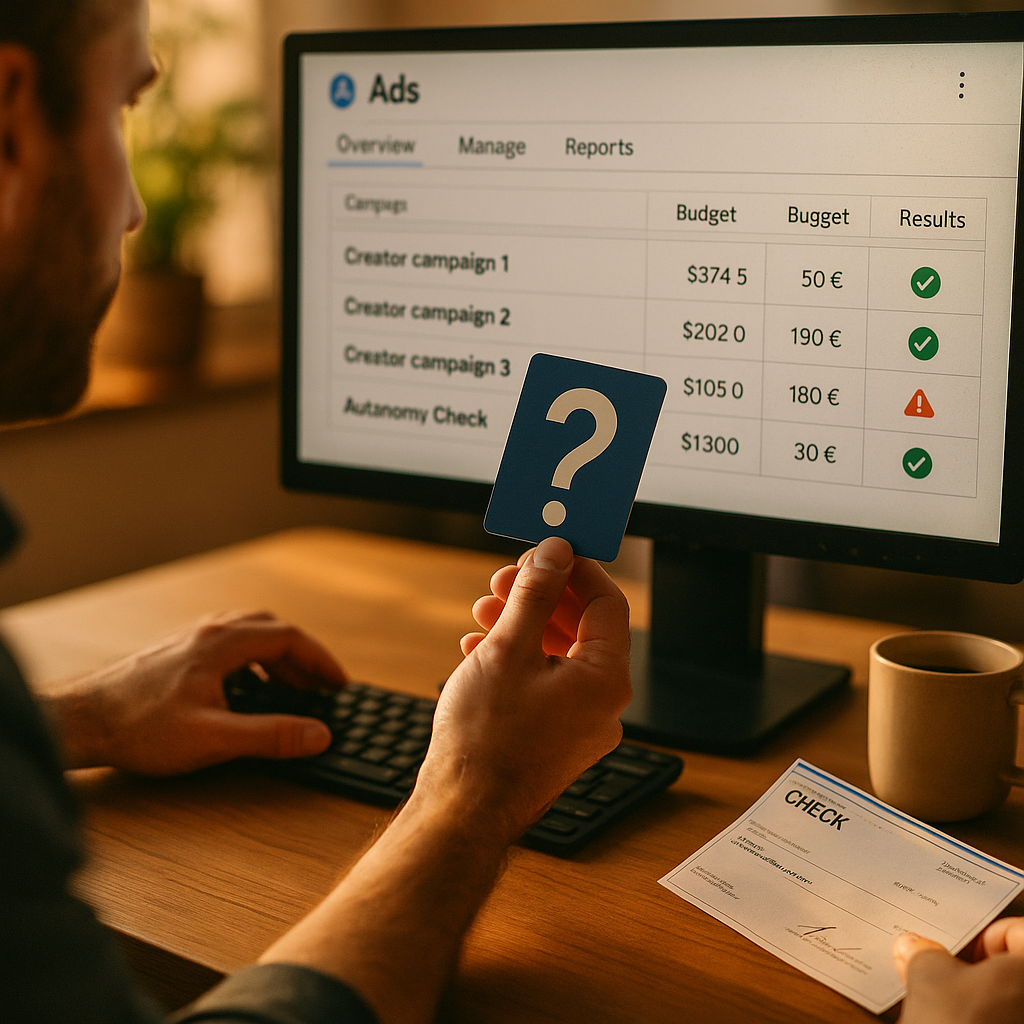
Would you hand a first-week hire your entire influencer budget with no sign-off required? That’s essentially what happens when brands grant unchecked spend authority to Google’s Ask Ad Manager chatbot on creator-adjacent campaigns. Google says the tool now handles bid adjustments, budget reallocation, and pacing decisions with minimal human review. Before you flip that switch, you need a real framework for testing its limits.
Why Creator Campaigns Are a Different Risk Class
Search and shopping campaigns are transactional. A bad bid adjustment costs you a few points of ROAS, and you fix it tomorrow. Creator-adjacent campaigns are different: they carry brand voice, contractual obligations, and public-facing content that can’t be quietly rolled back once it’s live.
If an AI agent reallocates budget away from a whitelisted creator mid-flight, or auto-boosts a post that hasn’t cleared legal review, the damage isn’t just a wasted dollar. It’s a broken contract, a compliance headache, or a screenshot on someone’s timeline. That asymmetry — small upside, outsized downside — is exactly why creator campaigns deserve stricter autonomy limits than standard search or PMax flows.
The real question isn’t whether Ask Ad Manager can optimize spend. It’s whether it knows the difference between a paid search line item and a contractual creator partnership.
Our earlier coverage of Google Ask Ad Manager’s autonomous rollout flagged this exact gap: the tool was built for performance media, not for the messier, relationship-driven mechanics of creator partnerships.
What “Autonomy Limits” Actually Mean in Practice
Google markets Ask Ad Manager as a conversational layer over campaign management — you type a goal, it executes. But “autonomy” isn’t binary. It’s a spectrum, and marketers need to know exactly where on that spectrum the tool sits for each campaign type before granting access.
- Suggestion-only mode: the bot recommends changes, a human approves each one.
- Threshold-bound autonomy: the bot acts within pre-set budget or bid caps, escalating anything outside those bounds.
- Full autonomy: the bot executes changes and reports after the fact.
For creator-adjacent line items — whitelisting, Spark Ads-style boosts, influencer-linked landing pages — you want threshold-bound autonomy at most. Full autonomy should be reserved for campaigns with no creator, contract, or brand-safety dependency. That’s not caution for its own sake; it’s basic risk segmentation, the same logic you’d apply to any vendor with write access to your budget.
Ask the Vendor These Questions First
Before you grant spend authority, get specific answers from Google’s team (or your agency partner managing the account). Vague reassurances about “safety guardrails” aren’t enough.
- What triggers a human escalation versus autonomous execution?
- Can the bot distinguish a creator-linked campaign from a standard one in the account structure?
- What’s the maximum single-action budget shift it can make without approval?
- Is there an audit log of every autonomous action, timestamped and exportable?
- Can autonomy be scoped at the campaign or ad-group level, not just account-wide?
If the answer to any of these is “we’re still building that,” treat it as a signal. You’re not being difficult — you’re doing the same interoperability check we’ve recommended for other AI agents entering the martech stack. See our framework on AI agent interoperability audits for a broader checklist that applies here too.
Run a Shadow Test Before Going Live
Don’t grant spend authority cold. Run Ask Ad Manager in shadow mode — where it generates recommendations but a human executes — for at least two to three full campaign cycles. Log every recommendation it makes and compare against what your team would have actually done.
Pay close attention to edge cases: a creator’s content gets flagged by a platform, a campaign underperforms because of external news, a partner asks for a mid-flight pause. Does the bot handle these gracefully, or does it treat every dip in performance as a signal to reallocate budget away from the creator?
This mirrors the human-override logic we outlined in our piece on the AI media-buying error rate and override framework — the goal isn’t zero automation, it’s knowing precisely where automation breaks down.
The Trust Gap Is Wider Than Adoption Numbers Suggest
Adoption of AI media planning tools has climbed sharply — recent industry surveys put usage above 60% among mid-market and enterprise marketers — but trust hasn’t kept pace. Our analysis of AI media planning adoption and spend caps found that most marketers using these tools still impose manual spend caps, even when the platform is technically capable of full autonomy.
That gap is rational, not paranoid. A recent eMarketer analysis of AI adoption in media buying found that marketers overwhelmingly want visibility into automated decisions before they’re willing to extend budget control. Creator campaigns amplify that hesitation because the stakes involve people, not just pixels.
Marketers aren’t rejecting automation. They’re rejecting automation without a visible decision trail — and creator campaigns make that trail non-negotiable.
This isn’t unique to Google. We’ve seen the same trust-but-verify pattern with Meta’s Advantage+ tools. Our review of Advantage+ Andromeda’s early performance data found similar caution: strong aggregate numbers, but brand teams still wanted campaign-level kill switches before scaling spend.
Build a Tiered Permission Structure, Not an On/Off Switch
The mistake most teams make is treating spend authority as a single toggle. Instead, build tiers based on campaign sensitivity:
- Tier 1 (full autonomy allowed): pure performance campaigns with no creator or influencer component, no contractual obligations, generic creative.
- Tier 2 (threshold-bound): campaigns with creator-produced content but no live talent relationship — think evergreen UGC repurposed as paid ads.
- Tier 3 (approval required): active creator partnerships, whitelisted ads, anything tied to a contract with usage rights, exclusivity clauses, or FTC disclosure requirements.
Tier 3 is where most of the real risk lives. The FTC’s endorsement guidelines hold brands accountable for creator disclosure compliance regardless of who — or what — is managing the media spend. An autonomous bot boosting a non-compliant post doesn’t shift that liability off your desk.
Assign each active campaign to a tier before you even open Ask Ad Manager’s settings. It forces a conversation your team should be having anyway: which campaigns can tolerate machine error, and which absolutely cannot?
Watch the Attribution Blind Spots Too
Autonomy limits aren’t only about spend control — they intersect with measurement. If Ask Ad Manager is making pacing decisions based on last-click or platform-reported conversions, it may systematically underweight creator-driven traffic that shows up as branded search or direct visits days later.
This is the same attribution distortion we’ve written about in the context of zero-click search breaking GA4 attribution. An AI agent optimizing purely on immediate, trackable signals will quietly starve the creator campaigns that actually build the demand it’s measuring. Ask specifically how the bot weighs assisted conversions and view-through data before trusting its reallocation logic on influencer-adjacent budgets.
For a broader industry read on how marketers are calibrating trust versus control, HubSpot’s marketing research and Sprout Social’s platform benchmarks both point to the same conclusion: automation adoption is high, but governance maturity lags behind it across the industry, not just at Google.
Next Step
Don’t grant account-wide spend authority to Ask Ad Manager in one move. Tier your campaigns, run a shadow test for two full cycles, and lock Tier 3 creator partnerships behind manual approval until the audit logs prove the bot can tell a contract from a conversion metric.
FAQs
What is Google’s Ask Ad Manager chatbot?
It’s a conversational AI layer within Google Ad Manager that lets marketers issue natural-language commands for campaign optimization, including bid adjustments, budget reallocation, and pacing changes, with varying levels of autonomous execution.
Why are creator-adjacent campaigns riskier for AI autonomy?
They involve contractual obligations, disclosure compliance, and public-facing brand relationships that can’t be reversed as easily as a search bid change. A wrong automated decision can damage a creator partnership or trigger a compliance issue, not just waste ad spend.
Should marketers give Ask Ad Manager full spend authority?
Not for creator-linked campaigns. Most practitioners should use threshold-bound autonomy or approval-required tiers for anything involving active talent relationships, reserving full autonomy for generic, non-creator performance campaigns.
How long should a shadow test run before granting live authority?
At minimum, two to three full campaign cycles, long enough to observe how the bot handles at least one real edge case like a performance dip, a platform flag, or a partner request for a mid-flight change.
Does using an AI agent shift FTC compliance liability away from the brand?
No. Brands remain responsible for creator disclosure compliance under FTC endorsement guidelines regardless of whether a human or an autonomous tool executed the media spend decision.
Top Influencer Marketing Agencies
The leading agencies shaping influencer marketing in 2026
Agencies ranked by campaign performance, client diversity, platform expertise, proven ROI, industry recognition, and client satisfaction. Assessed through verified case studies, reviews, and industry consultations.
Moburst

-
2

The Shelf
Boutique Beauty & Lifestyle Influencer AgencyA data-driven boutique agency specializing exclusively in beauty, wellness, and lifestyle influencer campaigns on Instagram and TikTok. Best for brands already focused on the beauty/personal care space that need curated, aesthetic-driven content.Clients: Pepsi, The Honest Company, Hims, Elf Cosmetics, Pure LeafVisit The Shelf → -
3

Audiencly
Niche Gaming & Esports Influencer AgencyA specialized agency focused exclusively on gaming and esports creators on YouTube, Twitch, and TikTok. Ideal if your campaign is 100% gaming-focused — from game launches to hardware and esports events.Clients: Epic Games, NordVPN, Ubisoft, Wargaming, Tencent GamesVisit Audiencly → -
4

Viral Nation
Global Influencer Marketing & Talent AgencyA dual talent management and marketing agency with proprietary brand safety tools and a global creator network spanning nano-influencers to celebrities across all major platforms.Clients: Meta, Activision Blizzard, Energizer, Aston Martin, WalmartVisit Viral Nation → -
5

The Influencer Marketing Factory
TikTok, Instagram & YouTube CampaignsA full-service agency with strong TikTok expertise, offering end-to-end campaign management from influencer discovery through performance reporting with a focus on platform-native content.Clients: Google, Snapchat, Universal Music, Bumble, YelpVisit TIMF → -
6

NeoReach
Enterprise Analytics & Influencer CampaignsAn enterprise-focused agency combining managed campaigns with a powerful self-service data platform for influencer search, audience analytics, and attribution modeling.Clients: Amazon, Airbnb, Netflix, Honda, The New York TimesVisit NeoReach → -
7

Ubiquitous
Creator-First Marketing PlatformA tech-driven platform combining self-service tools with managed campaign options, emphasizing speed and scalability for brands managing multiple influencer relationships.Clients: Lyft, Disney, Target, American Eagle, NetflixVisit Ubiquitous → -
8

Obviously
Scalable Enterprise Influencer CampaignsA tech-enabled agency built for high-volume campaigns, coordinating hundreds of creators simultaneously with end-to-end logistics, content rights management, and product seeding.Clients: Google, Ulta Beauty, Converse, AmazonVisit Obviously →