


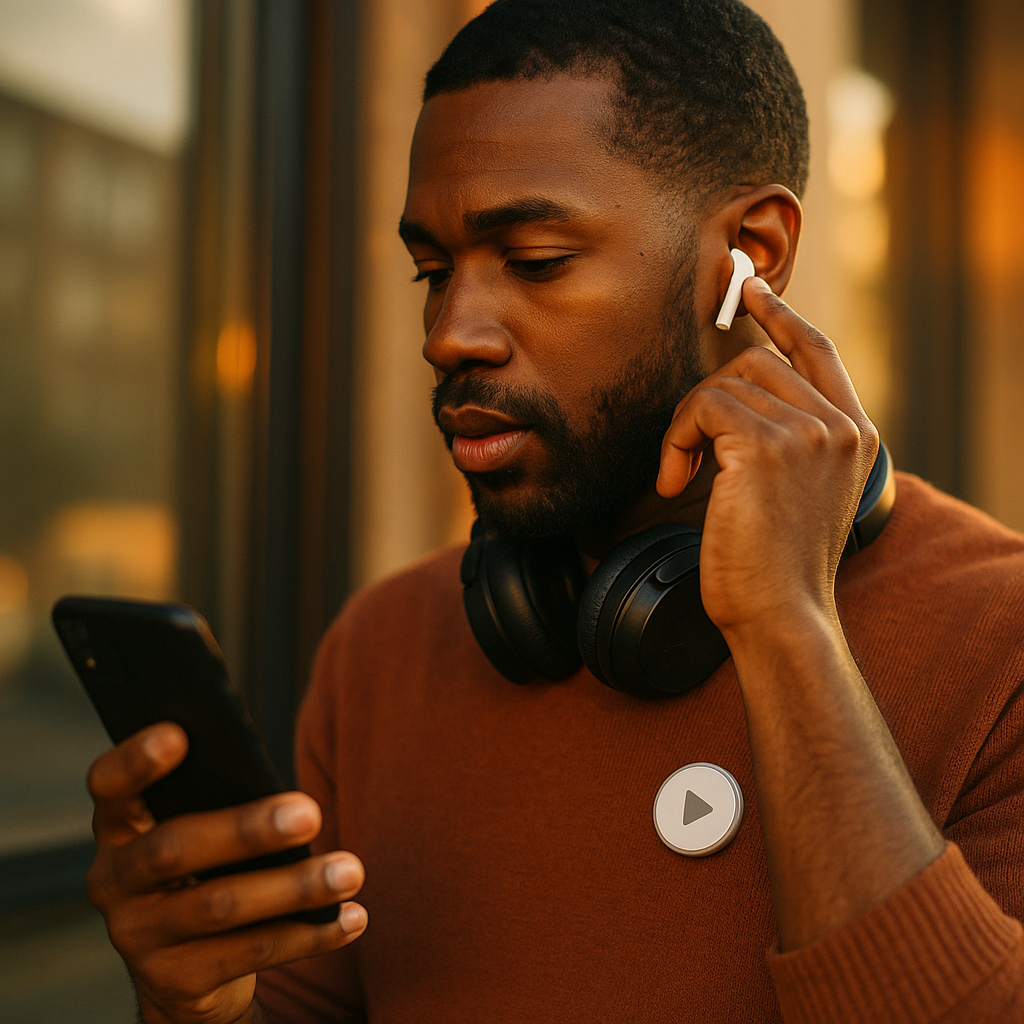
Audio First Marketing on Emerging Wearable Smart Pins is moving from novelty to measurable channel as people adopt screenless, voice-led devices for work, commuting, and errands. In 2025, brands that plan for consent, context, and clarity can earn attention without fighting feeds. This playbook covers strategy, creative, measurement, and compliance so you can launch responsibly, learn quickly, and win trust—ready to build your advantage?
Wearable smart pins marketing strategy
Wearable smart pins sit at the intersection of voice assistants, ambient computing, and personal productivity. They typically offer hands-free interaction, always-available microphones (with hardware indicators), compact speakers or bone-conduction audio output, and cloud-based AI that summarizes, searches, or triggers actions. For marketers, that changes the rules: you are not designing for a “click,” you are designing for a moment.
Start with three strategic truths:
- Attention is earned, not captured. A pin is worn on the body. Any interruption feels personal. Your brand must be invited through utility, not volume.
- Context outranks creative. The same message can be welcome during a commute and unwelcome during a meeting. Plan for time, place, and intent.
- Trust is the conversion event. Without a screen, users rely on credibility signals: clear source attribution, accurate claims, and respectful frequency.
Define the role of audio-first in your mix. Smart pins are best for: reminders, quick recommendations, short explainers, guided steps, voice search discovery, and service interactions. They are weaker for: complex comparisons, visual storytelling, or purchases that require configuration.
Pick use cases that naturally fit voice. Strong early use cases include:
- “How do I…” assistance: step-by-step troubleshooting, recipes, onboarding, insurance claims, or product setup.
- Local and time-bound suggestions: “near me” discovery, appointment availability, reorders, and travel updates.
- Membership and loyalty: balance checks, points prompts, personalized offers delivered only when asked.
Operationalize with a wearable pin funnel. Replace the traditional funnel with: trigger → ask → answer → action → confirm. Your objective is to show up as the best answer when the user asks, and then make the next action effortless (open a phone link, send an email, add to cart, schedule, or connect to a human).
Audio-first marketing tactics for voice AI
On smart pins, marketing performs best when it behaves like help. That means building experiences that are query-led, succinct, and explicit about what happens next.
Design for “micro-audio.” Aim for responses that fit in 8–20 seconds for a first answer. If more detail is needed, offer a choice: “Want the short version or the step-by-step?” This keeps control with the user and reduces accidental disruption.
Create a message hierarchy. Every audio unit should follow:
- One-sentence value: what it is and why it matters.
- One proof point: credential, guarantee, or source reference the assistant can cite.
- One next step: a single action the user can accept or decline.
Use intent-based prompts, not slogans. Replace brand taglines with phrases users actually say. Examples:
- “Find me a quiet hotel near the station.”
- “What’s the fastest way to remove this stain?”
- “Schedule a same-day appointment.”
Build “askable” assets. Prepare structured content that voice AI can reliably summarize:
- Short Q&A libraries for top intents (pricing, availability, returns, safety, compatibility).
- Step flows with clear checkpoints (step 1, step 2, safety note, confirmation).
- Comparative statements that avoid exaggeration and include qualifying context.
Answer follow-up questions proactively. Users will immediately ask: “How much?”, “How long?”, “What’s included?”, “Is it safe?”, “Can I cancel?” Include those answers in your content model so the assistant can respond without guesswork.
Plan the handoff to a screen. Smart pins often pair with a phone. Your audio response should offer a permissioned handoff: “I can send the details to your phone—yes or no?” This respects privacy while enabling deeper conversion paths.
Voice search optimization for smart pins
Smart pins amplify voice search behaviors: natural language, long-tail queries, and high reliance on entity understanding. Your goal is to be the most “citable” source for the assistant.
Optimize for conversational queries. Build content around question patterns:
- Problem-first: “Why is my skin irritated after shaving?”
- Constraint-first: “Best laptop under two pounds for travel.”
- Preference-first: “Low-sugar snacks with high protein.”
- Task-first: “Book a repair slot this afternoon.”
Strengthen entity signals. Ensure your brand, products, locations, and key people are unambiguous across your website, listings, customer support articles, and major directories. Assistants rely on consistent naming, addresses, and category data to avoid hallucinated or mismatched answers.
Make your content quotable. Pins favor short, stable statements. Create “answer blocks” inside your help content and product pages that can be read aloud cleanly:
- Use plain language and define jargon.
- Include units and ranges (time, size, coverage) instead of vague claims.
- State assumptions: “For most adults,” “For indoor use,” “If you have allergies, consult…”
Establish authority signals (EEAT). In 2025, credibility is a ranking and adoption factor. Improve assistive-readiness by:
- Showing expertise: named authors, credentials, and reviewed-by lines for health, finance, legal, and safety topics.
- Demonstrating experience: clear product testing notes, real customer scenarios, and troubleshooting steps that reflect actual use.
- Building trust: transparent policies, easy contact options, and up-to-date documentation.
Reduce “unknowns” for AI. Keep pricing, availability, service areas, and return terms current. If your data is stale, assistants will either avoid recommending you or deliver an outdated answer that erodes trust.
Wearable audio ads and conversational creative
Ads on smart pins will evolve, but the winning creative principles are already clear: relevance, restraint, and explicit consent. Even when the interaction is sponsored, it must feel like a useful exchange.
Choose formats that match pin behavior. Prioritize:
- Sponsored answers to high-intent queries, clearly labeled as sponsored and supported by factual claims.
- Opt-in briefings (daily or weekly) for subscribers who request updates.
- Service-first offers that solve a problem now: “I can book that” or “I can send a checklist.”
Write for the ear. Audio-first copy needs different discipline than visual ads:
- Lead with the outcome: “Get a same-day appointment within two miles.”
- Use concrete nouns and numbers: “three steps,” “ten minutes,” “two options.”
- Minimize brand repetition: say the brand once, then focus on utility.
- Avoid ambiguity: replace “best,” “amazing,” “guaranteed” with verifiable specifics.
Make sponsorship feel ethical. Use clear disclosures the assistant can read aloud. Provide a reason the recommendation is relevant: “Sponsored by X, based on your request for…” This reduces the “why am I hearing this?” reaction.
Plan for interruption sensitivity. The pin may be active during conversations or work. Build creative that:
- Can be paused and resumed without losing meaning.
- Includes a quick stop command: “Say ‘stop’ to end.”
- Defaults to silence unless the user asks or opts in.
Support accessibility. Offer adjustable speech speed, language options, and a text transcript delivered to the paired device. Accessibility is not only compliance; it directly improves completion rates and satisfaction.
Privacy, consent, and compliance for ambient audio
Smart pins raise justified concerns: microphones, bystander privacy, and sensitive context. Brands that treat privacy as a feature will outperform brands that treat it as a checkbox.
Adopt consent-first design. Ensure your experience:
- Uses explicit opt-in for proactive messages, reminders, and briefings.
- Confirms before collecting sensitive data (health, financial, precise location).
- Explains data use in plain language at the moment it matters, not buried in policies.
Respect bystanders. Even if the user consents, people nearby may not. Provide guidance in your UX: “For privacy, I can send this to your phone instead of reading it aloud.” Default to non-sensitive outputs when the environment is uncertain.
Minimize data retention. Keep only what you need, for as long as you need it. If you store voice logs or transcripts, state retention windows and provide deletion controls. This improves trust and lowers risk.
Verify claims and avoid unsafe advice. Audio summaries can compress nuance. For regulated or high-stakes areas (health, finance, safety), implement:
- Human review of key scripts and answer templates.
- Guardrails that route complex cases to a professional or support agent.
- Source attribution and “when to seek help” guidance.
Document governance. EEAT is easier to sustain with process: content owners, update cadence, approval workflows, and incident response for incorrect or harmful outputs. If a pin assistant misstates your policy, you should have a rapid correction loop.
Measurement and attribution for screenless conversion
If you measure smart pin performance like display advertising, you will undercount impact. Screenless experiences influence decisions upstream and often complete on another device.
Track “assistive conversions.” Use metrics that match audio behavior:
- Answer success rate: did the user get a satisfactory response without repeating?
- Follow-up depth: how often did users ask for details after the first answer?
- Handoff acceptance: did they permit sending a link, checklist, or booking to their phone?
- Task completion: booking confirmed, order placed, issue resolved, subscription activated.
Instrument consented identifiers. Where permitted, use privacy-safe identifiers and event logging tied to explicit opt-in. Avoid building shadow profiles. Make measurement transparent: “We track this to improve answers and reliability.”
Use controlled experiments. The most reliable way to prove incrementality in 2025 is still experimentation:
- Geo split tests for local services.
- Holdout groups for opt-in briefings.
- Creative A/B tests focused on clarity, length, and next-step phrasing.
Connect to business outcomes. Tie pin interactions to:
- Reduced support tickets via better self-serve answers.
- Higher appointment fill rates through frictionless booking.
- Lower churn through proactive, opt-in service reminders.
Plan for attribution limits. Some platforms will restrict data access. Build resilience by combining platform analytics, your own consented first-party events, and brand lift surveys delivered on the paired device.
FAQs about audio-first marketing on smart pins
What makes smart pins different from smart speakers for marketing?
Smart pins are worn all day and used in motion, so interactions are shorter, more contextual, and more sensitive to interruption. They also rely more on personal productivity tasks, which favors utility-driven experiences over entertainment-style audio.
Do I need an app to market on wearable smart pins?
Not always. You can win via voice search visibility and “citable” content first. If the ecosystem supports it, an app or integration helps with personalized actions like bookings, account lookups, and sending summaries to the paired phone.
How do I keep my brand safe from incorrect AI summaries?
Publish structured, updated source content; implement reviewed answer templates for sensitive topics; and monitor real queries to patch gaps. Offer an escalation path to human support when the request is complex or high-risk.
What types of businesses benefit most right now?
Local services, healthcare scheduling (with compliant guardrails), travel, insurance service, retail reorders, and B2B productivity tools. Any business that can complete a task in a few spoken steps tends to perform well.
How long should an audio ad or sponsored answer be?
For the first response, target 8–20 seconds, then offer options. Users should be able to stop, repeat, or request more detail without friction.
How do I handle privacy concerns with ambient microphones?
Use explicit opt-in for proactive messaging, minimize retention, default to sending sensitive details to the phone, and clearly explain what is stored and why. Respect bystanders by avoiding spoken sensitive information unless the user confirms.
Smart pins reward brands that behave like trusted assistants: concise, accurate, and permissioned. In 2025, the strongest results come from intent-based content, conversational creative, and measurement built around task completion rather than clicks. Treat privacy and credibility as core product features, not marketing claims. Build for helpful answers first, then scale sponsorship and automation with tight governance.