


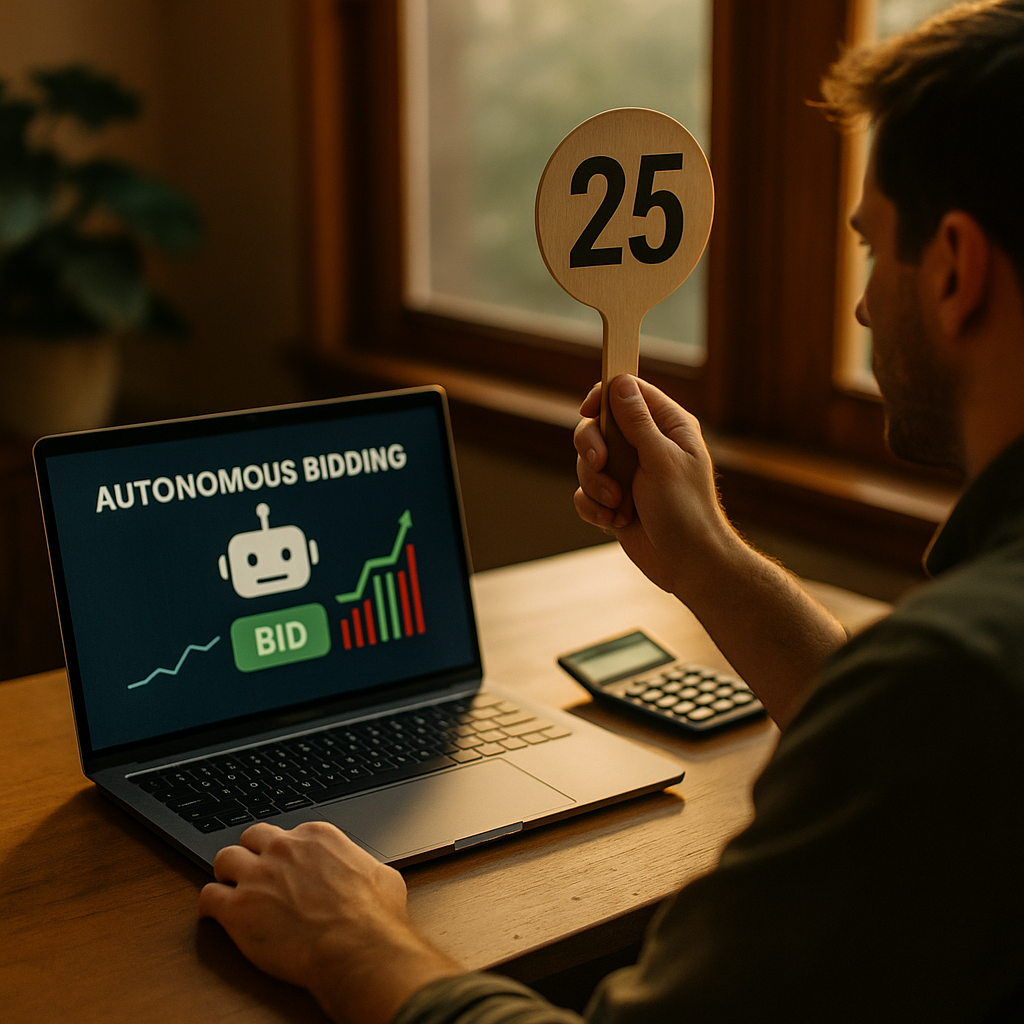
Google says DV360’s autonomous bidding now touches roughly 80% of managed spend for advanced advertisers. Meta claims Advantage+ campaigns deliver a 22% better cost-per-result on average. So why are seasoned media buyers still logging in every morning to check what the machine did overnight? Because autonomous bidding agents are good at optimization and bad at judgment — and in 2026, that gap is exactly where brands are getting burned or bailed out.
The pitch versus the reality
Google’s and Meta’s sales decks tell a clean story: feed the algorithm signal, let it bid across millions of auctions per second, and watch efficiency climb. It’s not fiction. DV360’s bidding agents genuinely outperform manual rules-based bidding on raw efficiency metrics, and Advantage+ shopping campaigns have become the default for DTC brands running paid social at scale.
But “better on average” hides a lot of ugly variance. Agentic bidding systems optimize toward whatever signal you give them, and they do it with zero context about brand safety, seasonality quirks, competitive shifts, or a category recall that just hit the news. They’re pattern-matching machines, not strategists. Ask any buyer who’s watched Advantage+ dump 40% of a monthly budget into a single day because a conversion spike looked like a trend, not noise.
The efficiency gains from autonomous bidding are real, but they’re calculated on a timeline that ignores brand risk, reputational exposure, and the messy context humans naturally screen for.
Where DV360 and Advantage+ actually diverge
These platforms aren’t interchangeable, and treating them that way is a common strategic mistake.
- DV360 leans on programmatic signal across open web and app inventory. Its bidding agents optimize for outcomes you define (viewability, conversions, CPA targets) but the black box is deep — you get reporting, not reasoning.
- Advantage+ operates inside Meta’s walled garden, with access to first-party behavioral data DV360 will never see. That makes it sharper at audience-level optimization but more opaque about creative-level attribution. You often can’t tell which asset is driving results.
- Both platforms increasingly discourage manual overrides in their default UI flow. Google’s own guidance nudges advertisers toward “Maximize Conversions” and broad targeting; Meta pushes advertisers toward fewer ad sets and more budget consolidation. That’s not neutral advice — it’s a design choice that favors the algorithm’s appetite for scale.
If your team hasn’t audited how much manual control got quietly stripped out of your account over the last renewal cycle, that’s worth doing this quarter. Platforms update defaults constantly, and yesterday’s opt-out is often today’s forced setting.
The metric mismatch problem
Autonomous bidding agents optimize for whatever you tell them to optimize for — and that’s the trap. Tell DV360 to hit a CPA target and it will, sometimes by shifting spend into low-quality inventory that technically converts but tanks brand perception. Tell Advantage+ to maximize purchases and it might overweight existing customers who were going to buy anyway, inflating your reported ROAS while your actual incremental lift stays flat.
This isn’t a hypothetical. a detailed post-mortem on agentic bidding failures found that several brands discovered their “efficient” campaigns were essentially harvesting existing demand rather than generating new demand — a distinction the algorithm has no incentive to flag.
What human oversight actually catches
Here’s the part vendors don’t put in the sales deck: humans aren’t better at bidding math. They’re better at catching the stuff bidding math can’t see.
Brand safety is the obvious one. An autonomous agent chasing conversion volume doesn’t know your CEO just gave a controversial interview, or that a competitor’s product just got recalled, or that running ads next to breaking news coverage of a tragedy is a reputational landmine regardless of the CPA. Humans catch context. Machines catch patterns.
Then there’s creative fatigue. Advantage+ will keep spending on a winning ad well past the point where frequency has cratered its actual persuasiveness, because the reported metrics still look decent in aggregate. A sharp media buyer notices the CTR curve bending before the dashboard forces the issue.
And there’s the compliance layer — increasingly non-negotiable. Regulators are paying closer attention to automated ad decisioning generally, and the FTC has signaled interest in algorithmic accountability across ad tech. If your bidding agent is making placement decisions that touch protected categories, financial products, or political adjacency, you need a documented human review process, not just a “the algorithm decided” shrug.
a clear human-override protocol is fast becoming table stakes for enterprise media governance, not a nice-to-have.
The oversight gap by function
Break it down by what humans versus agents each do well:
- Agents win at: real-time bid adjustment, cross-auction pacing, audience-level micro-optimization, budget reallocation at speed no human could match.
- Humans win at: context interpretation, brand-safety judgment calls, creative strategy, catching data anomalies that look fine in aggregate but are wrong in substance, and negotiating platform relationships when something breaks.
The mistake most teams make is trying to have humans compete with agents on speed. You’ll lose that fight every time. The winning posture is division of labor: let the agent handle pacing and bid mechanics, and dedicate human attention to the judgment calls the machine structurally cannot make.
Is full automation actually cheaper?
Cheaper in headcount, maybe. Cheaper overall? Not always, once you factor in the cost of unwinding a bad autonomous decision three weeks after it started compounding. eMarketer data on programmatic spend growth shows automated buying now represents the clear majority of display and video spend, which means the blast radius of an unsupervised error keeps growing too.
the skill set media buyers now need has shifted from “who’s fastest at manual bid adjustments” to “who’s best at auditing agent output and catching drift early.” That’s a different hire, and a different training curriculum, than most agencies had budgeted for two years ago.
There’s also a hidden cost in attribution confusion. When an autonomous system gets credit for conversions it didn’t actually influence, brands over-invest in the channel and under-invest in the ones that actually built demand. proxy attribution models are one way teams are trying to correct for this, but they require someone actually reviewing the output — which loops right back to the human oversight argument.
The real ROI question isn’t “how much cheaper is automation?” It’s “what’s the cost of the errors we didn’t catch because nobody was watching closely enough?”
Building an oversight layer that doesn’t slow everything down
Nobody wants to reintroduce the manual bottlenecks these platforms were built to eliminate. The goal isn’t more meetings. It’s smarter checkpoints.
- Set anomaly thresholds, not daily check-ins. Configure alerts for spend velocity, CPA drift, or frequency spikes that exceed your normal range, so humans get pulled in only when something’s actually off.
- Run weekly creative fatigue audits instead of trusting the platform’s own fatigue signals, which tend to lag real audience response by days.
- Document a kill-switch protocol. Someone needs explicit authority to pause an autonomous campaign without waiting for a committee. a governance checklist for autonomous media-buying agents is a useful starting template if you don’t have one yet.
- Separate the “learning phase” from the “steady state.” Agents need volatility tolerance during onboarding. Once a campaign stabilizes, tighten the guardrails — don’t leave day-one settings running for months.
- Cross-check reported ROAS against a second attribution source at least monthly. Platform-reported numbers grade their own homework, and they’re motivated to look good.
Findings from an academic pilot at the London School of Economics reinforce this pattern. a year of autonomous AI marketing pilot results showed strong efficiency gains early, but performance plateaued — and in some cases reversed — once human strategists stopped actively reviewing agent decisions. The lesson wasn’t “automation fails.” It was “automation drifts without a feedback loop.”
Where this is heading
Google and Meta aren’t walking back automation. If anything, DV360’s roadmap and Meta’s Advantage+ expansion both point toward less manual control over time, not more. That means the brands that win won’t be the ones resisting automation. They’ll be the ones building the sharpest oversight layer on top of it — treating the agent as a powerful, slightly reckless junior employee that needs a manager, not a hall pass.
Governance frameworks that used to feel like overkill are quickly becoming standard operating procedure. HubSpot’s and Sprout Social’s own guidance on AI in marketing ops both increasingly emphasize human-in-the-loop review, not full delegation — a signal that the industry consensus is converging on oversight, not blind trust.
The takeaway
Don’t disable autonomous bidding, and don’t rubber-stamp it either. Build a named oversight role with explicit kill-switch authority, set anomaly alerts tighter than the platform defaults, and audit ROAS against a second data source monthly — that’s the difference between automation that scales your judgment and automation that quietly replaces it.
FAQs
Do autonomous bidding agents in DV360 and Advantage+ actually reduce costs?
Often yes, on paper. Both platforms report double-digit efficiency gains in aggregate. But those numbers rarely account for the cost of unwinding errors, brand safety incidents, or inflated attribution that overstates incremental impact.
How much human oversight do these campaigns really need?
Not daily micromanagement, but structured checkpoints: anomaly alerts, weekly creative audits, a documented kill-switch protocol, and monthly cross-checks against a second attribution source.
Can I turn off automated bidding entirely in DV360 or Advantage+?
Technically yes in most account types, but both platforms increasingly nudge advertisers toward automated defaults, and manual bidding options get less visibility support and slower platform troubleshooting over time.
What’s the biggest risk of unsupervised autonomous bidding?
Brand safety and context blindness. The algorithm optimizes for the metric you gave it, not for reputational risk, competitive shifts, or category-specific sensitivities it has no way of knowing about.
Who should own oversight of autonomous bidding agents internally?
A named media buyer or strategist with explicit authority to pause campaigns, not a committee. Speed matters when catching drift, and shared ownership tends to slow response time.
Top Influencer Marketing Agencies
The leading agencies shaping influencer marketing in 2026
Agencies ranked by campaign performance, client diversity, platform expertise, proven ROI, industry recognition, and client satisfaction. Assessed through verified case studies, reviews, and industry consultations.
Moburst

-
2

The Shelf
Boutique Beauty & Lifestyle Influencer AgencyA data-driven boutique agency specializing exclusively in beauty, wellness, and lifestyle influencer campaigns on Instagram and TikTok. Best for brands already focused on the beauty/personal care space that need curated, aesthetic-driven content.Clients: Pepsi, The Honest Company, Hims, Elf Cosmetics, Pure LeafVisit The Shelf → -
3

Audiencly
Niche Gaming & Esports Influencer AgencyA specialized agency focused exclusively on gaming and esports creators on YouTube, Twitch, and TikTok. Ideal if your campaign is 100% gaming-focused — from game launches to hardware and esports events.Clients: Epic Games, NordVPN, Ubisoft, Wargaming, Tencent GamesVisit Audiencly → -
4

Viral Nation
Global Influencer Marketing & Talent AgencyA dual talent management and marketing agency with proprietary brand safety tools and a global creator network spanning nano-influencers to celebrities across all major platforms.Clients: Meta, Activision Blizzard, Energizer, Aston Martin, WalmartVisit Viral Nation → -
5

The Influencer Marketing Factory
TikTok, Instagram & YouTube CampaignsA full-service agency with strong TikTok expertise, offering end-to-end campaign management from influencer discovery through performance reporting with a focus on platform-native content.Clients: Google, Snapchat, Universal Music, Bumble, YelpVisit TIMF → -
6

NeoReach
Enterprise Analytics & Influencer CampaignsAn enterprise-focused agency combining managed campaigns with a powerful self-service data platform for influencer search, audience analytics, and attribution modeling.Clients: Amazon, Airbnb, Netflix, Honda, The New York TimesVisit NeoReach → -
7

Ubiquitous
Creator-First Marketing PlatformA tech-driven platform combining self-service tools with managed campaign options, emphasizing speed and scalability for brands managing multiple influencer relationships.Clients: Lyft, Disney, Target, American Eagle, NetflixVisit Ubiquitous → -
8

Obviously
Scalable Enterprise Influencer CampaignsA tech-enabled agency built for high-volume campaigns, coordinating hundreds of creators simultaneously with end-to-end logistics, content rights management, and product seeding.Clients: Google, Ulta Beauty, Converse, AmazonVisit Obviously →