


Most Brands Are Asking AI the Wrong Questions
Only 11% of companies surveyed by Bain have reached what the firm calls “AI fluency” — the stage where teams consistently ask better questions of AI systems rather than just using AI to execute faster. That gap is where brand leaders are quietly losing ground.
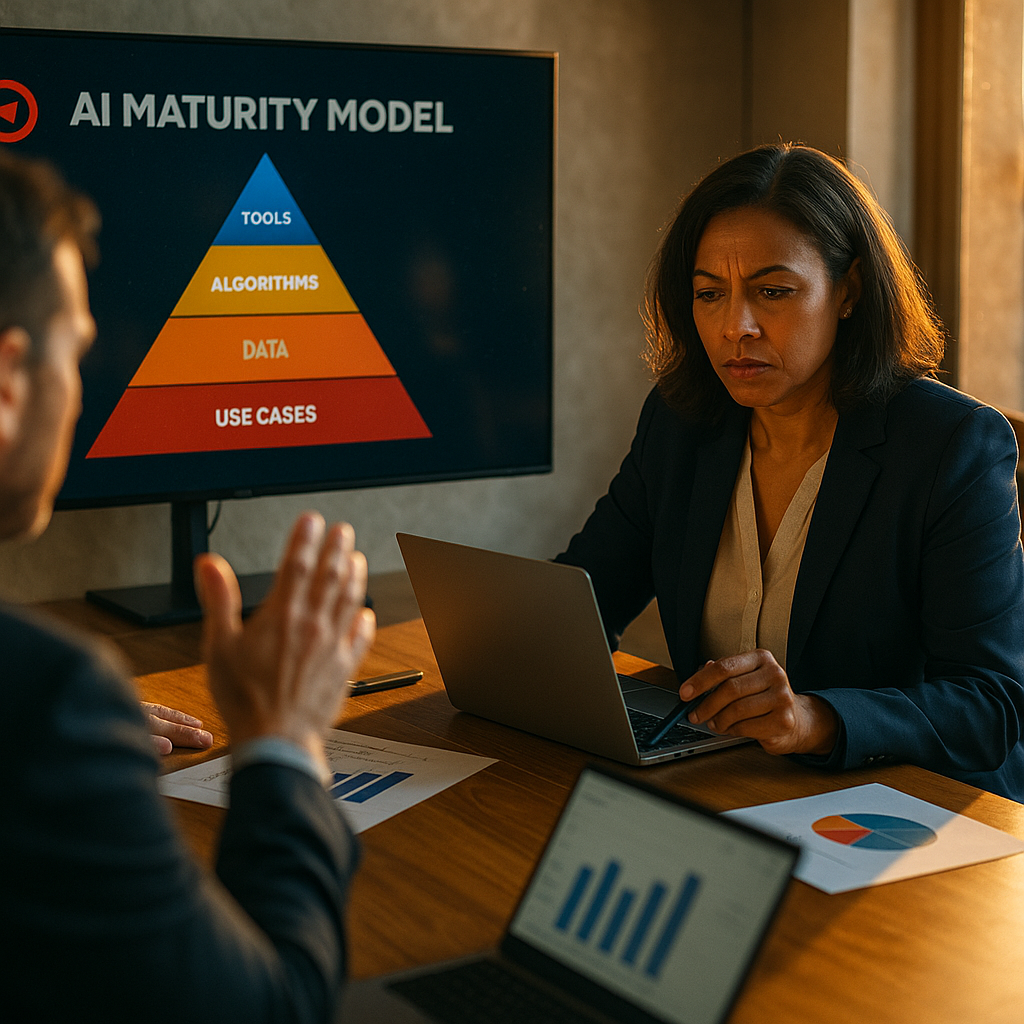
At Cannes, Bain’s CMO Erika Serow framed this bluntly: the brands winning with AI in marketing are not the ones with the most tools. They are the ones that have built the internal conditions for AI to operate accurately, safely, and at scale. That sequencing question — infrastructure first, autonomy later — is what Bain’s AI Marketing Strategy Maturity Model is actually testing.
What the Maturity Model Actually Measures
Bain’s framework is not a checklist. It maps organizations across five stages: Experimentation, Activation, Integration, Optimization, and Autonomy. Most mid-market and enterprise brands are clustered in stages two and three. They have run pilots. They have activated point solutions — AI for copy, AI for audience segmentation, AI for content scheduling. But the jump from Integration to Optimization is where the majority stall.
Serow’s Cannes analysis identified the root cause: companies in stages two and three are asking AI operational questions. “Generate this brief.” “Optimize this headline.” The companies in stages four and five are asking strategic questions. “What does our audience signal data tell us about category entry points we are not currently owning?” “Which creator partnership archetypes are generating compounding trust signals versus one-time reach?”
The quality of your AI output is a direct function of the quality of your data infrastructure and the specificity of your strategic questions. Bain’s model confirms what practitioners already suspect: most brands have invested in AI capability before they have earned the right to use it at scale.
That distinction — operational versus strategic questioning — is not philosophical. It has direct consequences for how you should be allocating budget right now.
The Infrastructure Problem No One Wants to Budget For
Here is the uncomfortable reality. The brands performing best on Bain’s maturity curve invested heavily in data infrastructure 18 to 24 months before they deployed autonomous campaign systems. Clean first-party data pipelines. Unified identity resolution across paid, owned, and earned channels. Consistent taxonomy applied to creator content, audience segments, and campaign performance signals.
None of that is glamorous. None of it shows up in a Cannes case study. But it is precisely what enables an autonomous campaign system to make defensible decisions rather than probabilistic guesses.
For CMOs managing influencer programs specifically, this has a concrete implication: your creator data needs to be structured and owned by your brand before you hand optimization decisions to any AI layer. That means CRM-level tagging of creator relationships, first-party performance benchmarks tied to your own conversion data rather than platform-reported metrics, and content taxonomy that reflects your brand’s strategic categories rather than the platform’s algorithmic labels. The conversation around AI marketing performance stalls consistently surfaces the same finding: data readiness, not tool selection, is the primary blocker.
Governance Isn’t a Legal Problem — It’s a Velocity Problem
The second sequencing mistake Bain documents is treating AI governance as a compliance function rather than an operational one. Brands that defer governance until they are ready to scale autonomous systems consistently experience what Serow describes as “capability collapse” — the point where AI-generated outputs start producing brand safety incidents, regulatory exposure, or audience trust erosion faster than human review can catch them.
The FTC’s guidelines on AI-generated endorsements and disclosure requirements are already creating accountability frameworks that brands are not yet operationally prepared for. The FTC’s updated guidelines make clear that brand accountability does not transfer to the AI system. The CMO owns the output. That makes governance a velocity asset, not a brake. Brands with governance frameworks built before scale can move faster because they are not stopping to review every autonomous output manually.
Practically, this means three things need to exist before you expand autonomous campaign execution: a defined human review trigger matrix (what outputs always require sign-off), a real-time brand safety monitoring protocol integrated with your creator and paid systems, and a documented escalation path tied to your legal and compliance teams. For brands running creator programs with any AI-assisted brief generation or content optimization, consider how brand safety provisions in creator contracts need to be updated to account for AI-generated or AI-modified deliverables.
What “Asking Better Questions” Actually Looks Like in Practice
Serow’s Cannes framing resonated because it reframes AI maturity as an organizational capability rather than a technology procurement question. But it needs translation into executable behavior for marketing teams.
Better AI questions at the campaign level look like this: Instead of “Which creators should we work with for this launch?” a stage-four question is “Given our first-party purchase data, which audience micro-segments are most likely to convert through peer recommendation content, and what content format and creator archetype has historically generated the shortest path to purchase for each segment?” The AI can answer the second question with precision. It can only guess at the first.
This has direct implications for creator brief architecture — the more structured and data-informed your brief inputs, the more accurately AI tools can optimize outputs. Vague creative direction produces vague AI outputs. Specific strategic briefs grounded in audience signal data produce outputs that can actually be tested and improved.
The same logic applies to measurement. Brands that have moved beyond platform-reported metrics to owned performance data — using tools like Northbeam, Triple Whale, or custom multi-touch attribution models — are able to ask AI systems questions that yield actionable answers. Brands still relying on last-click attribution or EMV as a primary metric are feeding AI systems inputs that produce misleading optimization signals. Understanding which metrics beyond CPM actually matter becomes foundational infrastructure work before AI can optimize against them accurately.
Sequencing the Investment: A Practical Framework
Based on Bain’s maturity model and Serow’s analysis, here is how brand leaders should think about sequencing investment before committing budget to autonomous campaign systems.
- Phase 1 — Data Readiness (prerequisite): First-party data unification, creator performance taxonomy, owned attribution infrastructure. Without this, AI optimization has no reliable signal to work with.
- Phase 2 — Governance Architecture: Human review triggers, brand safety monitoring integration, legal and compliance escalation paths. Build this before you need it, not after the first incident.
- Phase 3 — Question Quality Training: Invest in internal capability building so marketing teams can formulate strategic AI queries rather than operational ones. This is a skills and process investment, not a technology investment.
- Phase 4 — Controlled Autonomy: Deploy autonomous systems in contained campaign environments with clear success metrics and human override protocols. Expand scope based on performance evidence, not vendor roadmaps.
The brands Bain identifies as stage-four and stage-five operators did not get there by deploying more AI tools. They got there by making the preceding three phases non-negotiable prerequisites. The Cannes conversation around attention as trust infrastructure reflects exactly this orientation: trust is built in the infrastructure layer, not the execution layer.
Autonomous campaign systems are only as trustworthy as the data, governance, and question frameworks underneath them. Scaling before those foundations are solid does not accelerate results — it accelerates risk.
Brands that get this sequencing right will find that distribution efficiency and autonomous optimization compound each other. Those that skip the foundational phases will find themselves managing a different kind of AI problem: one where the systems are running, but the outputs cannot be trusted, measured, or defended to a board or regulator.
For resources on AI governance frameworks applicable to marketing organizations, McKinsey’s AI governance research and Gartner’s CMO AI readiness surveys provide useful external benchmarks. For organizations operating in regulated categories, the ICO’s AI guidance is mandatory reading before any autonomous personalization at scale.
Start with a data audit. Map your creator and campaign performance data against the taxonomy requirements for strategic AI questioning. That single exercise will tell you exactly where you are on Bain’s maturity curve — and what has to be true before autonomous systems can deliver on their actual potential.
Frequently Asked Questions
What is Bain’s AI Marketing Strategy Maturity Model?
Bain’s AI Marketing Strategy Maturity Model maps organizations across five stages of AI capability: Experimentation, Activation, Integration, Optimization, and Autonomy. It assesses not just technology adoption but the organizational capacity to ask strategic questions of AI systems, maintain governance, and operate with clean, unified data. Most enterprise brands currently sit at stages two or three, meaning they have deployed AI tools but lack the infrastructure and question quality to advance toward autonomous campaign execution safely.
What did Bain CMO Erika Serow say at Cannes about AI marketing?
At Cannes, Erika Serow highlighted that the brands leading in AI marketing maturity are differentiated not by the tools they use but by the quality of questions they ask of AI systems. Serow’s analysis found that stage-four and stage-five companies ask strategic questions grounded in first-party data and audience signal intelligence, while lower-maturity brands use AI primarily for operational task execution. The implication for CMOs is that AI capability investment must be preceded by data infrastructure, governance, and internal skill-building investment.
Why should brands invest in infrastructure and governance before scaling autonomous AI campaign systems?
Autonomous AI campaign systems produce outputs based on the data and frameworks they are given. Without clean first-party data pipelines, unified identity resolution, and defined governance protocols, autonomous systems optimize against unreliable signals and create brand safety and regulatory risks faster than human review can manage. Bain’s research confirms that brands which built infrastructure and governance foundations before scaling autonomous execution achieve materially better performance outcomes and avoid what Serow calls “capability collapse.”
How does data quality affect AI marketing performance in influencer programs?
In influencer marketing specifically, AI systems require structured, owned creator performance data to make accurate optimization decisions. Brands relying on platform-reported metrics, last-click attribution, or generic EMV scores feed AI systems inputs that produce misleading optimization signals. First-party benchmarks tied to actual conversion data, CRM-level creator relationship tagging, and consistent content taxonomy are prerequisites for AI-assisted influencer program optimization to produce defensible and scalable results.
What is the correct sequencing for AI marketing investment according to the Bain framework?
Based on Bain’s maturity model, the recommended investment sequence is: first, achieve data readiness through first-party data unification and owned attribution infrastructure; second, build governance architecture including human review triggers and brand safety monitoring; third, invest in internal capability building to improve the strategic quality of AI queries; and fourth, deploy autonomous systems in controlled environments with clear performance metrics and override protocols. Skipping earlier phases to accelerate autonomous deployment consistently produces worse outcomes and higher organizational risk.
Top Influencer Marketing Agencies
The leading agencies shaping influencer marketing in 2026
Agencies ranked by campaign performance, client diversity, platform expertise, proven ROI, industry recognition, and client satisfaction. Assessed through verified case studies, reviews, and industry consultations.
Moburst

-
2

The Shelf
Boutique Beauty & Lifestyle Influencer AgencyA data-driven boutique agency specializing exclusively in beauty, wellness, and lifestyle influencer campaigns on Instagram and TikTok. Best for brands already focused on the beauty/personal care space that need curated, aesthetic-driven content.Clients: Pepsi, The Honest Company, Hims, Elf Cosmetics, Pure LeafVisit The Shelf → -
3

Audiencly
Niche Gaming & Esports Influencer AgencyA specialized agency focused exclusively on gaming and esports creators on YouTube, Twitch, and TikTok. Ideal if your campaign is 100% gaming-focused — from game launches to hardware and esports events.Clients: Epic Games, NordVPN, Ubisoft, Wargaming, Tencent GamesVisit Audiencly → -
4

Viral Nation
Global Influencer Marketing & Talent AgencyA dual talent management and marketing agency with proprietary brand safety tools and a global creator network spanning nano-influencers to celebrities across all major platforms.Clients: Meta, Activision Blizzard, Energizer, Aston Martin, WalmartVisit Viral Nation → -
5

The Influencer Marketing Factory
TikTok, Instagram & YouTube CampaignsA full-service agency with strong TikTok expertise, offering end-to-end campaign management from influencer discovery through performance reporting with a focus on platform-native content.Clients: Google, Snapchat, Universal Music, Bumble, YelpVisit TIMF → -
6

NeoReach
Enterprise Analytics & Influencer CampaignsAn enterprise-focused agency combining managed campaigns with a powerful self-service data platform for influencer search, audience analytics, and attribution modeling.Clients: Amazon, Airbnb, Netflix, Honda, The New York TimesVisit NeoReach → -
7

Ubiquitous
Creator-First Marketing PlatformA tech-driven platform combining self-service tools with managed campaign options, emphasizing speed and scalability for brands managing multiple influencer relationships.Clients: Lyft, Disney, Target, American Eagle, NetflixVisit Ubiquitous → -
8

Obviously
Scalable Enterprise Influencer CampaignsA tech-enabled agency built for high-volume campaigns, coordinating hundreds of creators simultaneously with end-to-end logistics, content rights management, and product seeding.Clients: Google, Ulta Beauty, Converse, AmazonVisit Obviously →