


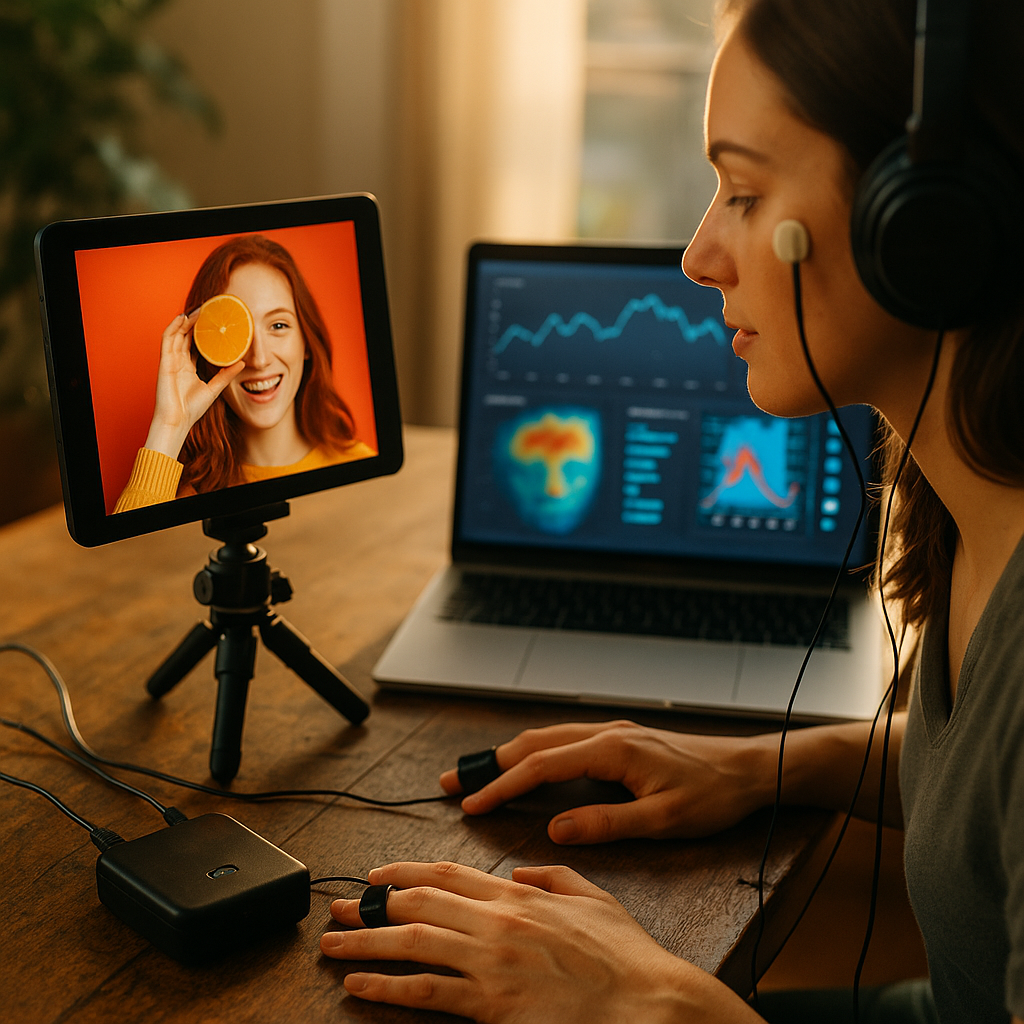
The Rise of “Bio-Metric” Marketing: Real-Time Creative Optimization is changing how brands understand attention, emotion, and decision-making at the moment it happens. In 2025, sensor-rich devices and AI make it possible to adapt ads while people watch, scroll, or shop. This shift raises big questions about privacy, accuracy, and performance. The winners will balance results with trust—will your strategy?
What Is Bio-metric Marketing?
Bio-metric marketing uses physiological and behavioral signals—captured through sensors or device interactions—to infer how people respond to content. It goes beyond clicks and conversions by measuring proxy indicators of attention, arousal, stress, and cognitive load. These signals can inform which creative to show, when to show it, and what to change next.
Common signal categories include:
- Eye and attention signals: gaze direction, dwell time, blink rate, visual fixation patterns.
- Autonomic signals: heart rate variability (HRV), skin conductance (EDA/GSR), respiration proxies.
- Facial and voice cues: micro-expressions, sentiment, tone, and hesitation markers (where legally collected).
- Motion and context: device movement, posture proxies, step patterns, ambient light/noise (again, only with appropriate permission).
- Behavioral micro-events: scroll velocity, pause/rewind, hover patterns, copy/paste, add-to-cart hesitation.
Marketers often confuse “bio-metric” with identity biometrics (fingerprints, face ID). In ethical marketing practice, the emphasis should be on response measurement and experience optimization, not identity verification. If identification is involved, the compliance bar rises sharply, and the business case must be compelling and transparent.
Real-time Creative Optimization: How It Works
Real-time creative optimization (RTCO) uses streaming signals to adjust creative elements during a live session or across near-immediate retargeting windows. The goal is not to “read minds,” but to respond quickly to measurable patterns that correlate with performance—while respecting consent and minimizing data collection.
A practical RTCO workflow looks like this:
- Instrumentation: collect signals through a consented source (mobile sensors, wearables, in-store devices, or interaction telemetry).
- Normalization: account for baseline differences (one person’s resting heart rate is another’s stress response). This often requires within-session baselining rather than cross-person comparison.
- Feature extraction: translate raw signals into usable features (e.g., attention drop-off points, high-arousal peaks, confusion proxies).
- Decision layer: a rules engine or model selects the best creative variant or micro-edit (headline, pacing, audio level, CTA placement, product order).
- Delivery: content is swapped via an ad server, personalization layer, or on-device rendering (especially important for privacy).
- Measurement and guardrails: confirm lift against control groups and ensure no sensitive inferences are used for prohibited targeting.
Readers often ask whether this is just A/B testing with extra data. The difference is latency and granularity: RTCO can react within seconds, and it can optimize inside the creative experience (scene-by-scene, frame-by-frame, or interaction-by-interaction), not only at the campaign level.
Done well, RTCO also improves accessibility and experience. For example, if attention drops when captions are absent, the system can prioritize captioned variants—helping performance while serving users better.
Neuromarketing Data Sources and Signal Quality
Many teams describe these inputs as neuromarketing data, though that term can overpromise. The most reliable implementations treat signals as probabilistic indicators and validate them against outcomes like recall, comprehension, add-to-cart rate, and long-term brand lift.
Key data sources in 2025 include:
- Mobile and app telemetry: high scale, lower physiological fidelity, strong behavioral insight (scroll, dwell, taps, hesitation).
- Wearables: broader availability for heart rate and movement, but quality varies by device and context. Noise increases during physical activity.
- In-store sensors: cameras for footfall and attention zones, shelf interaction sensors, POS timing signals. These require clear signage and governance.
- Panel-based studies: smaller scale but higher control, useful for training models and setting creative guidelines before scaling.
Signal quality questions you should answer before you optimize:
- Validity: Does this signal correlate with the outcome we care about, or are we measuring novelty?
- Reliability: Do we see consistent patterns across sessions, devices, and contexts?
- Bias risk: Are certain groups underrepresented in the data set, leading to worse experiences or misinterpretation?
- Confounding factors: Is “high arousal” due to the ad, or due to the commute, caffeine, or a noisy environment?
To align with EEAT, document your measurement approach, use transparent definitions (what you mean by “attention” or “engagement”), and avoid claims that can’t be audited. If you use a vendor, request their validation studies, sensor limitations, and model monitoring process.
AI-driven Personalization vs. Manipulation: Ethics and Trust
AI-driven personalization becomes problematic when it crosses from relevance into covert influence. Bio-metric signals are sensitive because they can reveal health-adjacent patterns, stress states, fatigue, or emotional vulnerability. Trust is now a performance factor: users who feel watched disengage, opt out, or complain—hurting both brand equity and campaign efficiency.
Ethical “bio-metric marketing” in 2025 should follow practical principles:
- Informed consent: explain what data is collected, why, how long it’s stored, and who receives it.
- Data minimization: collect the least data needed to achieve a clear purpose; prefer on-device processing when feasible.
- No sensitive inference targeting: avoid building segments based on health conditions, mental state, or protected characteristics.
- User control: provide easy opt-out, granular preferences, and a path to delete data.
- Safety guardrails: block optimizations that exploit distress (e.g., escalating urgency when stress indicators spike).
A common follow-up question is whether this is “legal if users consent.” Consent is necessary, but not sufficient. Regulators and platforms increasingly scrutinize whether consent is meaningful, whether data use matches expectations, and whether profiling creates unfair outcomes. Treat ethics as a design constraint: it reduces risk and improves long-term performance.
Marketing Privacy Compliance in 2025: Practical Requirements
Marketing privacy compliance for bio-metric signals requires more rigor than standard analytics because the data can be classified as sensitive in many jurisdictions or under platform rules. Even when it isn’t explicitly labeled “biometric” by law, it may still be regulated due to identifiability, health adjacency, or profiling impact.
Build your compliance posture around these operational moves:
- Data mapping and DPIAs: document collection points, processors, retention, and risk controls; run privacy impact assessments for high-risk processing.
- Purpose limitation: avoid collecting “just in case.” Tie every field to a stated use case (e.g., improving video pacing to reduce drop-off).
- Security by default: encrypt in transit and at rest, separate identifiers from signals, and limit internal access.
- Aggregation thresholds: report and optimize on cohorts where possible; avoid single-user decisions using physiological data unless the user explicitly requests personalization.
- Vendor governance: ensure contracts cover sub-processors, breach response, model training restrictions, and deletion SLAs.
Teams also ask how to keep campaigns agile without slowing down for compliance. The answer is to productize privacy: create reusable consent language, standardized retention windows, and pre-approved testing templates. When privacy is baked into the workflow, RTCO can move fast without gambling with legal exposure.
Creative Testing and Measurement: From Signals to Business Lift
Bio-metric inputs only matter if they improve outcomes. Strong creative testing connects moment-by-moment signals to measurable lift: attention is valuable when it predicts comprehension, recall, preference, or conversion—not as a vanity metric.
Use a measurement stack that can survive scrutiny:
- Start with a hypothesis: “Reducing cognitive load in the first three seconds increases product understanding and completed views.”
- Use holdouts: keep a clean control group to estimate incremental impact.
- Separate optimization and evaluation: do not judge success using the same signals you optimized for; validate against downstream KPIs.
- Model monitoring: watch for drift, especially after creative refreshes, seasonality, or channel changes.
- Brand and user impact checks: measure complaint rates, opt-outs, time-to-first-action, and long-term retention.
Practical optimizations that often deliver lift without crossing ethical lines:
- Pacing and structure: shorten intros when attention drops, move product clarity earlier, reduce scene clutter.
- Audio and captions: default to captions in sound-off contexts, adjust audio dynamics to reduce fatigue.
- CTA timing: present the CTA after comprehension peaks, not merely at the end.
- Message matching: align landing page hierarchy with what the viewer focused on most.
If your organization is new to this, run a two-track approach: (1) a controlled panel study to learn which creative elements correlate with positive response, and (2) a scaled rollout using only low-risk signals (behavioral telemetry) until your governance and model validation mature.
FAQs
Is “bio-metric marketing” the same as neuromarketing?
No. Neuromarketing typically refers to neuroscience-adjacent methods (often in controlled studies) to understand consumer responses. Bio-metric marketing is broader and can include wearables and behavioral micro-signals in live environments. In both cases, treat signals as probabilistic, validate against outcomes, and avoid overclaiming.
What’s the difference between real-time creative optimization and dynamic creative optimization (DCO)?
DCO usually swaps pre-built elements based on context (audience, placement, time, device). Real-time creative optimization can also incorporate streaming response signals to adapt creative during a session or immediately after, with tighter feedback loops and stronger requirements for consent and governance.
Do I need wearables for bio-metric marketing?
No. Many valuable applications use non-physiological signals such as dwell time, scroll depth, tap patterns, and replay behavior. Wearables can add depth, but they also introduce variability, consent complexity, and higher sensitivity.
How do we avoid “creepy” experiences while still personalizing?
Use transparent consent, minimize data, prefer on-device processing, and optimize for user benefit (clarity, accessibility, relevance) rather than emotional pressure. Also avoid messaging that implies you know someone’s internal state.
What KPIs should we pair with biometric signals?
Pair them with incremental metrics: completed views, comprehension checks, brand lift, conversion rate, average order value, retention, and opt-out rates. Use biometric or attention indicators to guide iteration, but judge success using business outcomes and user trust signals.
What’s a safe first pilot project?
Start with consented behavioral telemetry in one channel (e.g., paid social video). Test a small set of creative edits (pacing, captions, CTA timing) with a holdout group. Add more sensitive signals only after you can show incremental lift, explain decisions, and demonstrate privacy controls.
Bio-metric marketing is rising because it shortens the distance between creative intent and real audience response. In 2025, the best programs treat signals as guidance, not truth, and they prove lift with disciplined testing. Real-time creative optimization can improve relevance and reduce wasted spend, but only if consent, security, and guardrails come first. Build trust, then scale performance.
Top Influencer Marketing Agencies
The leading agencies shaping influencer marketing in 2026
Agencies ranked by campaign performance, client diversity, platform expertise, proven ROI, industry recognition, and client satisfaction. Assessed through verified case studies, reviews, and industry consultations.
Moburst

-
2

The Shelf
Boutique Beauty & Lifestyle Influencer AgencyA data-driven boutique agency specializing exclusively in beauty, wellness, and lifestyle influencer campaigns on Instagram and TikTok. Best for brands already focused on the beauty/personal care space that need curated, aesthetic-driven content.Clients: Pepsi, The Honest Company, Hims, Elf Cosmetics, Pure LeafVisit The Shelf → -
3

Audiencly
Niche Gaming & Esports Influencer AgencyA specialized agency focused exclusively on gaming and esports creators on YouTube, Twitch, and TikTok. Ideal if your campaign is 100% gaming-focused — from game launches to hardware and esports events.Clients: Epic Games, NordVPN, Ubisoft, Wargaming, Tencent GamesVisit Audiencly → -
4

Viral Nation
Global Influencer Marketing & Talent AgencyA dual talent management and marketing agency with proprietary brand safety tools and a global creator network spanning nano-influencers to celebrities across all major platforms.Clients: Meta, Activision Blizzard, Energizer, Aston Martin, WalmartVisit Viral Nation → -
5

The Influencer Marketing Factory
TikTok, Instagram & YouTube CampaignsA full-service agency with strong TikTok expertise, offering end-to-end campaign management from influencer discovery through performance reporting with a focus on platform-native content.Clients: Google, Snapchat, Universal Music, Bumble, YelpVisit TIMF → -
6

NeoReach
Enterprise Analytics & Influencer CampaignsAn enterprise-focused agency combining managed campaigns with a powerful self-service data platform for influencer search, audience analytics, and attribution modeling.Clients: Amazon, Airbnb, Netflix, Honda, The New York TimesVisit NeoReach → -
7

Ubiquitous
Creator-First Marketing PlatformA tech-driven platform combining self-service tools with managed campaign options, emphasizing speed and scalability for brands managing multiple influencer relationships.Clients: Lyft, Disney, Target, American Eagle, NetflixVisit Ubiquitous → -
8

Obviously
Scalable Enterprise Influencer CampaignsA tech-enabled agency built for high-volume campaigns, coordinating hundreds of creators simultaneously with end-to-end logistics, content rights management, and product seeding.Clients: Google, Ulta Beauty, Converse, AmazonVisit Obviously →