


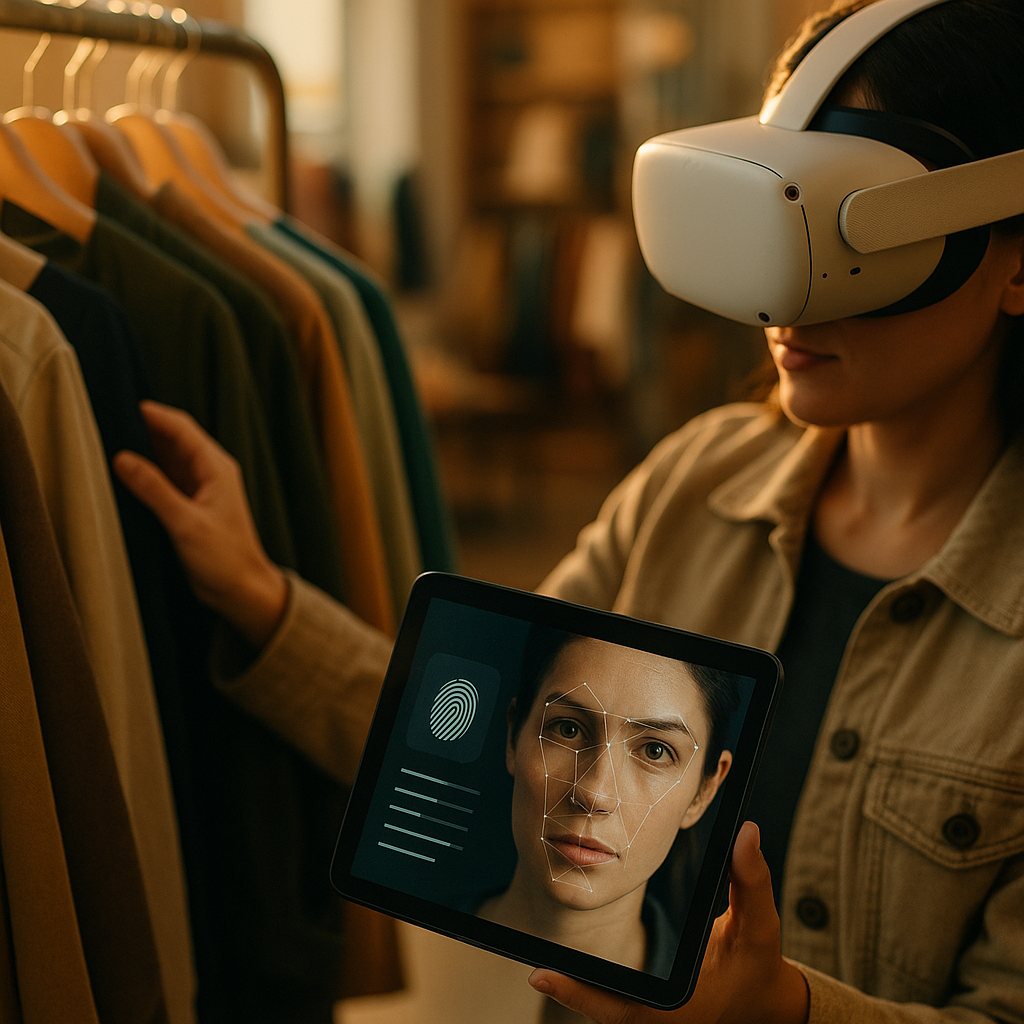
Navigating biometric data privacy in virtual reality shopping hubs has become a practical skill in 2025, not a niche concern. VR stores can read eye movements, body posture, voice, and even subtle gestures to personalize experiences and prevent fraud. Those same signals can expose identity, health, and behavior patterns if mishandled. Know what’s collected, why it’s collected, and how to control it—before you click “enter store” and get tracked.
Biometric data in VR commerce: what gets collected and why
Virtual reality shopping hubs rely on sensors to make immersion feel natural and to reduce friction at checkout. The problem is that VR “natural interaction” often depends on biometric and biometric-adjacent data. In many jurisdictions, biometric data is treated as sensitive because it can identify a person or infer intimate traits. In practice, VR platforms may collect:
- Eye tracking (gaze point, fixation time, pupil dilation): used for foveated rendering, attention analytics, and product placement optimization.
- Facial expression data (micro-expressions, blendshapes): used for avatar animation, social presence, and sentiment modeling.
- Voiceprints and voice features (tone, cadence, speech patterns): used for voice chat moderation, identity verification, and personalization.
- Hand and body tracking (skeletal data, gesture patterns, gait/posture): used for navigation, accessibility, and anti-bot or anti-fraud signals.
- Physiological signals when available (heart rate, skin response): used for comfort/safety features and, sometimes, engagement optimization.
- Derived inferences (interest profiles, emotional state estimates, fatigue/comfort indicators): created from raw signals and often more sensitive than the raw data itself.
Readers often ask whether “tracking for performance” is different from “tracking for advertising.” It is. Performance-related processing (like foveated rendering) can be done on-device and need not be stored. Advertising and personalization often require retention, profiling, and sharing—raising the risk level significantly. When a platform says “we don’t store biometric data,” confirm whether it still stores templates, embeddings, or derived attributes, which can function like identifiers.
VR shopping privacy risks: from re-identification to behavioral profiling
Biometric privacy risk in VR shopping is not limited to “someone steals my face.” It often shows up as quiet, persistent profiling. Common risk pathways include:
- Re-identification: Even if names are removed, unique combinations of movement, gaze patterns, and device identifiers can link sessions back to an individual.
- Cross-context tracking: A VR headset account used for gaming, work, and shopping can merge data into a single profile unless you separate accounts and permissions.
- Sensitive inference: Eye and voice signals can correlate with stress, attention, or potential health indicators. Inference can occur without explicit collection of “health data.”
- Function creep: Data collected for comfort or fraud prevention gets repurposed for marketing, dynamic pricing, or partner analytics.
- Children and teens exposure: Youth users face higher risks because biometric data can create long-lived identifiers.
- Security incidents: If templates or embeddings leak, you can’t “reset” your face or gait the way you reset a password.
Another follow-up question is whether these risks matter if you “have nothing to hide.” In VR commerce, the stakes include price discrimination, manipulation, unwanted personalization, and exposure of traits you did not volunteer. The most practical privacy mindset is: minimize what is collected, limit how long it’s kept, and constrain who can access it.
Consent and transparency in immersive experiences: what good looks like
In 2025, consent banners and vague privacy policies do not meet the standard of helpful transparency for immersive environments. In VR shopping, consent must be meaningful because interaction is continuous and data is high-resolution. Look for platforms that implement:
- Just-in-time prompts: Asking permission when a feature is activated (e.g., “Enable eye tracking for hands-free navigation?”), not buried in setup.
- Granular controls: Separate toggles for eye tracking, face tracking, voice analysis, ad personalization, and “share with partners.”
- Purpose limitation: Clear statements such as “eye tracking used only for rendering, processed on-device, not stored,” rather than “to improve services.”
- Retention clarity: Exact time windows (e.g., “30 days for fraud logs”) and what is retained (raw data vs. derived features vs. aggregated stats).
- Accessible explanations: Plain-language summaries inside the headset, not just on a website you never visit.
To evaluate consent quality quickly, ask: Can I shop without enabling biometric features that are not strictly necessary? A privacy-respecting hub should still let you browse and purchase with reduced tracking—perhaps with fewer social features—without punishing you through blocked access or misleading prompts.
If you manage a VR storefront, align consent with user expectations: introduce biometric options as benefits with honest tradeoffs, not as defaults. Provide a clear “no thanks” path and avoid dark patterns like repeated nag screens that push users to enable tracking.
Data minimization and security controls for biometric identifiers
Strong privacy is built on technical choices. Whether you’re a consumer choosing a platform or a business operating in a VR mall, focus on controls that reduce the value and exposure of biometric identifiers.
Best-practice controls to look for (or implement):
- On-device processing by default: Run eye/face tracking locally for avatar animation and rendering; transmit only what is necessary for the feature to work.
- Edge aggregation: Convert raw signals into coarse, non-identifying metrics before any cloud upload (e.g., “engagement score per scene” rather than gaze trails).
- Template protection: If biometric templates are used for authentication, store them in secure hardware enclaves where possible and avoid centralized template databases.
- Encryption in transit and at rest: Mandatory for any data that leaves the device, with key management that prevents broad internal access.
- Strict access controls: Role-based access, audit logs, and a “need-to-know” culture for staff and vendors.
- Short retention windows: Keep raw data only as long as needed; prefer immediate deletion after feature completion.
- Separate identifiers: Use different IDs for shopping, social interaction, and analytics to reduce linkability.
- Red-team testing: Test for re-identification risks, model inversion, and leakage from analytics dashboards.
A common buyer question is: “Can a company anonymize biometric data safely?” Sometimes, but anonymization is fragile for high-dimensional signals like motion and gaze. Treat “anonymous biometric data” claims as a risk flag unless supported by clear methods, independent review, and strong limitations on sharing.
Compliance in 2025: GDPR, CPRA, and biometric privacy laws
Legal obligations differ by region, but the direction is consistent: biometric data receives heightened protection, and VR does not get a special exemption. For businesses operating VR shopping hubs, strong governance is not optional; it reduces enforcement exposure and builds trust.
Key compliance themes you should align to:
- Lawful basis and explicit consent: Under GDPR-style frameworks, biometric data used for identification often requires explicit consent or another narrow legal basis. Even when not used for identification, sensitivity can trigger stricter rules.
- Consumer rights: Under CPRA and similar laws, users may have rights to access, delete, correct, and opt out of certain sharing or targeted advertising. You must operationalize these rights inside the VR environment and on the web.
- Data protection impact assessments: High-risk processing—like large-scale biometric profiling—typically requires documented impact assessments and risk mitigation.
- Vendor and partner governance: If analytics, ad tech, identity verification, or moderation vendors touch biometric signals, contracts must restrict use, require security, and define deletion.
- Children’s protections: Youth-focused experiences should avoid biometric profiling and targeted advertising; implement age-appropriate design and consent mechanisms.
Businesses often ask what “good” documentation looks like. Maintain a clear record of processing activities, a data map showing where biometric signals flow, retention schedules, model documentation for any inference systems, and incident response playbooks. If you can’t explain your biometric pipeline simply, you probably can’t govern it effectively.
Consumer controls: how to shop safely in VR without oversharing
You can reduce biometric exposure without giving up VR shopping entirely. Use this practical checklist before and during your sessions:
- Review headset permissions: Disable eye/face tracking unless needed. Some platforms enable them by default for avatars—turn them on only when you’re using social features.
- Opt out of ad personalization: Look for settings that disable targeted ads, “experience personalization,” and partner sharing. If there’s a separate toggle for “analytics,” disable it unless you want to contribute data.
- Use separate accounts: Keep shopping separate from social or gaming profiles when possible to reduce cross-context linking.
- Limit voice data: Use push-to-talk, disable voice “improvement” features that store clips, and avoid voice authentication unless you trust the provider’s template protections.
- Watch for in-app prompts: If a store asks for new access (e.g., enabling eye tracking “to improve recommendations”), consider declining and continue with standard browsing.
- Check data export/delete tools: Prefer platforms that let you download your data, delete it easily, and confirm deletion with timestamps.
- Secure your account: Use strong authentication, device lock features, and recovery methods. Account takeover can expose purchase history and behavioral profiles even without biometric leaks.
If you’re comparing two VR shopping hubs, choose the one that offers functional parity with privacy-friendly settings. If disabling eye tracking makes the store unusable, that is a design decision worth questioning.
FAQs
Is eye tracking considered biometric data in VR shopping?
Eye tracking can be biometric data when it is used to identify you, authenticate you, or create a unique profile that can be linked back to you. Even when used for performance (like foveated rendering), it can become sensitive if stored, shared, or combined with identifiers.
Can VR stores use my biometric data for targeted advertising?
Some can, depending on their settings and legal obligations. Look for explicit disclosures about “personalized ads,” “inference,” and “sharing with partners.” If the platform does not offer a clear opt-out, consider it a high-risk environment for profiling.
What’s the difference between raw biometric data and a biometric template?
Raw data is the original signal (e.g., gaze traces or facial movement data). A template (or embedding) is a processed representation used for matching or profiling. Templates can still be identifying and can be difficult to invalidate if compromised.
How long should a VR shopping hub keep biometric data?
The safest default is: as short as possible. Performance-related signals should be processed on-device and not retained. If retention is needed for fraud prevention or safety, it should be tightly limited, documented, and separated from advertising systems.
Can I shop in VR without providing biometric data?
Usually yes, but it depends on the platform. Many experiences can run with eye/face tracking turned off, using controller input or basic hand tracking. If a hub requires biometric features for basic browsing or checkout, treat that as a privacy tradeoff and consider alternatives.
What should businesses operating VR storefronts do first to improve privacy?
Start with a data map: list every biometric signal collected, where it is processed, who receives it, and how long it is retained. Then implement minimization (on-device processing, reduced retention), tighten vendor contracts, and add clear, in-headset consent and controls.
Biometric privacy in VR shopping hubs is manageable in 2025 when you focus on purpose, minimization, and control. Treat eye, face, voice, and movement signals as sensitive by default, because they can identify you or reveal patterns you never intended to share. Choose platforms with granular opt-outs, short retention, and on-device processing. When privacy settings don’t break the experience, you keep convenience without surrendering autonomy.