


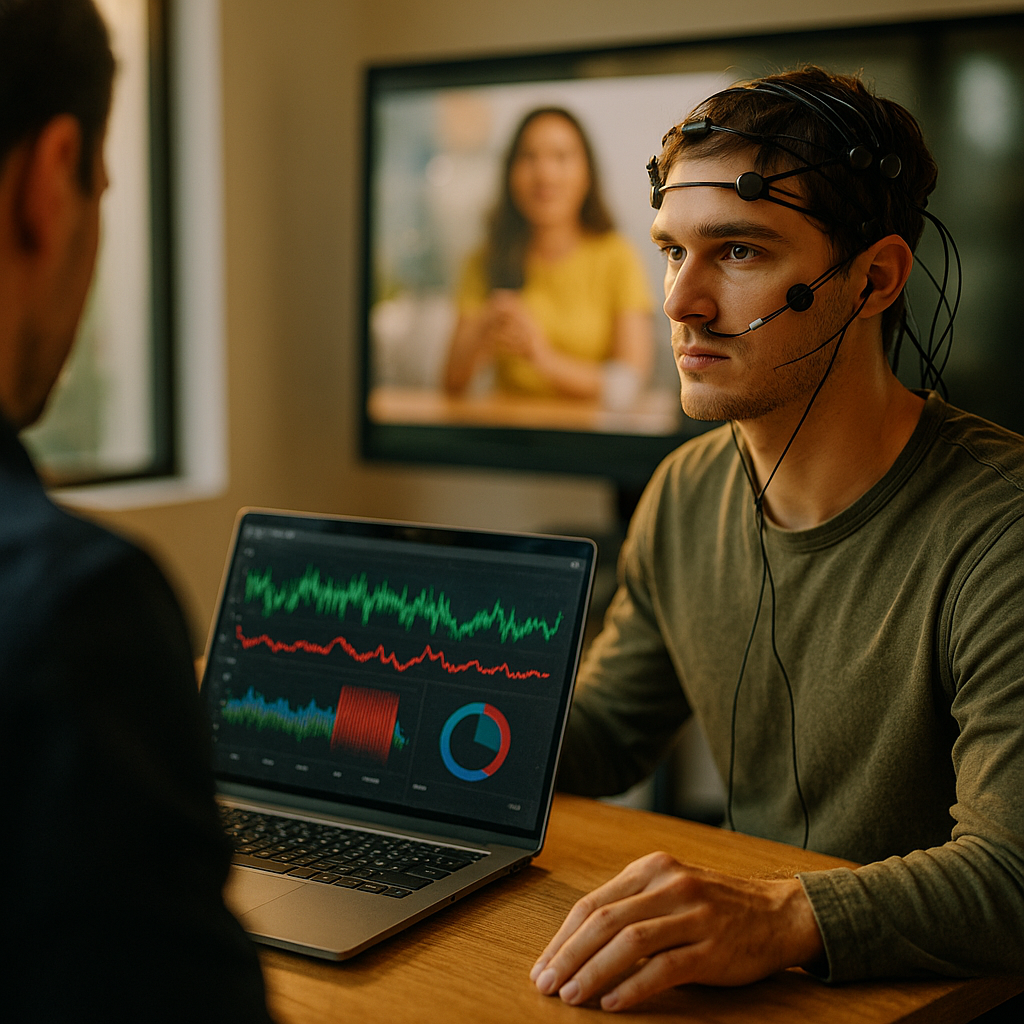
In 2025, advertisers can’t afford to guess what people feel when an ad plays. The rise of bio-metric feedback in real-time creative testing is changing how teams evaluate attention, emotion, and cognitive load as campaigns run. Instead of relying only on surveys, brands can now measure reactions as they happen and refine creative faster. But how do you use these signals responsibly and profitably?
Real-time creative testing: why it’s evolving beyond clicks and surveys
Traditional creative testing depends on what people say they noticed and how they claim they felt. That approach still matters, but it has clear limits: memory is imperfect, social desirability bias skews answers, and many reactions are non-conscious. Meanwhile, modern media environments move fast, and performance changes quickly across placements, creators, and formats.
Real-time creative testing aims to shorten the loop between exposure and decision-making. Instead of waiting days or weeks for post-campaign reports, teams can validate whether an opening scene grabs attention, whether a brand cue is recognized, and whether viewers feel confused or engaged—while the creative is live or in rapid iterative cycles.
Clicks, view-through rates, and conversions remain essential, but they are lagging indicators. They tell you what happened, not why. Biometrics help explain why a variant works, which reduces wasted spend and prevents overfitting to a single performance metric that may shift with audience mix or platform changes.
Biometric feedback: what signals matter and what they really mean
Biometric feedback refers to physiological or behavioral signals that correlate with attention, arousal, effort, and affect. In creative testing, the goal is not to “read minds,” but to quantify patterns that tend to accompany specific states. The most common signals include:
- Eye tracking: gaze fixation, time-to-first-fixation on brand cues, and scan paths that reveal what elements draw attention or get ignored.
- Facial expression analysis: probability-based detection of expressions (for example, surprise or confusion) that can indicate moment-by-moment valence shifts. Good practice treats these as directional, not definitive.
- Electrodermal activity (EDA/GSR): skin conductance changes associated with arousal and intensity. Useful for identifying “peaks” that align with key scenes.
- Heart rate and heart rate variability: proxies for arousal and cognitive load; helpful for spotting sustained stress or sustained engagement.
- EEG and neuro-based measures: in specialized settings, used to estimate attention and workload, but require careful interpretation and strong expertise.
- Voice and interaction signals: micro-pauses, speech tempo, scroll depth, and engagement behaviors that, while not strictly biometric, often complement physiological measures in “in-the-wild” testing.
The practical question most teams ask is: “Which signal predicts performance?” The better question is: “Which signal helps us diagnose creative quality problems we can fix?” For example, if eye tracking shows viewers miss the product demonstration, you can adjust framing, contrast, or timing. If EDA spikes align with a confusing cut, you can smooth the narrative or add clarifying overlays.
Teams also need to understand noise. Lighting, camera angles, device differences, and participant movement affect facial and gaze tracking. Even heart rate changes can reflect caffeine or room temperature. Strong creative testing separates signal from artifact through calibration, quality thresholds, and replication across segments.
Creative optimization: how real-time biometrics improves iteration speed
Biometrics shine when they speed up decisions without sacrificing rigor. In 2025, many creative teams run iterative loops that look like this:
- Define the creative hypothesis: for example, “Front-loading a clear benefit claim in the first 2 seconds increases attention and brand recall.”
- Instrument the experience: select biometric measures that map to the hypothesis (eye tracking for attention to the claim; EDA for intensity; brief recall checks for confirmation).
- Run short, controlled exposures: compare variants with consistent audience composition and similar viewing context.
- Identify actionable moments: pinpoint second-by-second segments where attention drops or confusion rises.
- Change only what you can attribute: adjust one or two creative elements per iteration to avoid muddled conclusions.
- Validate against business KPIs: verify that biometric improvements translate to lifts in view-through completion, brand search, add-to-cart, or conversion rate—depending on the objective.
Real-time does not mean reckless. The most effective teams treat biometrics as a diagnostic layer that guides editing choices, not as a replacement for outcomes. When a signal suggests “better engagement,” teams still verify it against platform metrics and, where feasible, incrementality tests.
Follow-up readers often ask: “Can this work for small budgets?” Yes, if you scope it correctly. You do not need a lab-grade setup for every decision. Many brands reserve high-fidelity biometric testing for hero assets, high-spend launches, or brand campaigns where creative quality has outsized impact, then use lighter-weight methods for ongoing variants.
Consumer neuroscience: building a measurement stack you can trust
As biometric tools become easier to access, trust becomes the differentiator. A helpful measurement stack aligns methods to decisions, documents limitations, and avoids overstating certainty. To meet EEAT expectations, teams should emphasize the following:
- Clear operational definitions: define what you mean by attention, emotional intensity, comprehension, and memory, and which metric approximates each.
- Transparent methodology: sample size logic, audience sourcing, inclusion/exclusion rules, device requirements, and data quality filters.
- Triangulation: combine biometrics with quick comprehension checks, recall questions, and observed behaviors (drop-off, rewinds, clicks).
- Repeatability: re-run tests across segments, placements, and times of day to ensure a result is not a one-off artifact.
- Calibration and baselines: compare against neutral content or a control creative so that “high arousal” has context.
- Interpretation discipline: treat biometrics as probabilistic signals. Avoid claims like “viewers felt X” without supporting evidence.
Consumer neuroscience concepts can be helpful if used carefully. For instance, “cognitive load” is relevant when an ad contains dense information, fast cuts, or complex claims. If biometrics and quick quizzes both indicate overload, simplification becomes a clear optimization path.
A common follow-up question is: “Will these tools replace creative intuition?” No. They sharpen it. Strong creative direction still sets the narrative, tone, and brand meaning. Biometrics reduce blind spots by showing where the audience stops following your story or where the brand disappears.
Marketing analytics: connecting biometric insights to ROI and attribution
Executives want to know whether biometric testing pays for itself. The best way to answer is to link biometric-driven edits to measurable outcomes with a defensible chain of evidence. In practice, that means integrating biometrics into marketing analytics rather than treating it as a separate research artifact.
Effective approaches include:
- Pre-post creative comparisons: test the original and edited versions, then compare platform KPIs under similar spend and targeting constraints.
- Multi-variant experiments: use structured A/B/n tests where each variant represents a specific creative hypothesis (for example, early brand cue vs. late brand cue).
- Lift measurement: when feasible, use holdouts or geo experiments to verify incremental impact beyond attribution models.
- Diagnostic dashboards: align second-by-second biometric markers with video timelines and performance markers like drop-off and click bursts.
The key is to avoid “metric theater.” If a team celebrates an increase in biometric attention but conversions do not move, that does not mean biometrics failed. It means the creative change improved one layer of the funnel but did not resolve the next bottleneck—perhaps the offer lacks relevance, the landing page is slow, or the product-market fit is weak in that audience.
Another likely question: “Is this only for video?” No. Biometrics can support static and interactive formats too, especially via eye tracking and measures of effort during comprehension. For example, if a carousel’s second card contains the key claim but viewers rarely reach it, you can reorder content and retest.
Data privacy compliance: ethics, consent, and responsible use in 2025
Biometric data is sensitive. Responsible use is not optional; it is essential for consumer trust and legal risk management. Brands that adopt biometric feedback should design governance into the workflow from day one.
Core best practices include:
- Informed consent: explain what is collected, how it will be used, how long it will be stored, and whether it will be shared with third parties. Consent should be specific and revocable.
- Data minimization: collect only what you need to answer the creative question. If eye tracking is sufficient, do not add additional sensors “just in case.”
- Purpose limitation: use biometric data for research and optimization, not for covert profiling, eligibility decisions, or sensitive inferences.
- Security controls: encryption in transit and at rest, strict access permissions, retention schedules, and vendor audits.
- Bias and fairness review: validate model performance across skin tones, lighting conditions, ages, and accessibility needs; document known limitations.
- Human oversight: keep expert review in the loop, especially when interpreting facial or neuro-based outputs.
Readers often ask: “What about testing on employees or small panels?” Even then, consent and governance matter. Internal participants may feel pressure to comply. Use neutral recruitment, allow opt-outs without consequences, and avoid collecting identifiable raw video unless it is essential.
Responsible use strengthens EEAT: it shows you understand the domain, respect users, and apply measurement with discipline. It also protects the validity of your results, because participants behave differently when they feel observed without clarity.
FAQs
What is biometric feedback in creative testing?
It is the use of physiological or behavioral signals—such as eye tracking, facial expression analysis, skin conductance, and heart rate—to understand attention, emotional intensity, and cognitive load while people view ads or branded content.
Is biometric testing better than surveys?
It is different, not universally better. Surveys capture conscious opinions and preferences. Biometrics capture moment-by-moment responses that people may not accurately report. The strongest programs combine both and validate against real performance outcomes.
Can biometric feedback be used in real time while campaigns run?
Yes, when workflows support rapid recruitment, automated processing, and clear decision rules. Many teams use near-real-time testing to guide edits, then deploy updated variants quickly through creative management platforms.
Which biometric metric is most useful for ad optimization?
It depends on the problem. Eye tracking is highly actionable for diagnosing missed brand cues and clutter. Skin conductance can highlight intensity peaks and confusion moments. The best metric is the one that maps directly to a creative decision you can change.
How do you connect biometric improvements to sales or conversions?
Use controlled experiments: compare original vs. edited creative under similar targeting and spend, and confirm impact with A/B/n tests and lift methods when feasible. Treat biometrics as diagnostics and business KPIs as the final scoreboard.
Are there privacy risks with biometric creative testing?
Yes. Biometric data can be sensitive and, in some contexts, regulated. Reduce risk with explicit consent, data minimization, strong security, limited retention, and clear restrictions on use. Choose vendors that document methods and provide audit-friendly controls.
Biometric feedback is reshaping creative testing in 2025 by revealing what audiences notice, feel, and struggle to process—right when it happens. Used well, it accelerates iteration, clarifies why performance changes, and reduces wasted media spend. The takeaway is simple: combine biometrics with surveys and KPI validation, and apply strict privacy governance so faster optimization never comes at the cost of trust.