


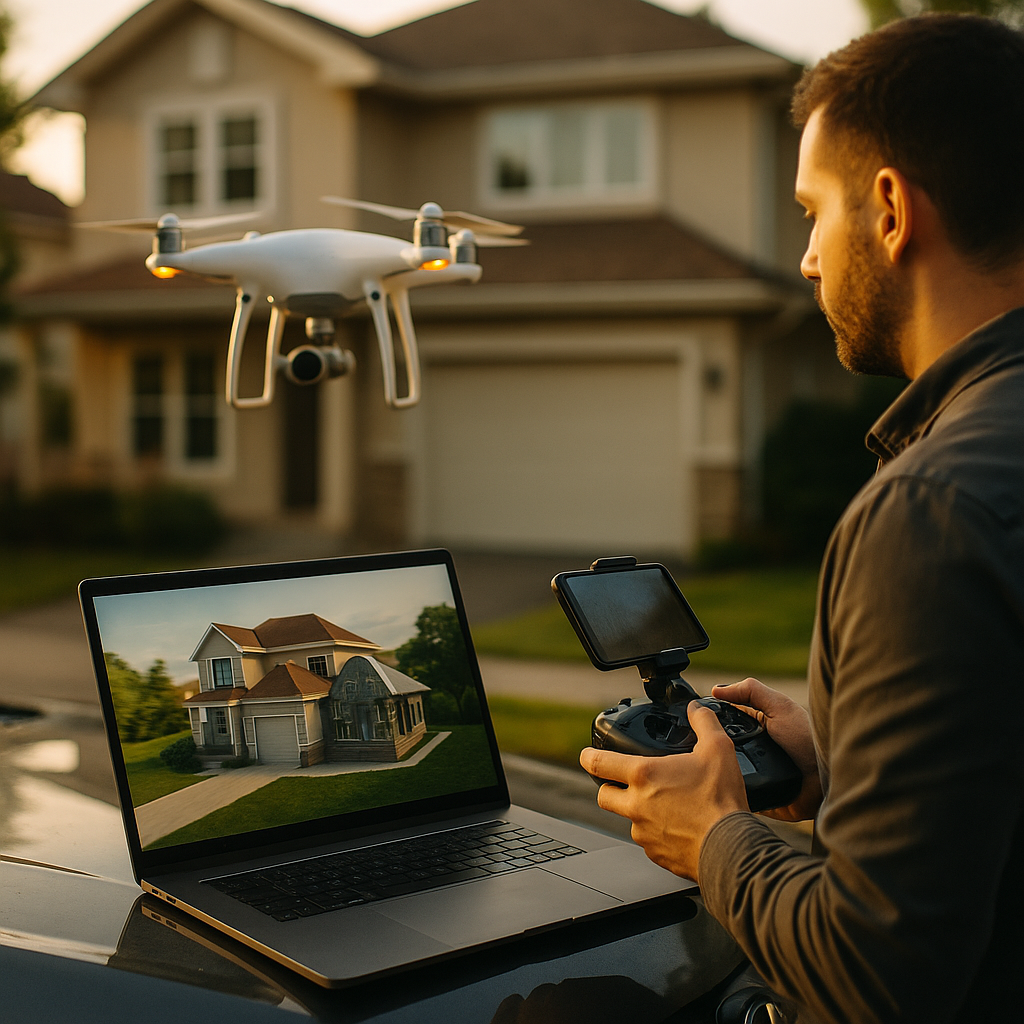
In 2025, buyers expect more than photos and a floor plan—they want confidence before they book a showing. This case study explains how one regional brokerage used drones and 3D video for sales to shorten listing cycles, improve lead quality, and win more listings with a stronger presentation. You’ll see the strategy, workflow, costs, results, and what to copy next—ready to rethink your marketing?
Real estate drone photography strategy: The brand, the challenge, and the goal
Brand profile (anonymized for privacy): A 40-agent real estate brand operating across a mix of suburban neighborhoods, waterfront communities, and rural acreage markets. The team relied on professional listing photos and occasional video, but agents reported a familiar pattern: online attention did not consistently translate into qualified showings, and sellers questioned marketing differentiation during listing presentations.
The challenge: The brokerage faced three specific issues:
- Low buyer certainty at the top of the funnel: Clicks were strong, but serious inquiries lagged for mid-to-high price homes.
- Hard-to-communicate property context: Lots, view corridors, proximity to amenities, and neighborhood feel were difficult to convey with standard photography.
- Listing acquisition pressure: Competing brokerages increasingly used video, creating a “same-ness” problem during seller pitches.
The goal: Build a repeatable content system that (1) increases high-intent inquiries, (2) reduces time-to-offer for selected listings, and (3) improves listing appointment conversion. The leadership team chose a pilot program using aerial capture paired with interactive interior scans, then scaled the process across qualifying listings.
Why this approach in 2025: National buyers continue to start online, and the National Association of Realtors’ 2024 “Home Buyers and Sellers Generational Trends” report reaffirmed the dominance of online search as the first step for most buyers. The brokerage decided to focus on “decision clarity” rather than chasing views: help buyers understand the home, the lot, and the setting before they raise their hand.
3D real estate video tour workflow: Tools, team roles, and production standards
The brokerage designed a workflow that balanced speed, compliance, and consistent quality. The key was to treat 3D and aerial as a single storytelling package rather than separate add-ons.
Team roles:
- Listing agent: Confirms property highlights, disclosure boundaries, and target buyer priorities (views, privacy, walkability, etc.).
- Licensed drone pilot: Captures aerial video and stills, plans flight path, and manages airspace checks.
- 3D capture technician: Scans the interior for a 3D walkthrough and schematic floor plan generation.
- Editor/producer: Builds a 60–90 second “hero” video plus vertical cut-downs for social and listing portals.
Production standards the brand enforced:
- Pre-shoot checklist: declutter guidance, lights on, blinds set, exterior staging, vehicles removed from driveway, and pool/yard readiness.
- Shot list: establishing aerial, approach sequence, roofline and lot boundaries (when appropriate), backyard amenities, plus interior flow from entry to primary living zones.
- Truthful representation: no deceptive lensing, no exaggerated skyline replacements, and no edits that materially change the property condition.
- Brand consistency: same color grade, same music licensing rules, and captions that are readable on mobile.
Delivery timeline: The target was 48 hours for 3D tour publishing and 72 hours for the edited video package. The brokerage discovered that speed mattered most on properties likely to receive early attention during the first week of listing exposure.
Common follow-up question: “Is 3D enough without video?” The brokerage found that 3D tours increased buyer confidence and reduced “just looking” showings, while video increased initial clicks and saves. Together, they improved both discovery and conversion.
Aerial property marketing impact: What they changed on listings and ads
The biggest performance lift came from how the content was deployed, not just the fact that it existed. The brand made four practical changes.
1) Listing page structure was rebuilt around clarity
- Above the fold: 20–30 second aerial-to-interior teaser.
- Next: 3D tour embed and “measurements disclaimer” for buyers.
- Then: aerial stills that explain context (corner lot, cul-de-sac, water access, trail adjacency).
- Finally: photo gallery and feature list.
2) They created “context captions” instead of generic labels
Rather than “Drone Photo #3,” captions clarified what buyers were seeing: distance to the marina, privacy buffer behind the home, or how the lot sits relative to the street. This reduced repetitive questions and made inquiries more specific.
3) Ads prioritized intent signals over reach
For paid social and YouTube placements, the brokerage optimized toward actions that correlate with intent: 3D tour starts, video completion rate, and “contact agent” clicks. They used short vertical clips (10–15 seconds) as prospecting assets and reserved longer edits for retargeting and listing pages.
4) They used aerial selectively to avoid compliance and perception issues
Not every home benefited from drone footage. Dense neighborhoods with limited exterior differentiation sometimes performed better with interior-first storytelling. The brand set a rule: use aerial when it explains a real buyer question—lot size, views, outbuildings, or proximity to amenities.
Common follow-up question: “Will drones make a small property look misleading?” The solution was a consistent altitude policy and honest framing. The brokerage avoided ultra-wide sweeps that imply acreage, and it included boundary context only when verified and appropriate for marketing.
Real estate lead conversion results: Metrics, outcomes, and what improved
The brokerage tracked results across a pilot group of 22 listings that fit their “high-impact” criteria: larger lots, view properties, premium renovations, unique layouts, or homes where flow mattered. They compared performance to similar listings from the same office using traditional media packages.
What they measured:
- Lead quality: percentage of inquiries that included a requested showing window, financing readiness, or specific questions.
- Engagement: video completion rate, 3D tour starts, time on listing page.
- Conversion: showing requests per 1,000 listing views; offer-to-showing ratio where available.
- Speed: days from go-live to first qualified showing burst; time-to-offer for homes that received offers.
What changed (directional outcomes reported by the brand):
- Higher-intent inquiries: Agents reported fewer “Is it still available?” messages and more questions tied to the tour (ceiling height, room dimensions, yard usability).
- More efficient showings: Fewer low-probability showings because buyers pre-qualified themselves using 3D walkthroughs.
- Stronger listing appointments: Sellers responded to the clarity of the marketing plan and the professionalism of the deliverables.
- Improved early momentum: The first week performed better when the aerial teaser and 3D tour were live at launch rather than added later.
What they did not claim: They avoided blanket promises like “guaranteed higher sale price.” The leadership team emphasized that market conditions, pricing strategy, and property condition still drive outcomes. The content system improved decision speed and buyer confidence, which can support stronger performance but does not replace pricing discipline.
Common follow-up question: “Does this work for entry-level homes?” Sometimes. The brokerage found the best ROI in listings where (1) layout comprehension was difficult in photos, (2) exterior context mattered, or (3) buyer competition was sensitive to first-week momentum. For straightforward entry-level inventory, a lighter package often sufficed.
Drone marketing ROI for brokers: Budget, pricing models, and scaling lessons
The brokerage treated the pilot like an operations project, not a creative experiment. They documented costs, turnaround, and agent adoption barriers, then adjusted.
Cost structure they used:
- Bundled media package: aerial video + aerial stills + 3D tour + short-form cut-downs.
- Add-ons: twilight aerials, community amenity shots, agent on-camera intro, and narrated walkthrough (used sparingly).
How they controlled spend:
- Qualification rules: The full package was reserved for listings where context and flow were major value drivers.
- Standardized edits: Templates reduced editor time while maintaining brand quality.
- Central scheduling: A single coordinator reduced delays and reshoots.
How they priced it internally: The broker offered two models. Some agents paid per listing from commission; others used a monthly marketing subscription that included a set number of full packages per quarter. The subscription model improved adoption because agents stopped treating video as a discretionary line item.
Scaling lesson: The limiting factor was not equipment—it was consistency. When a few listings launched without the full media set, performance data became harder to interpret and sellers noticed the difference. The brand solved this by aligning the media workflow with the listing launch checklist so nothing went live incomplete.
Common follow-up question: “Should we buy drones and do it in-house?” The brokerage tested both. In-house worked when they had a dedicated operator and clear legal compliance. For many teams, outsourcing to a reliable vendor produced more consistent turnaround and reduced risk. Their final approach was hybrid: preferred vendors plus one internal “quality reviewer” who approved deliverables before publishing.
FAA compliance and real estate video best practices: Trust, safety, and credibility
To align with Google’s EEAT principles, the brokerage centered their program on transparent practices that protect consumers and reduce liability. Trust was not a marketing claim; it was operational.
Compliance and safety controls:
- Licensed operations: They required proof of appropriate drone pilot credentials and insurance from any vendor.
- Airspace checks: Each flight required documented authorization steps when applicable, plus weather thresholds that triggered rescheduling.
- Privacy boundaries: They avoided lingering shots into neighboring yards and excluded identifying details unrelated to the listing.
Accuracy and disclosure:
- 3D tour disclaimers: Measurements and layouts were presented as approximate unless professionally verified.
- No “digital staging” confusion: If virtual staging was used, it was labeled as such and separated from real photos in the gallery.
- Clear property context: When aerials showed proximity to amenities, captions avoided exact distance claims unless verified.
Editorial best practices that improved performance:
- Start with orientation: Buyers need to know where they are before you show features. A brief aerial establishing shot reduced confusion.
- Show flow, not fragments: The most effective interior sequences followed how a person naturally walks the home.
- Keep it short, then go deep: A tight teaser earned attention; the 3D tour delivered detail for serious buyers.
Common follow-up question: “Will this replace open houses?” The brokerage used it to improve open houses. Buyers arrived with context, asked better questions, and spent more time evaluating fit. The content reduced “tourism” and increased the percentage of visitors who were already invested.
FAQs
What types of listings benefit most from drones and 3D tours?
Homes where context or layout drives value: waterfront or view properties, acreage and outbuildings, luxury renovations, unique architecture, multi-level floor plans, and properties near parks, trails, or community amenities that buyers want to visualize.
How long should a real estate drone and 3D video package be?
For most listings, a 60–90 second “hero” edit works best, supported by 10–15 second vertical clips for social. The 3D tour provides the long-form detail, so the video should focus on orientation and highlights, not exhaustive room coverage.
Do 3D tours reduce unnecessary showings?
Yes, often. Buyers can assess layout, room relationships, and livability before requesting a showing. This tends to reduce low-intent appointments and makes in-person tours more productive.
How do you use aerial footage without overpromising lot size or views?
Use consistent altitude and honest framing, avoid extreme wide shots that distort scale, and add captions that describe what’s visible without implying boundaries unless verified. When boundaries matter, confirm what can be legally represented in marketing materials.
Is it better to outsource drone and 3D production or do it in-house?
Outsourcing usually delivers faster consistency and lowers operational risk, while in-house can work if you have dedicated staff, documented compliance procedures, and reliable editing capacity. Many brokerages succeed with a hybrid approach: preferred vendors plus internal brand QA.
What should a brokerage track to measure ROI?
Track 3D tour starts, video completion rate, time on listing page, showing requests per listing view, percentage of inquiries that include specific intent signals, days to first strong showing burst, and listing appointment conversion where possible.
In 2025, this brokerage proved that aerial and 3D media works best as an operational system, not a one-off upgrade. By pairing drone context with 3D interior certainty, standardizing production, and publishing everything at launch, they improved lead quality and made showings more efficient. The clear takeaway: build a repeatable, compliant content workflow that answers buyer questions before they ask.