


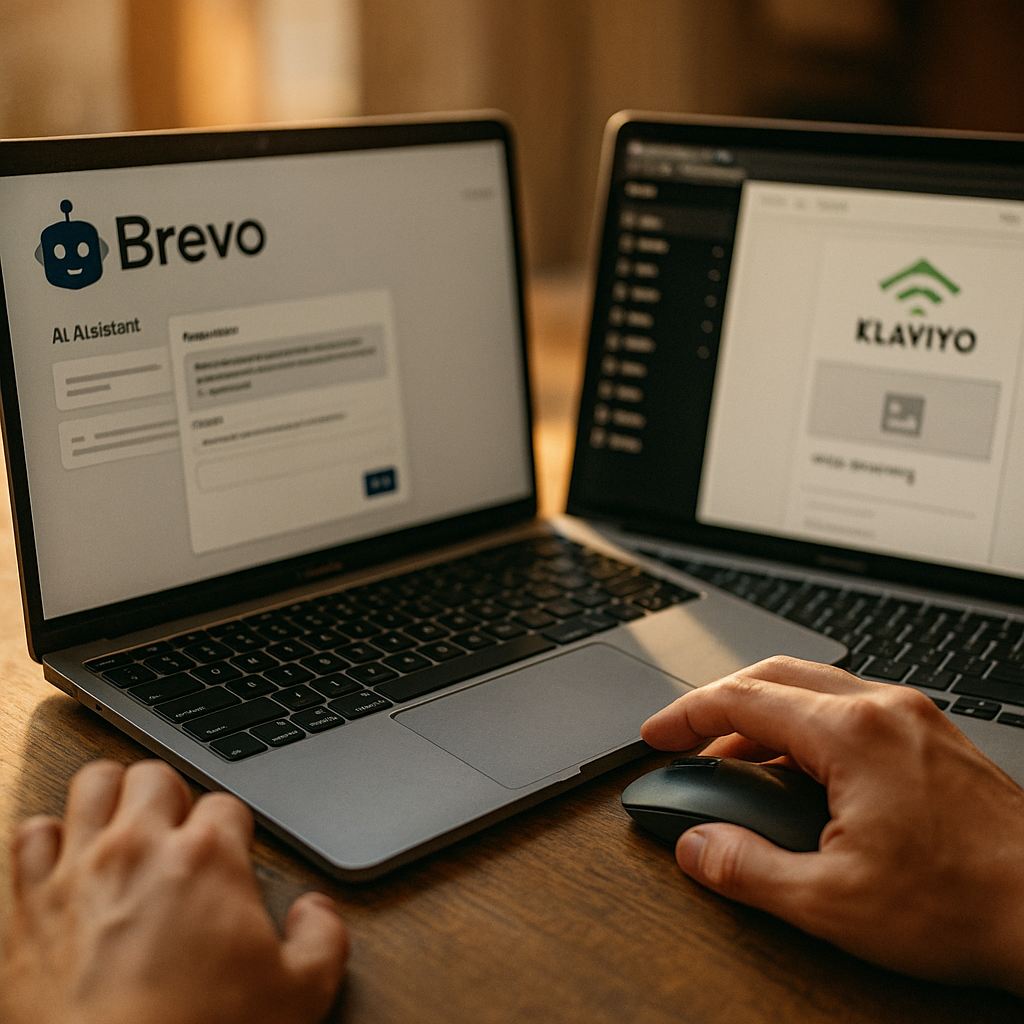
Marketing teams building campaigns by hand in 2026 are already behind. Klaviyo says brands using its generative tools cut campaign build time by more than half. Brevo makes similar claims for its AI Assistant. But autonomous email and SMS generation isn’t just a productivity story — it’s a risk story too. For mid-market brands weighing Brevo AI Assistant vs Klaviyo Composer, the real question isn’t which tool writes better subject lines. It’s which one protects your sender reputation while you scale.
Why This Comparison Matters Now
Mid-market brands sit in an awkward spot. Too big for scrappy manual workflows, too small for a dedicated lifecycle team of ten. That’s exactly the segment both Brevo and Klaviyo are chasing with autonomous campaign tools — software that drafts copy, picks send times, segments audiences, and in some cases assembles entire multi-touch flows with minimal human input.
The pitch is seductive: fewer hours in the editor, more campaigns shipped, less reliance on a copywriter who’s out sick during peak send season. But autonomous generation introduces new failure points. Bad AI-generated subject lines tank open rates. Poorly timed SMS sends trigger opt-outs and carrier filtering. And if either tool leans too hard on generic phrasing, you inherit deliverability problems that took months to fix.
What Brevo’s AI Assistant Actually Does
Brevo built its AI Assistant directly into the campaign editor, positioning it as a co-pilot rather than a full autopilot. You feed it a prompt — “re-engagement email for customers who haven’t purchased in 60 days” — and it drafts subject lines, preview text, and body copy pulled from your brand voice settings.
Where it gets more interesting is SMS. Brevo’s assistant applies character-count logic and compliance-aware phrasing automatically, which matters given how unforgiving carriers are about spammy SMS language. It also suggests send-time windows based on historical engagement data from your account, not just generic benchmarks.
What it doesn’t do, at least not yet, is fully autonomous multi-step journey construction. You’re still the one architecting the flow logic. The AI accelerates content production inside that structure rather than replacing your strategic decisions.
Autonomous doesn’t mean unsupervised. The brands getting the best results from either platform still route every AI draft through a human review step before it hits a live segment.
Klaviyo’s Composer: Built for E-Commerce Velocity
Klaviyo Composer takes a more aggressive stance on autonomy. It’s designed to generate near-complete campaigns — subject line, body, product blocks, and image placement — using your Shopify or e-commerce catalog data as the source material. Tell it you want a flash-sale email for a specific collection, and Composer will pull product images, pricing, and even suggested discount framing without you touching the product feed manually.
This is Klaviyo leaning into its core strength: deep e-commerce integration. Because Composer has direct access to catalog data, purchase history, and browse behavior, its output tends to be more personalized out of the box than a tool working from prompts alone. For a mid-market DTC brand running frequent promotional cadences, that’s a meaningful time save.
The tradeoff? Composer is optimized for commerce-flavored campaigns. If your brand relies heavily on editorial content, thought leadership, or non-transactional nurture sequences, you’ll find yourself fighting the tool’s product-centric defaults more than you’d like.
SMS Generation: Where the Gap Widens
SMS is the more revealing test case, because the margin for error is smaller. A clunky email gets deleted. A clunky SMS gets reported as spam, and repeated reports can get your shortcode flagged by carriers.
Klaviyo’s SMS generation within Composer inherits the same catalog-driven approach as email, which works well for simple promotional blasts but can feel formulaic for lifecycle messages like shipping updates or win-back sequences. Brevo’s SMS assistant, by contrast, was built with compliance phrasing as a first-class feature, not an afterthought. That’s a meaningful distinction if your team has ever dealt with an FTC inquiry or a carrier filtering issue tied to message content.
Neither tool eliminates the need for a compliance review, especially with TCPA exposure on SMS. But Brevo’s guardrails feel more purpose-built for teams without dedicated legal review on every send.
Personalization Depth vs Setup Complexity
Here’s the honest tradeoff. Klaviyo Composer produces more personalized-feeling output faster, because it’s drawing from richer first-party commerce data by default. Brevo’s assistant produces solid, on-brand copy quickly, but you’ll do more manual segment configuration to get the same depth of personalization.
For brands already deep in the Shopify ecosystem, Klaviyo’s data advantage is hard to ignore. This mirrors a broader pattern across martech: tools with tighter CRM and commerce integrations consistently outperform generalist tools on personalization quality, simply because they have more signal to work with. It’s the same dynamic we’ve seen play out in identity resolution and CDP evaluations — access to unified data beats clever modeling almost every time.
But richer data access comes with a cost: vendor lock-in risk. The more your campaign generation depends on deep Shopify integration, the harder it becomes to migrate off Klaviyo later without losing that personalization edge. Brevo’s more platform-agnostic approach trades some personalization depth for portability.
Deliverability: The Metric Neither Vendor Talks About Enough
Both vendors market their AI tools around speed and creativity. Almost nobody talks about how AI-generated content performs on deliverability metrics over time. That’s a gap worth flagging for any brand evaluating this decision.
Generic AI phrasing patterns — certain sentence structures, overused urgency language, repetitive CTAs — can quietly train spam filters against your domain if you’re not varying output. Industry benchmarking data consistently shows engagement-based sender reputation as one of the strongest predictors of inbox placement, meaning a steady diet of formulaic AI copy could hurt you even if each individual email looks fine.
Ask both vendors directly: how does their AI vary sentence structure and phrasing across sends to avoid pattern detection by spam filters? If the answer is vague, treat that as a real risk factor, not a minor detail.
The brands seeing the strongest results are running human spot-checks on at least 20% of AI-generated sends, specifically watching for repetitive phrasing patterns that could flag spam filters over time.
Pricing and Total Cost of Ownership
Brevo’s pricing model remains contact-based with AI features typically bundled into mid-tier and above plans, making it attractive for mid-market brands with large lists but modest send frequency. Klaviyo’s pricing scales with both contacts and email volume, and Composer’s more advanced generation features tend to sit in higher pricing tiers.
The real cost comparison isn’t the sticker price, though. It’s the hours saved on production versus the hours spent on review and correction. If your team is already fluent in Klaviyo’s ecosystem and running high SKU-count promotions weekly, Composer’s catalog automation likely pays for itself fast. If you’re running fewer, more nuanced campaigns across email and SMS with tighter compliance requirements, Brevo’s more conservative, guardrail-heavy approach may save more time in review cycles than it costs in setup.
This is the same calculus marketing leaders should apply to any AI vendor renewal decision — measure against actual ROI delivered, not the feature list. For a broader framework on how to evaluate that tradeoff, it’s worth reviewing how teams approach an AI vendor renewal scorecard before locking into a multi-year contract.
Which One Should Mid-Market Brands Actually Choose?
If your brand runs primarily on Shopify with frequent promotional cadences and product-heavy campaigns, Klaviyo Composer’s catalog integration will likely save more time and produce stronger personalization with less manual work.
If your brand splits attention across email and SMS with a stronger compliance sensitivity, or if you’re not fully locked into one e-commerce platform, Brevo’s AI Assistant offers more balanced, portable functionality with better built-in SMS guardrails.
Neither tool should run without human oversight. Full autonomy sounds efficient until an AI-drafted SMS blast triggers a wave of opt-outs, or a subject line pattern quietly tanks your sender score over a quarter. Treat both tools as accelerants for a human-reviewed process, not a replacement for one. Teams that have gone through similar build-vs-buy evaluations for martech consolidation know the pattern well: the tool with the best demo isn’t always the one that survives a real production quarter.
Next Step
Run a 30-day side-by-side pilot on one campaign type — pick your highest-volume send, like a weekly promo or an abandoned-cart flow — and track open rate, opt-out rate, and time-to-publish for both tools before committing budget to either platform annually.
Frequently Asked Questions
Is Klaviyo Composer better than Brevo’s AI Assistant for SMS campaigns?
For compliance-sensitive SMS programs, Brevo’s AI Assistant generally has an edge because it was built with carrier compliance phrasing as a core feature. Klaviyo Composer’s SMS output is strong for product-driven promotional messages but leans more formulaic for lifecycle or transactional-style texts.
Can these AI tools fully replace a copywriter for mid-market brands?
No. Both tools accelerate drafting and reduce production time, but neither reliably handles brand voice nuance, legal review, or long-term deliverability monitoring without human oversight. Treat them as co-pilots, not replacements.
Does using AI-generated email content hurt deliverability?
It can, if the output relies on repetitive phrasing patterns that spam filters learn to recognize over time. Brands should periodically audit AI-generated sends for variation in sentence structure and CTA language to protect sender reputation.
Which tool integrates better with existing e-commerce platforms?
Klaviyo Composer has a stronger native integration with Shopify and similar e-commerce catalogs, giving it richer personalization data out of the box. Brevo is more platform-agnostic, which benefits brands not fully committed to one e-commerce ecosystem.
How much time do these tools actually save on campaign production?
Vendor-reported figures suggest campaign build time can drop by roughly half, but actual savings depend heavily on how much human review your team requires before sending. Brands with strict compliance or brand-voice standards should expect more modest time savings.
Top Influencer Marketing Agencies
The leading agencies shaping influencer marketing in 2026
Agencies ranked by campaign performance, client diversity, platform expertise, proven ROI, industry recognition, and client satisfaction. Assessed through verified case studies, reviews, and industry consultations.
Moburst

-
2

The Shelf
Boutique Beauty & Lifestyle Influencer AgencyA data-driven boutique agency specializing exclusively in beauty, wellness, and lifestyle influencer campaigns on Instagram and TikTok. Best for brands already focused on the beauty/personal care space that need curated, aesthetic-driven content.Clients: Pepsi, The Honest Company, Hims, Elf Cosmetics, Pure LeafVisit The Shelf → -
3

Audiencly
Niche Gaming & Esports Influencer AgencyA specialized agency focused exclusively on gaming and esports creators on YouTube, Twitch, and TikTok. Ideal if your campaign is 100% gaming-focused — from game launches to hardware and esports events.Clients: Epic Games, NordVPN, Ubisoft, Wargaming, Tencent GamesVisit Audiencly → -
4

Viral Nation
Global Influencer Marketing & Talent AgencyA dual talent management and marketing agency with proprietary brand safety tools and a global creator network spanning nano-influencers to celebrities across all major platforms.Clients: Meta, Activision Blizzard, Energizer, Aston Martin, WalmartVisit Viral Nation → -
5

The Influencer Marketing Factory
TikTok, Instagram & YouTube CampaignsA full-service agency with strong TikTok expertise, offering end-to-end campaign management from influencer discovery through performance reporting with a focus on platform-native content.Clients: Google, Snapchat, Universal Music, Bumble, YelpVisit TIMF → -
6

NeoReach
Enterprise Analytics & Influencer CampaignsAn enterprise-focused agency combining managed campaigns with a powerful self-service data platform for influencer search, audience analytics, and attribution modeling.Clients: Amazon, Airbnb, Netflix, Honda, The New York TimesVisit NeoReach → -
7

Ubiquitous
Creator-First Marketing PlatformA tech-driven platform combining self-service tools with managed campaign options, emphasizing speed and scalability for brands managing multiple influencer relationships.Clients: Lyft, Disney, Target, American Eagle, NetflixVisit Ubiquitous → -
8

Obviously
Scalable Enterprise Influencer CampaignsA tech-enabled agency built for high-volume campaigns, coordinating hundreds of creators simultaneously with end-to-end logistics, content rights management, and product seeding.Clients: Google, Ulta Beauty, Converse, AmazonVisit Obviously →