


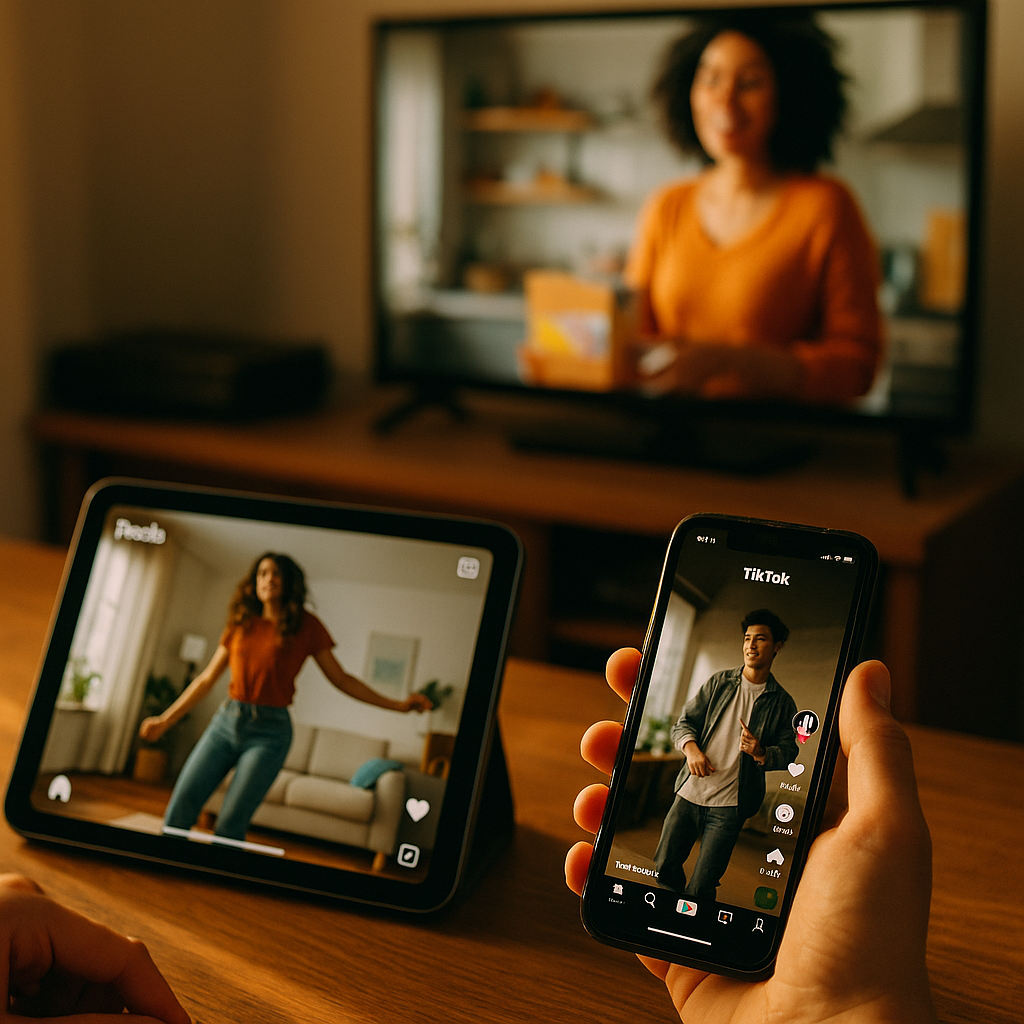
Brands running creator programs across six or more surfaces are losing message coherence at an alarming rate. Social-TV unified creator distribution is the operational answer: brief once, adapt everywhere, without sacrificing the creative integrity that makes audiences stop scrolling or stay on-channel.
The Fragmentation Problem Nobody Wants to Admit
Your TikTok creator is doing one thing. Your Reels creator is doing something adjacent. Your broadcast partner is doing something completely different. Three audiences, three messages, zero compounding brand recall. That is the default state of most influencer programs right now, and it is costing brands far more than production budget.
According to eMarketer research, connected TV and social video now share massive audience overlap, with a significant portion of viewers encountering brand content on both surfaces within the same day. When those two touchpoints deliver inconsistent messages, you are not getting reinforcement. You are getting confusion.
The fix is not more creators or more spend. It is better briefing architecture.
What a Creative Backbone Actually Means
A creative backbone is a single, irreducible unit of brand storytelling: one core scene, one hero product truth, one emotional beat. Everything else is adaptation. Think of it as the canonical source file that AI tools and creators both pull from.
This is different from a campaign concept. A campaign concept is a theme. A creative backbone is a specific piece of raw content, usually 60 to 90 seconds of unformatted creator footage, built around a brief that specifies emotional arc, key visual elements, mandatory brand signals, and what we call “adaptation anchors” — the moments that must survive every reformat.
The creative backbone is not the deliverable. It is the source of truth from which every deliverable is derived. Brands that confuse the two end up with six different executions that share a hashtag and nothing else.
For practical framework references, the AI creative backbone for social TV approach gives brands a repeatable structure for capturing this raw material in a way that AI tools can parse and reformat without losing the human authenticity that drives engagement.
How to Brief Creators for Maximum Adaptability
The brief is where most programs fail. Teams write briefs for a single deliverable, then scramble to repurpose. Invert that logic.
A backbone-first brief includes five non-negotiable components:
- The core message lock: One sentence, no qualifiers. This is what the audience must take away regardless of where they see the content.
- Adaptation anchors: Two or three specific moments, phrases, or visual elements that must appear in every format. These are your cross-surface recall triggers.
- Format-neutral shooting instructions: The creator shoots everything center-frame, no text overlays baked into the video, no captions burned in, clean audio as a separate track where possible. For more on this, the guidance around aspect-ratio-agnostic briefs is directly relevant.
- Emotional arc specification: Hook (0-3 seconds), problem or tension (3-20 seconds), resolution or product integration (20-50 seconds), call to action. This arc maps cleanly to both short-form social and broadcast slots when AI handles the trim.
- AI processing permissions and parameters: Explicitly state what AI can change (pacing, aspect ratio, music, caption style) versus what is locked (brand claim language, product close-up, disclosure language per FTC guidelines).
Teams using multi-format creator briefs consistently report fewer revision cycles and stronger cross-platform consistency. The upfront investment in brief quality pays back in production efficiency.
Where AI Fits and Where It Does Not
AI handles the mechanical work beautifully: reframing vertical to horizontal, trimming to broadcast durations (15s, 30s, 60s), swapping music for licensed alternatives, generating platform-native captions, and resizing safe zones for different UI overlays. Tools like Adobe Firefly, Runway, and Meta’s creative automation suite are genuinely capable of this at scale.
What AI cannot do: judge whether the adapted version still feels like the creator. That is a human review step that brands should not skip. Build a 48-hour human review window into your production calendar for every AI-adapted output before it goes to a broadcast partner or paid media buyer.
The other thing AI cannot replace is the creator’s tone calibration for their specific audience. A creator who lives on TikTok knows exactly how long they have before a Gen Z viewer exits. Brief them to capture that energy in the backbone. When AI trims a 90-second piece to a 15-second broadcast spot, it is working from that energy, not generating it.
The Broadcast Integration Challenge
Linear and streaming TV introduce compliance and quality requirements that social-native creators often have not encountered. Broadcast-ready content typically requires minimum resolution standards (4K delivery is now table stakes for streaming partners), specific loudness normalization, and in many cases clearance for any music or third-party IP visible in frame.
This means the brief must front-load these requirements, not attach them as afterthoughts. If a creator shoots in a space with a branded poster on the wall, that becomes a rights issue when the content moves to a broadcast surface. Address it in the brief. For deeper context on making creator content work across streaming and social simultaneously, the piece on creator ads for streaming TV and social covers the compliance and production spec side in useful detail.
Budget implications are real. Expect to add 15 to 25 percent to your creator fee when you are asking for broadcast-grade deliverables, plus additional post-production budget for AI adaptation and human QA. Factor this into program planning from the start, not after the creator has delivered.
Measuring Message Coherence Across Surfaces
You cannot optimize what you do not measure. Most brand safety and performance dashboards track individual platform metrics in isolation. That is insufficient for a unified distribution model.
Build a cross-surface message coherence score into your reporting framework. This is not complicated: survey a sample of exposed audiences on each surface, ask unaided recall questions tied to your core message lock, then compare scores across TikTok, Reels, and broadcast. Consistent scores across surfaces indicate your backbone is holding. Divergence indicates either the brief broke down or the AI adaptation introduced drift.
Brand lift studies that isolate social-exposed versus broadcast-exposed versus dual-exposed segments consistently show that dual-exposed audiences generate 1.4 to 2x the purchase intent lift of single-surface exposure. The compounding effect is the entire point.
Platforms like Sprout Social and dedicated influencer measurement tools like Traackr offer cross-channel performance views, though true cross-surface brand lift requires commissioning a separate study through your media agency or a research partner. Build that cost into Q-level campaign planning.
For programs running commerce integration, the framework in social commerce video briefs adds a transactional measurement layer that pairs well with cross-surface brand lift tracking, especially if your broadcast placements include QR codes or second-screen CTA sequences.
The Operational Model That Makes This Repeatable
Single-campaign experiments rarely survive contact with quarterly planning reality. To make unified distribution a repeatable operation, you need three things working in parallel: a standardized brief template that every creator partner uses (with surface-specific addenda rather than entirely separate briefs), a clear AI adaptation protocol with defined human touchpoints, and a cross-functional review team that includes media planning, creative, legal, and platform partnership contacts.
The brands doing this well, including several CPG and automotive advertisers running always-on creator programs, have essentially created an internal content operations function that sits between their creative agency and their media buying team. This is not a new role; it is a reconfiguration of existing resources around the logic of unified distribution.
The key governance question: who owns the backbone? It should not be the creator (who may not have broadcast distribution experience), it should not be the AI vendor (who optimizes for platform metrics, not brand strategy), and it should not sit in a silo between creative and media. The brand team owns the backbone. Everyone else serves it.
Refer to multi-format briefing on a single budget for a practical model on how to allocate production spend when one backbone needs to feed four or more distinct format deliverables.
Start by auditing your current most-distributed creator piece: pull the TikTok version, the Reels version, and the broadcast version side by side, then ask a colleague who has not seen the brief whether all three are clearly for the same brand campaign. If they hesitate, your backbone is broken, and that is your briefing problem to fix before your next campaign launches.
Frequently Asked Questions
What is a creative backbone in the context of social-TV unified creator distribution?
A creative backbone is a single source piece of creator content, typically 60 to 90 seconds of unformatted footage, built around a brief that specifies the core message, key visual elements, emotional arc, and adaptation anchors. It serves as the canonical input from which AI tools derive platform-specific versions for TikTok, Reels, broadcast, and other surfaces, while preserving message coherence across all of them.
How should creator briefs be structured to support AI adaptation across multiple formats?
A backbone-first brief should include a single-sentence message lock, two to three adaptation anchors (moments that must survive every reformat), format-neutral shooting instructions (center-frame, no burned-in captions, clean audio), an emotional arc mapped to both short-form and broadcast durations, and explicit AI processing permissions that define what can be changed versus what is locked for brand and compliance reasons.
What are adaptation anchors and why do they matter?
Adaptation anchors are specific moments, phrases, or visual elements within the creative backbone that must appear in every adapted format. They function as cross-surface recall triggers. When a viewer encounters the brand on TikTok and then on connected TV, the adaptation anchors create a recognition signal that compounds brand recall and purchase intent lift.
Do broadcast distribution requirements change how you brief creators?
Yes, significantly. Broadcast and streaming TV require minimum resolution standards (4K delivery is now standard for streaming partners), loudness normalization, and music or third-party IP clearances. These requirements must be built into the brief upfront. Brands should also budget an additional 15 to 25 percent on creator fees when broadcast-grade deliverables are part of the scope.
How do you measure message coherence across social and broadcast surfaces?
Build a cross-surface message coherence score by surveying exposed audiences on each platform using unaided recall questions tied to your core message lock, then comparing scores across TikTok, Reels, and broadcast. Consistent scores indicate the backbone is holding. Significant divergence indicates either a brief breakdown or AI adaptation drift, both of which require investigation before the next campaign cycle.
What role does human review play when AI is adapting creator content?
AI handles mechanical adaptation tasks such as reframing, trimming, caption generation, and music swaps, but it cannot judge whether an adapted version still feels authentic to the creator’s voice or audience. A 48-hour human review window should be built into every production calendar for AI-adapted outputs before they reach broadcast partners or paid media buyers.
Top Influencer Marketing Agencies
The leading agencies shaping influencer marketing in 2026
Agencies ranked by campaign performance, client diversity, platform expertise, proven ROI, industry recognition, and client satisfaction. Assessed through verified case studies, reviews, and industry consultations.
Moburst

-
2

The Shelf
Boutique Beauty & Lifestyle Influencer AgencyA data-driven boutique agency specializing exclusively in beauty, wellness, and lifestyle influencer campaigns on Instagram and TikTok. Best for brands already focused on the beauty/personal care space that need curated, aesthetic-driven content.Clients: Pepsi, The Honest Company, Hims, Elf Cosmetics, Pure LeafVisit The Shelf → -
3

Audiencly
Niche Gaming & Esports Influencer AgencyA specialized agency focused exclusively on gaming and esports creators on YouTube, Twitch, and TikTok. Ideal if your campaign is 100% gaming-focused — from game launches to hardware and esports events.Clients: Epic Games, NordVPN, Ubisoft, Wargaming, Tencent GamesVisit Audiencly → -
4

Viral Nation
Global Influencer Marketing & Talent AgencyA dual talent management and marketing agency with proprietary brand safety tools and a global creator network spanning nano-influencers to celebrities across all major platforms.Clients: Meta, Activision Blizzard, Energizer, Aston Martin, WalmartVisit Viral Nation → -
5

The Influencer Marketing Factory
TikTok, Instagram & YouTube CampaignsA full-service agency with strong TikTok expertise, offering end-to-end campaign management from influencer discovery through performance reporting with a focus on platform-native content.Clients: Google, Snapchat, Universal Music, Bumble, YelpVisit TIMF → -
6

NeoReach
Enterprise Analytics & Influencer CampaignsAn enterprise-focused agency combining managed campaigns with a powerful self-service data platform for influencer search, audience analytics, and attribution modeling.Clients: Amazon, Airbnb, Netflix, Honda, The New York TimesVisit NeoReach → -
7

Ubiquitous
Creator-First Marketing PlatformA tech-driven platform combining self-service tools with managed campaign options, emphasizing speed and scalability for brands managing multiple influencer relationships.Clients: Lyft, Disney, Target, American Eagle, NetflixVisit Ubiquitous → -
8

Obviously
Scalable Enterprise Influencer CampaignsA tech-enabled agency built for high-volume campaigns, coordinating hundreds of creators simultaneously with end-to-end logistics, content rights management, and product seeding.Clients: Google, Ulta Beauty, Converse, AmazonVisit Obviously →